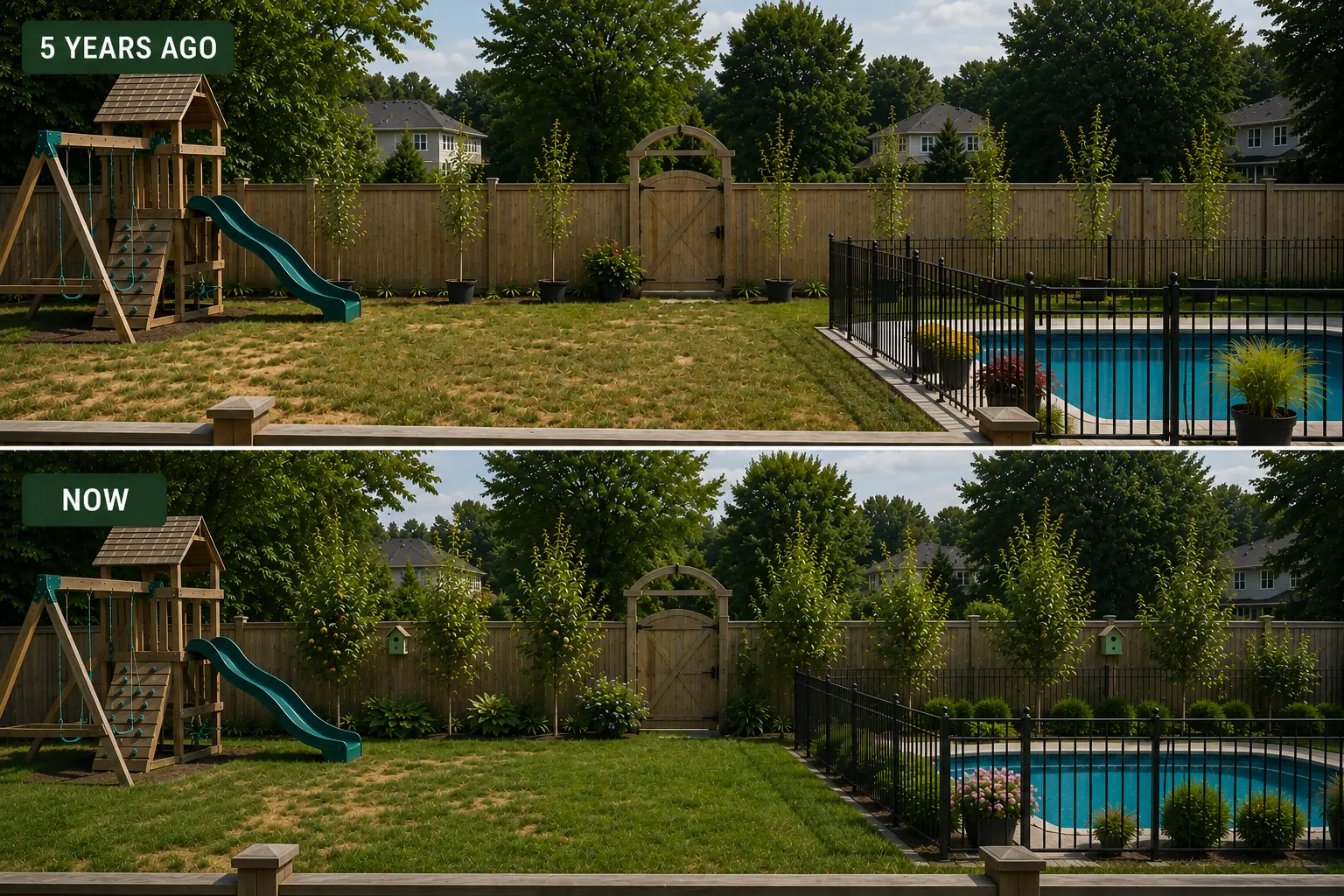
Postage Stamp Orchards: How to Grow Fruit Trees in Small Spaces Without Wasting Years
A fruit tree feels different from a tomato plant. A tomato plant asks for a season, a basil plant asks for a pot, and a fruit tree asks for years, which is exactly why so many people hesitate before planting one. They can walk into a backyard and immediately know where the grill should go, where the swing set might fit, or where a patio table would look nice on a summer evening, but a fruit tree feels heavier because it seems to ask for a place in the future version of the yard before the homeowner feels ready to make that promise.
That hesitation is understandable because a fruit tree is not just a weekend project. It raises questions that annual vegetables rarely ask. Will it get too big? Will it shade the garden? Will it drop fruit on the driveway? Will it need a pollination partner? Will deer eat it? Will it block a view, crowd a walkway, or become a problem if the family moves? Those are not silly questions. They are the exact questions a thoughtful gardener should be asking before planting something that may live for decades.
But thoughtful does not have to mean frozen. You do not have to know the final shape of your orchard before you begin. A postage stamp orchard does not have to start with a shovel, a permanent bed, and a perfect landscape plan. It can begin with a pot, a grow bag, a dwarf tree, a columnar apple, a patio fig, or a few blueberries placed where you can watch them, move them, and learn from them.
That is the real power of the postage stamp orchard. It is not about cramming fruit trees into a tiny yard. It is about starting a small, patient, movable fruit system that helps you learn your space before you make permanent decisions. It lets you begin the years of growth now while keeping the final orchard layout flexible.
What Is a Postage Stamp Orchard?
A postage stamp orchard is a fruit-growing system designed for small spaces. It might live in a narrow side yard, along a fence line, around a patio, beside a front walkway, near a pool, or in the sunny corner of a suburban lot that currently holds nothing but mulch and missed opportunity. The point is not to recreate a traditional apple orchard in miniature. The point is to design a small fruit system where every tree, container, shrub, trellis, and walkway has a purpose.
A postage stamp orchard might include columnar apple trees along a fence, dwarf pear trees in containers, a fig near a warm wall, blueberries in large pots, espalier fruit trees trained flat against a sunny boundary, a patio peach beside the back door, dwarf citrus near the front entrance, grapes on a trellis, or edible shrubs replacing a plain decorative hedge. It can be formal or playful, traditional or tropical, permanent or still in its testing stage.
The best way to think about it is this: a postage stamp orchard is not measured by acreage. It is measured by intention. If a tiny space produces fruit, beauty, shade, pollinator value, family memory, and long-term usefulness, it is already acting like an orchard.
How to Grow Fruit Trees Without Wasting Years on the Wrong Spot
Fruit trees make people nervous because the feedback loop is slow. If you plant lettuce in the wrong place, you lose a few weeks. If you plant a fruit tree in the wrong place, it can feel like you lost years. That fear is one of the biggest reasons people delay planting, even when they dream about apples, pears, peaches, figs, lemons, cherries, or berries growing just outside the kitchen door.
The problem is not that people do not want fruit trees. The problem is that they are afraid of making the wrong long-term decision. They worry about the mature size of the tree, the rootstock, the pollination requirements, the chill hours, the winter care, the pruning, the pests, the location, and the possibility that life may change before the tree reaches its best years.
That is why the first goal of this article is not to convince you to plant recklessly. The goal is to help you start wisely. A well-designed postage stamp orchard removes fear by making the first step smaller, more movable, and more forgiving.
Start a Practice Orchard in Containers Before You Plant Forever
One of the smartest ways to begin a postage stamp orchard is to create a practice orchard first. A practice orchard is a small collection of dwarf, columnar, or container-friendly fruit trees that lets you learn your yard before you decide where the permanent orchard belongs.
Instead of trying to solve everything on paper, you let the yard teach you. You place a columnar apple on the patio and watch how much sun it gets. You move a dwarf pear near the fence line and notice whether it feels useful or crowded. You try a fig near the warm side of the house and see how it handles the microclimate. You put blueberries near the kitchen door and realize that because they are close, you actually remember to water them. Each move gives you information, and that information is what turns hesitation into design.
This is especially useful because many people have trouble visualizing a landscape from a drawing. A sketch can help, but a container tree lets you walk through the decision. You can stand beside it, move around it, sit near it, look out the window at it, and decide whether the space feels better or worse with that tree in place.
The Practice Orchard Is Like Musical Furniture for the Yard
Most families know the ritual. Someone looks at the living room on a Saturday morning and says, “What if we moved the couch over there?” Then the furniture starts sliding, the chairs rotate, the rug shifts, and everyone walks around the room to see if the new arrangement feels better. Nothing about that process is failure. It is how people learn a space by living in it.
A practice orchard works the same way. You can line up three columnar apples along the fence for a weekend and see whether they make the yard feel more private or too narrow. You can place a dwarf citrus tree beside the front door and decide whether it feels welcoming. You can put a fig near the patio and see whether the big leaves soften the space. You can move a container pear ten feet and suddenly realize that the whole walkway breathes better.
This matters because a fruit tree in the ground feels permanent, but a fruit tree in a container gives you permission to experiment. It lets you test the rhythm of the yard before committing to the final planting. The tree becomes both a plant and a measuring tool, helping you understand sunlight, traffic flow, watering habits, deer paths, wind exposure, and the places where your family naturally gathers.
Why Container Fruit Trees Make Small-Space Orchards Less Scary
A container-grown fruit tree changes the emotional weight of the decision. Instead of saying, “This tree must live here forever,” you are saying, “Let me learn from this tree.” That is a much easier first step for a hesitant gardener.
Containers help with mobility, soil control, drainage control, patio placement, seasonal protection, design testing, and beginner confidence. They also let you start the years of growth while keeping your final layout flexible. A columnar apple in a large pot can spend one year on the patio, another year near the fence, and then eventually move into the ground once you know exactly where it belongs.
The important thing is to treat the container stage as a learning stage, not as neglect. A potted tree still needs water, nutrition, pruning, proper drainage, and enough root space to grow well. Containers make the tree movable, not maintenance-free, and that is a fair trade because they give you time, flexibility, and experience.
Good Fruit Trees to Start With in Containers
Not every fruit tree is ideal for a container, but many small-space fruit options can work beautifully when matched to the right pot, climate, and care routine. The best candidates are trees that naturally stay compact, respond well to pruning, or are sold on dwarfing rootstock.
Columnar Apple Trees for Fence Lines, Patios, and Narrow Spaces
Columnar apple trees are one of the most exciting options for a postage stamp orchard because they grow upright instead of wide. They can create a row along a fence, a formal edible entrance, a narrow patio orchard, or a small privacy screen without spreading like a traditional apple tree. Nurseries such as Stark Bro’s, Nature Hills, and FastGrowingTrees.com all feature columnar fruit tree options aimed at small-space growers.
The reason columnar apples are so useful is that they help people visualize an orchard in a place where a traditional tree would feel impossible. A row of upright apple trees can behave almost like a living fence, but instead of only separating one space from another, it can flower in spring, fruit later in the season, and give the yard a sense of rhythm.
Dwarf Pear Trees for Classic Orchard Beauty in a Smaller Form
Dwarf pear trees can bring a classic orchard feeling into a much smaller space. They offer spring bloom, elegant structure, and the possibility of a long-lived fruiting tree without requiring the scale of a traditional pear orchard. In containers, dwarf pears can help you test whether a future permanent tree belongs near the garden gate, the patio, the side yard, or a prepared orchard bed.
Pears often require attention to pollination, variety choice, fire blight resistance, and rootstock, so they are a good reminder that the fruit variety is only part of the decision. The rootstock, mature size, disease resistance, and bloom timing matter just as much as the name of the pear on the tag.
Figs for Patios, Warm Walls, and Bold Edible Landscaping
Figs are wonderful candidates for many container orchards because they can be visually striking as well as productive. Their large leaves make them feel lush and sculptural, and in the right climate or with the right winter protection, they can become one of the most rewarding small-space fruit plants.
A fig near a sunny wall can make a patio feel warmer, softer, and more intentional. It is also a good example of how a postage stamp orchard does not have to look like a row of apple trees. Sometimes the best small orchard begins with one beautiful plant that makes the space feel alive.
Dwarf Citrus for Front Doors, Patios, and Container Orchards
Dwarf citrus can be one of the most beautiful choices for container growing, especially for people who want a patio or front-door orchard that feels polished and fragrant. Meyer lemon, kumquat, calamondin, and dwarf orange can all bring the feeling of an edible landscape into places where a traditional orchard would never fit.
Citrus is different from apples, pears, peaches, and cherries because it does not need the same winter chill period. In cold climates, citrus may need to be moved indoors or into protection during winter, while deciduous fruit trees may need to remain outside to experience dormancy. That distinction is important, and it is one of the reasons the buyer should choose trees based on biology, not just appearance.
Blueberries for Edible Borders and Container Hedges
Blueberries are not trees, but they absolutely belong in the postage stamp orchard conversation. They can look neat, produce flowers, offer fall color, and provide fruit, all while fitting into containers, patio edges, and edible borders. Because blueberries need acidic soil, containers can actually make them easier for many homeowners to manage than planting them directly into unsuitable native soil.
A row of blueberries can act like a low edible hedge, especially when paired with herbs, flowers, or a nearby fruit tree. For a hesitant gardener, blueberries can be a friendly first step because they feel less permanent than a tree while still helping the yard become more productive.
What Type of Container Should You Use?
The container matters because a fruit tree in a tiny decorative pot is not a practice orchard. It is a short-term decoration. A tree needs root room, drainage, stability, and enough soil volume to avoid drying out every afternoon in summer.
Large decorative patio pots are best when the tree will live near a seating area, front door, walkway, or visible patio. They make the tree look intentional and finished, although heavy ceramic or stone pots can become difficult to move once they are filled with soil and a growing tree. Lightweight resin or plastic containers are more practical during the learning stage because they are easier to shift around the yard, even if they do not always look as polished.
Wood planters can be beautiful in edible landscapes because they fit naturally with gardens, patios, and rustic designs, though they may eventually rot and should be chosen with drainage and durability in mind. Fabric grow bags are especially useful for a practice orchard because they are lightweight, often affordable, and commonly designed to encourage air root pruning, which helps reduce circling roots and promotes a more fibrous root system.
A simple rule is this: use beautiful pots where the tree is part of the design, and use grow bags where the tree is still in training.
Air Root Pruning and Grow Bags
Fabric grow bags and air-pruning containers are worth discussing because they solve a common container problem. In traditional hard-sided pots, roots can circle around the inside of the container, which may eventually lead to a stressed or poorly structured root system. In fabric grow bags or air-pruning containers, roots are exposed to air at the edge of the container, which encourages branching rather than circling.
For the postage stamp orchard, this makes grow bags useful during the testing stage. They may not look as elegant as a matching pair of front-door planters, but they can be a practical way to grow young fruit trees while you learn the yard. They are easier to move, easier to arrange temporarily, and easier to treat as part of the design process rather than a final display.
Chill Hours: Why Some Fruit Trees Need Winter, Not a Garage Vacation
Container trees are movable, but movable does not always mean they should be brought indoors. This is especially important with apples, pears, peaches, plums, cherries, and many other deciduous fruit trees, because these trees usually need a winter rest period before they can bloom and fruit properly the following season.
That cold requirement is commonly called chill hours. A simple definition of chill hours is the number of hours a fruit tree spends in a cool temperature range during dormancy, often described as roughly 32°F to 45°F, although different models calculate chill in different ways. UC Davis explains that there are multiple models for measuring chilling, including hours below 45°F, hours between 32°F and 45°F, and the Utah Model, while nursery guides often use chill-hour numbers as useful estimates rather than perfect thresholds.
This matters because an apple tree may need winter in a way that a lemon tree does not. If you grow a columnar apple in a container, the goal is not necessarily to drag it into a warm garage or heated room all winter. In many climates, the better approach is to leave it outside where it can experience the seasonal cold it needs, while still protecting the container roots from extreme freeze-thaw stress, drying winds, or brutal exposure.
There is a difference between protecting a tree and confusing it. A container apple may need mulch over the root zone, insulation around the pot, a sheltered outdoor location, or wind protection, but it may still need winter. A dwarf citrus tree in a cold climate, on the other hand, may need to come indoors or into a protected space because citrus is not looking for the same dormancy period as an apple.
Before buying, ask a few important questions: How many chill hours does this tree need? How many chill hours does my area usually receive? Can this tree stay outdoors in a container? Does it need winter protection, or does it need true indoor overwintering? Container growing gives you flexibility, but the tree’s biology still matters.
Useful chill-hour resources include UC Davis Fruit & Nut Research, Raintree Nursery’s chill-hour guide, and the Philadelphia Orchard Project’s explanation of chill hours.
A Postage Stamp Orchard Does Not Have to Look Like an Apple Orchard
When people hear the word orchard, they often picture rows of apple trees. That is one version of an orchard, but it is not the only version, and it may not be the best version for a small yard, patio, pool area, or front walkway.
A postage stamp orchard can be themed around the space, the climate, the food you love, or the feeling you want the yard to have. You could build a columnar apple fence line with upright trees marching along the edge of the property, or you could build a fruit cocktail-style orchard with one apple, one pear, one peach, one fig, one blueberry, and one grape vine. You could build a patio citrus orchard with Meyer lemon, kumquat, calamondin, and dwarf orange in containers, or a tropical poolside orchard in the right climate with banana, papaya, mango, pineapple, and citrus.
Themed orchards help people think beyond the traditional orchard model. A berry-and-brunch orchard might include blueberries, strawberries, dwarf cherries, and a small apple tree. A chef’s orchard might include figs for pizza and cheese boards, lemons for dressings, apples for baking, pears for salads, peaches for grilling, and herbs at the base of the containers. A formal front-yard foodscape might use matching pots, columnar trees, edible flowers, and a clean walkway design to make the entrance feel both beautiful and productive.
The point is not to copy someone else’s orchard. The point is to build a small fruit system that fits your life, your climate, your recipes, your family, and your space.
Multi-Grafted Fruit Trees: More Variety From Less Space
Another useful tool for the postage stamp orchard is the multi-grafted fruit tree. A multi-grafted tree has more than one variety grafted onto the same tree, which means a gardener may be able to grow several compatible apple varieties on one trunk instead of planting several separate trees.
This can help a small-space gardener solve several problems at once. A multi-grafted tree may provide more variety in less space, help with pollination when compatible varieties bloom together, stretch the harvest window, and let a family enjoy different flavors without turning the backyard into a full orchard. Raintree Nursery, for example, describes combination apple trees as trees with several varieties grafted onto the same tree, while FastGrowingTrees.com offers compact multi-variety options such as a 3-in-1 columnar apple tree.
A multi-grafted tree is not magic, though. It asks for observation and pruning because one grafted branch may grow more aggressively than another. The gardener may need to keep the branches balanced so one variety does not dominate the tree. In a postage stamp orchard, one well-managed multi-grafted tree can sometimes do the work of several trees, but only if the owner is willing to learn how that tree grows.
Edible Landscaping Ideas That Add Curb Appeal and Fruit
Many developments use fast-growing evergreen screens to separate neighbors. They are useful, they create privacy, and they give a new yard a quick green wall, but they usually do only one job. They block a view.
A postage stamp orchard asks a better question: if you are going to plant a living boundary anyway, why not plant one that also feeds you? A hedge can hide a fence, but an edible hedge can feed a family, mark the seasons, attract pollinators, create beauty, and still provide privacy.
That edge of the yard could become a row of columnar apples, espalier pears along a fence, blueberries as a low edible hedge, grapes trained on a trellis, figs near a warm wall, serviceberries in a mixed border, dwarf cherries near a patio, or currants and gooseberries where they grow well. Instead of treating the fence line as dead space, you can treat it as one of the most valuable strips of land on the property.
This is where the postage stamp orchard becomes more than a gardening project. It becomes a different way of seeing the home landscape. The side yard is not wasted space, the patio is not just furniture, the fence line is not just a boundary, and the front walk is not just decoration. Every edge becomes a possible asset.
Do Fruit Trees Add Curb Appeal and Home Value?
Healthy, well-placed trees can make a property feel more established, shaded, beautiful, and memorable, and research generally supports the idea that tree cover is associated with residential property value. A USDA Forest Service meta-analysis reviewed 21 hedonic property-value studies and 157 observations to examine the influence of tree cover on U.S. home values, while another Forest Service-linked meta-analysis found that certain levels of property and county tree cover were associated with maximizing the implicit price effect of tree canopy.
That does not mean every tree automatically raises a home’s value. A diseased tree, a dangerous tree, a messy tree in the wrong place, or a giant tree too close to the house can become a liability. Buyers may love a mature shade tree over the lawn, but they may worry about a weak-limbed tree hanging over the roof or an overgrown planting that blocks light, crowds the house, or creates maintenance headaches.
The honest message is this: planting a tree is not guaranteed to increase resale value, but planting the right tree in the right place can make a property more useful, beautiful, memorable, and marketable. That is why dwarf, columnar, espalier, container-grown, and thoughtfully placed edible landscape trees are so interesting. They give homeowners a way to add living value without automatically creating a giant maintenance burden.
Fruit Trees, Childhood Memories, and Backyard Hide-and-Seek Spots
A tree can add value to a property, but it can also add something harder to measure. People remember trees. They remember the apple tree in the backyard, the maple with the swing, the branch they climbed too high, the pear tree that dropped fruit every August, the cherry tree they were told not to pick from, or the shade tree where everyone sat during hot summer afternoons.
Research on tree climbing and childhood development gives this memory angle more depth. Children & Nature Network summarizes a 2017 study involving more than 1,600 parents of children ages 3 to 13 who climbed trees, connecting tree climbing with risky outdoor play, agency, self-esteem, resilience, and nature connection. The study indexed by ERIC found that while minor injuries can happen, tree climbing was generally a relatively safe outdoor activity and was associated with developmental and resiliency themes.
That does not mean every yard needs a climbing tree, and it certainly does not mean every fruit tree should become a swing tree. Many dwarf and columnar trees are not appropriate for climbing at all. But the larger idea matters: a tree can become part of a child’s map of home. The appraiser may see landscape. A child may remember the place where summer happened.
That kind of value is not easy to put into a spreadsheet, but it is one of the reasons planting now matters. A tree needs time before it becomes shade, fruit, privacy, beauty, or memory. The person who plants a small tree today gives the future more to work with.
What If You Plant a Fruit Tree in the Wrong Place?
Another fear worth removing is the idea that planting a tree means you can never change your mind. A fruit tree is a commitment, but it is not always a life sentence. Young trees can often be moved, especially if they are still small, container-grown, or handled during dormancy.
Maybe you move to a new house. Maybe you planted the tree in the wrong place. Maybe the children outgrow the play area and the orchard plan changes. Maybe you realize the columnar apples would be better along the fence than beside the patio. You are allowed to adjust, especially in the early years when the tree is still manageable.
The best time to move many deciduous fruit trees is usually while they are dormant, after leaf drop and before active spring growth. The bigger and more established the tree becomes, the harder the move will be, but a young dwarf tree or container-grown tree is far less intimidating than a mature standard tree that has been in the ground for a decade.
This is one more reason to begin with a practice orchard. A tree in a container lets you learn, move, observe, and adjust before you make the final decision. It gives you growth without locking you into the first location you imagined.
Plant One Small Fruit Tree Now and Let the Yard Teach You
The person who plants a small fruit tree today has options in three years. The person who waits three years still has a blank yard. That does not mean you need to rush blindly into the wrong tree or the wrong location, but it does mean that waiting for perfect certainty can quietly become its own mistake.
Start small enough that you can manage the decision. Start with one columnar apple, one dwarf pear, one fig in a grow bag, one patio citrus, or two blueberry bushes near the kitchen door. Start with something movable, useful, and alive. Let the tree teach you about the yard, and let the yard teach you about the orchard.
The goal is not perfection. The goal is momentum. Once you begin, you gain information, confidence, and growth that you cannot get from waiting.
Buyer’s Guide: Where to Start Looking for Small-Space Fruit Trees
Before buying any fruit tree, do not look only at the fruit variety. Look at the whole tree. Ask whether it is dwarf, semi-dwarf, columnar, multi-grafted, espalier-trained, or standard. Look for the rootstock, mature height and width, chill-hour needs, pollination requirements, disease resistance, USDA hardiness zone, container suitability, and expected maintenance.
Here are useful places to begin your research.
Stark Bro’s
Stark Bro’s is a strong source to explore columnar apple trees, dwarf fruit trees, patio trees, and traditional home orchard varieties. Their columnar fruit tree pages are especially useful for small-space growers who want upright apple trees that fit patios, narrow yards, and fence lines.
Nature Hills Nursery
Nature Hills Nursery offers columnar fruit trees, ornamental trees, fruit trees, and edible landscape plants. This can be a helpful place to compare trees not only as food producers, but also as landscape features for front yards, borders, privacy lines, and patio spaces.
Raintree Nursery
Raintree Nursery is useful for gardeners who want a broader range of fruit varieties, including dwarf apples, unusual fruits, berries, and multi-grafted options. Their combination apple tree section is especially relevant for postage stamp orchard planning because it shows how multiple varieties can sometimes fit onto one tree.
FastGrowingTrees.com
FastGrowingTrees.com is a helpful addition for beginner-friendly shopping because it carries many small-space and patio-friendly options, including dwarf trees, citrus, tropical plants, columnar apples, and multi-variety trees such as the 3-in-1 Fruit Snacks® Columnar Apple Tree. This type of tree is worth studying even if you do not buy that exact product, because it shows how compact growth and variety can work together in a small-space orchard.
Local Nurseries
Local nurseries may be the most important source of all because they understand regional chill hours, disease pressure, winter survival, soil conditions, and pollination timing. Online research can help you dream and compare, but local knowledge can help you avoid buying a beautiful tree that is poorly matched to your climate.
Grow Bags and Air-Pruning Containers
If you are building a practice orchard, consider large fabric grow bags or air-pruning containers. They can be lighter, more movable, and more forgiving during the testing stage than heavy decorative pots, especially while you are still deciding where the final orchard belongs.
A Simple First-Year Plan for the Hesitant Gardener
If the whole idea still feels overwhelming, do not start with ten trees. Start with one to three, and choose a theme that helps you learn without burying you in maintenance.
A patio starter orchard might include one columnar apple, one fig, and one blueberry bush. This gives you vertical structure, bold foliage, and fruit diversity without demanding a full landscape redesign. A fence-line test might include three columnar apples in matching containers, which lets you see whether an edible screen belongs along the property edge. A front-door foodscape might include one dwarf citrus or fig in a decorative pot with herbs and edible flowers nearby, turning the entrance into a living welcome. A future orchard trial might include two dwarf pears, one columnar apple, and one fig in a grow bag, giving you a few seasons to decide which trees deserve permanent ground.
The first year does not have to solve everything. It only has to begin the relationship.
The Postage Stamp Orchard Mindset
A postage stamp orchard is not about having the most trees. It is about making the smallest space more alive. It turns a fence line into food, a patio into a nursery, a front door into an edible welcome, and hesitation into observation.
It also changes how you think about time. A tree is not just a plant you buy; it is a living clock you start. Every year it grows, you learn something. Every season it survives, it becomes more familiar. Every time you move it, prune it, water it, or watch it bloom, you understand your yard a little better.
You may not know where the final orchard belongs yet. You may not know whether the fence line, patio, side yard, pool area, or front walkway is the best place. You may not know whether you want apples, pears, figs, peaches, cherries, citrus, blueberries, tropicals, or a fruit cocktail collection.
Start anyway. Start small. Start movable. Start with one tree you can care for.
A tree in a pot is not a failure to commit. It is a wise first chapter. Three years from now, you could be standing in your yard with a tree you know, a landscape you understand, and a clearer vision for the orchard you want to build. Or you could still be waiting for the perfect plan.
The postage stamp orchard does not begin when everything is certain. It begins when you decide to grow something anyway.