A simple garden story that explains P/E, PEG, PEGY, dividend yield, and value investing
Most financial writing has a fundamental flaw: it starts with the answers.
It immediately hands you formulas, metrics, and conclusions before giving you a reason to care about them:
- P/E Ratios
- PEG Ratios
- PEGY Ratios
- Dividend Yields
- Earnings Growth
- Valuation Multiples
The information may be technically correct, but it often feels emotionally empty. The reader is handed the equation before the mystery—the answer before they have even asked the question.
The best educators do the exact opposite. A master science teacher doesn’t begin by forcing you to memorize orbital mechanics; they start by asking, “What would happen if you threw a baseball while standing on the International Space Station?” They provoke curiosity, invite you to wonder, and reveal the underlying pattern before delivering the formula. The insight feels earned, not delivered.
That is how this story begins. Not with Wall Street, stock charts, or quarterly earnings reports , but with an ordinary apple tree.
The Mystery at the Nursery: Price vs. Value
Tom never expected to learn value investing at a local nursery. Like most people, he assumed stock market analysis belonged to a separate world—one occupied by analysts staring at six monitors and discussing interest rates over expensive coffee.
Tom was not that person; Tom was a gardener. He knew how to read a yard, which corner stayed wet too long after a rain, and how to spot changing seasons when the first forsythia bloomed. He knew plants told stories. What he didn’t realize was that companies tell stories, too.
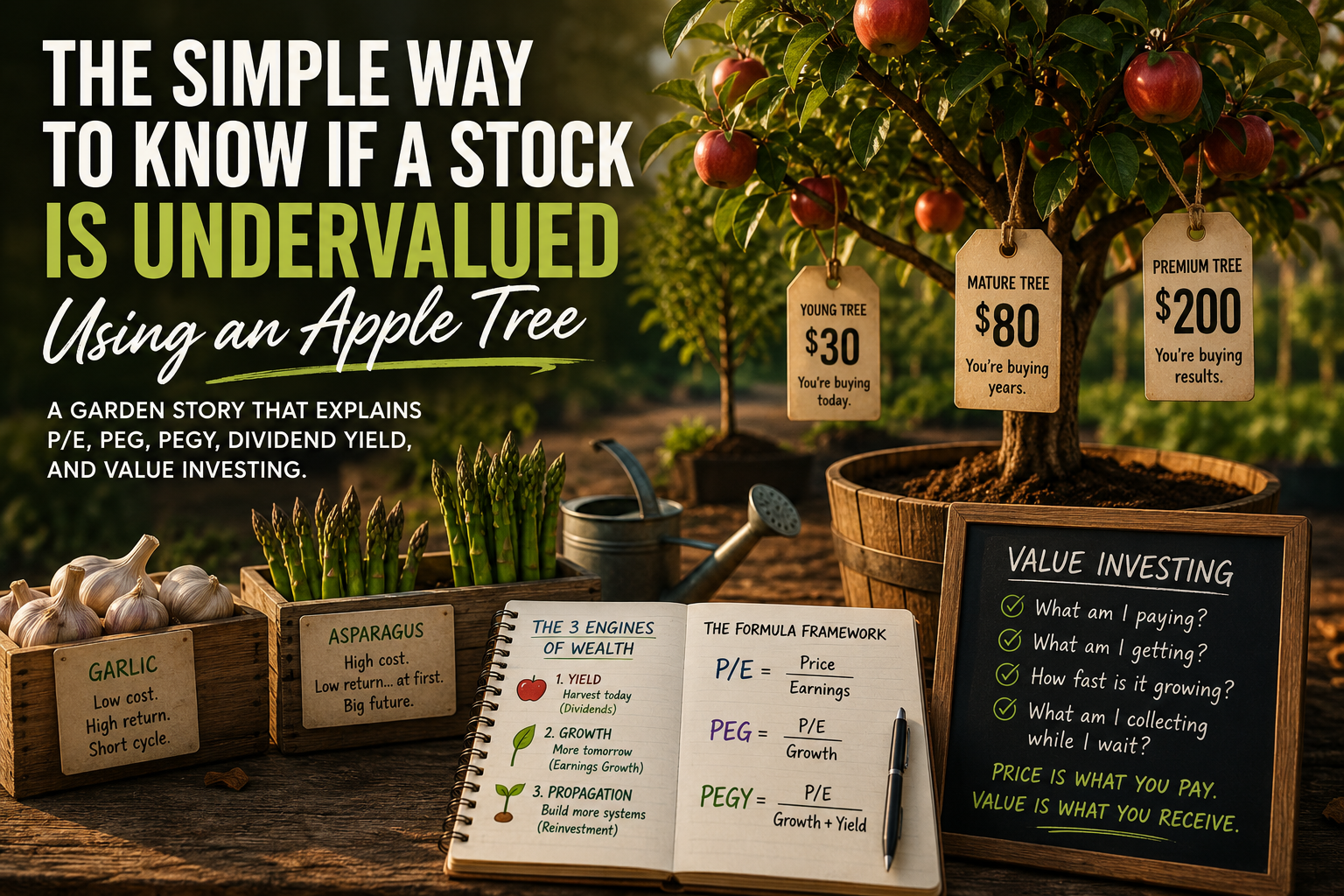
One spring afternoon, standing between rows of fruit trees, Tom noticed three apple trees of the exact same variety with wildly different price tags:
- Apple Tree #1: $30
- Apple Tree #2: $80
- Apple Tree #3: $200
The thirty-dollar tree barely reached his waist. The second had a stronger trunk and more defined branching. The two-hundred-dollar tree looked mature, shaped, and ready for serious production. Still, the stark price gap bothered him. Why would one tree cost nearly seven times more than another tree of the exact same variety?
Tom tracked down a nursery employee and asked, “Why would anyone pay two hundred dollars for that tree?”
The employee smiled and gave a response that changed everything: “You’re not buying a tree. You’re buying years.”
Suddenly, the price tag wasn’t about wood, leaves, or roots. It was about time. Someone else had already done the waiting. Someone else had watered it, pruned it, and protected it from pests, disease, and harsh winters. The older tree cost more because someone else had absorbed the early risks and waiting period, bringing the future harvest closer to today.
This was Tom’s first lesson in stock valuation: Price is what you pay; value is what you receive. A beginner sees a $200 expense ; a steward sees five years of stored growth.
Garlic, Asparagus, and the Birth of the P/E Ratio
A few weeks later, Tom planted two entirely different crops in his garden: garlic and asparagus.
The garlic was cheap and simple. A small bag of seed garlic cost $10. He planted the cloves, waited a single season, and harvested roughly $30 worth of garlic.
The asparagus bed was a structural investment. Between crowns, soil amendments, mulch, and irrigation setup, it cost him $50 upfront. By the end of the first season, it had done almost nothing—producing a few thin, disappointing spears worth maybe $10.
| Crop | Initial Cost (Price) | First-Year Harvest (Earnings) | First Impression |
| Garlic | $10 | $30 | Cheap and highly productive |
| Asparagus | $50 | $10 | Expensive and disappointing |
That evening, Tom listened to a financial podcast explaining the P/E (Price-to-Earnings) ratio. The formula was direct:
$$\text{P/E Ratio} = \frac{\text{Price}}{\text{Earnings}}$$
If a stock costs $30 per share and earns $3 per share, its P/E ratio is 10. This means investors are paying $10 for every $1 of current annual earnings. Tom paused the audio and applied this framework directly to his garden:
- $$\text{Garlic P/E} = \frac{\$10 \text{ Cost}}{\$30 \text{ Harvest}} = 0.33$$
- $$\text{Asparagus P/E} = \frac{\$50 \text{ Cost}}{\$10 \text{ Harvest}} = 5.0$$
On a strict P/E basis, garlic looked incredible, while asparagus looked terrible. If Tom judged his garden solely by today’s immediate data, he would rip out the asparagus and plant garlic everywhere. Yet, experienced gardeners love asparagus beds. This raised a critical question: what vital variable was the P/E ratio missing?
Upstream Thinking: The Limitations of P/E
The garlic and the asparagus were operating on entirely separate timelines.
Garlic delivers a fast, loud return. It is highly productive, but once you harvest the bulb, the original plant is gone. To keep the system running, you must replant your cloves and start completely from scratch every single year.
Asparagus plays a long-term, quiet melody. It spends its early years establishing an underground crown. Most of its foundational work is completely invisible from the surface. But once established, that single asparagus bed will produce a reliable harvest every spring for decades without needing to be replanted.
The garlic was showing Tom its final harvest, while the asparagus was building an enduring system.
This highlights the primary limitation of the P/E ratio. P/E tells you exactly what you are paying for today’s harvest, but it cannot tell you what the asset is becoming. It evaluates current symptoms rather than upstream potential. To fix this, finance professionals don’t just invent acronyms for fun; they introduce a secondary formula because the first one is inherently incomplete.
The Aha Moment: P/E Meets Growth (The PEG Ratio)
Real learning expands on existing frameworks rather than replacing them. Just as multiplication is simply repeated addition, valuation ratios expand as an asset’s cycle develops. To factor in the future, investors integrate the Earnings Growth Rate, transforming the P/E ratio into the PEG (Price-to-Earnings-to-Growth) ratio.
$$\text{PEG Ratio} = \frac{\text{P/E Ratio}}{\text{Earnings Growth Rate}}$$
While P/E asks, “What am I paying for today’s harvest?” PEG asks, “How fast is that harvest growing?”
Now, the asparagus bed makes systemic sense. It carries a high upfront P/E because it is building roots, but because its year-over-year production growth is explosive once it matures, its long-term cost is incredibly reasonable.
The exact same pattern governs the stock market:
- A company with a high P/E ratio may actually be a bargain if its earnings are growing rapidly.
- A company with a low P/E ratio can be an expensive trap if its earnings are flat, stagnant, or dying.
Cheap is not synonymous with value, and expensive is not synonymous with overpriced. You must track what happens next.
Tracking True Production: What Does Growth Actually Mean?
Tom initially assumed that growth meant physical size—a tree getting taller or a trunk getting thicker. A Japanese maple might put on several feet of height in a single season, while a young apple tree grows much slower. Does that mean the maple is outperforming the apple tree?
Biologically, yes. But financially, no. In investing, true growth refers to production output (earnings), not visual metrics or vanity indicators.
Suppose an apple tree yields the following output over two seasons:
- Year 1: 40 lbs of apples
- Year 2: 60 lbs of apples
To find the actual growth rate, we measure the change in production against the original base:
$$\text{Growth Rate} = \frac{\text{New Harvest} – \text{Old Harvest}}{\text{Old Harvest}}$$
$$\text{Growth Rate} = \frac{60 – 40}{40} = \frac{20}{40} = 50\%$$
The harvest grew by 50%. This is PEG-style growth. A steward does not build wealth because an asset looks more imposing or collects more leaves ; wealth compounds because the asset produces more baseline utility.
Why Growth Rates Fall While Harvests Rise
This dynamic often confuses beginners: An asset’s absolute production can increase every year even as its growth percentage steadily declines. Consider this expanding harvest schedule:
| Timeline | Net Harvest Value | Absolute Increase | Growth Rate (%) |
| Year 1 | $30 | — | — |
| Year 2 | $58 | +$28 | 93% ($28 ÷ $30) |
| Year 3 | $95 | +$37 | 64% ($37 ÷ $58) |
| Year 4 | $150 | +$55 | 58% ($55 ÷ $95) |
Notice the paradox: The actual dollar value increased more in Year 4 (+$55) than it did in Year 2 (+$28). Yet, the growth rate mathematically dropped from 93% to 58%.
Why? Because the baseline math expanded.
This is why young startup companies frequently exhibit explosive, triple-digit growth rates—they are calculating from an incredibly small foundation. Conversely, mature businesses might only grow their annual earnings by 4% or 5%, but that single digit can represent billions of dollars in real value. They aren’t fragile saplings anymore; they are fully established orchards. Their purpose has shifted from rapid physical expansion to deep, reliable harvest production.
The Apple Tree vs. The Japanese Maple: Shifting from PEG to PEGY
Walking back through the nursery, Tom noticed an elegant row of Japanese maples. They featured striking branching, fine leaves, and massive ornamental appeal. A mature specimen could easily command a premium price tag in the future. It could appreciate, grow, and be sold for a profit.
But it would never feed him.
The apple tree was fundamentally different. It also grew in physical size, appreciated in structural value, and expanded its canopy. But every single autumn, without fail, it dropped a tangible harvest of apples into his basket.
The Japanese maple forces you to wait for a single final sale to realize value. The apple tree feeds you while you wait. This pivotal realization bridges the gap between the PEG ratio and the PEGY ratio.
Developed by legendary investor Peter Lynch, the PEGY ratio takes the core layout of PEG and factors in Dividend Yield (“Y”).
$$\text{PEGY Ratio} = \frac{\text{P/E Ratio}}{\text{Earnings Growth Rate} + \text{Dividend Yield}}$$
A dividend is cash value distributed directly to owners while they retain full ownership of the underlying asset. In the garden, this is your annual apple harvest. The tree remains firmly rooted in your orchard, the system continues to compound, yet recurring value arrives at your door.
| Asset Type | Growth Potential | Recurring Yield | Financial Parallel |
| Japanese Maple | Yes | No edible harvest | Growth without regular income |
| Apple Tree | Yes | Annual apple harvest | PEGY Asset: Growth plus yield |
Peter Lynch wasn’t simply looking for raw growth; he wanted to know if a company rewarded its stewards for their patience. That is the essence of PEGY.
The Three Engines of Garden Wealth
Tom wondered if propagating a plant—taking cuttings, dividing roots, or saving seeds—was the same as receiving a dividend.
Not quite. A dividend is a payout of excess value while the core asset is untouched. Propagation is something deeper: it is capital reinvestment. When you divide a perennial crown or graft a new stem, you are taking the profits of your system and using them to construct entirely new infrastructure. This is identical to a business utilizing its cash flow to build a new fulfillment center or launch a secondary product line.
Through this lens, the garden reveals three distinct wealth-building engines:
| Wealth Engine | Garden Manifestation | Financial Equivalent |
| 1. Yield | Apples harvested each season | Dividends paid to shareholders |
| 2. Growth | Canopy expanding, yielding more total fruit | Earnings expansion over time |
| 3. Propagation | Dividing crowns, saving seed, rooting cuttings | Capital reinvestment & business expansion |
The most resilient ecosystems—and portfolios—actively utilize all three engines simultaneously. They produce, they grow, and they clone themselves to scale the underlying system.
The Nursery Sale: Exploiting Price Dislocation
Later that autumn, Tom returned to the nursery and discovered that the exact same mature apple tree that previously cost $200 was now marked down to $120.
The tree hadn’t suddenly lost its capability. Its years of stored growth hadn’t vanished, and its future seasonal harvests were completely intact. The only variable that had shifted was the market price tag.
This is the bedrock of value investing. A market sell-off or drop in price doesn’t automatically mean a business is broken or dying. Often, the broader market is simply experiencing a temporary wave of fear, distraction, or short-term thinking.
The critical question a steward must ask is: Has the price fallen further than the underlying value? Tom wasn’t just buying wood and leaves; he was buying years of future production at a steep, unearned discount.
Real-World Application: Auditing an Orchard Like Procter & Gamble
To anchor these concepts, Tom analyzed a classic, mature business: Procter & Gamble (NYSE: PG).
Procter & Gamble doesn’t operate like a high-growth tech sapling; it functions exactly like an established orchard. It manufactures everyday consumer staples—essential products that households consistently purchase across every single economic season. Because it is a mature pillar, evaluating it strictly through a raw P/E lens or a basic growth lens fails to show the full picture. You need the complete PEGY calculation to capture the value of its dividend yield.
The Step-by-Step PEGY Formula
To run a PEGY analysis on any company, pull current figures from a financial platform or investor relations dashboard using these steps:
- Locate the Forward P/E Ratio: Find the forward-looking P/E ratio rather than trailing figures, as investing is entirely an exercise in buying the future, not the past.
- Identify the Projected Growth Rate (G): Look for the consensus 3-to-5-year annualized Earnings Per Share (EPS) growth estimate. Input this percentage as a whole number (e.g., 6% growth is entered as
6, not0.06). - Find the Current Dividend Yield (Y): Note the annualized dividend yield. Input this value as a whole number as well (e.g., a 2.5% yield is entered as
2.5). - Execute the Calculation:$$\text{PEGY} = \frac{\text{Forward P/E}}{\text{Growth Rate} + \text{Dividend Yield}}$$
A Practical Example
Suppose you run the metrics and gather the following sample data for a stable consumer anchor:
- Forward P/E: 25
- Estimated Earnings Growth (G): 6%
- Current Dividend Yield (Y): 2.5%
$$\text{PEGY} = \frac{25}{6 + 2.5} = \frac{25}{8.5} = 2.94$$
Interpreting the Clues
In classic financial analysis, a PEGY ratio below 1.0 is traditionally flagged as an indicator of an undervalued asset. However, a ratio is a valuable clue, never an absolute commandment. A poor, structurally compromised business can look incredibly cheap on paper for a valid reason (a value trap). Conversely, an exceptional, highly reliable company can command a premium multiple for decades because investors willingly pay up for its operational resilience. The ratio highlights where you should look; the strength of the underlying system determines whether you should invest.
The Stewardship Blueprint: Your Portfolio Ecosystem Worksheet
You can map these exact financial indicators back to a physical garden bed or life asset. The goal isn’t to reduce nature to a cold spreadsheet, but to train your eyes to identify foundational systems wherever they hide.
| PEGY Element | Financial Definition | Garden Counterpart | Life System Equivalent |
| P (Price) | Cost per share of stock | Upfront cost of nursery stock, soil, and tools | Capital, time, or energy required to initiate a system |
| E (Earnings) | Net profits per share | Annual dollar value of food harvested minus costs | Regular tangible output or personal capability generated |
| G (Growth) | Year-over-year expansion of profits | Annual increase in total harvest volume | Compounding expansion of your personal leverage or skills |
| Y (Yield) | Dividend cash flow paid to owners | Perennial harvests that return every year without replanting | Recurring energy or financial freedom returned to you |
Take Action: Audit Your Portfolio Ecosystem
To move from a passive consumer to an intentional steward, look past immediate superficial price tags and perform a deep systemic audit of your life and capital allocations.
1. Identify Your “Garlic” Assets
Where in your financial or personal life are you chasing rapid, high-yield returns that ultimately force you to constantly restart from scratch? Garlic is highly useful, but if your entire ecosystem consists of temporary annual setups, you will experience operational burnout the moment you stop planting.
2. Nurture Your “Asparagus” Assets
What long-term foundations are you cultivating that look slow, stagnant, or disappointing on the surface today, but possess the systemic infrastructure to feed you for decades to come? This could be an unglamorous index fund, a deep technical skill, or a foundational health routine.
3. Value Your “Apple Trees”
Are you actively acquiring assets that simultaneously expand their core value while distributing regular income along the way? These PEGY-style assets provide the ultimate ownership experience by insulating you with regular payouts while your foundation grows.
4. Classify Your “Japanese Maples”
Which elements of your portfolio or life are pure appreciation plays? They may grow beautifully and hold immense value, but because they lack an ongoing yield, they require a final sale to be useful. Ensure your liquid needs are covered elsewhere.
5. Scout for Nursery Sales
Where has market panic, temporary noise, or short-term distraction driven the price of a fundamentally pristine asset well below its intrinsic value? Do not buy blindly—use it as a prompt to deeply analyze the underlying root system.
Final Reflection
Tom looked across his garden with an entirely new perspective. The garlic taught him current yield, the asparagus modeled delayed growth, the apple tree demonstrated compounding dividends, and the nursery sale proved that price and value frequently separate.
The stock market was no longer an abstract wall of confusing jargon and flashing red and green numbers. It was simply an expansive garden filled with varying productive systems.
The ultimate question for any investor is never merely, “Is this asset cheap?” The real question is: “What is this system producing right now, how fast is that production scaling, and what am I collecting while I wait?”
Once you recognize that pattern in the soil, you will see it everywhere. Because lasting wealth is never merely accumulated—it is cultivated.