A beginner-friendly guide to pest lifecycles with smarter garden action
A garden pest is not just a bug.
It is a moment in a cycle.
That may sound simple, but it changes everything.
When most new gardeners see an insect, they usually ask the same question right away:
How do I get rid of it?
That question makes sense. You see holes in leaves. You see tiny insects clustered on stems. You see a squash plant suddenly wilt. You see something jump, fly, crawl, or disappear under a leaf, and your first thought is that you need to act fast.
Sometimes you do.
But not always.
The better question is not simply, “How do I kill this bug?”
The better question is:
What stage is this pest in, and what is the safest useful action right now?
That is the difference between panic and stewardship.
A beginner sees a bug and reaches for a spray.
A gardener asks what the bug is.
A steward asks what stage the system is in.
That is the purpose of this guide.
In the first article in this series, we focused on identification. We looked at common garden bugs in Virginia and asked whether they were friends, foes, or warning signs. We talked about taking clear photos before asking for help: the bug, the whole plant, and the damage.
This second article goes one step deeper.
Now that you know what you may be looking at, the next question is timing.
Is it an egg?
Is it a nymph?
Is it a larva?
Is it an adult?
Is it a fresh infestation?
Is it a late-season problem?
Is it a sign that beneficial insects are already helping?
Because pest control is not just about what you use.
It is about when you use it.
The same treatment that works well at one stage may be almost useless at another. Squash bug eggs can be removed before they hatch, but adult squash bugs are harder to control. Aphids can often be knocked off early with water, but a heavy colony may need more attention. A tomato hornworm can be hand-picked, but a hornworm covered in white cocoons may be better left alone because parasitic wasps are already doing the work.
This is why lifecycle matters.
Identification tells you what it is.
Lifecycle tells you when to act.
And timing tells you whether you are preventing a problem, managing a problem, or reacting too late.
A Safety Note for Nervous Gardeners
Most garden insects are not trying to injure you.
They are usually feeding, hiding, mating, laying eggs, or trying to escape.
Some bugs may jump suddenly when you move a leaf. Leafhoppers are a good example. They can spring away quickly and startle you, but they are not attacking. Flying insects may lift off when disturbed. Squash bugs may scurry under the leaf. Cucumber beetles may move fast. Spotted lanternflies may jump or fly away.
That movement can surprise you, especially when you are new.
So go slowly.
Wear gloves if you are uncomfortable. Move leaves gently. Use your phone camera before touching anything. Do not handle insects you cannot identify. Some beneficial insects, like assassin bugs, can bite if handled roughly, even though they are helpful predators in the garden.
The goal is not to be fearless.
The goal is to be calm enough to observe.
Before You Treat: Take These 3 Photos
Before you spray, squash, prune, or panic, take photos if you can.
A single blurry bug photo is often not enough.
Try to capture three views:
Photo 1: The pest or insect close-up
Get the insect as clear as possible. This helps with identification.
Photo 2: The whole plant
This shows what crop the insect is on and how healthy the plant looks overall.
Photo 3: The damage or life stage
Photograph holes, sticky leaves, wilted stems, eggs, frass, missing leaves, nymph clusters, or egg masses.
These three photos help ChatGPT, Google Lens, local garden groups, farmers, nurseries, and Extension agents give better answers.
A bug is only part of the story.
The plant matters.
The date matters.
The damage matters.
The life stage matters.
The Beginner Pest-Control Ladder
Before we look at individual pests, keep this simple ladder in mind.
Start at the bottom and only climb higher if needed.
1. Identify the pest
Do not treat what you have not identified.
A lady beetle larva can look scary if you have never seen one. A parasitized hornworm may look disgusting, but it is actually a sign that tiny wasps are helping. A squash vine borer adult may look like a wasp, but it is actually a moth.
If you spray before identifying, you may remove the help and keep the problem.
2. Identify the stage
Egg, nymph, larva, adult, damage, or disease sign.
This matters because the best treatment often depends on the stage. Eggs may be removable. Young caterpillars may be easier to treat. Adults may be harder to manage. Hidden larvae may be almost impossible to reach after they enter a stem.
3. Check the damage level
A few holes may not matter. Sudden wilting may matter a lot.
Look at the whole plant.
Is it still growing?
Is new growth healthy?
Is the fruit affected?
Is the plant wilting?
Is the pest spreading?
Are there eggs or young insects increasing?
The goal is not a perfect garden.
The goal is a productive garden.
4. Try physical control first
Physical controls are often the safest first move.
These include water spray, hand-picking, removing eggs, pruning damaged leaves, row covers, barriers, checking leaf undersides, and removing old plant debris when needed.
These methods may not feel fancy, but they teach the most important skill in gardening:
observation.
You learn where pests hide.
You learn what eggs look like.
You learn when insects move.
You learn how fast damage spreads.
That knowledge becomes part of your garden skill.
5. Support the whole garden system
Sometimes pests are not just a problem.
They are a signal.
Aphids may appear on tender new growth or stressed plants. Dense plantings may reduce airflow. Overfertilized plants may produce soft growth that pests like. Weak soil may create weak plants. A garden with no flowers may lack beneficial insects.
Before escalating, ask:
Is the plant stressed?
Is it getting enough water?
Is it crowded?
Are beneficial insects present?
Are flowers nearby for pollinators and predators?
Am I planting the same crop in the same spot every year?
Healthy plants are not immune to pests, but they often recover better.
6. Use organic controls carefully
Organic controls can be useful, but organic does not automatically mean harmless.
Insecticidal soap, horticultural oil, neem oil, Bt, diatomaceous earth, traps, and other options all have limits. Some must touch the insect directly. Some must be eaten. Some work better on young insects than adults. Some can burn leaves in heat. Some can harm beneficial insects if used carelessly.
The goal is not to coat the whole garden.
The goal is targeted use.
Spray the pest, not the world.
7. Use chemical controls only when necessary
There may be times when a gardener chooses a stronger chemical control.
That decision should be made carefully.
Chemical controls should not be the first reaction. They should come after identification, damage assessment, and lower-risk options have been considered.
If you use any pesticide, organic or synthetic, read the label before buying and again before applying.
Use only on plants listed on the label.
Use only for pests listed on the label.
Follow harvest waiting periods.
Avoid spraying flowers.
Avoid spraying when pollinators are active.
Avoid windy days.
Do not assume more is better.
The label is not a suggestion.
It is the instruction manual.
The Garden Pest Response Chart
Use this as a beginner decision guide.
| What You See | Best First Move | Organic Option | Chemical Option | When to Ask for Help |
|---|---|---|---|---|
| Tiny soft insects on new growth | Spray with water and check for lady beetles or lacewings | Insecticidal soap if needed | Labeled aphid product if severe | If the plant is declining fast |
| Large green caterpillar on tomato | Hand-pick and check for white cocoons | Bt on young caterpillars | Labeled caterpillar product if severe | If you are unsure whether it is parasitized |
| Bronze eggs under squash leaves | Remove eggs by hand | Repeat scouting and use row cover early season | Usually not the first choice | If squash wilts suddenly |
| Sawdust-like frass at squash stem | Inspect stem for vine borer | Early physical removal may be attempted | Prevention is usually better than rescue | If several plants wilt fast |
| Metallic beetles skeletonizing leaves | Knock into soapy water early morning | Hand removal; traps only with caution | Labeled beetle product if severe | If pollinators are active nearby |
| Yellow beetles on cucumbers | Use row cover early and monitor flowers | Delayed planting, resistant varieties, hand removal | Labeled product if disease risk is high | If cucumber plants wilt suddenly |
| Tiny jumping insects | Photograph damage and inspect leaves | Row cover, reduce stress, targeted soap if appropriate | Labeled product if severe | If damage spreads quickly |
| Unknown insect | Photograph and log | Do nothing until identified | Do not spray yet | Ask Extension, nursery, farmer, or garden group |
This chart is not a replacement for local guidance.
It is a thinking tool.
Its job is to slow you down long enough to make a better decision.
Stage-by-Stage Pest Guide for Virginia Gardeners
1. Aphids
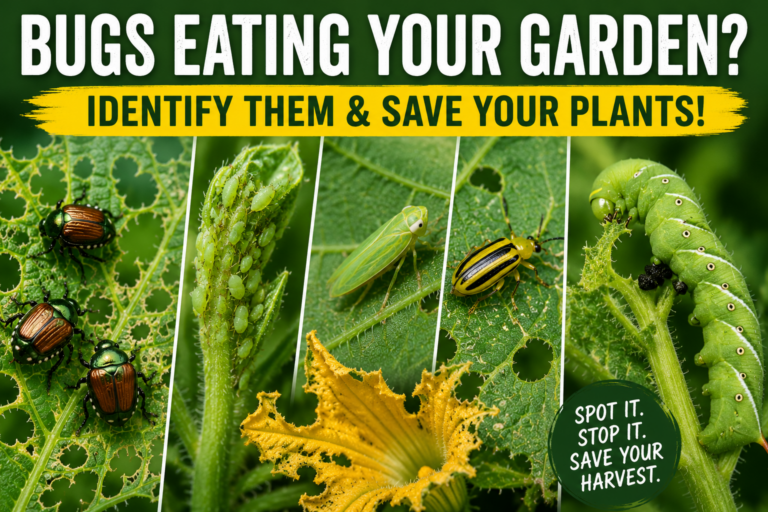
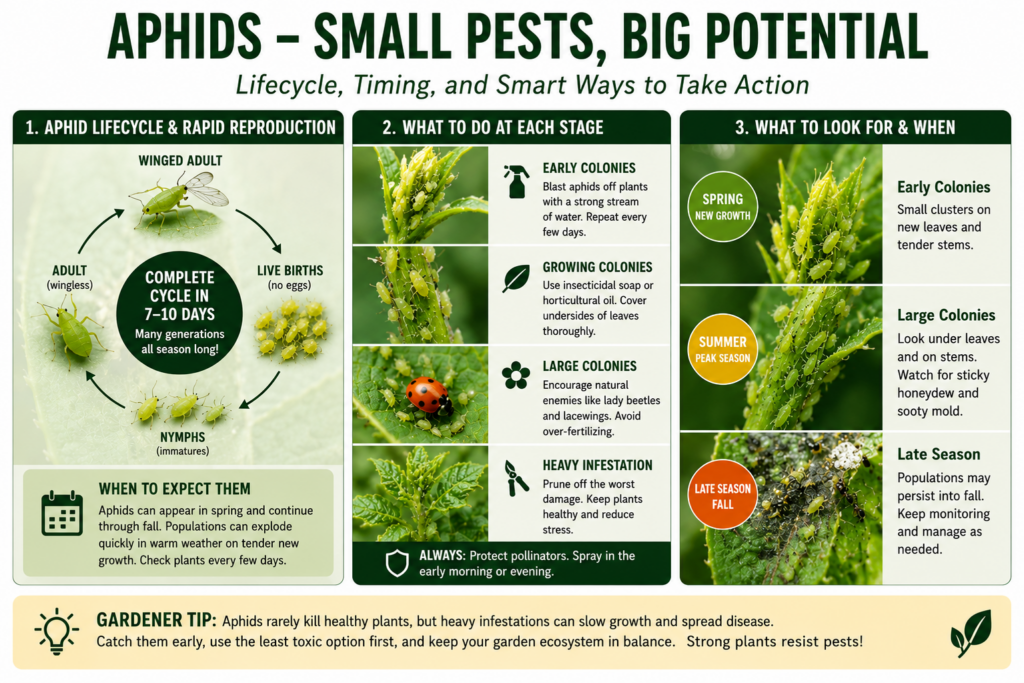
Aphids are tiny, soft-bodied insects that often cluster on tender new growth, stems, buds, and the underside of leaves. They may be green, black, yellow, gray, or reddish. They suck plant sap and can cause curled leaves, sticky honeydew, distorted growth, and sooty mold.
Aphids can appear repeatedly during the growing season. They can multiply quickly when conditions are favorable, especially on soft new growth.
This is why aphids are a perfect pest for learning timing.
Early colonies are often easy to reduce.
Large colonies can become frustrating.
When to expect them
Aphids can show up in spring and continue through the growing season. Watch closely during warm weather, tender new growth, and periods of plant stress.
What to do by stage
When you first see a small colony, use a firm spray of water to knock aphids off the plant. Check again the next day.
When the colony grows, look for lady beetles, lacewing larvae, hoverfly larvae, and parasitic wasp activity. Beneficial insects may already be helping.
If aphids continue spreading, insecticidal soap may help when sprayed directly on the insects. It must touch the aphids to work well.
If the plant is heavily infested, prune the worst sections if practical. Reduce plant stress and avoid overfertilizing with too much nitrogen, which can create tender growth aphids like.
Best first move
Spray the aphids off the plant with water.
This is simple, cheap, and often enough for early colonies.
Organic treatment options
Insecticidal soap may help if it directly contacts aphids. Neem oil may be used in some situations, but it should be used carefully and according to the label.
Do not spray when plants are heat-stressed or in full hot sun.
Chemical treatment options
If aphids are severe and the plant is declining, use only a product labeled for aphids and for that edible crop. Avoid broad spraying that kills beneficial insects.
Beginner tip
Aphids rarely destroy a healthy plant overnight. Catch them early, use water first, and look for beneficial insects before spraying.
2. Tomato Hornworms
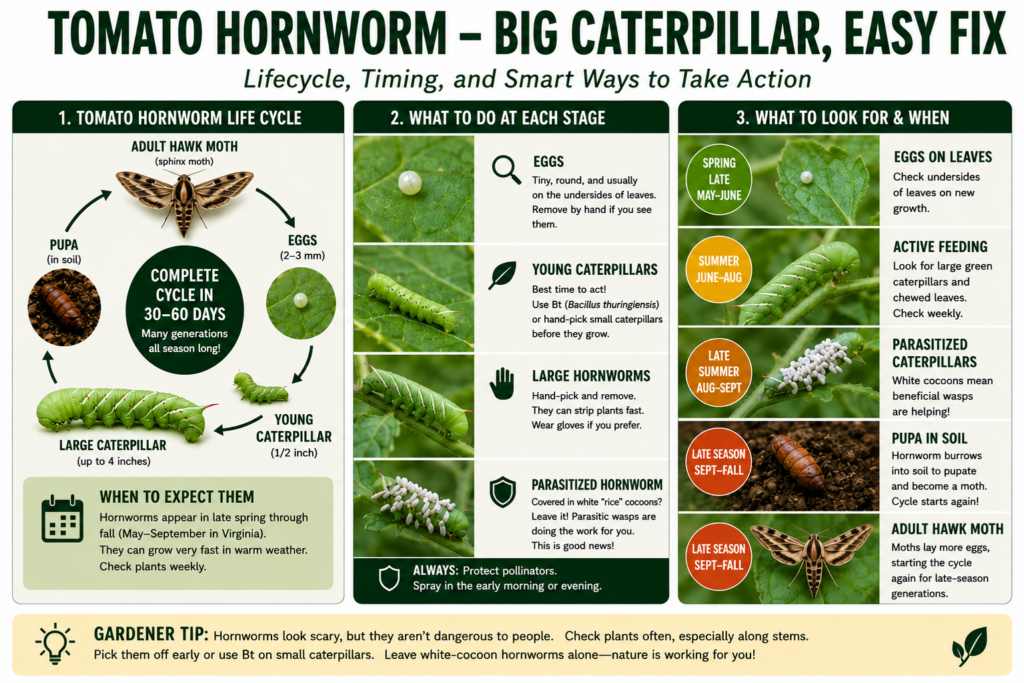
Tomato hornworms are large green caterpillars that feed on tomatoes and other nightshade crops. They are excellent at hiding. Many gardeners notice missing leaves or dark droppings before they see the caterpillar.
Hornworms look alarming because they are big.
But they are not dangerous to people.
They do not sting. They are not trying to bite you. If you are uncomfortable touching them, wear gloves and hand-pick them.
When to expect them
Tomato hornworms are often noticed from late spring through summer and into early fall when tomato plants are growing strongly. Watch for sudden missing leaves, bare stems, and dark droppings on leaves or soil below the plant.
What to do by stage
When eggs or small caterpillars are present, early action is easiest.
When caterpillars are small, Bt can be useful if used according to label directions.
When hornworms are large, hand-picking is usually the simplest beginner method. Look carefully along stems because they blend in well.
If you see a hornworm covered in white rice-like cocoons, do not remove it. Those white cocoons are from parasitic wasps. The hornworm has become part of the natural pest-control system.
Best first move
Hand-pick large hornworms.
If you are uncomfortable touching them, wear gloves.
Organic treatment options
Bt can be useful on young feeding caterpillars. It works best when caterpillars are small and actively eating treated leaves.
Chemical treatment options
Most home gardens do not need stronger chemical treatment for hornworms if they are caught early. If damage is severe, use only a labeled product for caterpillars on tomatoes and follow the harvest interval.
Beginner tip
The hornworm stage matters. A feeding hornworm may need removal. A parasitized hornworm is a sign that the garden’s natural defense system is working.
3. Squash Bugs
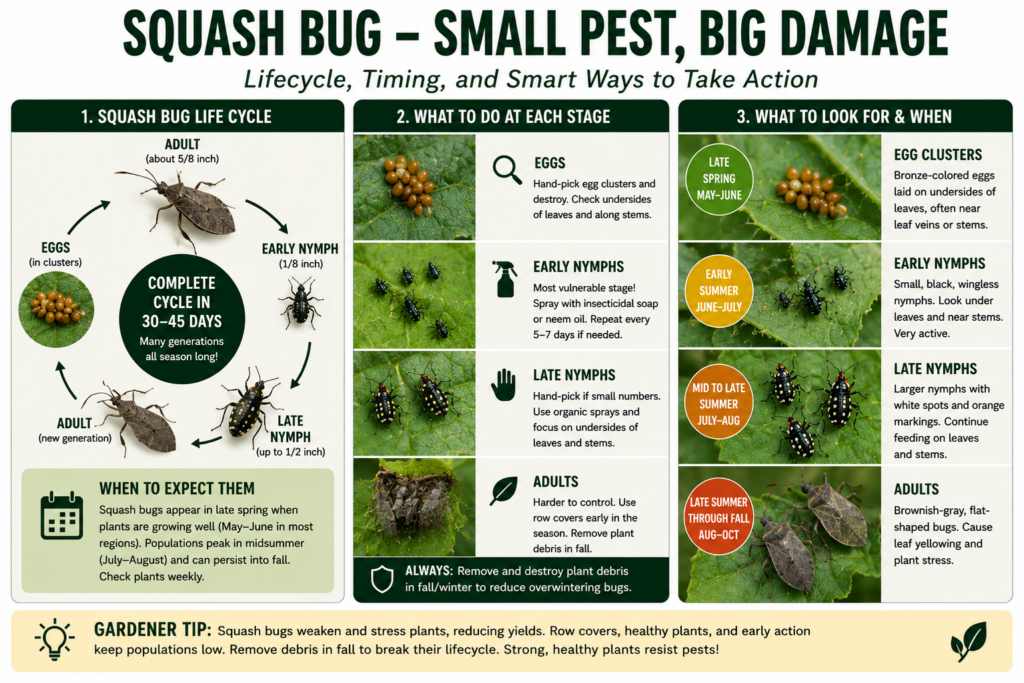
Squash bugs are common pests of squash, zucchini, pumpkins, and related crops. They feed by sucking plant sap and can cause leaves to wilt, yellow, brown, or collapse.
Adults are hard to control because they hide well and move quickly.
Eggs are much easier.
That is why this pest is all about timing.
When to expect them
Squash bugs usually become active as squash plants grow in late spring and summer. They often hide under leaves, near stems, and around the base of the plant.
What to do by stage
Look under leaves for bronze or copper-colored egg clusters. Removing eggs early is one of the best beginner actions.
When nymphs hatch, they are smaller and often cluster together. This is another good time to act before they become adults.
Adults are more difficult. Hand-pick them if possible, use boards or traps to find them in the morning, and remove plant debris where they may hide.
Row covers may help early in the season, but they must be removed when flowers need pollination unless you hand-pollinate.
Best first move
Check the underside of leaves and remove egg clusters.
Eggs cannot run away.
Organic treatment options
Repeated scouting, egg removal, row covers early in the season, and hand-picking can all help. Some gardeners place boards near plants as hiding places, then check underneath in the morning.
Chemical treatment options
Squash bugs are often difficult to manage once adults are established. If a product is used, young nymphs are usually the better target than adults. Follow current local guidance and the product label.
Beginner tip
Do not wait until the squash plant is wilting badly. For squash bugs, the egg stage is your best opportunity.
4. Squash Vine Borers
Squash vine borers are one of the most frustrating pests because the damaging stage is hidden inside the stem.
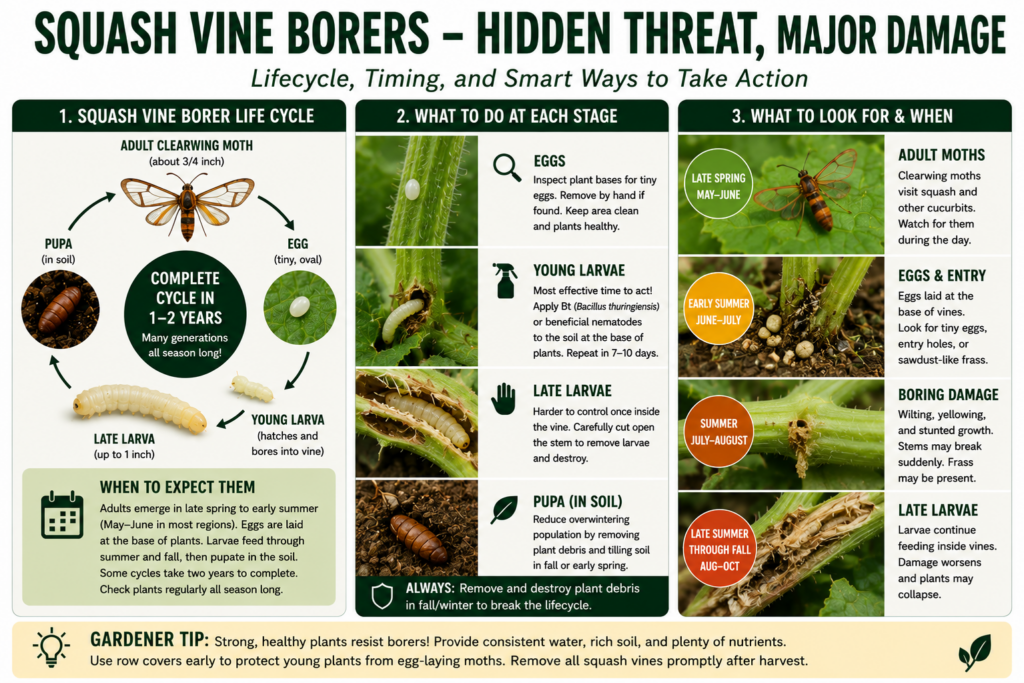
The adult looks like a wasp, but it is actually a moth. The larva tunnels into the stem of squash plants. Once inside, it is much harder to reach.
This pest teaches a hard but important lesson:
Some problems are best handled before they become visible.
When to expect them
Watch squash plants during warm weather, especially when vines are growing strongly. Sudden wilting and sawdust-like frass near the base of the stem are key warning signs.
What to do by stage
Before egg-laying, row covers can help protect young plants. Remove covers when flowers need pollination.
At the early damage stage, inspect stems for frass. Some gardeners carefully slit the stem to remove the larva, then cover the wound with soil, but this is more advanced and does not always work.
Once the plant is collapsing, rescue is harder. Consider succession planting or planting a second round so one loss does not end the season.
Best first move
Watch the base of the stem before the plant collapses.
Frass is the warning sign.
Organic treatment options
Row covers, stem wrapping, succession planting, resistant squash types, and early inspection can help. Some gardeners attempt physical removal if caught early.
Chemical treatment options
Chemical rescue is difficult once the larva is inside the stem. Prevention and timing matter more than late spraying. Follow Extension guidance and label directions.
Beginner tip
With squash vine borers, timing matters more than force. Once the larva is inside the stem, late spraying is often not the answer.
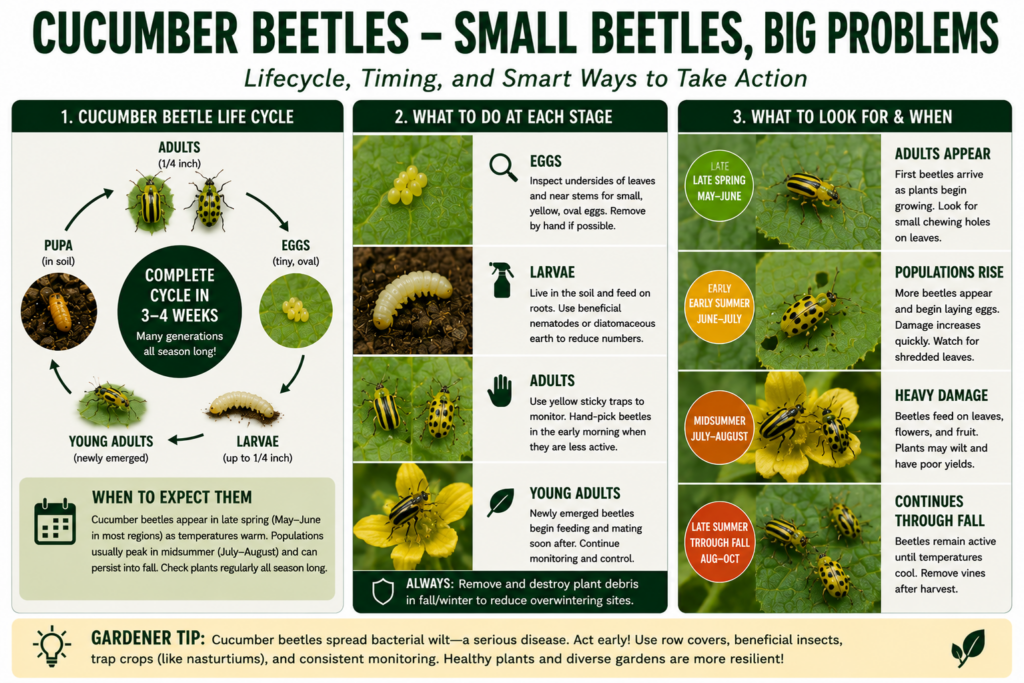
5. Cucumber Beetles
Cucumber beetles are small but serious pests of cucumbers, squash, melons, pumpkins, and related crops. They may be striped or spotted. They chew leaves, flowers, stems, and fruit.
The bigger problem is that cucumber beetles can spread bacterial wilt.
That means the insect is not just causing chewing damage. It may also carry disease.
When to expect them
Cucumber beetles often appear when young cucurbit plants are getting established. They may also be found in flowers later in the season.
What to do by stage
At the seedling stage, protect plants with row covers. This is one of the best early defenses.
When flowers appear, row covers usually need to come off so pollinators can reach the blooms unless you are hand-pollinating.
If beetles are feeding heavily, hand removal may help in small gardens, but they move quickly.
If bacterial wilt is a concern and beetles are numerous, you may need local Extension guidance and careful label-based treatment.
Best first move
Protect young plants early.
Once disease enters the plant, killing the beetle may not save that plant.
Organic treatment options
Row covers, crop rotation, delayed planting, resistant varieties, and regular scouting may help. Hand-picking is possible but difficult because the beetles move quickly.
Chemical treatment options
Chemical treatment may be considered when beetles are numerous and disease risk is high. Use only labeled products for the crop and pest. Avoid spraying flowers or pollinators.
Beginner tip
For cucumber beetles, early protection matters. Once bacterial wilt takes hold, the problem may be bigger than the beetle itself.
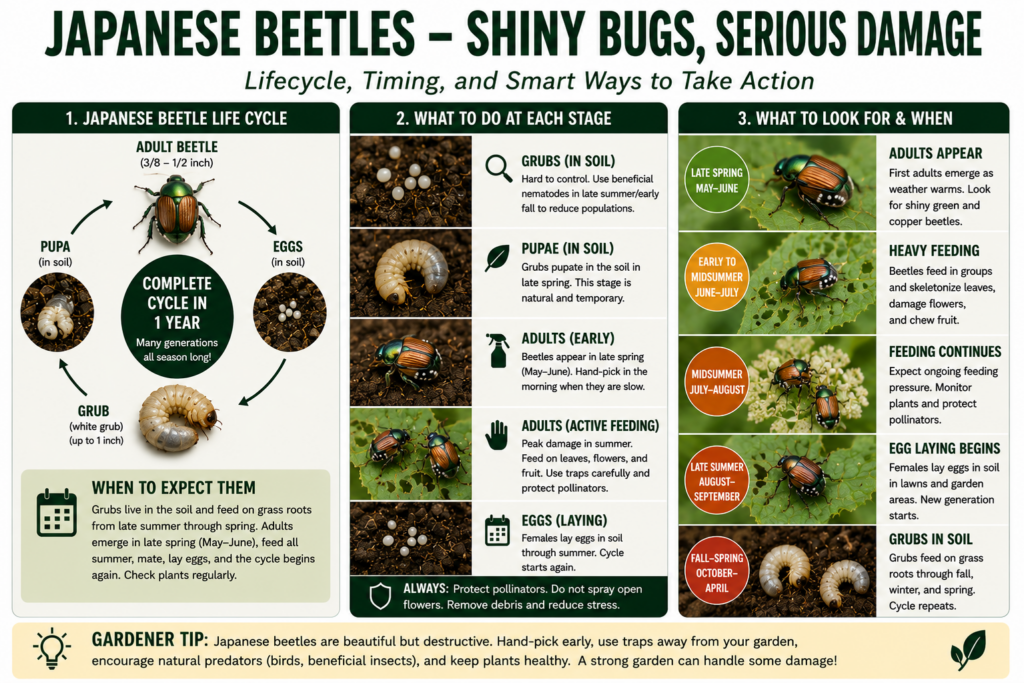
6. Japanese Beetles
Japanese beetles are shiny, metallic beetles with green bodies and copper-colored wings. They often feed in groups and skeletonize leaves, leaving only the veins behind.
They are easy to see.
They are also easy to overreact to.
When to expect them
Japanese beetles are usually seen in summer. They often feed on leaves, flowers, and fruit crops.
What to do by stage
The grub stage happens in the soil, often in lawns or turf areas. Adult beetles are the stage most gardeners notice on plants.
Early in the morning, adults are slower. Knock them into a container of soapy water.
Use traps carefully. Traps may attract more beetles into the area if placed poorly.
If you use any pesticide, protect pollinators. Do not spray open flowers visited by bees.
Best first move
Hand-remove adults early in the morning when they are slower.
Organic treatment options
Hand removal is often the most practical small-garden method. Traps should be used cautiously and placed away from plants you want to protect.
Chemical treatment options
If damage is heavy, chemical options exist, but they can threaten pollinators and beneficial insects. Never spray open flowers visited by bees. Follow label directions carefully.
Beginner tip
Japanese beetles are visible and dramatic, but do not spray blindly. Protect pollinators and focus on practical removal when possible.
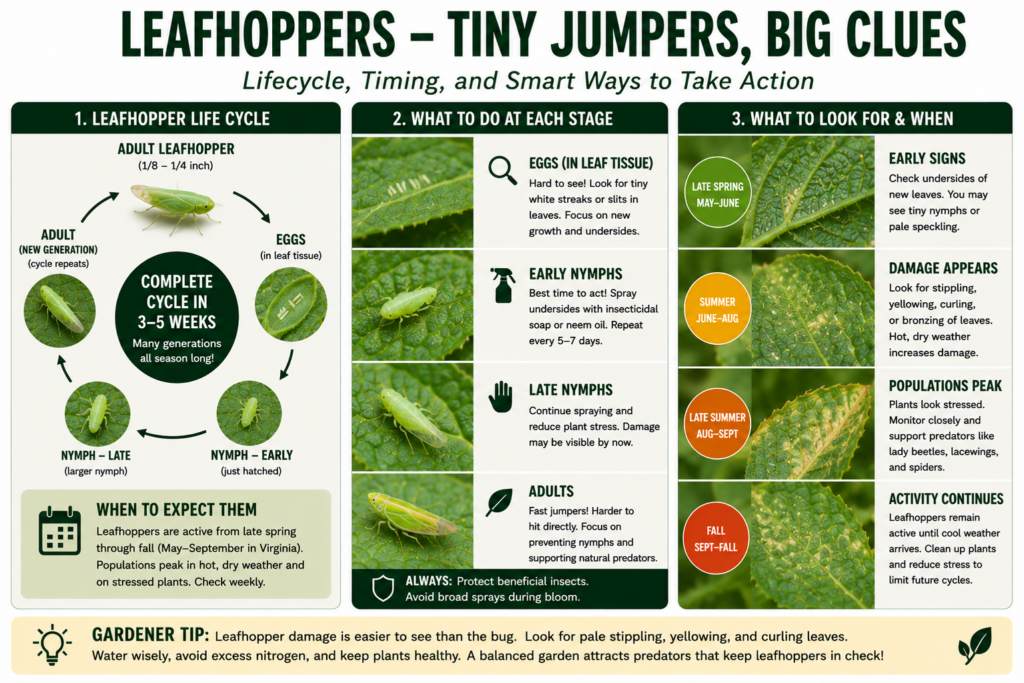
7. Leafhoppers
Leafhoppers are small, wedge-shaped insects that may jump or fly suddenly when disturbed. This can startle a new gardener.
They are not attacking you.
They are escaping.
Leafhoppers feed by sucking plant juices. Their damage may appear as pale speckling, stippling, yellowing, curling, or bronzing of leaves.
When to expect them
Leafhoppers may appear during the growing season, especially in warm weather and on stressed plants.
What to do by stage
Nymphs may be found on the underside of leaves. Adults move quickly and can be harder to photograph.
If you cannot get a clear bug photo, photograph the damage.
Reduce plant stress, avoid overfertilizing, and encourage beneficial insects.
Row covers may help protect vulnerable young plants.
Insecticidal soap may help on young stages if it directly contacts them, but fast-moving adults are harder to hit.
Best first move
Photograph the damage and inspect leaf undersides.
Expect the insect to jump or fly.
Organic treatment options
Reduce stress, use row covers for vulnerable young plants, encourage beneficial insects, and use targeted insecticidal soap only when appropriate.
Chemical treatment options
If damage is serious and the pest is confirmed, use a labeled product appropriate for the crop and pest. Ask Extension if unsure.
Beginner tip
When the insect jumps away, the damage becomes your evidence.
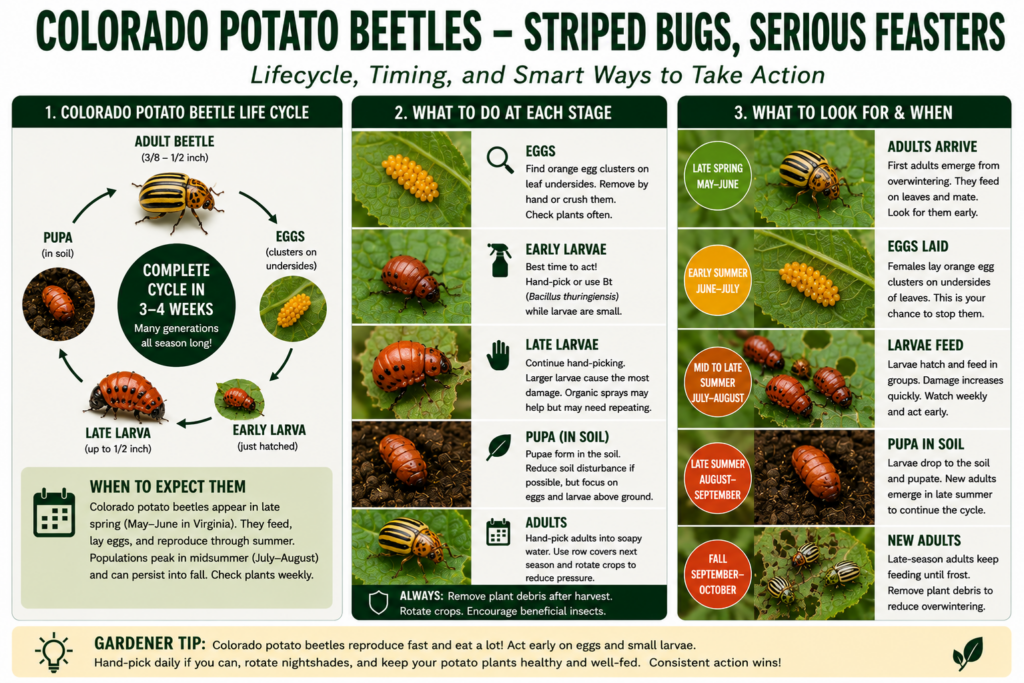
8. Colorado Potato Beetles
Colorado potato beetles attack potatoes, eggplants, tomatoes, and other nightshade crops. Adults have striped wing covers, and larvae are often soft, reddish-orange, and hungry.
Like squash bugs, this pest is easier to manage early.
When to expect them
Look for Colorado potato beetles during the growing season on potatoes and related crops. Check undersides of leaves for eggs and watch for larvae feeding in groups.
What to do by stage
Remove egg clusters when you find them.
Hand-pick larvae and adults into soapy water in small gardens.
Rotate crops each year if possible.
Avoid relying on one control method again and again, because resistance can be a problem with this pest in some areas.
Best first move
Scout early and remove eggs or larvae.
Organic treatment options
Hand-picking, crop rotation, mulching to support predators, and careful use of labeled organic products may help.
Chemical treatment options
Use Extension guidance and label directions. Avoid unnecessary spraying and repeated use of the same approach.
Beginner tip
Eggs and larvae are easier to manage than a full infestation.
9. Cabbage Worms and Cabbage Loopers
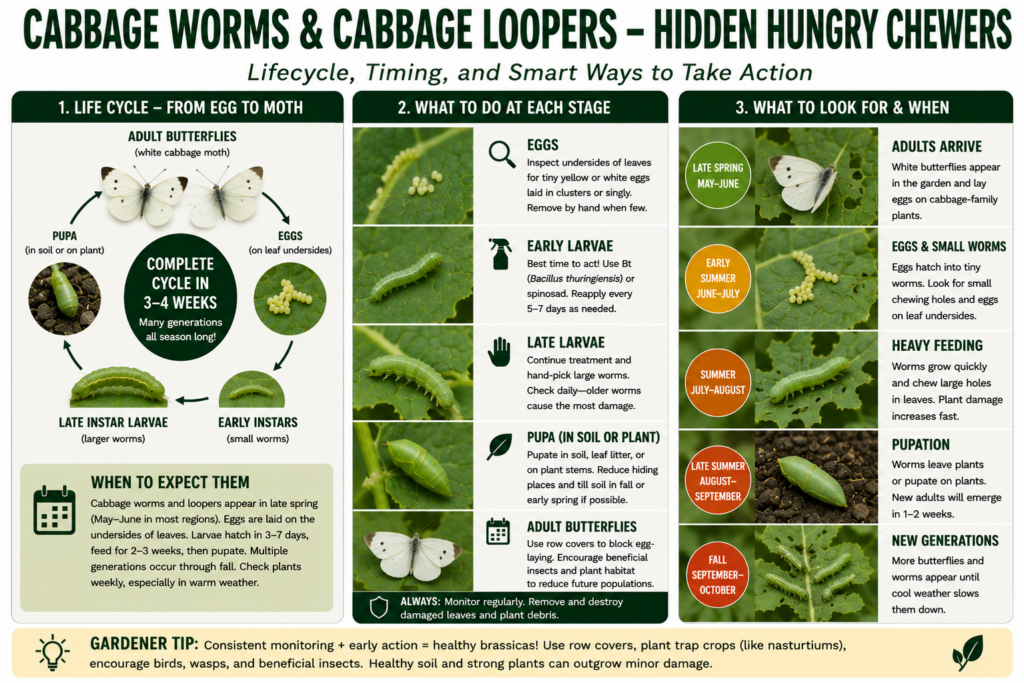
Cabbage worms and loopers feed on cabbage, kale, broccoli, collards, cauliflower, and other brassicas. They chew holes in leaves and may leave dark droppings behind.
Because they are green, they can blend in.
You may see the damage before you see the caterpillar.
When to expect them
Watch brassicas closely from spring through fall, especially when white butterflies or moths are active around the garden.
What to do by stage
Use row covers before eggs are laid if possible.
Inspect leaves regularly, especially the undersides.
Hand-pick caterpillars when you find them.
Bt can be effective on young feeding caterpillars when used correctly. It works best when caterpillars are small and actively eating treated leaves.
Best first move
Look under the leaves early and often.
Organic treatment options
Row covers, hand-picking, and Bt on young caterpillars can help.
Chemical treatment options
If using a chemical product, make sure it is labeled for edible brassicas and the specific pest. Follow harvest intervals.
Beginner tip
Do not wait for cabbage leaves to look shredded. Look under the leaves before the problem becomes obvious.
10. Spotted Lanternfly
Spotted lanternfly is different from many garden pests because it is invasive and regionally important. It feeds on grapevines, fruit trees, tree-of-heaven, maples, and many other plants.
It can jump or fly suddenly when disturbed.
It is not dangerous to people, but it is a serious pest for agriculture and landscapes.
When to expect them
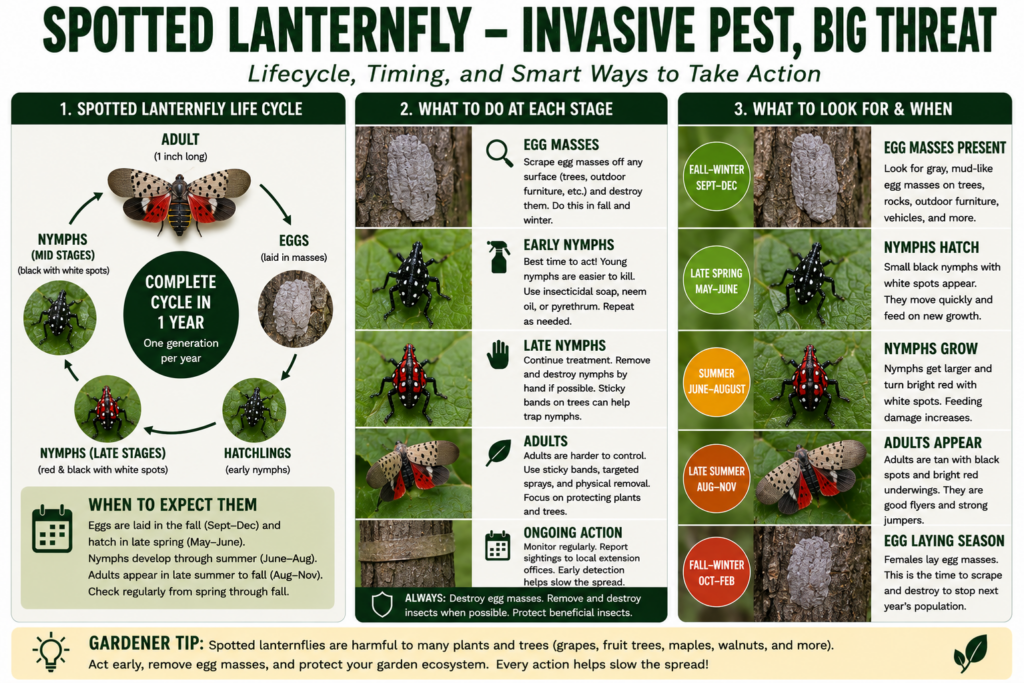
Spotted lanternfly overwinters as egg masses. Eggs hatch in spring. Nymphs appear through late spring and summer. Adults appear later in summer. Egg masses are laid in fall and can remain through winter.
This pest is one of the clearest examples of why a lifecycle photo set matters.
What to do by stage
In fall through spring, look for egg masses on outdoor surfaces such as trees, stones, vehicles, patio furniture, and other hard surfaces.
In spring and summer, watch for nymphs. Early nymphs are black with white spots. Later nymphs show red and black coloring with white spots.
In late summer and fall, watch for adults with gray spotted wings.
Check current Virginia guidance. Some areas may have established populations, while others may still request reports.
Best first move
Photograph it clearly and check current Virginia guidance.
Organic or physical treatment options
Destroy egg masses when appropriate. Destroy nymphs and adults when found. Check outdoor items before moving them from infested areas.
Chemical treatment options
Because spotted lanternfly can involve trees, property edges, vineyards, and larger-scale management, chemical control should follow current state and Extension guidance. This is a pest where local recommendations matter.
Beginner tip
Spotted lanternfly is not just a garden pest. It is a community pest. When in doubt, check current Virginia guidance or contact your local Extension office.
Organic Does Not Mean “Spray Freely”
This is worth repeating.
Organic pesticides can still harm beneficial insects. They can still burn leaves. They can still be misused. They can still create problems if applied at the wrong time.
A good rule:
Use organic sprays like medicine, not perfume.
Apply only when needed.
Target the pest.
Avoid flowers.
Avoid pollinator activity.
Avoid heat stress.
Follow the label.
If the pest can be removed by hand, water, pruning, or timing, start there.
Chemical Does Not Mean “Evil”
It is also important to be fair.
Some gardeners hear the word “chemical” and immediately think “bad.” But the more useful question is not whether something sounds natural or synthetic.
The better question is:
Is this the right tool, used correctly, at the right time, for the right reason?
There are situations where a labeled chemical control may be part of a responsible plan. But it should not be casual. It should not be broad. It should not be used because we are afraid.
Strong tools require strong judgment.
The garden does not reward panic.
It rewards attention.
Protect the Helpers
A garden is not only made of pests.
It is also made of helpers.
Lady beetles eat aphids.
Lacewing larvae hunt soft-bodied pests.
Parasitic wasps attack hornworms and other caterpillars.
Bees pollinate squash, cucumbers, melons, berries, fruit trees, and many other crops.
If you spray broadly without thinking, you may kill the help along with the problem.
That can make the garden more dependent on sprays later.
Before using any product, ask:
Are flowers open?
Are bees active?
Are beneficial insects present?
Can I treat only the affected area?
Can I wait until pollinators are less active?
Is there a non-spray option?
A garden that protects its helpers becomes stronger over time.
The Before-You-Spray Checklist
Before using any pesticide, organic or chemical, walk through this checklist.
- Did I identify the bug?
If not, stop.
- Do I know its life stage?
Egg, nymph, larva, adult, damage, or disease sign?
- Is the bug actually causing serious damage?
A few holes may not require treatment.
- Is the plant still growing well?
Healthy plants can often tolerate minor damage.
- Are beneficial insects already helping?
If yes, avoid broad treatment.
- Can I remove the pest physically?
Try water spray, hand-picking, egg removal, pruning, or row cover first.
- Is the pest in the right life stage for treatment?
Young caterpillars may respond to Bt. Adult squash bugs may be harder to manage. Borers inside stems are harder to reach.
- Is the plant blooming?
Protect pollinators.
- Is the plant heat-stressed or drought-stressed?
Do not add spray stress to plant stress.
- Did I read the label?
Read it every time.
- Did I log what I did?
Write it down so you know whether it worked.
That last question matters.
Because next season, you will not remember everything.
A note today becomes a better decision later.
The Garden Bug Ledger: Treatment Edition
Your first bug ledger helps identify the pest.
Your second layer tracks what worked.
Use this simple format:
| Date | Plant | Pest Stage | Action Taken | Result After 2–3 Days | Next Step |
|---|---|---|---|---|---|
| June 10 | Pepper | Small aphid colony | Sprayed with water | Fewer aphids next day | Check again tomorrow |
| June 15 | Tomato | Large hornworm | Hand-picked | No new damage | Keep scouting |
| June 18 | Zucchini | Squash bug eggs | Removed eggs from underside of leaf | Found more eggs two days later | Check twice weekly |
| June 25 | Cucumber | Striped cucumber beetles on young plant | Added row cover | Less feeding | Remove at flowering |
| July 10 | Grape vine | Possible spotted lanternfly nymph | Photographed and checked guidance | Confirmed ID | Follow local recommendations |
This turns pest control into a feedback loop.
You are no longer guessing.
You are observing, acting, and learning.
That is how a beginner becomes a gardener.
When Doing Nothing Is the Right Choice
Sometimes the strongest move is restraint.
Do nothing when the insect is beneficial.
Do nothing when damage is minor.
Do nothing when the plant is healthy and still growing.
Do nothing when predators are already present.
Do nothing when you are not sure what the insect is.
Doing nothing does not mean ignoring the garden.
It means observing before escalating.
A calm gardener is not passive.
A calm gardener is precise.
Why This Matters
The point of pest management is not to erase every insect.
That is not possible.
It is also not desirable.
The goal is to protect the productive system.
Some bugs are enemies.
Some are helpers.
Some are warnings.
Some are simply present.
Your job is to learn the difference, understand the timing, and act with care.
Because the wrong action at the wrong time can do more damage than the pest itself.
But the right action at the right stage can save the plant, protect the helpers, and teach you something for next season.
That is real garden skill.
Where This Connects
If you are still trying to identify what you found in the garden, start with the first article in this series:
10 Virginia Garden Bugs That Every New Gardener Should Watch For
If you already know what pest you are dealing with, use this guide to ask the next question:
What stage is it in?
Then choose the least harmful method that actually works.
And if you want to make this easier, keep a Garden Bug Ledger.
Take photos.
Write down dates.
Record what stage you saw.
Track what worked.
A beginner sees a bug.
A gardener identifies it.
A steward learns its cycle.
That is how the garden teaches you to respond instead of react.
Final Thought
Before you spray, pause.
Look at the bug.
Look at the plant.
Look at the damage.
Look at the season.
Ask what stage the pest is in.
Then act with care.
The goal is not to win a war against insects.
The goal is to protect the system that feeds you.
And in a garden, timing is often the difference between panic and wisdom.