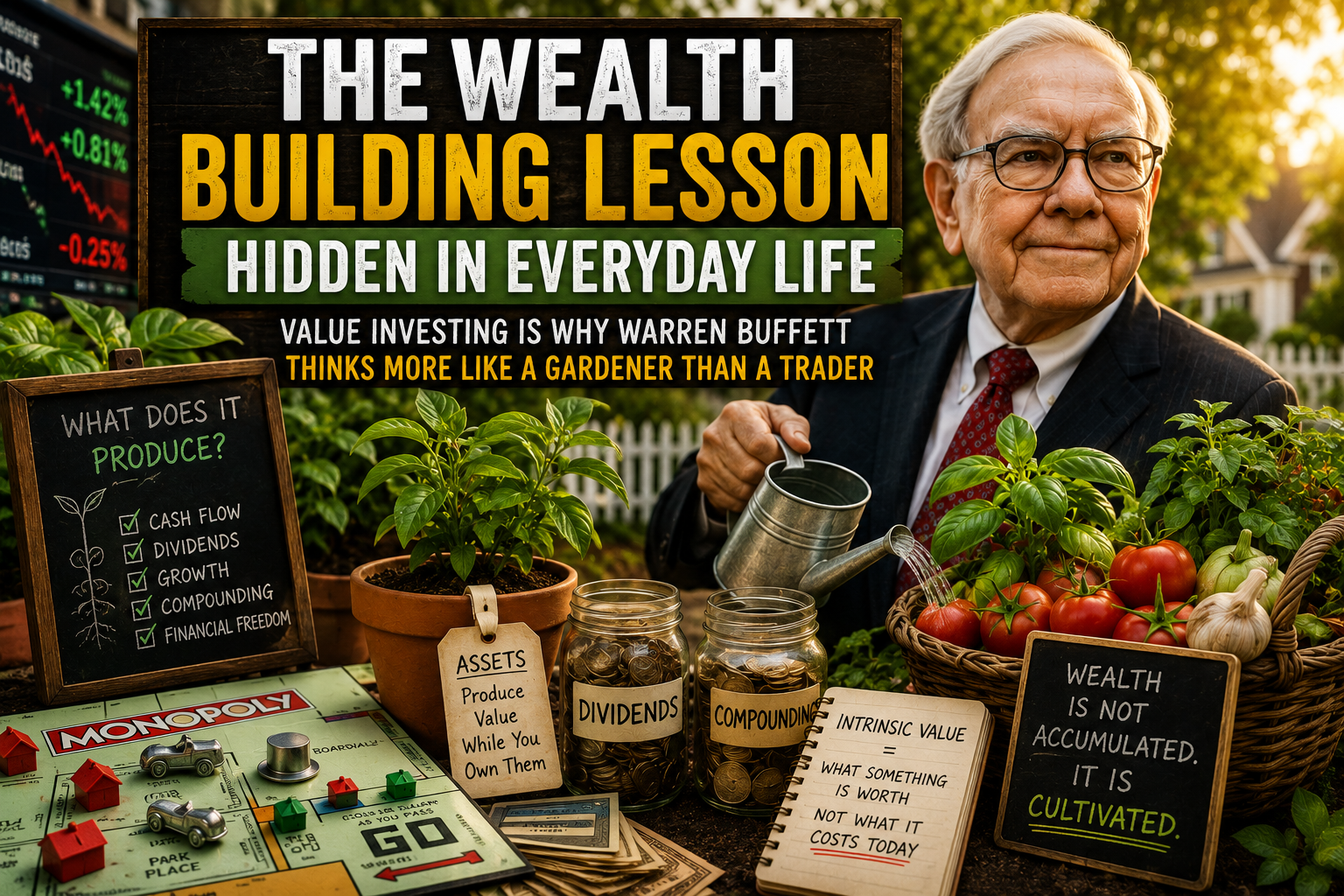
Value Investing is Why Warren Buffett Thinks More Like a Gardener Than a Trader
Before we talk about stocks, dividends, or Warren Buffett, I want to tell you about a paperclip.
Not a valuable paperclip.
Not a rare paperclip.
Just an ordinary red paperclip.
In 2005, a Canadian blogger named Kyle MacDonald began an experiment. He wondered whether he could trade a single red paperclip for something slightly more valuable, then trade that item for something slightly more valuable again.
His first trade was simple.
He exchanged the paperclip for a fish-shaped pen.
Then the pen became a doorknob.
The doorknob became a camping stove.
The camping stove became something else.
Trade after trade, the value increased.
A year later, after fourteen trades, Kyle MacDonald had traded that single red paperclip for a farmhouse in Saskatchewan.
It’s one of the internet’s earliest viral success stories.
🌱 Fun Fact
The project became so famous that it inspired books, TED Talks, and countless “trade up” challenges that still appear on YouTube, TikTok, and social media today.
If you’re curious, search:
“One Red Paperclip – Kyle MacDonald”
It’s a fascinating story.
But it also teaches an important lesson.
Because Kyle was doing something very specific.
He was trading.
Trading vs Investing
Let’s pause and ask a simple question.
When Kyle traded the paperclip for the fish pen, what happened while he owned the fish pen?
Did the fish pen produce another fish pen?
Did it generate income?
Did it become more valuable on its own?
No.
It simply sat there waiting for the next trade.
That isn’t bad.
It’s just a different game.
Trading is the act of exchanging value.
Investing is the act of owning something that produces value.
That difference sounds small.
But it changes everything.
Everyday Trading Examples
Most people trade every day without realizing it.
You trade:
- a loaf of bread for a quart of milk
- an hour of labor for a paycheck
- a baseball card for another card
- cash for groceries
- time for money
Nothing wrong with any of these.
But notice something:
The value only changes when the next transaction happens.
If transactions stop, the system stops.
That’s trading.
Everyday Investing Examples
Now imagine something different.
You buy:
- a lemonade stand
- a fruit tree
- a rental property
- a vending machine
- a dividend-paying stock
- a 401(k)
While you own these things, they can continue producing.
The value isn’t waiting for the next trade.
The value is being created while you sleep.
That is investing.
Monopoly Might Be the Best Investing Game Ever Made
Think about Monopoly.
At the beginning of the game, everyone is mostly trading.
Buying properties.
Selling properties.
Making deals.
Then something changes.
A player buys a property and puts a house on it.
Now that property collects rent.
Suddenly the game shifts.
The property has become an asset.
The player no longer needs to find another trade.
The property produces.
Monopoly quietly teaches one of the most important lessons in investing:
Assets produce.
Traders exchange.
The Garden Version
A garden teaches the same lesson.
Imagine two gardeners.
The first grows roses and ornamental shrubs.
The second grows blueberries, basil, garlic, and tomatoes.
Neither garden is wrong.
But they produce different returns.
The ornamental garden produces beauty.
The edible garden produces food, seeds, herbs, and future harvests.
The key lesson is not:
“One is good and one is bad.”
The lesson is:
Know what kind of return you are expecting.
The same principle applies to investing.
What Is An Asset?
Many people think an asset is simply something valuable.
But that’s not quite right.
A better definition is:
An asset is something that produces value while you own it.
Examples:
- a blueberry bush
- a fruit tree
- a rental property
- a profitable business
- a dividend-paying stock
The important phrase is:
while you own it
The asset continues working.
Dividend Stocks vs Growth Stocks
This is where many new investors get confused.
Imagine two companies.
Company A
Pays no dividend.
The only way you benefit is if the company grows and becomes more valuable in the future.
Many excellent companies work this way.
Amazon spent years reinvesting profits instead of paying dividends.
Company B
Pays a dividend.
Every quarter, money shows up in your account simply because you own shares.
Neither is automatically better.
But dividend stocks are often easier for beginners to understand.
A dividend stock is similar to owning an apple tree.
The tree keeps producing fruit.
You can see the production happening.
Warren Buffett’s Question
Warren Buffett asks a question that gardeners understand naturally:
“What does this produce?”
Let’s use a real example.
Imagine you are standing in a grocery store looking at a jar of Smucker’s strawberry jam.
Most people see breakfast.
Buffett might see something different.
He might see:
The J.M. Smucker Company (NYSE: SJM)
He begins asking questions.
How much jam do they sell?
Are customers loyal?
Are profits growing?
Will people still buy jam ten years from now?
Eventually, he estimates what he believes the business is worth.
Let’s say he thinks it is worth $150 per share.
Then he checks the market.
The stock is selling for $110.
Now things get interesting.
The price says $110.
His analysis says $150.
That gap is where value investing begins.
A Hidden Wealth Moment
The next time you’re in a grocery store, look around.
Smucker’s jam.
Hershey chocolate.
Toothpaste.
Paper towels.
Coffee.
Thousands of products surround you.
Many of the companies behind them are publicly traded.
Most people walk through the store as customers.
Investors sometimes walk through the same store as partial owners.
Once you realize this, the world starts looking different.
The Lifetime Utility Score
This might be the most useful concept in the entire article.
Before buying something, ask:
How often will I use this?
Let’s compare two purchases.
Apple Corer
Cost: $20
Uses: 10
Lifetime Utility Score:
$2 per use
Kitchen Knife
Cost: $20
Uses: 2,000
Lifetime Utility Score:
1 cent per use
Suddenly the knife looks like a much better investment.
Not because it was cheaper.
Because it created more utility over its life.
The Harvest Ratio
The Harvest Ratio takes this idea one step further.
Ask:
How much value will I receive compared to the cost?
This connects directly to what we discussed in our article on the Poor Tax.
A cheaper pair of boots may cost less today.
But if they wear out every year, the Harvest Ratio is poor.
A durable pair may cost more upfront.
But if they last ten years, the Harvest Ratio becomes much better.
The same principle applies to tools, investments, appliances, gardens, and businesses.
What Benjamin Graham and Warren Buffett Really Teach
Benjamin Graham and Warren Buffett didn’t teach people how to guess.
They taught people how to think.
They taught people to ask:
What is this worth?
What does it produce?
How long will it produce it?
Am I paying less than that value?
Those questions work just as well in a garden as they do on Wall Street.
Key Takeaways
Trading
Exchanging value.
Examples:
- bread for milk
- labor for money
- day trading
- baseball cards
Investing
Owning systems that produce value.
Examples:
- fruit trees
- businesses
- rental properties
- 401(k)s
- dividend stocks
Asset
Something that produces value while you own it.
Lifetime Utility Score
How much use do you receive from something over its lifetime?
Harvest Ratio
How much value do you receive compared to what you paid?
Intrinsic Value
What something is truly worth based on what it can produce.
The red paperclip became a farmhouse because Kyle MacDonald kept finding better trades.
A blueberry bush becomes more valuable because it keeps producing.
Both are interesting.
But only one continues creating value while you own it.
That difference is the heart of value investing.
Because wealth is not accumulated.
It is cultivated.What Is Value Investing? A Garden Wealth Lesson
Before we talk about stocks, dividends, or Warren Buffett, I want to tell you about a paperclip.
Not a valuable paperclip.
Not a rare paperclip.
Just an ordinary red paperclip.
In 2005, a Canadian blogger named Kyle MacDonald began an experiment. He wondered whether he could trade a single red paperclip for something slightly more valuable, then trade that item for something slightly more valuable again.
His first trade was simple.
He exchanged the paperclip for a fish-shaped pen.
Then the pen became a doorknob.
The doorknob became a camping stove.
The camping stove became something else.
Trade after trade, the value increased.
A year later, after fourteen trades, Kyle MacDonald had traded that single red paperclip for a farmhouse in Saskatchewan.
It’s one of the internet’s earliest viral success stories.
🌱 Fun Fact
The project became so famous that it inspired books, TED Talks, and countless “trade up” challenges that still appear on YouTube, TikTok, and social media today.
If you’re curious, search:
“One Red Paperclip – Kyle MacDonald”
It’s a fascinating story.
But it also teaches an important lesson.
Because Kyle was doing something very specific.
He was trading.
Trading vs Investing
Let’s pause and ask a simple question.
When Kyle traded the paperclip for the fish pen, what happened while he owned the fish pen?
Did the fish pen produce another fish pen?
Did it generate income?
Did it become more valuable on its own?
No.
It simply sat there waiting for the next trade.
That isn’t bad.
It’s just a different game.
Trading is the act of exchanging value.
Investing is the act of owning something that produces value.
That difference sounds small.
But it changes everything.
Everyday Trading Examples
Most people trade every day without realizing it.
You trade:
- a loaf of bread for a quart of milk
- an hour of labor for a paycheck
- a baseball card for another card
- cash for groceries
- time for money
Nothing wrong with any of these.
But notice something:
The value only changes when the next transaction happens.
If transactions stop, the system stops.
That’s trading.
Everyday Investing Examples
Now imagine something different.
You buy:
- a lemonade stand
- a fruit tree
- a rental property
- a vending machine
- a dividend-paying stock
- a 401(k)
While you own these things, they can continue producing.
The value isn’t waiting for the next trade.
The value is being created while you sleep.
That is investing.
Monopoly Might Be the Best Investing Game Ever Made
Think about Monopoly.
At the beginning of the game, everyone is mostly trading.
Buying properties.
Selling properties.
Making deals.
Then something changes.
A player buys a property and puts a house on it.
Now that property collects rent.
Suddenly the game shifts.
The property has become an asset.
The player no longer needs to find another trade.
The property produces.
Monopoly quietly teaches one of the most important lessons in investing:
Assets produce.
Traders exchange.
The Garden Version
A garden teaches the same lesson.
Imagine two gardeners.
The first grows roses and ornamental shrubs.
The second grows blueberries, basil, garlic, and tomatoes.
Neither garden is wrong.
But they produce different returns.
The ornamental garden produces beauty.
The edible garden produces food, seeds, herbs, and future harvests.
The key lesson is not:
“One is good and one is bad.”
The lesson is:
Know what kind of return you are expecting.
The same principle applies to investing.
What Is An Asset?
Many people think an asset is simply something valuable.
But that’s not quite right.
A better definition is:
An asset is something that produces value while you own it.
Examples:
- a blueberry bush
- a fruit tree
- a rental property
- a profitable business
- a dividend-paying stock
The important phrase is:
while you own it
The asset continues working.
Dividend Stocks vs Growth Stocks
This is where many new investors get confused.
Imagine two companies.
Company A
Pays no dividend.
The only way you benefit is if the company grows and becomes more valuable in the future.
Many excellent companies work this way.
Amazon spent years reinvesting profits instead of paying dividends.
Company B
Pays a dividend.
Every quarter, money shows up in your account simply because you own shares.
Neither is automatically better.
But dividend stocks are often easier for beginners to understand.
A dividend stock is similar to owning an apple tree.
The tree keeps producing fruit.
You can see the production happening.
Warren Buffett’s Question
Warren Buffett asks a question that gardeners understand naturally:
“What does this produce?”
Let’s use a real example.
Imagine you are standing in a grocery store looking at a jar of Smucker’s strawberry jam.
Most people see breakfast.
Buffett might see something different.
He might see:
The J.M. Smucker Company (NYSE: SJM)
He begins asking questions.
How much jam do they sell?
Are customers loyal?
Are profits growing?
Will people still buy jam ten years from now?
Eventually, he estimates what he believes the business is worth.
Let’s say he thinks it is worth $150 per share.
Then he checks the market.
The stock is selling for $110.
Now things get interesting.
The price says $110.
His analysis says $150.
That gap is where value investing begins.
A Hidden Wealth Moment
The next time you’re in a grocery store, look around.
Smucker’s jam.
Hershey chocolate.
Toothpaste.
Paper towels.
Coffee.
Thousands of products surround you.
Many of the companies behind them are publicly traded.
Most people walk through the store as customers.
Investors sometimes walk through the same store as partial owners.
Once you realize this, the world starts looking different.
The Lifetime Utility Score
This might be the most useful concept in the entire article.
Before buying something, ask:
How often will I use this?
Let’s compare two purchases.
Apple Corer
Cost: $20
Uses: 10
Lifetime Utility Score:
$2 per use
Kitchen Knife
Cost: $20
Uses: 2,000
Lifetime Utility Score:
1 cent per use
Suddenly the knife looks like a much better investment.
Not because it was cheaper.
Because it created more utility over its life.
The Harvest Ratio
The Harvest Ratio takes this idea one step further.
Ask:
How much value will I receive compared to the cost?
This connects directly to what we discussed in our article on the Poor Tax.
A cheaper pair of boots may cost less today.
But if they wear out every year, the Harvest Ratio is poor.
A durable pair may cost more upfront.
But if they last ten years, the Harvest Ratio becomes much better.
The same principle applies to tools, investments, appliances, gardens, and businesses.
What Benjamin Graham and Warren Buffett Really Teach
Benjamin Graham and Warren Buffett didn’t teach people how to guess.
They taught people how to think.
They taught people to ask:
What is this worth?
What does it produce?
How long will it produce it?
Am I paying less than that value?
Those questions work just as well in a garden as they do on Wall Street.
Key Takeaways
Trading
Exchanging value.
Examples:
- bread for milk
- labor for money
- day trading
- baseball cards
Investing
Owning systems that produce value.
Examples:
- fruit trees
- businesses
- rental properties
- 401(k)s
- dividend stocks
Asset
Something that produces value while you own it.
Lifetime Utility Score
How much use do you receive from something over its lifetime?
Harvest Ratio
How much value do you receive compared to what you paid?
Intrinsic Value
What something is truly worth based on what it can produce.
The red paperclip became a farmhouse because Kyle MacDonald kept finding better trades.
A blueberry bush becomes more valuable because it keeps producing.
Both are interesting.
But only one continues creating value while you own it.
That difference is the heart of value investing.
Because wealth is not accumulated.
It is cultivated.What Is Value Investing? A Garden Wealth Lesson
Before we talk about stocks, dividends, or Warren Buffett, I want to tell you about a paperclip.
Not a valuable paperclip.
Not a rare paperclip.
Just an ordinary red paperclip.
In 2005, a Canadian blogger named Kyle MacDonald began an experiment. He wondered whether he could trade a single red paperclip for something slightly more valuable, then trade that item for something slightly more valuable again.
His first trade was simple.
He exchanged the paperclip for a fish-shaped pen.
Then the pen became a doorknob.
The doorknob became a camping stove.
The camping stove became something else.
Trade after trade, the value increased.
A year later, after fourteen trades, Kyle MacDonald had traded that single red paperclip for a farmhouse in Saskatchewan.
It’s one of the internet’s earliest viral success stories.
🌱 Fun Fact
The project became so famous that it inspired books, TED Talks, and countless “trade up” challenges that still appear on YouTube, TikTok, and social media today.
If you’re curious, search:
“One Red Paperclip – Kyle MacDonald”
It’s a fascinating story.
But it also teaches an important lesson.
Because Kyle was doing something very specific.
He was trading.
Trading vs Investing
Let’s pause and ask a simple question.
When Kyle traded the paperclip for the fish pen, what happened while he owned the fish pen?
Did the fish pen produce another fish pen?
Did it generate income?
Did it become more valuable on its own?
No.
It simply sat there waiting for the next trade.
That isn’t bad.
It’s just a different game.
Trading is the act of exchanging value.
Investing is the act of owning something that produces value.
That difference sounds small.
But it changes everything.
Everyday Trading Examples
Most people trade every day without realizing it.
You trade:
- a loaf of bread for a quart of milk
- an hour of labor for a paycheck
- a baseball card for another card
- cash for groceries
- time for money
Nothing wrong with any of these.
But notice something:
The value only changes when the next transaction happens.
If transactions stop, the system stops.
That’s trading.
Everyday Investing Examples
Now imagine something different.
You buy:
- a lemonade stand
- a fruit tree
- a rental property
- a vending machine
- a dividend-paying stock
- a 401(k)
While you own these things, they can continue producing.
The value isn’t waiting for the next trade.
The value is being created while you sleep.
That is investing.
Monopoly Might Be the Best Investing Game Ever Made
Think about Monopoly.
At the beginning of the game, everyone is mostly trading.
Buying properties.
Selling properties.
Making deals.
Then something changes.
A player buys a property and puts a house on it.
Now that property collects rent.
Suddenly the game shifts.
The property has become an asset.
The player no longer needs to find another trade.
The property produces.
Monopoly quietly teaches one of the most important lessons in investing:
Assets produce.
Traders exchange.
The Garden Version
A garden teaches the same lesson.
Imagine two gardeners.
The first grows roses and ornamental shrubs.
The second grows blueberries, basil, garlic, and tomatoes.
Neither garden is wrong.
But they produce different returns.
The ornamental garden produces beauty.
The edible garden produces food, seeds, herbs, and future harvests.
The key lesson is not:
“One is good and one is bad.”
The lesson is:
Know what kind of return you are expecting.
The same principle applies to investing.
What Is An Asset?
Many people think an asset is simply something valuable.
But that’s not quite right.
A better definition is:
An asset is something that produces value while you own it.
Examples:
- a blueberry bush
- a fruit tree
- a rental property
- a profitable business
- a dividend-paying stock
The important phrase is:
while you own it
The asset continues working.
Dividend Stocks vs Growth Stocks
This is where many new investors get confused.
Imagine two companies.
Company A
Pays no dividend.
The only way you benefit is if the company grows and becomes more valuable in the future.
Many excellent companies work this way.
Amazon spent years reinvesting profits instead of paying dividends.
Company B
Pays a dividend.
Every quarter, money shows up in your account simply because you own shares.
Neither is automatically better.
But dividend stocks are often easier for beginners to understand.
A dividend stock is similar to owning an apple tree.
The tree keeps producing fruit.
You can see the production happening.
Warren Buffett’s Question
Warren Buffett asks a question that gardeners understand naturally:
“What does this produce?”
Let’s use a real example.
Imagine you are standing in a grocery store looking at a jar of Smucker’s strawberry jam.
Most people see breakfast.
Buffett might see something different.
He might see:
The J.M. Smucker Company (NYSE: SJM)
He begins asking questions.
How much jam do they sell?
Are customers loyal?
Are profits growing?
Will people still buy jam ten years from now?
Eventually, he estimates what he believes the business is worth.
Let’s say he thinks it is worth $150 per share.
Then he checks the market.
The stock is selling for $110.
Now things get interesting.
The price says $110.
His analysis says $150.
That gap is where value investing begins.
A Hidden Wealth Moment
The next time you’re in a grocery store, look around.
Smucker’s jam.
Hershey chocolate.
Toothpaste.
Paper towels.
Coffee.
Thousands of products surround you.
Many of the companies behind them are publicly traded.
Most people walk through the store as customers.
Investors sometimes walk through the same store as partial owners.
Once you realize this, the world starts looking different.
The Lifetime Utility Score
This might be the most useful concept in the entire article.
Before buying something, ask:
How often will I use this?
Let’s compare two purchases.
Apple Corer
Cost: $20
Uses: 10
Lifetime Utility Score:
$2 per use
Kitchen Knife
Cost: $20
Uses: 2,000
Lifetime Utility Score:
1 cent per use
Suddenly the knife looks like a much better investment.
Not because it was cheaper.
Because it created more utility over its life.
The Harvest Ratio
The Harvest Ratio takes this idea one step further.
Ask:
How much value will I receive compared to the cost?
This connects directly to what we discussed in our article on the Poor Tax.
A cheaper pair of boots may cost less today.
But if they wear out every year, the Harvest Ratio is poor.
A durable pair may cost more upfront.
But if they last ten years, the Harvest Ratio becomes much better.
The same principle applies to tools, investments, appliances, gardens, and businesses.
What Benjamin Graham and Warren Buffett Really Teach
Benjamin Graham and Warren Buffett didn’t teach people how to guess.
They taught people how to think.
They taught people to ask:
What is this worth?
What does it produce?
How long will it produce it?
Am I paying less than that value?
Those questions work just as well in a garden as they do on Wall Street.
Key Takeaways
Trading
Exchanging value.
Examples:
- bread for milk
- labor for money
- day trading
- baseball cards
Investing
Owning systems that produce value.
Examples:
- fruit trees
- businesses
- rental properties
- 401(k)s
- dividend stocks
Asset
Something that produces value while you own it.
Lifetime Utility Score
How much use do you receive from something over its lifetime?
Harvest Ratio
How much value do you receive compared to what you paid?
Intrinsic Value
What something is truly worth based on what it can produce.
The red paperclip became a farmhouse because Kyle MacDonald kept finding better trades.
A blueberry bush becomes more valuable because it keeps producing.
Both are interesting.
But only one continues creating value while you own it.
That difference is the heart of value investing.
Because wealth is not accumulated.
It is cultivated.
What Is Value Investing? A Garden Wealth Lesson
Before we talk about stocks, dividends, or Warren Buffett, I want to tell you about a paperclip.
Not a valuable paperclip.
Not a rare paperclip.
Just an ordinary red paperclip.
In 2005, a Canadian blogger named Kyle MacDonald began an experiment. He wondered whether he could trade a single red paperclip for something slightly more valuable, then trade that item for something slightly more valuable again.
His first trade was simple.
He exchanged the paperclip for a fish-shaped pen.
Then the pen became a doorknob.
The doorknob became a camping stove.
The camping stove became something else.
Trade after trade, the value increased.
A year later, after fourteen trades, Kyle MacDonald had traded that single red paperclip for a farmhouse in Saskatchewan.
It’s one of the internet’s earliest viral success stories.
🌱 Fun Fact
The project became so famous that it inspired books, TED Talks, and countless “trade up” challenges that still appear on YouTube, TikTok, and social media today.
If you’re curious, search:
“One Red Paperclip – Kyle MacDonald”
It’s a fascinating story.
But it also teaches an important lesson.
Because Kyle was doing something very specific.
He was trading.
Trading vs Investing
Let’s pause and ask a simple question.
When Kyle traded the paperclip for the fish pen, what happened while he owned the fish pen?
Did the fish pen produce another fish pen?
Did it generate income?
Did it become more valuable on its own?
No.
It simply sat there waiting for the next trade.
That isn’t bad.
It’s just a different game.
Trading is the act of exchanging value.
Investing is the act of owning something that produces value.
That difference sounds small.
But it changes everything.
Everyday Trading Examples
Most people trade every day without realizing it.
You trade:
- a loaf of bread for a quart of milk
- an hour of labor for a paycheck
- a baseball card for another card
- cash for groceries
- time for money
Nothing wrong with any of these.
But notice something:
The value only changes when the next transaction happens.
If transactions stop, the system stops.
That’s trading.
Everyday Investing Examples
Now imagine something different.
You buy:
- a lemonade stand
- a fruit tree
- a rental property
- a vending machine
- a dividend-paying stock
- a 401(k)
While you own these things, they can continue producing.
The value isn’t waiting for the next trade.
The value is being created while you sleep.
That is investing.
Monopoly Might Be the Best Investing Game Ever Made
Think about Monopoly.
At the beginning of the game, everyone is mostly trading.
Buying properties.
Selling properties.
Making deals.
Then something changes.
A player buys a property and puts a house on it.
Now that property collects rent.
Suddenly the game shifts.
The property has become an asset.
The player no longer needs to find another trade.
The property produces.
Monopoly quietly teaches one of the most important lessons in investing:
Assets produce.
Traders exchange.
The Garden Version
A garden teaches the same lesson.
Imagine two gardeners.
The first grows roses and ornamental shrubs.
The second grows blueberries, basil, garlic, and tomatoes.
Neither garden is wrong.
But they produce different returns.
The ornamental garden produces beauty.
The edible garden produces food, seeds, herbs, and future harvests.
The key lesson is not:
“One is good and one is bad.”
The lesson is:
Know what kind of return you are expecting.
The same principle applies to investing.
What Is An Asset?
Many people think an asset is simply something valuable.
But that’s not quite right.
A better definition is:
An asset is something that produces value while you own it.
Examples:
- a blueberry bush
- a fruit tree
- a rental property
- a profitable business
- a dividend-paying stock
The important phrase is:
while you own it
The asset continues working.
Dividend Stocks vs Growth Stocks
This is where many new investors get confused.
Imagine two companies.
Company A
Pays no dividend.
The only way you benefit is if the company grows and becomes more valuable in the future.
Many excellent companies work this way.
Amazon spent years reinvesting profits instead of paying dividends.
Company B
Pays a dividend.
Every quarter, money shows up in your account simply because you own shares.
Neither is automatically better.
But dividend stocks are often easier for beginners to understand.
A dividend stock is similar to owning an apple tree.
The tree keeps producing fruit.
You can see the production happening.
Warren Buffett’s Question
Warren Buffett asks a question that gardeners understand naturally:
“What does this produce?”
Let’s use a real example.
Imagine you are standing in a grocery store looking at a jar of Smucker’s strawberry jam.
Most people see breakfast.
Buffett might see something different.
He might see:
The J.M. Smucker Company (NYSE: SJM)
He begins asking questions.
How much jam do they sell?
Are customers loyal?
Are profits growing?
Will people still buy jam ten years from now?
Eventually, he estimates what he believes the business is worth.
Let’s say he thinks it is worth $150 per share.
Then he checks the market.
The stock is selling for $110.
Now things get interesting.
The price says $110.
His analysis says $150.
That gap is where value investing begins.
A Hidden Wealth Moment
The next time you’re in a grocery store, look around.
Smucker’s jam.
Hershey chocolate.
Toothpaste.
Paper towels.
Coffee.
Thousands of products surround you.
Many of the companies behind them are publicly traded.
Most people walk through the store as customers.
Investors sometimes walk through the same store as partial owners.
Once you realize this, the world starts looking different.
The Lifetime Utility Score
This might be the most useful concept in the entire article.
Before buying something, ask:
How often will I use this?
Let’s compare two purchases.
Apple Corer
Cost: $20
Uses: 10
Lifetime Utility Score:
$2 per use
Kitchen Knife
Cost: $20
Uses: 2,000
Lifetime Utility Score:
1 cent per use
Suddenly the knife looks like a much better investment.
Not because it was cheaper.
Because it created more utility over its life.
The Harvest Ratio
The Harvest Ratio takes this idea one step further.
Ask:
How much value will I receive compared to the cost?
This connects directly to what we discussed in our article on the Poor Tax.
A cheaper pair of boots may cost less today.
But if they wear out every year, the Harvest Ratio is poor.
A durable pair may cost more upfront.
But if they last ten years, the Harvest Ratio becomes much better.
The same principle applies to tools, investments, appliances, gardens, and businesses.
What Benjamin Graham and Warren Buffett Really Teach
Benjamin Graham and Warren Buffett didn’t teach people how to guess.
They taught people how to think.
They taught people to ask:
What is this worth?
What does it produce?
How long will it produce it?
Am I paying less than that value?
Those questions work just as well in a garden as they do on Wall Street.
Key Takeaways
Trading
Exchanging value.
Examples:
- bread for milk
- labor for money
- day trading
- baseball cards
Investing
Owning systems that produce value.
Examples:
- fruit trees
- businesses
- rental properties
- 401(k)s
- dividend stocks
Asset
Something that produces value while you own it.
Lifetime Utility Score
How much use do you receive from something over its lifetime?
Harvest Ratio
How much value do you receive compared to what you paid?
Intrinsic Value
What something is truly worth based on what it can produce.
The red paperclip became a farmhouse because Kyle MacDonald kept finding better trades.
A blueberry bush becomes more valuable because it keeps producing.
Both are interesting.
But only one continues creating value while you own it.
That difference is the heart of value investing.
Because wealth is not accumulated.
It is cultivated.
Before we talk about stocks, dividends, or Warren Buffett, I want to tell you about a paperclip.
Not a valuable paperclip.
Not a rare paperclip.
Just an ordinary red paperclip.
In 2005, a Canadian blogger named Kyle MacDonald began an experiment. He wondered whether he could trade a single red paperclip for something slightly more valuable, then trade that item for something slightly more valuable again.
His first trade was simple.
He exchanged the paperclip for a fish-shaped pen.
Then the pen became a doorknob.
The doorknob became a camping stove.
The camping stove became something else.
Trade after trade, the value increased.
A year later, after fourteen trades, Kyle MacDonald had traded that single red paperclip for a farmhouse in Saskatchewan.
It’s one of the internet’s earliest viral success stories.
🌱 Fun Fact
The project became so famous that it inspired books, TED Talks, and countless “trade up” challenges that still appear on YouTube, TikTok, and social media today.
If you’re curious, search:
“One Red Paperclip – Kyle MacDonald”
It’s a fascinating story.
But it also teaches an important lesson.
Because Kyle was doing something very specific.
He was trading.
Trading vs Investing
Let’s pause and ask a simple question.
When Kyle traded the paperclip for the fish pen, what happened while he owned the fish pen?
Did the fish pen produce another fish pen?
Did it generate income?
Did it become more valuable on its own?
No.
It simply sat there waiting for the next trade.
That isn’t bad.
It’s just a different game.
Trading is the act of exchanging value.
Investing is the act of owning something that produces value.
That difference sounds small.
But it changes everything.
Everyday Trading Examples
Most people trade every day without realizing it.
You trade:
- a loaf of bread for a quart of milk
- an hour of labor for a paycheck
- a baseball card for another card
- cash for groceries
- time for money
Nothing wrong with any of these.
But notice something:
The value only changes when the next transaction happens.
If transactions stop, the system stops.
That’s trading.
Everyday Investing Examples
Now imagine something different.
You buy:
- a lemonade stand
- a fruit tree
- a rental property
- a vending machine
- a dividend-paying stock
- a 401(k)
While you own these things, they can continue producing.
The value isn’t waiting for the next trade.
The value is being created while you sleep.
That is investing.
Monopoly Might Be the Best Investing Game Ever Made
Think about Monopoly.
At the beginning of the game, everyone is mostly trading.
Buying properties.
Selling properties.
Making deals.
Then something changes.
A player buys a property and puts a house on it.
Now that property collects rent.
Suddenly the game shifts.
The property has become an asset.
The player no longer needs to find another trade.
The property produces.
Monopoly quietly teaches one of the most important lessons in investing:
Assets produce.
Traders exchange.
The Garden Version
A garden teaches the same lesson.
Imagine two gardeners.
The first grows roses and ornamental shrubs.
The second grows blueberries, basil, garlic, and tomatoes.
Neither garden is wrong.
But they produce different returns.
The ornamental garden produces beauty.
The edible garden produces food, seeds, herbs, and future harvests.
The key lesson is not:
“One is good and one is bad.”
The lesson is:
Know what kind of return you are expecting.
The same principle applies to investing.
What Is An Asset?
Many people think an asset is simply something valuable.
But that’s not quite right.
A better definition is:
An asset is something that produces value while you own it.
Examples:
- a blueberry bush
- a fruit tree
- a rental property
- a profitable business
- a dividend-paying stock
The important phrase is:
while you own it
The asset continues working.
Dividend Stocks vs Growth Stocks
This is where many new investors get confused.
Imagine two companies.
Company A
Pays no dividend.
The only way you benefit is if the company grows and becomes more valuable in the future.
Many excellent companies work this way.
Amazon spent years reinvesting profits instead of paying dividends.
Company B
Pays a dividend.
Every quarter, money shows up in your account simply because you own shares.
Neither is automatically better.
But dividend stocks are often easier for beginners to understand.
A dividend stock is similar to owning an apple tree.
The tree keeps producing fruit.
You can see the production happening.
Warren Buffett’s Question
Warren Buffett asks a question that gardeners understand naturally:
“What does this produce?”
Let’s use a real example.
Imagine you are standing in a grocery store looking at a jar of Smucker’s strawberry jam.
Most people see breakfast.
Buffett might see something different.
He might see:
The J.M. Smucker Company (NYSE: SJM)
He begins asking questions.
How much jam do they sell?
Are customers loyal?
Are profits growing?
Will people still buy jam ten years from now?
Eventually, he estimates what he believes the business is worth.
Let’s say he thinks it is worth $150 per share.
Then he checks the market.
The stock is selling for $110.
Now things get interesting.
The price says $110.
His analysis says $150.
That gap is where value investing begins.
A Hidden Wealth Moment
The next time you’re in a grocery store, look around.
Smucker’s jam.
Hershey chocolate.
Toothpaste.
Paper towels.
Coffee.
Thousands of products surround you.
Many of the companies behind them are publicly traded.
Most people walk through the store as customers.
Investors sometimes walk through the same store as partial owners.
Once you realize this, the world starts looking different.
The Lifetime Utility Score
This might be the most useful concept in the entire article.
Before buying something, ask:
How often will I use this?
Let’s compare two purchases.
Apple Corer
Cost: $20
Uses: 10
Lifetime Utility Score:
$2 per use
Kitchen Knife
Cost: $20
Uses: 2,000
Lifetime Utility Score:
1 cent per use
Suddenly the knife looks like a much better investment.
Not because it was cheaper.
Because it created more utility over its life.
The Harvest Ratio
The Harvest Ratio takes this idea one step further.
Ask:
How much value will I receive compared to the cost?
This connects directly to what we discussed in our article on the Poor Tax.
A cheaper pair of boots may cost less today.
But if they wear out every year, the Harvest Ratio is poor.
A durable pair may cost more upfront.
But if they last ten years, the Harvest Ratio becomes much better.
The same principle applies to tools, investments, appliances, gardens, and businesses.
What Benjamin Graham and Warren Buffett Really Teach
Benjamin Graham and Warren Buffett didn’t teach people how to guess.
They taught people how to think.
They taught people to ask:
What is this worth?
What does it produce?
How long will it produce it?
Am I paying less than that value?
Those questions work just as well in a garden as they do on Wall Street.
Key Takeaways
Trading
Exchanging value.
Examples:
- bread for milk
- labor for money
- day trading
- baseball cards
Investing
Owning systems that produce value.
Examples:
- fruit trees
- businesses
- rental properties
- 401(k)s
- dividend stocks
Asset
Something that produces value while you own it.
Lifetime Utility Score
How much use do you receive from something over its lifetime?
Harvest Ratio
How much value do you receive compared to what you paid?
Intrinsic Value
What something is truly worth based on what it can produce.
The red paperclip became a farmhouse because Kyle MacDonald kept finding better trades.
A blueberry bush becomes more valuable because it keeps producing.
Both are interesting.
But only one continues creating value while you own it.
That difference is the heart of value investing.
Because wealth is not accumulated.
It is cultivated.
What Is Value Investing? A Garden Wealth Lesson
Before we talk about stocks, dividends, or Warren Buffett, I want to tell you about a paperclip.
Not a valuable paperclip.
Not a rare paperclip.
Just an ordinary red paperclip.
In 2005, a Canadian blogger named Kyle MacDonald began an experiment. He wondered whether he could trade a single red paperclip for something slightly more valuable, then trade that item for something slightly more valuable again.
His first trade was simple.
He exchanged the paperclip for a fish-shaped pen.
Then the pen became a doorknob.
The doorknob became a camping stove.
The camping stove became something else.
Trade after trade, the value increased.
A year later, after fourteen trades, Kyle MacDonald had traded that single red paperclip for a farmhouse in Saskatchewan.
It’s one of the internet’s earliest viral success stories.
🌱 Fun Fact
The project became so famous that it inspired books, TED Talks, and countless “trade up” challenges that still appear on YouTube, TikTok, and social media today.
If you’re curious, search:
“One Red Paperclip – Kyle MacDonald”
It’s a fascinating story.
But it also teaches an important lesson.
Because Kyle was doing something very specific.
He was trading.
Trading vs Investing
Let’s pause and ask a simple question.
When Kyle traded the paperclip for the fish pen, what happened while he owned the fish pen?
Did the fish pen produce another fish pen?
Did it generate income?
Did it become more valuable on its own?
No.
It simply sat there waiting for the next trade.
That isn’t bad.
It’s just a different game.
Trading is the act of exchanging value.
Investing is the act of owning something that produces value.
That difference sounds small.
But it changes everything.
Everyday Trading Examples
Most people trade every day without realizing it.
You trade:
- a loaf of bread for a quart of milk
- an hour of labor for a paycheck
- a baseball card for another card
- cash for groceries
- time for money
Nothing wrong with any of these.
But notice something:
The value only changes when the next transaction happens.
If transactions stop, the system stops.
That’s trading.
Everyday Investing Examples
Now imagine something different.
You buy:
- a lemonade stand
- a fruit tree
- a rental property
- a vending machine
- a dividend-paying stock
- a 401(k)
While you own these things, they can continue producing.
The value isn’t waiting for the next trade.
The value is being created while you sleep.
That is investing.
Monopoly Might Be the Best Investing Game Ever Made
Think about Monopoly.
At the beginning of the game, everyone is mostly trading.
Buying properties.
Selling properties.
Making deals.
Then something changes.
A player buys a property and puts a house on it.
Now that property collects rent.
Suddenly the game shifts.
The property has become an asset.
The player no longer needs to find another trade.
The property produces.
Monopoly quietly teaches one of the most important lessons in investing:
Assets produce.
Traders exchange.
The Garden Version
A garden teaches the same lesson.
Imagine two gardeners.
The first grows roses and ornamental shrubs.
The second grows blueberries, basil, garlic, and tomatoes.
Neither garden is wrong.
But they produce different returns.
The ornamental garden produces beauty.
The edible garden produces food, seeds, herbs, and future harvests.
The key lesson is not:
“One is good and one is bad.”
The lesson is:
Know what kind of return you are expecting.
The same principle applies to investing.
What Is An Asset?
Many people think an asset is simply something valuable.
But that’s not quite right.
A better definition is:
An asset is something that produces value while you own it.
Examples:
- a blueberry bush
- a fruit tree
- a rental property
- a profitable business
- a dividend-paying stock
The important phrase is:
while you own it
The asset continues working.
Dividend Stocks vs Growth Stocks
This is where many new investors get confused.
Imagine two companies.
Company A
Pays no dividend.
The only way you benefit is if the company grows and becomes more valuable in the future.
Many excellent companies work this way.
Amazon spent years reinvesting profits instead of paying dividends.
Company B
Pays a dividend.
Every quarter, money shows up in your account simply because you own shares.
Neither is automatically better.
But dividend stocks are often easier for beginners to understand.
A dividend stock is similar to owning an apple tree.
The tree keeps producing fruit.
You can see the production happening.
Warren Buffett’s Question
Warren Buffett asks a question that gardeners understand naturally:
“What does this produce?”
Let’s use a real example.
Imagine you are standing in a grocery store looking at a jar of Smucker’s strawberry jam.
Most people see breakfast.
Buffett might see something different.
He might see:
The J.M. Smucker Company (NYSE: SJM)
He begins asking questions.
How much jam do they sell?
Are customers loyal?
Are profits growing?
Will people still buy jam ten years from now?
Eventually, he estimates what he believes the business is worth.
Let’s say he thinks it is worth $150 per share.
Then he checks the market.
The stock is selling for $110.
Now things get interesting.
The price says $110.
His analysis says $150.
That gap is where value investing begins.
A Hidden Wealth Moment
The next time you’re in a grocery store, look around.
Smucker’s jam.
Hershey chocolate.
Toothpaste.
Paper towels.
Coffee.
Thousands of products surround you.
Many of the companies behind them are publicly traded.
Most people walk through the store as customers.
Investors sometimes walk through the same store as partial owners.
Once you realize this, the world starts looking different.
The Lifetime Utility Score
This might be the most useful concept in the entire article.
Before buying something, ask:
How often will I use this?
Let’s compare two purchases.
Apple Corer
Cost: $20
Uses: 10
Lifetime Utility Score:
$2 per use
Kitchen Knife
Cost: $20
Uses: 2,000
Lifetime Utility Score:
1 cent per use
Suddenly the knife looks like a much better investment.
Not because it was cheaper.
Because it created more utility over its life.
The Harvest Ratio
The Harvest Ratio takes this idea one step further.
Ask:
How much value will I receive compared to the cost?
This connects directly to what we discussed in our article on the Poor Tax.
A cheaper pair of boots may cost less today.
But if they wear out every year, the Harvest Ratio is poor.
A durable pair may cost more upfront.
But if they last ten years, the Harvest Ratio becomes much better.
The same principle applies to tools, investments, appliances, gardens, and businesses.
What Benjamin Graham and Warren Buffett Really Teach
Benjamin Graham and Warren Buffett didn’t teach people how to guess.
They taught people how to think.
They taught people to ask:
What is this worth?
What does it produce?
How long will it produce it?
Am I paying less than that value?
Those questions work just as well in a garden as they do on Wall Street.
Key Takeaways
Trading
Exchanging value.
Examples:
- bread for milk
- labor for money
- day trading
- baseball cards
Investing
Owning systems that produce value.
Examples:
- fruit trees
- businesses
- rental properties
- 401(k)s
- dividend stocks
Asset
Something that produces value while you own it.
Lifetime Utility Score
How much use do you receive from something over its lifetime?
Harvest Ratio
How much value do you receive compared to what you paid?
Intrinsic Value
What something is truly worth based on what it can produce.
The red paperclip became a farmhouse because Kyle MacDonald kept finding better trades.
A blueberry bush becomes more valuable because it keeps producing.
Both are interesting.
But only one continues creating value while you own it.
That difference is the heart of value investing.
Because wealth is not accumulated.
It is cultivated.