A Professional Kitchen Guide for Choosing, Using, Storing, and Respecting Cooking Fats
Heat With Purpose. Cook With Flavor. Store With Care.
The Cooking Fats Field Guide Promise
This is not just an article about oil.
It is not a diet argument.
It is not a list of “good fats” and “bad fats.”
It is a working kitchen reference for anyone who wants to cook with more skill, more intention, more flavor, and more respect for the ingredients.
A home cook can use this guide to understand when to choose olive oil, when to choose butter, when ghee makes more sense, when a neutral oil is useful, when lard or tallow belongs in the pan, and when toasted sesame oil should be used only as a finishing accent.
A gardener can use this guide to understand how fat turns vegetables into meals: potatoes into crisp roasted wedges, cabbage into satisfying skillet food, herbs into pesto, peppers into chile oil, garlic into compound butter, greens into rich side dishes, and beans into comfort food.
A pantry builder can use this guide to store oils and rendered fats properly, avoid rancid flavors, preserve quality, and know when fat belongs in the refrigerator or freezer.
A safety-minded cook can use this guide to understand garlic-in-oil risk, grease-fire safety, smoke point caution, and why homemade infused oils must be handled carefully.
A Wealth Garden reader can use this guide to understand a major principle in The Gardening Chef system:
Fat is a flavor multiplier.
It does not replace the harvest.
It helps the harvest become a meal.
Save this guide if you want to:
Choose the right fat for low, medium, and high heat.
Understand the difference between extra virgin olive oil, refined olive oil, avocado oil, neutral oil, coconut oil, butter, ghee, lard, tallow, duck fat, bacon grease, schmaltz, sesame oil, nut oils, and flaxseed oil.
Know which fats are best for roasting, sautéing, frying, baking, finishing, dressings, greens, beans, potatoes, brassicas, herbs, and cast iron.
Store oils, butter, lard, tallow, bacon grease, duck fat, schmaltz, nut oils, and infused fats safely.
Avoid serious mistakes with garlic oil and herb-infused oils.
Understand grease-fire safety.
Use fat with purpose instead of habit.
Build a practical cooking fat pantry without buying every oil on the shelf.
Start Here: Choose Your Reading Path
| If you are… | Start with… | You will learn… |
|---|---|---|
| A beginner cook | The Core Lesson: Fat Is a Cooking Tool | Why fat transfers heat, carries flavor, creates texture, and carries tradition. |
| A practical home cook | Heat Guide: Choose by Temperature | Which fats fit low, medium, high heat, and finishing. |
| A flavor builder | Fat and Flavor | How to match fats with potatoes, greens, beans, brassicas, herbs, and peppers. |
| A safety-minded cook | Infused Fats and Grease Fire Safety | Why garlic oil, hot oil, and saved grease require care. |
| A pantry builder | Storage Guide for Cooking Fats | How to store oils and rendered fats so they do not go rancid. |
| A health-conscious reader | The Health and Nutrition Layer | How to use traditional fats and everyday oils with balance. |
| A Wealth Garden reader | Fat as a Flavor Multiplier | How fat helps garden food become memorable meals. |
Cooking Fats Master Index
| Section | Use it when… |
|---|---|
| The Guide Promise | You want the big-picture reason cooking fats matter. |
| Why Cooking Fats Deserve Their Own Guide | You want to understand fat as more than calories or grease. |
| The Core Lesson | You want the four jobs of fat in cooking. |
| Cooking Fats at a Glance | You want a fast comparison chart. |
| Heat Guide | You need to choose a fat by cooking temperature. |
| Meet the Cooking Fats | You want fat-by-fat guidance. |
| The Word “Grease” | You want to understand saved bacon grease and pan drippings. |
| Fat and Flavor | You want to match fat to the harvest. |
| Infused Fats | You need garlic oil and herb oil safety rules. |
| Grease Fire Safety | You need the non-negotiable cooking fire rules. |
| Storage Guide | You want to avoid rancid oils and unsafe storage. |
| Health and Nutrition Layer | You want practical, non-fad guidance. |
| Kitchen Fat Formula | You want to layer cooking fat, flavor fat, and finishing fat. |
| Common Mistakes | You want to avoid the errors that ruin food or create risk. |
| Best Fats by Cooking Job | You want a quick decision table. |
| Wealth Garden Insight | You want the deeper system lesson. |
| Beginner Cooking Fat Pantry | You want a simple starting set. |
| FAQ | You want quick answers to common questions. |
The Cooking Fats Field Guide
Every kitchen has fat.
A bottle of olive oil near the stove.
A stick of butter in the refrigerator.
A jar of bacon grease saved from breakfast.
A tub of lard for pie crust.
A spoonful of ghee melting into a pan.
A slick of sesame oil finishing noodles.
A shimmer of avocado oil before vegetables hit the skillet.
A cast iron pan seasoned by years of meals.
But most people do not think of fat as a system.
They think of it as something added.
A little oil so food does not stick.
A pat of butter for flavor.
A spoonful of grease because Grandma did it that way.
But cooking fat is much more than lubrication.
Fat carries flavor.
Fat controls heat.
Fat creates texture.
Fat preserves tradition.
It is the reason potatoes crisp.
It is the reason herbs bloom.
It is the reason garlic becomes fragrant.
It is the reason fried food browns.
It is the reason sauces become glossy.
It is the reason a simple vegetable can taste finished.
The Cooking Fats Field Guide exists because fat is one of the most important cooking tools a home cook can understand.
Not all fats behave the same.
Some are for raw finishing.
Some are for roasting.
Some are for frying.
Some are for baking.
Some are for seasoning cast iron.
Some are for sauces.
Some are for tradition.
Some should never be overheated.
Some should never be stored carelessly with garlic or fresh herbs.
The goal is not to use more fat.
The goal is to use the right fat, at the right heat, for the right purpose.
Why Cooking Fats Deserve Their Own Field Guide
A potato roasted in olive oil is not the same as a potato fried in lard.
A cabbage sautéed in butter is not the same as cabbage cooked in bacon grease.
A vinaigrette made with extra virgin olive oil does not behave like one made with neutral canola oil.
A curry bloomed in coconut oil carries a different memory than one started in ghee.
A pan of Brussels sprouts browned in duck fat tastes different from one tossed in vegetable oil.
That is the whole lesson.
Fat is not neutral unless you choose a neutral fat.
Fat has character.
It has heat behavior, flavor, texture, storage needs, nutrition considerations, and safety rules.
Even smoke points are not fixed magic numbers. They vary by refinement, age, storage, impurities, food particles, and quality. The practical cook should use categories and sensory feedback instead of treating every bottle like a laboratory constant.
If the fat is smoking heavily, smelling harsh, darkening quickly, or making food taste bitter, the pan is too hot, the oil is worn out, or the fat is being used outside its best role.
This guide is here to help cooks answer practical questions:
Which fat should I use for high heat?
Which fat gives the best flavor?
Which fat belongs in baking?
Which fat belongs in vinaigrette?
Which fat should stay cold?
Which fat stores well?
Which fat goes rancid quickly?
What do I do with bacon grease?
Is homemade garlic oil safe?
What do I do if oil catches fire?
The more you understand fat, the better you cook.
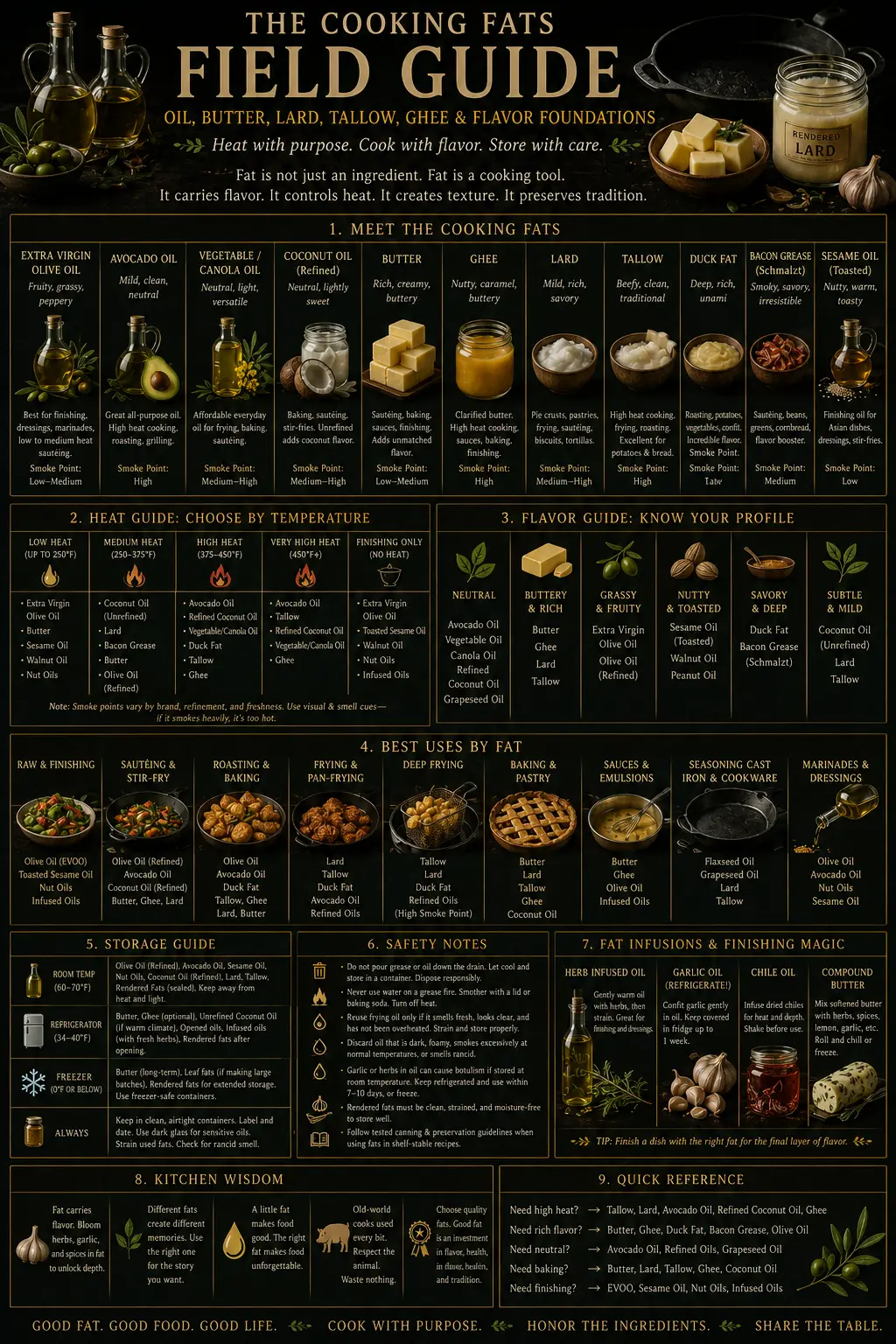
Field Guide Poster Preview
The Cooking Fats Field Guide poster is designed as a practical kitchen reference.
Use it when you need to remember:
Which fats are best for low heat.
Which fats are best for medium heat.
Which fats are best for high heat.
Which fats are finishing oils.
Which fats belong in baking.
Which fats are best for potatoes, greens, beans, brassicas, herbs, and peppers.
How to store oils and rendered fats.
Which fats should be refrigerated.
Why garlic-in-oil safety matters.
What to do if cooking fat catches fire.
How fat fits into the larger Garden Wealth system.
The poster gives the map.
This field guide gives the deeper explanation.
Download the Printable Cooking Fats Field Guide — $0.99
[Button: Download the Cooking Fats Field Guide]
The Core Lesson: Fat Is a Cooking Tool
A cooking fat has four major jobs.
1. Fat Transfers Heat
Fat helps transfer heat from the pan to the food.
That is why sautéing, frying, roasting, and searing depend on it.
Water steams.
Fat browns.
A vegetable cooked in a dry pan may scorch in patches. A vegetable cooked with the right amount of fat browns more evenly.
This is why roasted potatoes need oil or rendered fat.
This is why onions soften better with butter or olive oil.
This is why stir-fries need a hot pan and a thin layer of heat-friendly fat.
Fat is the bridge between heat and food.
2. Fat Carries Flavor
Many aroma compounds dissolve and move through fat.
Garlic, herbs, spices, chiles, onions, shallots, ginger, pepper, and curry spices become more expressive when gently warmed in fat.
This is why so many cuisines begin with aromatics in oil, butter, ghee, lard, tallow, coconut oil, or another fat.
The fat catches the aroma.
Then it carries it through the dish.
That is why garlic in olive oil changes a tomato sauce.
That is why cumin bloomed in ghee changes a lentil dish.
That is why chile oil can season a whole bowl of noodles.
Fat does not only hold calories.
It holds memory.
3. Fat Creates Texture
Fat makes crusts flaky, potatoes crisp, sauces silky, cakes tender, and fried foods golden.
A biscuit made with butter is different from one made with lard.
A pie crust made with leaf lard is different from one made with shortening.
A sauce mounted with butter is different from one thickened only with starch.
A roasted vegetable tossed in oil behaves differently from a boiled vegetable.
Fat shapes texture before flavor even reaches the tongue.
It decides whether food feels dry, crisp, tender, glossy, rich, flaky, creamy, or heavy.
This is why fat choice matters in baking.
This is why fat amount matters in roasting.
This is why fat temperature matters in frying.
Texture is not decoration.
Texture is part of taste.
4. Fat Carries Tradition
Olive oil carries Mediterranean memory.
Ghee carries South Asian and Middle Eastern traditions.
Lard carries old-world pastry, beans, tortillas, Appalachian and farmhouse cooking.
Tallow carries roasting, frying, and hearth food.
Sesame oil carries East Asian finishing flavor.
Bacon grease carries Southern, Appalachian, and country-kitchen memory.
Duck fat carries French and bistro cooking.
Schmaltz carries Jewish kitchen tradition.
Fat is not just chemistry.
It is culture.
Every fat has a story.
The point is not to treat tradition as a rulebook.
The point is to recognize that old kitchens kept certain fats because they worked.
Cooking Fats at a Glance
| Fat | Flavor Profile | Heat Role | Best Uses | Storage Notes | Watch-Out |
|---|---|---|---|---|---|
| Extra Virgin Olive Oil | Fruity, grassy, peppery | Low to medium heat; finishing | Dressings, marinades, sautéing, vegetables, beans, finishing | Cool, dark, sealed | Flavor fades; can smoke if overheated |
| Refined Olive Oil | Mild, cleaner, less peppery | Medium to higher heat | Sautéing, roasting, pan cooking | Cool, dark, sealed | Less flavor than extra virgin |
| Avocado Oil | Mild, buttery, clean | Medium to high heat | Searing, roasting, frying, all-purpose cooking | Cool, dark, sealed | Quality varies by brand |
| Vegetable / Canola Oil | Neutral, light | Medium to high heat | Frying, baking, sautéing, general cooking | Cool, dark, sealed | Flavorless by design; freshness matters |
| Coconut Oil | Mild to coconut-forward | Medium heat; refined handles more heat | Baking, curries, granola, sautéing | Cool, sealed | Strong flavor if unrefined; high in saturated fat |
| Butter | Rich, creamy, dairy-sweet | Low to medium heat | Baking, sauces, finishing, gentle sautéing | Refrigerate or freeze | Milk solids brown and can burn |
| Ghee | Nutty, buttery, caramel-like | Medium to high heat | Searing, sautéing, curries, rice, finishing | Cool storage or refrigerate after opening | Strong flavor; still energy-dense |
| Lard | Mild, savory, pork-rich | Medium to high heat | Pie crust, frying, biscuits, beans, tortillas | Refrigerate or freeze for longer storage | Quality varies; strain rendered fat well |
| Tallow | Beefy, clean, savory | High heat | Frying, roasting potatoes, searing | Refrigerate or freeze for longer storage | Stronger flavor; not for every dish |
| Duck Fat | Rich, deep, savory | Medium to high heat | Roasted potatoes, root vegetables, Brussels sprouts | Refrigerate or freeze | Expensive; very distinctive |
| Bacon Grease | Smoky, salty, savory | Medium heat | Greens, beans, cornbread, cabbage, eggs | Strain and refrigerate | Salt, meat bits, and spoilage risk |
| Schmaltz | Savory poultry richness | Medium heat | Matzo balls, potatoes, onions, traditional dishes | Refrigerate or freeze | Distinct poultry flavor |
| Toasted Sesame Oil | Nutty, toasted, intense | Finishing only or very low heat | Noodles, stir-fries after cooking, soups, dressings | Cool, dark, sealed; refrigerate if needed | Burns easily; use as flavor accent |
| Nut Oils | Nutty, delicate | Finishing; low heat | Salads, baking accents, vegetables | Refrigerate after opening for many types | Can go rancid quickly |
| Flaxseed Oil | Earthy, delicate | No heat | Cold dressings, smoothies if used | Refrigerate | Not a cooking oil |
Heat Guide: Choose by Temperature, Not Habit
The most useful way to choose a fat is not by popularity.
It is by heat.
Smoke point means the temperature where a fat begins to smoke and break down. But in real kitchens, smoke point is affected by refinement, age, storage conditions, food particles, and oil quality.
So use heat categories first.
Then use your senses.
If the fat is smoking heavily, lower the heat.
If the oil smells acrid, harsh, burnt, metallic, or bitter, stop and reassess.
If food particles are burning in the fat, strain it or discard it.
Heat is not just a number.
It is a relationship between the pan, the fat, the food, and time.
Low Heat
Best fats:
Butter.
Extra virgin olive oil.
Coconut oil.
Toasted sesame oil only as a very gentle flavor addition.
Nut oils only if used carefully.
Low heat is best for gentle sautéing, sweating onions, warming herbs, low-heat eggs, finishing, and sauces.
This is where flavor fats shine.
Butter can melt into mushrooms.
Olive oil can warm garlic.
Coconut oil can begin a curry.
Sesame oil can finish a bowl.
Low heat is not weak cooking.
It is careful cooking.
Medium Heat
Best fats:
Olive oil.
Refined olive oil.
Butter with oil.
Bacon grease.
Lard.
Coconut oil.
Ghee.
Canola or vegetable oil.
Medium heat is the everyday kitchen zone.
It is where cabbage softens, beans deepen, greens wilt, eggs set, onions turn sweet, pancakes brown, and vegetables become dinner.
Medium heat is also where many cooks learn control.
Too low and food sweats without browning.
Too high and delicate fats burn.
A good medium heat gives food time to transform.
High Heat
Best fats:
Avocado oil.
Refined olive oil.
Canola or vegetable oil.
Refined coconut oil.
Ghee.
Lard.
Tallow.
Duck fat.
High heat is for roasting, searing, stir-frying, frying, crisping potatoes, and browning meat.
High heat needs a fat that can handle stress.
It also needs attention.
A high-heat fat is not permission to walk away.
It is permission to cook with intensity.
Finishing Only
Best fats:
Extra virgin olive oil.
Toasted sesame oil.
Walnut oil.
Flaxseed oil.
Herb oils.
Chile oils.
Specialty nut and seed oils.
Finishing oils are about aroma, not heat.
They go on at the end.
A drizzle over soup.
A spoonful over roasted vegetables.
A few drops over noodles.
A gloss over beans.
A ribbon over tomato salad.
Finishing oils work because their flavor is still alive.
Do not burn the best part out of them.
Meet the Cooking Fats
Extra Virgin Olive Oil: The Garden-to-Table Classic
Extra virgin olive oil is one of the most important fats in a garden kitchen.
It is fruity, peppery, grassy, sometimes bitter, and deeply tied to Mediterranean cooking.
It is best when the flavor matters.
Use it for salad dressings, roasted vegetables, bean dishes, marinades, bread dipping, tomato salads, herb sauces, grilled vegetables, and finishing soups.
It can handle many low-to-medium everyday cooking tasks, but its greatest value is flavor.
A good extra virgin olive oil can make tomatoes taste brighter, beans feel richer, greens taste finished, and bread feel like a meal.
Do not store it beside a hot stove for months.
Heat, light, oxygen, and time damage oils.
Best Uses:
Dressings, finishing, sautéing, vegetables, bread, beans, tomatoes, marinades.
Flavor Role:
Grassy, fruity, peppery, fresh.
Kitchen Lesson:
Use extra virgin olive oil when you want the fat to speak.
Refined Olive Oil: The Practical Olive Oil
Refined olive oil has less bold olive flavor than extra virgin olive oil.
That can be an advantage.
It is useful when you want olive oil’s cooking flexibility without strong grassy or peppery notes.
Use it for vegetables, chicken, fish, potatoes, beans, eggs, and everyday pan cooking.
It can be a good bridge between neutral oils and full-flavored extra virgin olive oil.
Best Uses:
Sautéing, roasting, pan cooking, mild marinades.
Flavor Role:
Mild, clean, lightly olive.
Kitchen Lesson:
Refined olive oil is for function. Extra virgin is for flavor.
Avocado Oil: The High-Heat All-Purpose Oil
Avocado oil is popular because it is mild, clean, and useful for higher-heat cooking.
Refined avocado oil is often chosen for searing, roasting, grilling, and frying because it tends to tolerate heat well.
Its flavor is less assertive than extra virgin olive oil, which makes it useful when you do not want the fat to dominate.
Use avocado oil for roasted vegetables, stir-fries, seared meats, sheet-pan meals, eggs, potatoes, and general high-heat cooking.
Best Uses:
Roasting, searing, frying, all-purpose cooking.
Flavor Role:
Mild, clean, slightly buttery.
Kitchen Lesson:
Avocado oil is a strong choice when heat matters more than tradition.
Vegetable and Canola Oil: The Neutral Workhorses
Neutral oils are not glamorous.
But they are useful.
Vegetable oil and canola oil are designed to stay out of the way.
They are common in baking, frying, sautéing, pancakes, muffins, quick breads, and recipes where you want texture without a strong fat flavor.
They are also economical, which matters for deep frying and large batches.
Their weakness is also their strength:
They do not bring much flavor.
If a dish needs personality, neutral oil should usually be supported by herbs, spices, alliums, acid, butter, chile oil, or finishing oil.
Best Uses:
Frying, baking, sautéing, neutral cooking.
Flavor Role:
Clean, light, quiet.
Kitchen Lesson:
Neutral oil is a blank canvas.
Coconut Oil: Tropical, Solid, and Distinctive
Coconut oil behaves differently from many liquid oils because it is solid at cooler room temperatures.
Unrefined coconut oil has a clear coconut flavor and aroma.
Refined coconut oil is milder.
It is useful in baking, curries, granola, sautéing, vegan baking, and tropical or South Asian-inspired dishes.
But coconut oil is high in saturated fat, so it should be used thoughtfully. Heart-health guidance from the American Heart Association generally recommends replacing saturated and trans fats with monounsaturated and polyunsaturated fats, and it notes that nontropical liquid vegetable oils are generally preferred over solid fats and tropical oils for everyday heart-health cooking.
Best Uses:
Baking, curries, granola, coconut-forward dishes, sautéing.
Flavor Role:
Tropical, sweet, rich, or neutral if refined.
Kitchen Lesson:
Coconut oil is best when its flavor belongs.
Butter: Flavor, Browning, and Tenderness
Butter is one of the most beloved cooking fats because it brings water, milk solids, and butterfat together.
That combination is why butter is magical and delicate.
The milk solids brown into nutty flavor.
They can also burn.
The water creates steam in baked goods.
The fat makes pastries tender, vegetables glossy, sauces rich, and toast memorable.
Use butter for baking, finishing sauces, mashed potatoes, eggs, pancakes, sautéed mushrooms, toast, compound butter, and low-to-medium heat cooking.
Brown butter deserves special mention.
When butter is heated until the milk solids turn golden brown and nutty, it becomes one of the best flavor tools in the kitchen.
Best Uses:
Baking, sauces, finishing, eggs, low-heat sautéing, brown butter.
Flavor Role:
Creamy, sweet, nutty when browned.
Kitchen Lesson:
Butter rewards attention and punishes neglect.
Ghee: Butter Made Heat-Friendly
Ghee is clarified butter cooked until water is removed and milk solids are separated, often creating a nutty, caramel-like flavor.
Because the milk solids are removed, ghee behaves better at higher heat than whole butter.
It is central in many South Asian kitchens and useful for sautéing, curries, rice dishes, eggs, roasted vegetables, and finishing.
Ghee brings butter flavor with more heat flexibility.
Best Uses:
Curries, sautéing, searing, rice, eggs, roasted vegetables.
Flavor Role:
Nutty, buttery, caramel-like.
Kitchen Lesson:
Ghee is butter transformed into a stronger cooking tool.
Lard: The Old-World Pastry and Frying Fat
Lard is rendered pork fat.
Good lard can be mild, clean, and excellent for pastry.
Leaf lard, rendered from fat around the kidneys, is especially prized for pie crust because it can create flaky texture with less pork flavor.
Lard is also useful for frying, beans, tortillas, biscuits, roasted vegetables, and old-world cooking.
The key is quality.
Fresh, properly rendered, well-strained lard is very different from old, stale, porky, or poorly stored fat.
Store it carefully, preferably refrigerated or frozen for longer keeping.
Best Uses:
Pie crust, biscuits, tortillas, frying, beans, sautéing.
Flavor Role:
Mild to pork-rich, savory, traditional.
Kitchen Lesson:
Lard is not just grease. Good lard is a baking tool.
Tallow: Beef Fat for Roasting and Frying
Tallow is rendered beef fat.
It is firm, savory, and excellent for high-heat cooking.
It is especially good for roasted potatoes, frying, searing, and old-fashioned cooking.
Tallow has a beefy character, so it should be used where that flavor belongs.
It can make potatoes taste deeply savory.
It would be strange in a delicate lemon cake.
Like lard, tallow must be cleanly rendered, strained, and stored properly.
Best Uses:
Roasted potatoes, frying, searing, savory pastries, traditional cooking.
Flavor Role:
Beefy, savory, rich.
Kitchen Lesson:
Tallow is powerful when matched to hearty food.
Duck Fat: The Luxury Roasting Fat
Duck fat is famous for roasted potatoes for a reason.
It browns beautifully, carries deep flavor, and gives vegetables a rich, savory edge.
It is excellent with potatoes, carrots, parsnips, Brussels sprouts, mushrooms, beans, confit-style cooking, and hearty winter vegetables.
Duck fat is more expensive than many fats, so it is best used where it makes a visible difference.
Best Uses:
Roasted potatoes, root vegetables, Brussels sprouts, mushrooms, confit-style cooking.
Flavor Role:
Rich, savory, deep, luxurious.
Kitchen Lesson:
Duck fat turns simple vegetables into memorable food.
Bacon Grease: Smoky Kitchen Memory
Bacon grease is rendered fat left after cooking bacon.
It is smoky, salty, savory, and powerful.
A spoonful can season greens, beans, cabbage, cornbread, potatoes, eggs, and skillet vegetables.
But bacon grease is not the same as clean neutral fat.
It often contains salt, browned meat particles, and smoky compounds.
It should be strained if saved, cooled, stored in a clean container, and refrigerated.
USDA FSIS treats cooked bacon like other perishable cooked foods and gives short refrigerator guidance for safe storage; saved grease with meat particles should be handled with the same caution rather than treated like a shelf-stable oil.
Best Uses:
Greens, beans, cornbread, eggs, cabbage, potatoes.
Flavor Role:
Smoky, salty, savory, nostalgic.
Kitchen Lesson:
Bacon grease is seasoning as much as fat.
Schmaltz: Poultry Fat With Tradition
Schmaltz is rendered chicken or goose fat.
It is deeply tied to Jewish cooking and traditional kitchens.
It brings savory poultry richness to matzo balls, potatoes, onions, chopped liver, root vegetables, and pan cooking.
Like other rendered animal fats, it should be strained and stored cold.
Best Uses:
Matzo balls, potatoes, onions, traditional dishes, savory cooking.
Flavor Role:
Poultry-rich, savory, comforting.
Kitchen Lesson:
Schmaltz carries food memory.
Toasted Sesame Oil: The Finishing Accent
Toasted sesame oil is not a general frying oil.
It is a finishing oil.
Its flavor is intense, nutty, warm, and aromatic.
A few drops can finish noodles, rice bowls, stir-fried vegetables, soups, dumpling sauces, marinades, and dressings.
If overheated, it can become bitter or burnt.
Add it at the end or use it gently.
Best Uses:
Finishing noodles, stir-fries, soups, sauces, dressings, marinades.
Flavor Role:
Nutty, toasted, aromatic, intense.
Kitchen Lesson:
Toasted sesame oil is punctuation, not paragraphs.
Nut and Seed Oils: Delicate Flavor Oils
Walnut oil, hazelnut oil, almond oil, pumpkin seed oil, flaxseed oil, and other specialty oils can be beautiful.
But many are delicate.
They are often best used cold or as finishing oils.
Use them in salad dressings, roasted vegetable finishing, grain bowls, desserts, dips, and drizzles.
Store them carefully because nut and seed oils can go rancid.
Refrigeration may be wise after opening, depending on the oil.
Best Uses:
Finishing, dressings, cold sauces, dessert accents.
Flavor Role:
Nutty, delicate, aromatic.
Kitchen Lesson:
Specialty oils are flavor accents, not workhorses.
The Word “Grease”: What It Really Means
In home kitchens, “grease” usually means fat left behind after cooking meat.
Bacon grease.
Sausage grease.
Chicken drippings.
Hamburger grease.
Pan drippings.
Some of it is useful.
Some of it is waste.
The difference depends on cleanliness, flavor, salt, burning, moisture, food particles, and storage.
Good saved grease should be:
Strained.
Free of excess food bits.
Stored in a clean container.
Labeled.
Refrigerated or frozen.
Smelled before use.
Discarded if rancid, moldy, burnt, or questionable.
Grease should never be poured down the drain.
Let it cool and dispose of it in the trash, or save clean rendered fat for cooking.
Grease is not automatically bad.
But careless grease is dangerous, messy, and wasteful.
Fat and Flavor: How to Match the Fat to the Food
Potatoes
Best fats:
Duck fat.
Tallow.
Lard.
Olive oil.
Avocado oil.
Butter and oil.
Bacon grease.
Potatoes love fat because fat creates crisp edges and carries salt, herbs, garlic, pepper, paprika, and browned flavor.
A potato roasted dry is food.
A potato roasted in duck fat with rosemary and garlic is memory.
Leafy Greens
Best fats:
Olive oil.
Butter.
Bacon grease.
Lard.
Ghee.
Sesame oil for finishing.
Greens often need fat to soften bitterness and carry aromatics.
Kale, collards, mustard greens, chard, spinach, and turnip greens all become more satisfying when fat helps carry garlic, onion, vinegar, chile, lemon, or broth.
Fat does not hide greens.
It helps them become dinner.
Beans
Best fats:
Olive oil.
Lard.
Bacon grease.
Schmaltz.
Butter.
Ghee.
Beans are earthy, starchy, and humble.
Fat gives them body, gloss, richness, and depth.
A pot of beans with onion, garlic, herbs, and a little good fat can become one of the most powerful budget meals in the kitchen.
Brassicas
Best fats:
Olive oil.
Butter.
Bacon grease.
Duck fat.
Avocado oil.
Ghee.
Cabbage, Brussels sprouts, broccoli, cauliflower, collards, and kale all improve when fat is used to manage bitterness, create browning, and carry flavor.
This is why roasted Brussels sprouts became popular.
It was not because the plant changed.
The method did.
Fat plus heat changed everything.
Herbs
Best fats:
Olive oil.
Butter.
Ghee.
Neutral oil.
Nut oils.
Sesame oil for specific cuisines.
Herbs release aroma into fat.
Pesto, herb oil, compound butter, herb sauces, chimichurri, salsa verde, sage butter, rosemary oil, and dill butter all depend on this relationship.
Herbs are flavor multipliers.
Fat is the carrier.
Together, they turn a harvest into a tool.
Peppers and Chiles
Best fats:
Olive oil.
Neutral oil.
Lard.
Sesame oil.
Ghee.
Butter.
Chiles bloom in fat.
Pepper flavor becomes deeper when roasted, fried, infused, or cooked into oil-based sauces.
A dried chile is powerful.
A dried chile bloomed in oil becomes a whole new ingredient.
This is why chile crisp, hot oil, paprika oil, curry bases, and pepper pastes matter.
Fat unlocks the pepper.
Infused Fats: Flavor With Safety Rules
Infused oils are tempting.
Garlic oil.
Herb oil.
Chile oil.
Rosemary oil.
Basil oil.
Pepper oil.
They are also one of the areas where food safety matters most.
Garlic, herbs, and vegetables stored in oil can create a low-oxygen environment where Clostridium botulinum can become a risk if handled improperly. NCHFP guidance warns that garlic-in-oil mixtures stored at room temperature are at risk for botulism; garlic-in-oil should be made fresh, refrigerated at 40°F or lower, and used within 4 days, or frozen for longer storage.
Safe Mindset for Infused Oils
Do not store homemade garlic oil at room temperature.
Refrigerate garlic-in-oil mixtures and use quickly.
Freeze for longer storage.
Use clean tools and containers.
Label and date everything.
When in doubt, throw it out.
Better Beginner Options
Make garlic oil fresh for immediate use.
Use dried herbs rather than fresh herbs for shelf-stable seasoning blends.
Make compound butter and freeze it.
Make pesto and freeze it.
Make chile oil from properly dried chiles and store carefully.
Use commercial infused oils from reputable producers.
Infused fat is powerful.
But it must be respected.
Grease Fire Safety
Cooking with fat means understanding fire.
Oil and grease fires are not handled like ordinary fires.
Cooking is a major source of home fires; NFPA reports that from 2020–2024, cooking equipment was involved in an estimated 48% of reported home structure fires, 35% of home fire injuries, and 16% of home fire deaths.
The basic kitchen rule is simple:
Respect hot fat before it becomes a problem.
Heat oil slowly.
Add food gently to avoid splatter.
Keep a lid nearby.
Do not leave hot oil unattended.
If a small pan fire starts and it is safe to act, turn off the burner and slide a lid over the pan to smother the flames.
Leave the pan covered while it cools.
Never throw water on a grease fire.
Do not carry a burning pan.
If the fire does not go out or you do not feel safe, get everyone out and call the fire department.
Golden Rules
Never leave hot oil unattended.
Heat oil slowly.
Keep a lid nearby.
If oil smokes heavily, lower the heat.
If fire starts, turn off the burner if safe.
Slide a lid over the pan if safe.
Never use water.
Do not carry a burning pan.
Evacuate if unsure.
A good cook respects the pan.
Storage Guide for Cooking Fats
Fat does not last forever.
It can oxidize, go rancid, absorb odors, separate, mold if contaminated, or become unsafe when mixed with fresh ingredients and stored improperly.
The storage rule is simple:
Protect fat from heat, light, oxygen, moisture, food particles, and time.
Room Temperature
Good candidates:
Many unopened oils.
Refined oils.
Some shelf-stable fats.
Unopened commercial products.
Rules:
Keep sealed.
Keep cool.
Keep dark.
Keep away from the stove.
Buy amounts you can use before quality declines.
A giant bottle of oil is not a bargain if it goes rancid before you finish it.
Refrigerator
Good candidates:
Butter.
Opened nut oils.
Bacon grease.
Schmaltz.
Duck fat.
Rendered animal fats.
Garlic-in-oil mixtures for short safe storage.
Delicate oils that go rancid quickly.
Rules:
Use clean containers.
Label and date.
Keep covered.
Smell before use.
Discard anything questionable.
Freezer
Good candidates:
Butter for long storage.
Lard.
Tallow.
Duck fat.
Schmaltz.
Compound butter.
Pesto.
Garlic-in-oil mixtures for longer storage.
Rules:
Use freezer-safe containers.
Portion small amounts.
Label clearly.
Freeze flat when helpful.
Thaw only what you need.
Signs Fat Has Gone Bad
Discard fat or oil if it smells:
Paint-like.
Stale.
Sour.
Musty.
Metallic.
Bitter.
Rancid.
Burnt.
Old nuts.
Used motor oil.
Rancid fat ruins food.
It also teaches a simple pantry lesson:
Fat is a living-quality ingredient.
It does not last forever.
The Health and Nutrition Layer
This is a cooking guide, not medical advice.
But it would be incomplete without saying that fats are nutritionally different.
The American Heart Association generally recommends replacing saturated and trans fats with monounsaturated and polyunsaturated fats, and it specifically points to nontropical liquid plant oils as healthier everyday cooking choices than solid fats like butter, shortening, lard, and stick margarine or tropical oils like palm and coconut oil.
That does not mean traditional fats have no place in a kitchen.
It means they should be used with purpose.
Butter in pastry.
Lard in pie crust.
Bacon grease in greens.
Duck fat for special potatoes.
Tallow for certain frying.
Ghee for curries.
Olive oil for daily vegetables.
Neutral oil for practical baking.
The practical kitchen rule is:
Use flavorful saturated fats where they matter most, and use unsaturated oils for everyday flexibility.
Not fear.
Not fad.
Not purity.
Skill, balance, and purpose.
People following heart-health guidance, managing cholesterol, or working with medical dietary advice should follow their clinician’s recommendations.
Food is personal.
Technique still matters.
The Kitchen Fat Formula
A good dish often uses fat in three stages.
1. Cooking Fat
This is the fat that handles the heat.
Examples:
Avocado oil.
Refined olive oil.
Ghee.
Lard.
Tallow.
Duck fat.
Neutral oil.
This fat’s job is performance.
It gets the food cooked.
2. Flavor Fat
This is the fat that builds taste.
Examples:
Butter.
Olive oil.
Bacon grease.
Sesame oil.
Chile oil.
Herb oil.
Garlic butter.
This fat’s job is character.
It makes the dish taste like something specific.
3. Finishing Fat
This is the fat that lands the dish.
Examples:
Extra virgin olive oil.
Toasted sesame oil.
Compound butter.
Nut oil.
Herb oil.
Brown butter.
This fat’s job is aroma and final polish.
This is why restaurant food often tastes more complete.
The fat is not random.
It is layered.
Common Mistakes With Cooking Fats
Mistake 1: Using One Oil for Everything
One bottle cannot do every job perfectly.
Extra virgin olive oil is not toasted sesame oil.
Butter is not tallow.
Bacon grease is not avocado oil.
Each fat has a role.
Mistake 2: Overheating Flavor Oils
Toasted sesame oil, nut oils, flaxseed oil, and delicate extra virgin oils can lose their best qualities when overheated.
Use them for finishing.
Do not burn the aroma out of the oil.
Mistake 3: Letting Oil Smoke Heavily
A little wisp may happen during hot cooking.
Heavy smoking means the oil is breaking down, flavor is degrading, and the kitchen is moving toward danger.
Lower the heat.
Mistake 4: Saving Dirty Grease
Grease full of burnt crumbs, meat bits, and salt will spoil faster and flavor food poorly.
Strain it or discard it.
Saved grease should be clean enough to deserve saving.
Mistake 5: Making Garlic Oil and Leaving It Out
This is one of the most serious mistakes.
Homemade garlic oil should not sit at room temperature.
Refrigerate and use within safe time limits, or freeze. NCHFP specifically warns against room-temperature garlic-in-oil storage because of botulism risk.
Mistake 6: Pouring Grease Down the Drain
Grease can clog pipes.
Cool it, save it properly, or dispose of it in the trash.
A good kitchen respects the plumbing too.
Mistake 7: Thinking Fat Is Only About Calories
Fat is energy-dense.
But in cooking, fat is also heat management, aroma, texture, tradition, and satisfaction.
Use it with purpose.
Best Fats by Cooking Job
| Cooking Job | Best Choices | Why |
|---|---|---|
| Salad Dressing | Extra virgin olive oil, avocado oil, walnut oil, sesame oil | Flavor and mouthfeel matter more than heat |
| Sautéing Vegetables | Olive oil, avocado oil, butter with oil, ghee, lard | Balanced heat and flavor |
| Roasting Potatoes | Duck fat, tallow, lard, olive oil, avocado oil | Crisp edges and savory depth |
| Frying | Avocado oil, neutral oil, lard, tallow | Heat stability and clean cooking |
| Baking Cakes | Neutral oil, butter, coconut oil | Texture and flavor depend on recipe |
| Pie Crust | Butter, lard, shortening, tallow in savory crusts | Flakiness and structure |
| Finishing Soup | Extra virgin olive oil, butter, chile oil, sesame oil | Adds aroma and gloss |
| Cooking Greens | Olive oil, bacon grease, butter, lard, ghee | Softens bitterness and carries alliums |
| Beans | Olive oil, lard, bacon grease, schmaltz, butter | Adds body and depth |
| Cast Iron Seasoning | Grapeseed oil, canola oil, lard, tallow, flaxseed oil | Thin layers can polymerize into seasoning |
| Stir-Fry | Avocado oil, neutral oil, refined peanut oil, refined sesame oil | High heat and fast cooking |
| Asian Finishing | Toasted sesame oil, chile oil | Aroma and final flavor |
| Compound Butter | Butter, herbs, garlic, citrus zest, spices | Freezer-ready flavor tool |
| Roasted Brassicas | Olive oil, avocado oil, duck fat, bacon grease, ghee | Browning plus bitterness balance |
| Griddle Cooking | Butter with oil, neutral oil, bacon grease | Browning without burning too quickly |
The Wealth Garden Insight: Fat as a Flavor Multiplier
Fat is one of the reasons a home garden becomes a kitchen system.
A potato is valuable.
A potato roasted in duck fat, garlic, rosemary, and salt becomes memorable.
A cabbage is valuable.
A cabbage sautéed in bacon grease with onions and vinegar becomes dinner.
A tomato is valuable.
A tomato cooked slowly in olive oil with garlic and basil becomes sauce.
A pepper is valuable.
A pepper dried, crushed, and bloomed in oil becomes chile oil.
An herb is valuable.
An herb folded into butter becomes a freezer-ready flavor tool.
This is the Cooking Fats Field Guide’s place in the $10,000 Garden system.
Fat multiplies the value of the harvest.
It makes stored food taste fresh.
It makes simple food satisfying.
It turns vegetables into meals.
It helps leftovers become something new.
It carries herbs, garlic, peppers, and spices through the dish.
The value is not only in the fat.
It is in what the fat helps everything else become.
The $10,000 Garden Insight: The Flavor Conversion Layer
Most people think garden value ends at the harvest.
But the kitchen decides how much of that value is actually enjoyed.
A potato can sit in a bin.
Or it can become crisp roasted potatoes.
A cabbage can sit in the refrigerator.
Or it can become silky skillet cabbage with onions and bacon grease.
A bunch of herbs can wilt.
Or it can become compound butter, pesto, herb oil for immediate use, or freezer cubes.
A pepper can dry on the counter.
Or it can become paprika oil, chile crisp, hot sauce, or seasoning powder.
Fat is one of the major conversion tools.
It converts raw ingredients into satisfying food.
It converts leftovers into new meals.
It converts preserved food into something that still tastes alive.
It converts garden abundance into household joy.
That matters because a garden is only as valuable as the meals it becomes.
The harvest is the ingredient.
The cooking is the conversion.
Fat is one of the tools that makes the conversion work.
Designing a Beginner Cooking Fat Pantry
Do not buy every fat at once.
Start with a working set.
The right pantry is not the biggest pantry.
It is the one you actually cook from.
Everyday Core
Extra virgin olive oil.
Neutral oil or avocado oil.
Butter.
One high-heat fat such as avocado oil, ghee, lard, or tallow.
This covers most daily cooking.
Flavor Layer
Toasted sesame oil.
Bacon grease or lard if part of your cooking tradition.
Ghee or brown butter.
Chile oil or herb oil made and stored safely.
This gives meals identity.
Baking Layer
Butter.
Neutral oil.
Lard or shortening if you make pie crusts or biscuits.
This helps you bake with texture in mind.
Finishing Layer
Extra virgin olive oil.
Toasted sesame oil.
Walnut oil or another specialty oil if you use it often.
Compound butter.
This makes finished food feel complete.
The 1% Kitchen Fat Rule
A better cooking fat pantry does not require buying ten bottles today.
Fifteen minutes is enough to improve the system.
You can:
Move oils away from the stove.
Smell old oils and discard rancid ones.
Label bacon grease.
Freeze compound butter.
Make one herb butter from garden herbs.
Strain saved cooking fat.
Write a “use first” note on delicate oils.
Clean the oil shelf.
Check garlic oil safety.
Choose one high-heat fat and one finishing oil for the week.
Good cooking often improves through small corrections.
The fat pantry is no different.
A Quick Note About Pets and Children
Cooking fats deserve household safety.
Keep hot oil away from children and pets.
Turn pan handles inward.
Do not leave frying unattended.
Keep jars of grease, infused oils, and strongly seasoned fats out of reach.
Do not feed pets onion, garlic, chive, heavily seasoned, rancid, moldy, or greasy scraps.
Do not leave loose bacon grease or meat drippings where pets can reach them.
A kitchen that feeds the household should also protect the household.
Frequently Asked Questions About Cooking Fats
What is the best all-purpose cooking fat?
For many kitchens, a combination works better than one “best” fat. Extra virgin olive oil covers flavor and everyday low-to-medium cooking, avocado oil or a neutral oil covers higher heat, and butter covers baking and finishing.
Can I cook with extra virgin olive oil?
Yes, extra virgin olive oil can be used for many low-to-medium heat cooking tasks, but its greatest strength is flavor. For very high heat, refined olive oil, avocado oil, neutral oil, ghee, lard, or tallow may be better choices depending on the dish.
What fat is best for frying?
Common frying choices include neutral oil, avocado oil, lard, and tallow. The best choice depends on heat, flavor, cost, and what you are frying.
Is butter good for high heat?
Whole butter can burn because of its milk solids. It is better for low-to-medium heat, baking, sauces, and finishing. For more heat-friendly butter flavor, use ghee or combine butter with another cooking fat.
What is ghee?
Ghee is clarified butter cooked so water is removed and milk solids are separated. It has a nutty, buttery flavor and handles higher heat better than whole butter.
Is bacon grease safe to save?
Bacon grease can be saved if strained, cooled, stored in a clean container, labeled, and refrigerated or frozen. Discard grease that smells rancid, burnt, sour, or questionable.
Can I leave homemade garlic oil on the counter?
No. Homemade garlic-in-oil mixtures should not be stored at room temperature because of botulism risk. NCHFP recommends making garlic-in-oil fresh, refrigerating at 40°F or lower for no more than 4 days, or freezing for longer storage.
What should I do if oil catches fire?
Do not use water. If it is safe, turn off the burner and slide a lid over the pan to smother the fire. Do not move the pan. If the fire does not go out or you feel unsafe, evacuate and call emergency services.
How do I know if oil is rancid?
Rancid oil may smell stale, paint-like, metallic, bitter, sour, musty, or like old nuts. When in doubt, discard it.
Should nut oils be refrigerated?
Many nut and seed oils are delicate and can go rancid quickly after opening. Refrigeration is often wise, especially for walnut oil, flaxseed oil, and other fragile specialty oils.
Is coconut oil a healthy everyday oil?
Coconut oil is high in saturated fat. It can be useful for certain flavors and recipes, but heart-health guidance generally favors replacing saturated fats with unsaturated fats and using nontropical liquid plant oils for everyday cooking.
Where This Connects
The Cooking Fats Field Guide connects naturally to the rest of the Field Guide Library.
The Potato Field Guide
Potatoes are one of the clearest examples of fat changing texture. Baking, roasting, frying, mashing, and gratins all depend on fat choice.
The Herb Flavor Multiplier Guide
Herbs release aroma into fat. Pesto, herb oil, compound butter, and herb sauces belong directly in this conversation.
The Garlic Field Guide
Garlic and fat are powerful together, but garlic-in-oil safety must be respected.
The Pepper Library
Peppers become chile oil, hot sauce, roasted pepper oil, dried chile flakes, and spice pastes when paired with fat.
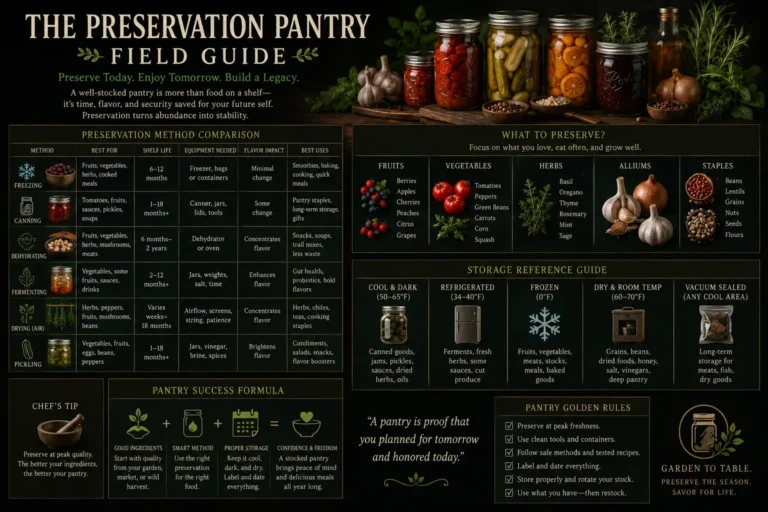
The Preservation Pantry Field Guide
Rendered fats, infused oils, pesto, compound butter, and storage rules all connect preservation to fat safety.
The Root Cellar Field Guide
Roots become winter comfort through roasting fats, butter, lard pastry, tallow potatoes, and soup foundations.
The Brassica Family Field Guide
Brussels sprouts, cabbage, collards, kale, and cauliflower often need fat to balance bitterness and create browning.
The Beans and Peas Field Guide
Beans become richer, deeper, and more satisfying when paired with olive oil, lard, bacon grease, butter, ghee, or schmaltz.
The Onion Family Field Guide
Onions become sweetness, depth, and sauce foundation when slowly cooked in fat. Fat is the tool that turns sharp raw onion into caramelized flavor.
This cooking fats guide is one of the bridges between the garden and the table.
Source Notes for Accuracy
This article expands your original Cooking Fats Field Guide while keeping its core framework: fat as a cooking tool, the heat guide, the fat comparison chart, flavor matching, saved grease handling, infused oil safety, grease-fire safety, storage, nutrition balance, the Kitchen Fat Formula, and fat as a Wealth Garden flavor multiplier. For safety-sensitive and nutrition-sensitive claims, this rewrite leans on current public guidance from the National Center for Home Food Preservation for garlic-in-oil safety, NFPA for home cooking fire risk and safety framing, USDA FSIS for food safety handling, and the American Heart Association for general cooking-oil guidance.
The Cooking Fats Field Guide Lesson
Cooking fat is easy to overlook because it is always there.
A bottle by the stove.
A stick in the fridge.
A jar in the back corner.
A spoonful left in the pan.
But fat is one of the quiet powers of the kitchen.
It decides whether food sticks or sears.
It decides whether herbs whisper or bloom.
It decides whether potatoes soften or crisp.
It decides whether cabbage tastes flat or finished.
It decides whether beans taste thin or comforting.
It decides whether a sauce feels watery or luxurious.
It decides whether a meal tastes like fuel or memory.
A good cook does not fear fat.
A good cook understands it.
Use the right fat.
Use the right heat.
Store it carefully.
Respect the safety rules.
Let it carry flavor.
Final Thought
Fat is not just an ingredient.
It is a cooking tool.
It carries heat.
It carries aroma.
It creates texture.
It preserves tradition.
It turns simple food into satisfying food.
It helps the garden become dinner.
A potato with the right fat becomes crisp.
A green with the right fat becomes rich.
A bean with the right fat becomes comfort.
A pepper with the right fat becomes heat.
An herb with the right fat becomes a sauce.
A meal with the right fat becomes memorable.
Heat with purpose.
Cook with flavor.
Store with care.
Honor the ingredients.
Share the table.