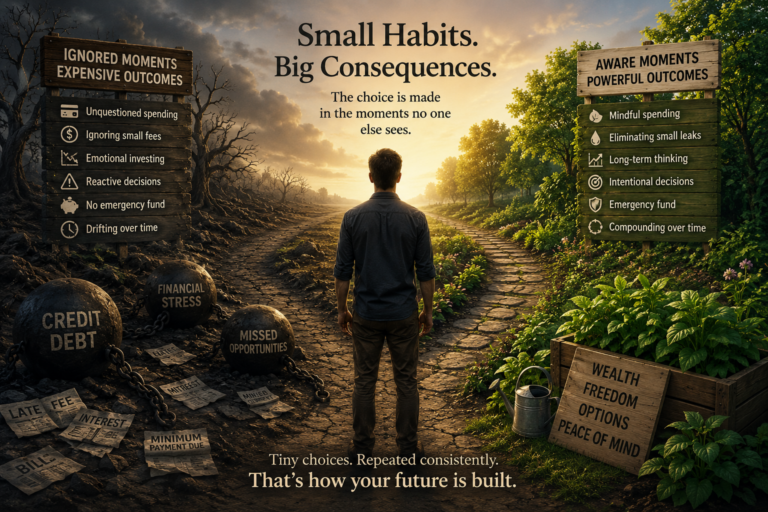

Most people believe they know exactly what dictates the trajectory of their lives. They point to the obvious, highly visible milestones: a steady paycheck, a mortgage, a major promotion, a growing retirement account, or a new car parked in the driveway of a larger house.
These milestones are easy to see because they are loud. They demand our immediate attention, dominating our calendars, bank statements, and daily conversations. Because they are so visible, we mistake them for the things that matter most.
But years of working in gardens have taught me a profound lesson: The loudest signal is rarely the most important one.
Often, the forces quietly shaping our future are so subtle that we fail to notice them—until they’ve been playing in the background for decades. If you want to shift from merely reacting to life to actively cultivating it, you have to learn how to listen to the “song beneath the song.”
The Song Beneath the Song: Shifting Your Internal Focus
Have you ever sung “Row, Row, Row Your Boat” as a round? One person starts, another joins, and suddenly multiple versions of the same melody interweave. At first, it sounds like chaotic noise. But then, something interesting happens: your brain tunes into one specific voice. The other voices don’t disappear; your focus simply shifts.
Life operates the exact same way. Most of us spend our lifetimes listening exclusively to the loud, urgent melodies:
- The career melody
- The money melody
- The schedule melody
- The responsibility melody
These tracks are loud for a reason—they help us survive. But while we obsess over them, quieter melodies are playing simultaneously: health, relationships, personal growth, stewardship, purpose, and legacy.
The paradox of intentional living is that these quieter melodies almost always shape our long-term future far more than the loud ones.
The Compounding Effect of Micro-Habits
To understand how these quiet melodies manifest, look no further than two everyday examples: your shoes and your office chair.
1. The Shoelace Melody
For decades, tying your shoes is an unremarkable task. You bend over, squat, balance, and reach toward your toes. You stretch muscles and joints without ever calling it “exercise.” Nobody logs it into a fitness tracker; it’s just part of life.
Then, convenience arrives. You switch to slip-on shoes, elastic laces, or Velcro. The convenience melody gets louder. The mobility melody goes quiet. Nothing dramatic happens immediately. But years pass, and one day you find yourself saying, “I don’t know where my flexibility went.” It didn’t disappear overnight. Your body was keeping score the entire time.
2. The Chair Melody
The same pattern repeats at work. The visible melody sounds like ultimate success: a good job, a reliable routine, and a steady paycheck. But beneath the applause, another melody is recording repetitions: eight hours of sitting, day after day, year after year.
When retirement finally arrives, the paycheck melody fades. Suddenly, your body begins playing the physical song it has been recording for decades. The sudden stiffness or lack of vitality didn’t appear overnight. The melody was there all along.
Stop and Reflect: What quiet melody are you ignoring right now in the name of convenience or temporary comfort?
Upstream Thinking: Mistaking Symptoms for Problems
When these quiet melodies finally force their way to the surface, most people fall into a dangerous trap: they mistake symptoms for root causes.
- A symptom is what you notice (the visible effect).
- A problem is the underlying system that caused it.
Imagine walking past a tomato plant and noticing yellow leaves. The yellow leaves are obvious and catch your attention immediately. A novice gardener says, “The problem is yellow leaves.” But yellow leaves are never the problem; they are just the messenger. The actual problem is upstream: poor soil, root damage, overwatering, or an improper pH balance.
[Upstream Root Cause: Poor Soil] ──> [Downstream Symptom: Yellow Leaves]
Our financial and personal lives operate under this exact same law of cause and effect.
When someone says, “I’m broke,” that empty bank account feels like the problem. In reality, the empty bank account is just a yellow leaf. The real problem is an invisible upstream system: a lack of an emergency fund, lifestyle inflation, unchecked debt, or poor daily habits.
Walking the River
Imagine walking beside a river and discovering dead fish floating downstream. Most people focus on cleaning up the fish. But an intentional steward walks upstream to find the source—the chemical spill or the broken system.
Life constantly presents us with downstream “dead fish”:
- Chronic financial stress
- Sudden burnout
- Clutter and disorganization
- Fraying relationships
These are rarely isolated events. They are the end of a story, not the beginning. To fix them, we must practice upstream thinking.
Why Invisible Foundations Feel Boring
One of the primary reasons people struggle with wealth building, holistic health, and life optimization is that building foundations is incredibly boring.
- People want tomatoes; they don’t want to mix soil.
- People want massive investment returns; they don’t want to budget.
- People want physical strength; they don’t want to prioritize eight hours of sleep.
We applaud the visible result while neglecting the invisible foundation. But gardeners and sustainable wealth-builders share a powerful secret: the visible result is simply the delayed expression of an invisible system.
The Financial Scale
Musicians understand that you cannot play a beautiful melody by skipping foundational notes. Consider a simple musical scale: Do, Re, Mi, Fa, Sol, La, Ti, Do. Each note supports the next and creates the necessary context. If you randomly skip around, the continuity is lost.
Life has foundational scales, too. In personal finance, the scale looks like this:
$$\text{Emergency Fund} \longrightarrow \text{Debt Control} \longrightarrow \text{Savings Habit} \longrightarrow \text{Investing} \longrightarrow \text{Compounding} \longrightarrow \text{Financial Freedom}$$
Many people try to skip directly to investing or financial freedom because those notes sound exciting. But without the supporting notes of debt control and a rock-solid savings habit, the melody of their financial life remains entirely unstable.
Eventually, the melodies we practice become the emotions we live in. A life anchored by margin, preparation, and capability produces a deep, lasting calm. A life built on debt, clutter, and deferred decisions produces constant, underlying tension. These feelings aren’t random—they are built one note, one decision, and one habit at a time.
The Steward’s Advantage: Developing Your Awareness
Experienced gardeners develop a unique skill: they learn to hear quiet signals. They spot dry soil before a drought, pull weeds before an overgrowth, and identify nutrient deficiencies before crop failure. They know that by the time a problem becomes obvious, it has already been developing in secret for a very long time.
Money, health, relationships, and purpose all leave subtle clues long before they manifest into final outcomes.
| Average Thinker (Reactive) | Intentional Steward (Proactive) |
| Asks: “What is wrong?” | Asks: “What caused what I’m seeing?” |
| Focuses entirely on downstream symptoms | Investigates upstream systems |
| Reacts to the loud and visible | Restores the quiet and invisible |
| Treats the yellow leaves | Improves the soil quality |
The ultimate tragedy is not that these life-shaping melodies are hidden; it’s that we often refuse to listen to them until they become too loud to ignore.
True wisdom lies in training yourself to hear them sooner. Because wealth is not merely accumulated—it is cultivated.
Take Action: Tune Into Your Quiet Melodies
If you are ready to stop reacting to the loud noises of life and start engineering better upstream systems, here is how you can begin today:
- ⚡ Step 1: Identify Your “Yellow Leaf.” What is the loudest, most stressful symptom in your life right now? (e.g., credit card debt, constant fatigue, feeling disconnected from purpose).
- 🚶 Step 2: Walk Upstream. Write down three quiet habits or invisible systems that contributed to that symptom over the last few years. Be brutally honest with yourself.
- 🌱 Step 3: Nurture the Soil. Choose one tiny, boring, foundational habit to implement this week. Fix the scale before you try to play the symphony.
📬 Join the Conversation
What quiet signal have you been ignoring lately? Have you ever successfully fixed an “upstream” problem in your health or finances? Leave a comment below and share your experience with our community!
Where to Go Next
What happens when these life melodies naturally shift volume as you age? Why does health suddenly sound deafening during retirement, while legacy becomes an urgent anthem with age? Why do some people tune into these frequencies early, while others miss them entirely?
We dive deep into those exact questions in our next piece: [The Game Never Ends: Why Retirement Is Just Another Season of the Garden →]
Because the melodies never stop playing. Only the volume changes.