
The Game Never Ends
Most people imagine retirement as a definitive finish line. For decades, they grind toward it with singular focus—saving diligently, investing wisely, maximizing retirement accounts, paying down mortgages, and counting down the years.
Somewhere in the back of their minds lives a vivid picture of the ultimate destination: One day, the work stops. The alarm clock goes silent. The grueling commute disappears. The endless meetings vanish. The game is finally won—or at least, completed.
But the longer I watch gardens, the more I realize we have misunderstood retirement entirely.
Gardens don’t have finish lines. They have seasons. Life operates by the exact same law. When you transition out of the workforce, the season changes, the responsibilities shift, and the priorities evolve. But the game never actually ends.
The Retirement Surprise: When Hidden Melodies Crank the Volume
Many people spend forty years preparing financially for retirement. Far fewer prepare physically, emotionally, socially, or spiritually. When retirement day finally arrives, a jarring shift occurs.
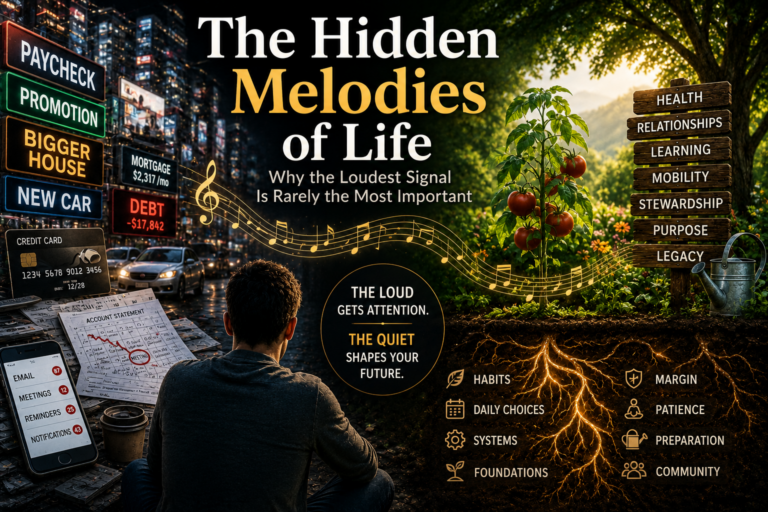
The paycheck melody—which has dominated the audio mix for decades—suddenly goes dead silent. In that new stillness, other melodies instantly become deafening:
- Health and Mobility
- Relationships and Community
- Stewardship and Purpose
- Legacy and Meaning
Retirement doesn’t magically create these new elements of your life; it simply reveals the ones that have been playing quietly in the background all along.
The Lifelong Mixing Board
Imagine your life as a giant audio mixing board in a recording studio. Every slider represents a different core melody.
Age 25 Mix:  [Career: 10] [Adventure: 9] [Learning: 8] [Health: 5] [Legacy: 1]
Age 75 Mix:  [Career: 1]  [Health: 10]    [Family: 9]   [Mobility: 9] [Legacy: 8]
At age twenty-five, a career-heavy mix is perfectly normal. The song is just in a different verse. But by age seventy-five, the sliders inevitably shift. The melodies don’t disappear; the volume changes.
The great surprise of retirement is realizing that the tracks that matter most later in life must be quietly recorded long before they become important.
The Compounding Cost of Daily Repetitions
To see this play out in real-time, we have to look closely at the invisible habits of our working years.
The Shoelace Test
Can you comfortably bend over and tie your shoes? It sounds like a strange health metric, but consider what that motion represents. For decades, bending down to tie your shoes forces you to stretch, balance, squat, and reach. You don’t log it in a fitness tracker, yet it quietly maintains your functional mobility.
Then, convenience takes over. You buy slip-on shoes, elastic laces, or Velcro. The convenience melody gets louder; the mobility melody goes quiet. Nothing dramatic happens for years. But when retirement arrives, your body begins playing back decades of accumulated, unmoving notes. The score was still being written while you sat still.
The Chair That Nobody Notices
The same trap exists at the office. Your visible daily melody sounds like peak success: a stable career, a prestigious title, and a great income.
But beneath that applause sits another melody: eight hours a day in an office chair. Year after year, your career receives validation, while your body quietly records a lack of movement. When people retire and wonder why their vitality has vanished, the answer is rarely found in retirement itself. It is found in the decades that came before it.
The Body Keeps the Score: Your body doesn’t record your good intentions. It records your physical repetitions. Retirement simply hits “play” on the music you stored away.
The Erosion of Modern Legacies
This fading of critical life melodies doesn’t just happen within an individual; it happens across generations.
Consider traditional, self-reliant skills like cooking from scratch, canning vegetables, preserving food, or maintaining tools. Generation One practices it daily. Generation Two remembers watching it. Generation Three merely knows about it. By Generation Four, the melody has faded entirely, leaving a future generation scrambling to relearn basic stewardship.
We see this same erosion in our neighborhoods. Years ago, the community melody was foundational—neighbors shared harvests, borrowed tools, repaired fences, and watched each other’s children. Today, modern convenience allows us to live next to someone for a decade without learning their name.
The cost of this silence is entirely invisible—until a crisis arrives, and we suddenly discover the severe lack of a community melody we stopped practicing.
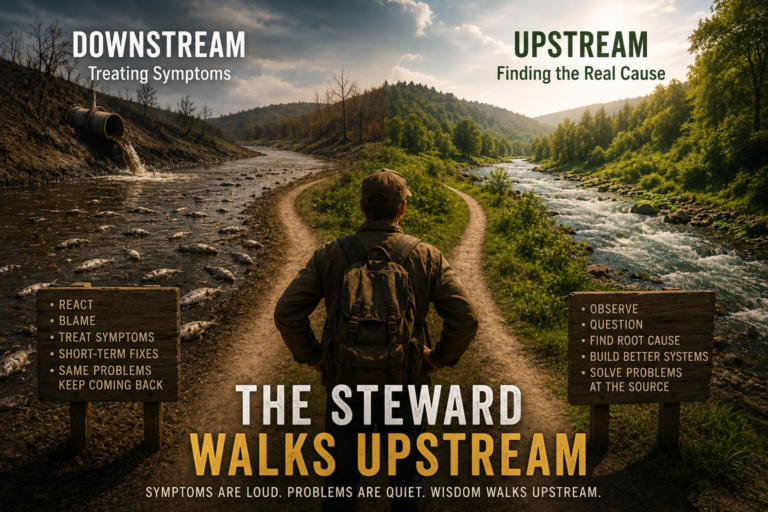
Upstream Stewardship: Recognizing “System Drift”
Why do master electricians, plumbers, and chefs use intensive apprenticeships? It isn’t just to memorize a textbook; it’s to learn the sound of a healthy system.
A master chef knows a sauce is breaking before a measurement reveals it. A gardener notices dry soil before a drought destroys the crop. They have trained themselves to hear “drift.”
Everything Drifts
Left unmonitored, every system naturally decays:
- Gardens drift into overgrowth.
- Bodies drift into stiffness.
- Relationships drift into estrangement.
- Investments drift into risk or imbalance.
Most people only react to drift after a catastrophic failure occurs. Intentional stewards train themselves to hear the wrong note before the audience notices the song has changed.
While modern automation (like automated investing or smart-home tech) is highly beneficial, it must rest on foundational understanding. Automation follows rigid rules, but humans recognize drift. You must understand your life’s systems deeply enough to notice when the melody begins to warp.
The Great Retirement Question
When planning for your future, the standard financial industry always asks: “Will I have enough money?”
While that is a critical question, it shouldn’t be the only one. A far deeper, systemic question to ask yourself today is:
“Which melodies am I practicing right now that will become louder later?”
Are you actively practicing mobility, deep relationships, curiosity, community, and purpose? Because retirement preparation doesn’t start at age sixty-five. It begins decades earlier in the notes you repeat every single day.
| The Finite View (The Finish Line) | The Garden View (The Infinite Season) |
| Work is a grind to escape | Work is a season of cultivation |
| Health is addressed after you stop working | Health is a continuous daily repetition |
| Wealth is a fixed number in an account | Wealth is a living, breathing ecosystem |
| Purpose ends when the paycheck stops | Purpose evolves as the seasons change |
A fruit tree never truly retires. The orchard changes seasons, the harvest comes and goes, and the daily care shifts—but the underlying biological system continues. You are no different. Your traditional job will end, but the larger game of health, learning, stewardship, and legacy continues until your final movement.
Musicians often give this beautiful piece of advice: Play every single note as if the audience is hearing it for the very first time, and as if it may be the last time you ever play it. That is the ultimate secret to a well-cultivated life. It infuses your days with wonder, gratitude, and presence.
Retirement isn’t the end of your song. Every note just matters a little bit more.
Cultivate Your Next Season: Action Steps
Don’t wait for a change in season to start auditing your life’s mixing board. Take control of your upstream systems today:
- 🎛️ Audit Your Audio Mix: Look at your calendar and budget from the past month. If your life was a song right now, which melody is drowning out everything else?
- 🛠️ Practice One Legacy Skill: Reclaim a quiet melody this week. Mend something broken, cook a meal entirely from scratch, or introduce yourself to a neighbor you haven’t met.
- 🩺 Take the Mobility Test: Pay attention to your physical repetitions today. Sit less, stretch more, and protect the physical foundation you will need for your future seasons.
💬 Join the Chorus
What is one “quiet melody” you want to turn up the volume on before you reach retirement? How are you preparing your health and relationships for the next season of your life? Share your thoughts in the comments below!
Where to Go Next
If retirement reveals these hidden melodies, how do we train our ears to hear them before they become deafening? How do we successfully distinguish between a fleeting symptom and a deep, systemic root cause?
We break down the exact blueprint for proactive lifestyle auditing in our core guide: [The Hidden Melodies of Life: Why the Loudest Signal Is Rarely the Most Important →]
Wealth is not accumulated. It is cultivated.