The Steward Walks Upstream: Why Symptoms Are Loud, Problems Are Quiet
Most people do not notice problems. They notice symptoms.
While the distinction sounds incredibly small, it represents a massive cognitive divide. In fact, it is the defining boundary between people who continually solve problems and people who spend their lives frantically reacting to them.
- A symptom is the visible effect—what you see.
- A problem is the underlying root cause—what created what you see.
Most people stop entirely at the symptom. The intentional steward, however, keeps walking upstream. That single habit changes absolutely everything about how you build wealth, manage your health, and structure your life.
The Parable of the Dead Fish
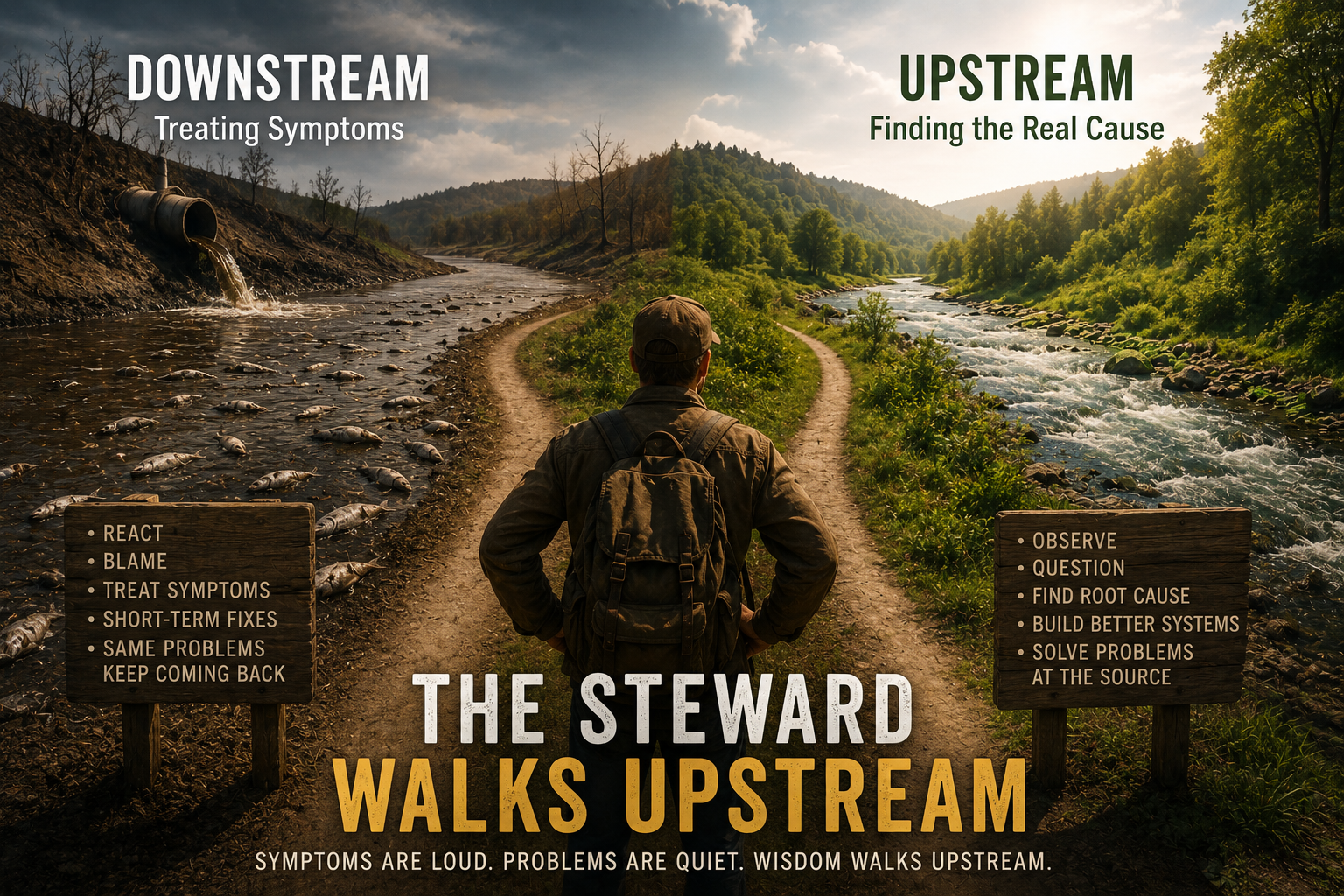
Imagine walking beside a pristine river. At first, everything seems normal. Then, you notice something floating in the water: a dead fish. A little farther downstream, you spot another. Then another. Soon, there are dozens of them bobbing on the surface.
Most people instinctively focus on the fish. They discuss the fish, photograph them, argue about them, and map out elaborate strategies to clear them away.
The steward completely bypasses the chaos and asks a fundamentally different question: “What happened upstream?”
[Upstream Root Cause: Chemical Spill] ──> [River System] ──> [Downstream Symptom: Dead Fish]
The dead fish are not the beginning of the story; they are the absolute end of it. Somewhere miles upstream, there is a chemical leak, a broken containment system, or a severe ecological imbalance.
The fish are simply the messengers. The messenger is never the problem; it is just delivering unavoidable news about the problem. Real life operates under this exact same law of fluid dynamics.
Cultivating Systems Thinking: Leaves vs. Soil
A novice gardener walks into the backyard and notices yellow leaves on a prize tomato plant. The yellow leaves are obvious, unsightly, and demand immediate attention. They are loud.
The untrained eye immediately concludes: “The problem is yellow leaves.” They buy topical leaf sprays, trim away the discoloration, and hope for the best.
But yellow leaves are rarely the problem. They are a downstream symptom. The actual problem is buried completely out of sight:
- Severe nutrient deficiencies
- Waterlogged or poorly drained roots
- Compacted soil starving the plant of oxygen
- An improper, imbalanced soil pH
The leaves are merely a diagnostic report. The gardener who treats only the foliage remains permanently trapped in a cycle of decay. The gardener who shifts focus to improving the soil biology solves the issue permanently.
This is exactly how gardeners transform into powerful systems thinkers. They learn the ultimate truth of cultivation: visible problems almost always originate in completely invisible places.
The Financial “Yellow Leaf”
Our financial structures are filled with downstream yellow leaves. Consider the common refrain: “I’m broke.”
To the person experiencing it, an empty bank account feels like the primary problem. It isn’t. Being broke is almost always a lagging symptom.
The real, upstream causes are quietly operating in the background:
| Downstream Symptom (The Leaf) | Upstream Cause (The Soil) |
| “My credit card balance is maxed out.” | Unchecked lifestyle inflation and a complete lack of financial margin. |
| “An unexpected car repair ruined my month.” | The absence of a dedicated emergency fund system. |
| “I can never seem to get ahead.” | Weak financial habits and automated consumer debt cycles. |
An empty bank account is simply the visible, delayed expression of invisible decisions repeated over time. The steward trains themselves to distinguish between the current account balance (the symptom) and the daily behaviors that created it (the system).
Why We Seductively Chase Symptoms
If upstream thinking is so effective, why do most people stay downstream fighting dead fish? Because symptoms are incredibly seductive.
Symptoms are glaringly obvious, create immense urgency, and offer the comforting illusion of quick, satisfying fixes. True problems, on the other hand, are remarkably different. True problems are inherently boring, invisible, foundational, and agonizingly slow-moving.
- People want thriving tomatoes; they don’t want to turn compost piles.
- People want massive investment compounding; they don’t want to track a monthly budget.
- People want a lean, energized body; they don’t want to enforce an unglamorous 8-hour sleep schedule.
- People want deeply connected relationships; they don’t want to initiate uncomfortable conversations.
Symptoms attract all the attention, but your foundations determine your ultimate outcomes.
The Dashboard Fallacy and System Drift
Modern life has trained us to become obsessive watchers of digital dashboards. We constantly track stock tickers, credit scores, fitness wearables, bank balances, and real-time analytics notifications.
While dashboards are incredibly useful tools, we must remember: the dashboard is not the system. It is merely a mirror reporting on the health of the system. A dashboard can instantly alert you that something has changed, but it can almost never tell you why.
What Apprenticeships Teach Us
Think about why master trades—like electricians, plumbers, chefs, and blacksmiths—rely so heavily on multi-year apprenticeships. Most assume it is purely to memorize mechanical skills.
In reality, it is to teach the apprentice what normal sounds like.
A master chef can smell that a reduction is breaking before a digital food thermometer registers a single degree of change. A master electrician senses an anomalous magnetic hum before a digital meter throws an error code. They can hear the “Drift Melody” long before it causes a catastrophic system failure.
Guarding Against Automation Risks
We live in an extraordinary golden age of automation: smart thermostats, automated target-date funds, predictive AI systems, and self-driving vehicles handle our heavy lifting. None of these technologies are inherently bad—most are spectacular.
However, they introduce a subtle psychological risk: we begin blindly trusting automated systems we no longer fundamentally understand.
[Automation] ──> Executes Rigid Instructions
[Human Steward] ──> Evaluates and Detects System Drift
A commercial pilot must still master manual aerodynamics. A world-class chef must still understand the raw chemistry of food behavior. An exceptional investor must still comprehend how market macro-cycles function.
Automation is built to execute instructions; stewards are built to detect drift. The danger is never the progress of automation—it is the voluntary surrender of our own baseline understanding.
The Manual Transmission Analogy
There was a time when learning to drive meant mastering a manual transmission. You had to actively listen to the pitch of the engine, feel the physical vibrations of the drivetrain, and develop acute environmental awareness.
Today’s automatic vehicles are objectively more convenient. But as the convenience melody grew louder, the engagement melody went completely silent. Progress is wonderful, but an intentional steward always tracks exactly what is gained and what is lost whenever the volume changes.
Building Structural Scales
Musicians understand structural foundations better than anyone. Consider a standard musical scale: Do, Re, Mi, Fa, Sol, La, Ti, Do. Every single note establishes the context and structural support for the note that follows it.
If a musician tries to skip haphazardly through the scale (Do $\rightarrow$ Sol $\rightarrow$ Ti), the composition turns chaotic. The notes technically exist, but the melody is completely unstable because the foundational support is missing.
Your financial life requires building an identical structural scale:
Emergency Fund – Debt Control – Savings Habits – Investing – Compounding – Financial Freedom
Reactors try to jump straight to the flashy solos like investing or financial freedom. Stewards focus entirely on building the baseline scales. They know that your body, your relationships, and your finances are constantly recording your physical repetitions—not your plans or intentions.
The Ultimate Steward’s Question
When confronted with a crisis, the average reactor immediately asks: “What is wrong?”
The upstream steward looks at the exact same situation and asks: “What caused what I am seeing?”
This single shift in vocabulary completely realigns your focus:
- From downstream fish to the health of the river
- From yellowing leaves to the chemistry of the soil
- From temporary outcomes to permanent foundations
- From flashing dashboards to fundamental reality
The greatest competitive advantage in life doesn’t come from luck, superior intellect, or sudden, dramatic interventions. It comes from training your ear to hear the quiet, upstream signals while everyone else is still deafened by the loud downstream consequences.
Listen closely to the drift. Fix the system, and the symptoms will take care of themselves.
Upstream Action Blueprint: Audit Your Systems
Stop chasing downstream symptoms today. Use this step-by-step diagnostic framework to walk upstream in your own life:
1.Isolate the Symptom:Step 1.
Identify the loudest, most stressful “dead fish” or “yellow leaf” currently distracting you (e.g., chronic exhaustion, an imbalanced investment portfolio, or escalating credit card debt).
2.Deploy the ‘Five Whys’ Framework:Step 2.
Ask yourself why that symptom exists. When you get an answer, ask why again. Repeat this process at least five layers deep to move past surface excuses and uncover the invisible system failure.
3.Locate the System Drift:Step 3.
Determine where you allowed convenience or automation to replace your fundamental understanding. Pinpoint exactly when and where the core melody began to slowly slide out of tune.
4.Rebuild the Foundational Scale:Step 4.
Stop trying to execute complex, advanced solutions. Return to the very first missing note on your life scale—whether that means setting up a basic budget, fixing your sleep hygiene, or having an uncomfortable conversation.
✍️ The Stewardship Trilogy in One Sentence
The hidden melodies are always playing; retirement eventually turns up the volume; and proactive stewardship teaches you how to hear them long before they become impossible to ignore.
💬 Walk Upstream With Us
What “dead fish” have you been trying to clear out of your life lately? If you walk upstream, what is the real, hidden problem causing it? Drop a comment below and let’s dissect the systems together!
Explore the Rest of the Trilogy
Stewardship is a continuous journey of learning to hear what others miss. Navigate through the full cultivation series:
- [Part 1: The Hidden Melodies of Life — Why the Loudest Signal Is Rarely the Most Important →]
- [Part 2: The Game Never Ends — Why Retirement Is Just Another Season of the Garden →]
Wealth is not accumulated. It is cultivated.