
🌿20 Pounds In. 3.5 Pounds Out.
Originally published · Letters from the Garden
Hi friends,
This week I put twenty pounds of russet potatoes into my dehydrator. They came home from Kroger in two ten-pound bags that were on sale for $5 each, so the whole experiment started with a $10 purchase.
I had a few meals in mind. I wanted potatoes ready for au gratin potatoes, but I also knew the dried slices could become potato soup, breakfast hash, casseroles, and other meals later in the year.
I peeled the potatoes, sliced them about 1/8 to 1/4 inch thick, blanched them, cooled them in an ice-water bath, and loaded the trays. When they were finished drying, I weighed the result.
3.51 pounds.
Twenty pounds of potatoes had become two little bags.
The potatoes hadn’t disappeared. The water had.
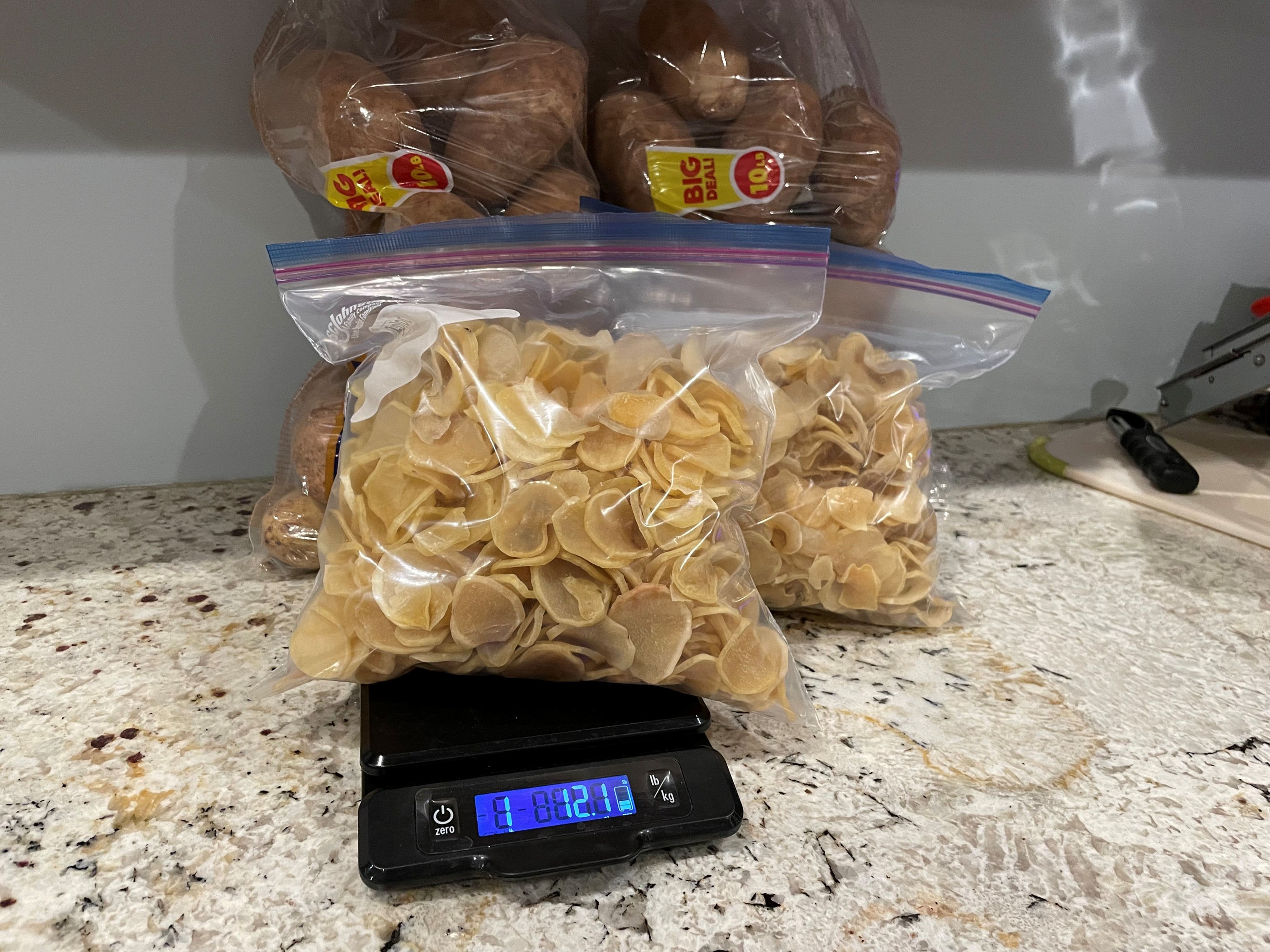
I was curious about the value, too. A packaged dehydrated potato product I found was selling for roughly $11–$12 per pound. My potatoes cost me $10 for the entire twenty pounds, so I wanted to see what that original purchase looked like after I took the peels and water out of the equation.
Why Preserve Potatoes?
Could I store these potatoes fresh? Absolutely. Properly cured, mature russet potatoes can keep for many months under suitable root-cellar conditions, and Penn State notes that good-quality late-season russets can remain in condition for about seven or eight months. Penn State Extension
Dried potatoes solve a different storage problem. They take up dramatically less space and, once properly dried, should be stored somewhere cool, dry, and dark. National Center for Home Food Preservation
So I don’t have to preserve every potato the same way.
I can choose the storage system that fits my year.
And don’t get me started on how many potatoes I cut, blanch, and freeze.
The point isn’t necessarily to make food last forever. Sometimes it is simply about taking something abundant today and putting it somewhere useful for later.
We’re not just removing water. We’re moving food through time.
The Old Ronco
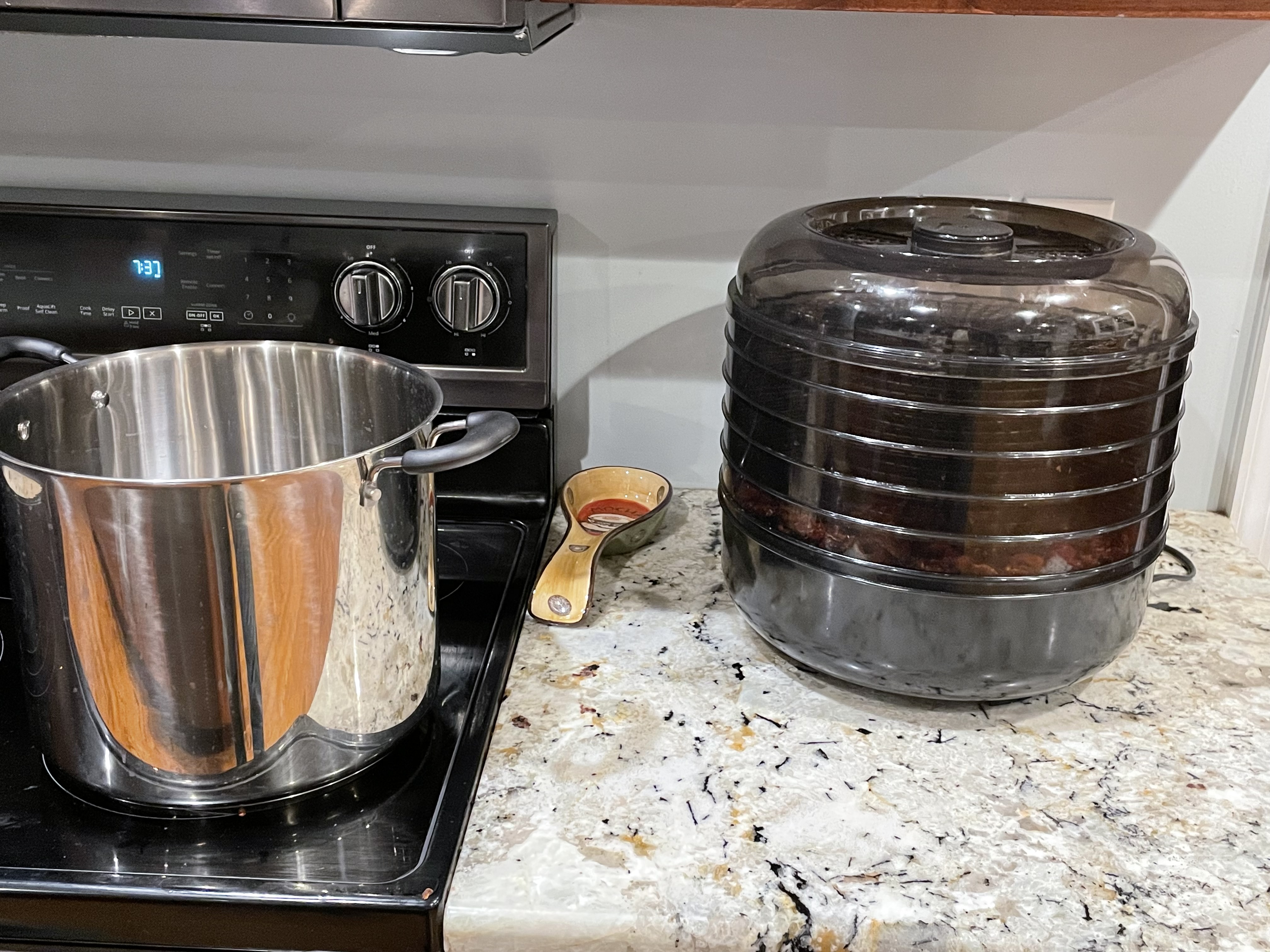
The dehydrator I used for this batch was given to me by my in-laws because they weren’t using it. I’ve been using it ever since.
After seeing what it did to twenty pounds of potatoes, I started wondering what this old machine actually costs to run.
That also brought me back to a little professional kitchen math.
AP Versus EP
In professional kitchens, we use AP, or As Purchased, and EP, or Edible Portion, to understand what an ingredient actually costs after preparation.
AP (As Purchased) is the amount and price of the food exactly as you bought it. That might be ten pounds of potatoes, one head of lettuce, a dozen eggs, a gallon of milk, or another quantity altogether. The important part is knowing what you bought and what you paid for it.
EP (Edible Portion) is what remains after peeling, trimming, cleaning, or otherwise preparing the food.
Here’s why that matters.
If I buy ten pounds of potatoes for $5, my AP cost is $0.50 per pound.
Suppose I remove one pound of peels and trimming. That waste represents about $0.50 of the food I paid for, leaving nine pounds of usable potato.
I still spent the entire $5, so those nine pounds now cost me about $0.56 per pound.
The more of what I buy that I don’t use, the more of the original purchase cost gets carried by what remains.
Then dehydration takes that usable potato and concentrates the cost into an even smaller finished product.
I didn’t weigh my potatoes after peeling this first batch, so I don’t know my actual EP. I can estimate it, but I’d rather measure it.
So I bought two more ten-pound bags before the sale ended.
Next Week’s Experiment
One batch will be peeled and one will keep the skins. I’ll weigh the peels, the prepared potatoes, and the final dried product.
I’m also putting a Kill A Watt meter on the Ronco Dehydrator.
Then we’ll know.
My guess is we will see that leaving the skins on gives us a higher finished yield and a lower cost per pound without sacrificing our au gratin potatoes and other dishes
🌱 Play Along
Want to try this with something you’re preserving?
Write down what you bought, what you paid, and what you removed:
AP (what you bought) ______ at $______
WASTE (peels, stems, trim, etc.) ______
EP (what remained after preparation) ______
END WEIGHT (what you have after preserving) ______
Then complete your kitchen Mad Lib:
I started with ______ of food for $______, which means I paid $______ per unit. I removed ______ of waste, leaving ______ of usable food. After preserving it, I ended with ______, which cost me $______ per finished unit. I found a comparable product for $______ per finished unit at the store, so I saved $______ per finished unit by doing it myself.
Here’s my potato example:
I started with 20 lb of potatoes for $10, which means I paid $0.50 per pound. I estimate I removed 2 lb of peels and trimming, leaving about 18 lb of usable potato. After dehydrating, I ended with 3.51 lb, which put my potato cost at about $2.85 per pound of finished dried potato. I found a comparable product for about $11 per pound at the store, so I saved about $8.15 per pound by doing it myself, before counting electricity, packaging, and my time.
That’s the apples-to-apples comparison.
Now you can decide whether the preservation was worth it to you.
A Couple Places to Continue the Journey
This potato experiment made me think about two questions that come up every time we preserve food: What should I do with what I grew or bought? And which preservation method fits the food I have?
Our Potato Field Guide answers the first question, with russets, Yukon Golds, red potatoes, fingerlings, and more, along with the ways their differences show up in the kitchen.
Explore the Potato Field Guide →
Our Preservation Pantry Field Guide answers the second. It looks at freezing, canning, drying, fermenting, pickling, storage, and the bigger decision of choosing the preservation system that fits what you have.
Explore the Preservation Pantry →
From the Community
I’m also thinking about buying a new dehydrator, and I’d rather hear from people who actually use them than rely on another manufacturer’s sales pitch.
What dehydrator do you use and trust?
Send me the make and model, especially if you’ve had it for years. I’d like to know what people in this community are actually using.
I’ll bring you the next set of numbers next week.
See you in the kitchen,
Karel 🌻
P.S. What’s the most surprising thing you’ve ever dehydrated? And if you have a dehydrator you swear by, tell me about it.
Know someone who loves preserving food? Forward this newsletter to them. Maybe they’ll run the experiment with you.