A Garden-to-Kitchen Guide for Turning Seasonal Abundance Into Year-Round Food Security
Preserve Today. Enjoy Tomorrow. Build a Legacy.
The Preservation Pantry Field Guide Promise
This is not just an article about jars.
It is not just a canning guide.
It is not just a freezer checklist.
It is a full garden-to-kitchen preservation system for anyone who wants to turn seasonal abundance into future meals, pantry confidence, food savings, gifts, resilience, and household freedom.
A gardener can use this guide to decide what to do when the tomatoes ripen all at once, the cucumbers pile up, the basil bolts toward frost, the zucchini overwhelms the counter, the beans keep coming, the berries soften fast, and the root crops need a winter plan.
A cook can use this guide to choose whether a harvest should become sauce, soup base, jam, frozen packs, herb salt, dried powder, pickles, ferments, cold storage, or ready-to-use pantry ingredients.
A beginner can use this guide to understand which preservation methods are easiest, which require more precision, and why food safety is not optional.
A pantry builder can use this guide to stop collecting random jars and start building meal pathways.
A Wealth Garden reader can use this guide to understand one of the most important principles in the entire system:
The garden produces value. The kitchen transforms value. The pantry holds value.
Preservation is the conversion layer.
Without it, abundance has a deadline.
With it, abundance becomes flexible.
Save this guide if you want to:
Know which foods freeze best.
Know when to use water-bath canning.
Know when pressure canning is required.
Understand why acidity matters.
Understand why low-acid vegetables cannot simply be water-bath canned.
Learn how drying and dehydrating concentrate flavor.
Use fermentation safely and confidently.
Turn cucumbers, onions, beets, carrots, peppers, and beans into pickles.
Store roots, onions, garlic, squash, potatoes, apples, and pantry staples properly.
Avoid common preservation mistakes.
Build a beginner preservation system in layers.
Connect preservation to the larger Gardening Chef Field Guide Library.
Start Here: Choose Your Reading Path
| If you are… | Start with… | You will learn… |
|---|---|---|
| A beginner | The Core Lesson: Match the Food to the Method | Why preservation starts with the crop, not the jar. |
| A safety-minded reader | Safety First: Preservation Is Food Science | Why tested recipes matter for canning and shelf-stable storage. |
| A gardener with surplus | What to Preserve | How to route tomatoes, peppers, herbs, berries, cucumbers, beans, cabbage, roots, onions, garlic, and squash. |
| A pantry builder | The Pantry Success Formula | How ingredients, method, storage, and rotation work together. |
| A meal planner | The Preservation Pantry as a Meal System | How preserved foods become soups, pasta meals, tacos, breakfasts, and winter comfort. |
| A Wealth Garden reader | The Pantry Multiplier | How temporary abundance becomes durable household value. |
| A small-space preserver | Best Preservation Choices by Goal | Which methods work when space, money, or equipment is limited. |
Preservation Pantry Master Index
| Section | Use it when… |
|---|---|
| The Guide Promise | You want the big-picture reason preservation matters. |
| Why the Preservation Pantry Deserves Its Own Guide | You want to understand preservation as a system, not a hobby. |
| Field Guide Poster Preview | You want the visual reference purpose. |
| Match the Food to the Method | You need the most important preservation decision rule. |
| Preservation Methods at a Glance | You want a fast comparison chart. |
| Safety First | You need the non-negotiable food safety foundation. |
| High Acid vs Low Acid | You need to know why canning methods differ. |
| Meet the Preservation Methods | You want freezing, water-bath canning, pressure canning, dehydrating, air drying, fermenting, pickling, and cold storage explained. |
| What to Preserve | You want crop-by-crop preservation strategy. |
| Storage Reference Guide | You want pantry zones and storage logic. |
| Pantry Success Formula | You want the four-part system. |
| Pantry Golden Rules | You want practical habits that prevent waste. |
| Common Preservation Mistakes | You want to avoid the errors that ruin food, quality, or safety. |
| Preservation by Crop Type | You want specific guidance for tomatoes, peppers, herbs, berries, cucumbers, beans, cabbage, roots, alliums, and winter squash. |
| Preservation as a Meal System | You want pantry ingredients to become dinner. |
| Wealth Garden Connection | You want the deeper value framework. |
| Beginner Preservation Pantry | You want a step-by-step starting path. |
| FAQ | You want quick answers to common preservation questions. |
The Preservation Pantry
A garden gives in waves.
One week there are three cucumbers.
The next week there are twenty.
A tomato plant begins slowly, then suddenly every counter has ripening fruit.
Basil grows faster than the kitchen can use it.
Beans arrive by the handful, then by the basket.
Peppers change from green to red almost overnight.
Apples, berries, herbs, squash, onions, garlic, greens, roots, and cabbage each have their own moment of abundance.
That is the beauty of the garden.
It is also the problem.
Fresh food is alive, temporary, and seasonal.
If the gardener does not have a plan, abundance becomes pressure.
Tomatoes soften.
Herbs wilt.
Cucumbers outgrow their best texture.
Greens collapse in the refrigerator.
Fruit ripens faster than a family can eat it.
Zucchini quietly becomes furniture.
The preservation pantry solves that problem.
It turns the question from:
How do I use all this before it goes bad?
Into:
What future meal is this harvest becoming?
A jar of sauce is summer saved for winter.
A bag of frozen berries is breakfast months from now.
A bundle of dried herbs is flavor waiting in the dark.
A crock of sauerkraut is cabbage transformed.
A tray of dehydrated tomatoes is sunlight concentrated.
A root cellar shelf is patience made practical.
Preservation is not just storage.
It is stewardship.
It is the art of catching abundance at the right moment, choosing the right method, and carrying the season forward.
Why the Preservation Pantry Deserves Its Own Field Guide
Every good garden eventually teaches the same lesson:
Growing food is only half the system.
The other half is knowing what to do when the harvest arrives.
Without preservation, the garden remains tied to the day’s appetite. You can only eat what you can eat right now.
With preservation, the harvest becomes flexible. It can become jars, bags, powders, sauces, ferments, dried bundles, freezer packs, soup bases, pantry staples, gifts, and future meals.
This is where a garden becomes a household system.
Preservation helps with:
Reducing waste.
Extending seasonal flavor.
Building emergency food reserves.
Saving money over time.
Improving meal planning.
Creating gifts and small products.
Capturing peak freshness.
Turning surplus into value.
Building confidence and skill.
But accuracy matters.
Preservation is not one skill.
It is a family of skills.
Some methods are forgiving. Others are exact.
Freezing is simple and safe for beginners.
Drying requires enough moisture removal to prevent spoilage.
Fermentation requires salt, time, temperature, cleanliness, and observation.
Pickling requires proper acidity.
Canning requires tested recipes and the correct processing method.
The National Center for Home Food Preservation describes itself as a source for current research-based recommendations for home food preservation, and it hosts USDA Complete Guide to Home Canning resources that cover preserving food, canning, pickled products, sweet spreads, freezing, and drying.
That is the spirit of this guide:
Preserve boldly, but preserve correctly.
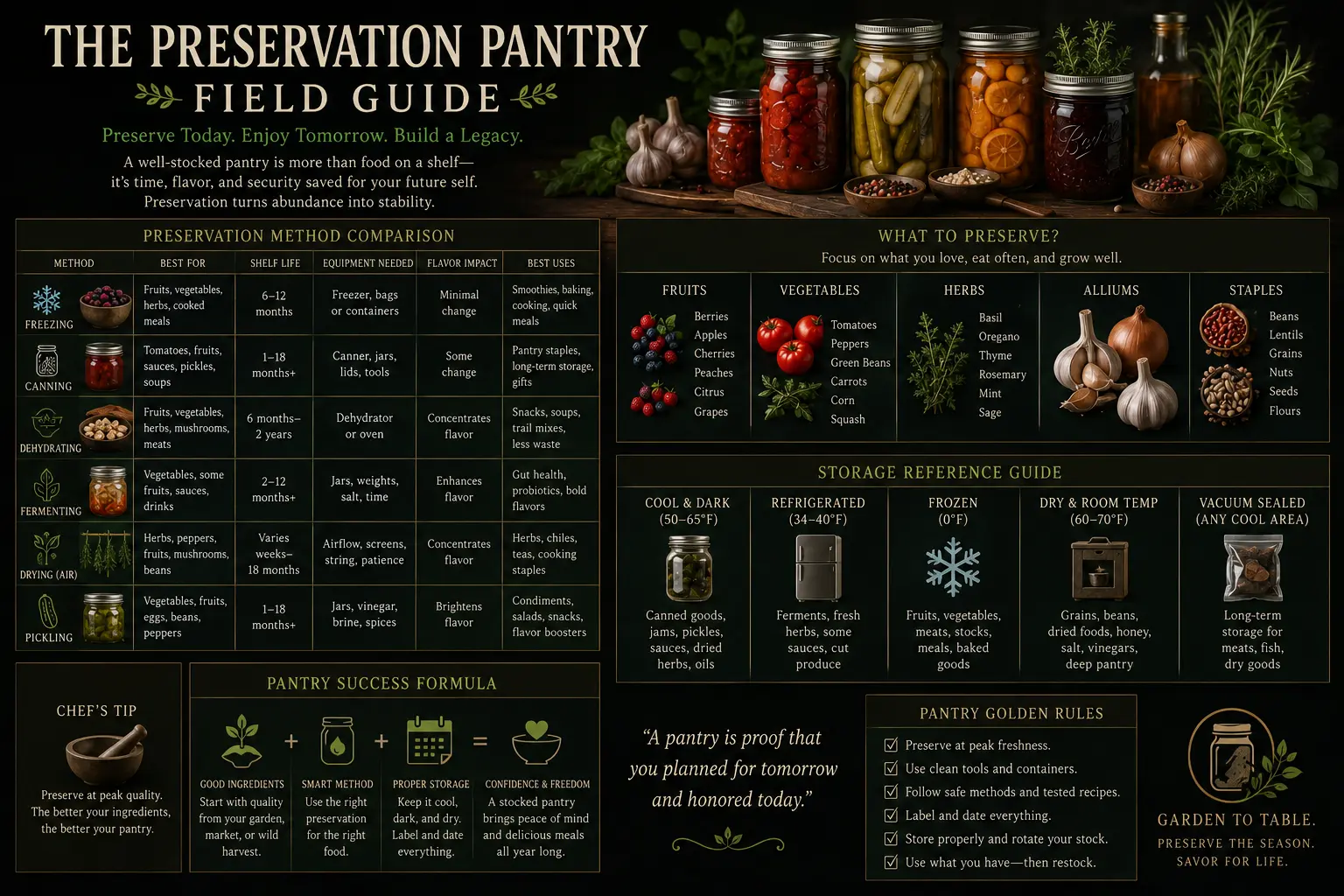
Field Guide Poster Preview
The Preservation Pantry Field Guide poster is designed as a kitchen and pantry decision tool.
Use it when you need to answer:
What should I preserve?
Which method fits this food?
What equipment do I need?
How long will quality last?
How will the flavor change?
Where should I store it?
What safety rules matter most?
How do I turn abundance into meals instead of waste?
The poster gives the map.
This field guide gives the deeper explanation.
Download the Printable Preservation Pantry Field Guide — $0.99
[Button: Download the Preservation Pantry Field Guide]
The Core Lesson: Match the Food to the Method
The biggest mistake in preservation is thinking every food can be preserved the same way.
It cannot.
A tomato can become sauce, salsa, dried slices, freezer packs, roasted purée, powder, or canned product, but each path has different rules.
A cucumber can become refrigerator pickles, fermented pickles, canned pickles, relish, or dehydrated chips, but each method changes texture and safety requirements.
Basil can become pesto, frozen herb cubes, dried leaves, herb salt, compound butter, or infused vinegar, but each one has a different shelf life and storage need.
Green beans can be frozen, pressure canned, pickled, or fermented, but plain green beans are low-acid and cannot be safely water-bath canned without proper acidification and a tested process.
That is the preservation pantry lesson:
Do not begin with the jar. Begin with the food.
Ask:
What is this crop best at?
Is it high-acid or low-acid?
Does it freeze well?
Does it dry well?
Does it ferment well?
Will it lose texture?
Will it become more useful as a sauce, powder, pickle, frozen pack, dried ingredient, meal starter, or cold-storage crop?
Do I want convenience, shelf stability, flavor transformation, or long-term storage?
Preservation is not only about saving food.
It is about choosing the right future for the harvest.
Preservation Methods at a Glance
| Method | Best For | Storage Life | Equipment Needed | Flavor Impact | Best Uses |
|---|---|---|---|---|---|
| Freezing | Fruits, vegetables, herbs, cooked meals, sauces | Quality varies by food and packaging | Freezer, bags or containers | Minimal flavor change, some texture softening | Smoothies, baking, soups, sauces, quick meals |
| Water-Bath Canning | High-acid foods, jams, jellies, many fruits, tested pickles | Shelf-stable when properly processed | Canner, jars, lids, rack, tested recipe | Some cooked flavor | Pantry staples, gifts, long-term storage |
| Pressure Canning | Low-acid vegetables, meats, poultry, seafood, beans, broths, tested soups | Shelf-stable when properly processed | Pressure canner, jars, lids, tested recipe | Cooked flavor | Shelf-stable meals, beans, vegetables, soups |
| Dehydrating | Fruits, vegetables, herbs, mushrooms, some meats with proper method | Months to longer depending food and storage | Dehydrator or oven, airtight containers | Concentrates flavor | Snacks, powders, soups, trail mixes |
| Air Drying | Herbs, peppers, garlic, onions, flowers, seed crops | Weeks to months depending crop and storage | Airflow, screens, string, racks | Concentrates flavor | Herbs, teas, chile strings, seasoning |
| Fermenting | Cabbage, cucumbers, carrots, radishes, peppers, garlic, some sauces | Often refrigerated after active fermentation | Jars or crocks, salt, weights, time | Tangy, complex, living flavor | Sauerkraut, kimchi-style vegetables, fermented pickles, hot sauce |
| Pickling | Cucumbers, onions, beets, carrots, peppers, beans, radishes | Days to shelf-stable depending method | Vinegar or brine, jars, refrigerator or canner | Brightens flavor | Condiments, snacks, salads, flavor boosters |
| Cold Storage | Roots, winter squash, potatoes, onions, garlic, apples | Weeks to months depending crop | Cool storage, crates, ventilation | Minimal change, sometimes sweetening | Winter pantry, root cellar meals |
Safety First: Preservation Is Food Science
A preservation pantry should feel beautiful, abundant, and empowering.
But it must also be safe.
This is especially important for canning. The canning process uses heat, jars, and vacuum sealing to destroy spoilage organisms and prevent recontamination after processing. Done correctly, it is a powerful preservation method. Done incorrectly, it can create serious food safety risks.
The most important rule is this:
Use tested recipes from trusted sources for shelf-stable canning.
Do not invent canning times.
Do not reduce vinegar in pickles.
Do not thicken canned products unless the tested recipe says to.
Do not water-bath can low-acid vegetables in plain water.
Do not assume a sealed lid means the food is safe.
Do not trust old family recipes unless they match current tested guidance.
Penn State Extension summarizes safe home canning methods as boiling-water bath canning, atmospheric steam canning, and pressure canning, and specifically warns against taking chances with old handed-down recipes that have not been scientifically tested.
The National Center for Home Food Preservation explains that processing time depends on food type, packing method, jar size, and elevation, and it notes that high elevations require process adjustments because water boils at lower temperatures as elevation increases.
This guide will help you understand the system.
But when it is time to can, follow the tested recipe.
High Acid vs Low Acid: The Line You Must Respect
In home preservation, acidity determines which canning method is appropriate.
High-acid foods include many fruits, jams, jellies, and properly acidified pickles.
Low-acid foods include most vegetables, meats, poultry, seafood, beans, and many soups.
Low-acid foods require pressure canning when shelf-stable storage is desired because pressure canners reach temperatures above boiling water. Boiling-water canning is not an appropriate shortcut for plain low-acid vegetables or meats. The National Center for Home Food Preservation notes that safely processing low-acid foods in boiling water would require extremely long times, while pressure canning provides the method designed for these foods.
This is the preservation pantry’s non-negotiable rule:
Acid decides the method.
A green bean is not a peach.
A carrot is not a jam.
Plain vegetable soup is not a pickle.
A jar of tomato sauce is not automatically safe just because it looks right.
The pantry must be built on trust, not guesswork.
Meet the Preservation Methods
Freezing: The Beginner’s Best Friend
Freezing is one of the easiest and most forgiving preservation methods.
It is often the best first step for beginners because it does not require pressure canning, acidity calculations, or shelf-stable processing.
Freezing works especially well for berries, chopped peppers, herbs in cubes, roasted tomatoes, blanched green beans, peas, corn, cooked squash purée, pesto, soup bases, stock, shredded zucchini, fruit slices, and prepared meals.
The biggest limitation is texture.
Freezing expands water inside plant cells, so many foods soften after thawing. That is not a problem if the food is going into soup, sauce, smoothie, baking, stew, chili, or cooked dishes. It is a problem if you expect a thawed cucumber to behave like a fresh cucumber.
The USDA Food Safety and Inspection Service explains that food stored continuously at 0°F remains safe, but quality declines over long freezer storage.
For many vegetables, blanching before freezing is important because it slows or stops enzyme actions that cause loss of flavor, color, and texture.
Best Foods to Freeze:
Berries, peaches, cherries, apples for cooking, tomatoes, peppers, green beans, peas, corn, herbs, pesto, cooked squash, greens, soup bases, stocks, sauces, and prepared meals.
Best Uses:
Smoothies, pies, muffins, soups, sauces, stews, chili, casseroles, quick dinners, winter baking.
Pantry Lesson:
Freezing is the bridge between fresh harvest and future convenience.
Water-Bath Canning: The High-Acid Shelf
Water-bath canning is used for high-acid foods and properly acidified foods.
This includes many fruits, jams, jellies, preserves, tested tomato recipes with proper acidification, tested salsas, tested relishes, and tested pickles.
This method is beautiful because it creates shelf-stable jars without needing freezer space.
A pantry shelf of tomato sauce, apple butter, berry jam, peach slices, salsa, and pickles feels like a season preserved in glass.
But water-bath canning must be respected.
It is not a general-purpose method for all foods.
It is for foods with the proper acidity and a tested process.
USDA and NCHFP canning resources separate guidance by food type, including fruits, tomatoes, vegetables, fermented and pickled products, and jams and jellies because each category behaves differently in processing.
Best Foods for Water-Bath Canning:
Jams, jellies, fruit preserves, many fruits, tested pickles, tested relishes, tested salsa, tested tomato products with proper acidification.
Best Uses:
Pantry staples, gifts, sauces, condiments, fruit desserts, long-term storage.
Pantry Lesson:
A beautiful jar must also be a safe jar.
Pressure Canning: The Low-Acid Workhorse
Pressure canning is the method for low-acid foods that need shelf-stable storage.
This includes most plain vegetables, meats, poultry, seafood, dried beans, broths, and many tested soups.
The pressure canner is not the same as a boiling-water bath. It processes jars at temperatures above boiling water, which is necessary for low-acid foods.
Pressure canning is one of the most powerful preservation skills because it can turn a garden and kitchen into shelf-stable meals.
Green beans, carrots, potatoes, beans, chicken, broth, and tested soups can become pantry assets when processed correctly.
But it is also the method where precision matters most.
Use the right pressure for your altitude.
Use the correct jar size.
Use the tested processing time.
Vent the canner properly.
Do not rush cooling.
Do not thicken soups or alter density unless a tested recipe allows it.
Do not use electric multicookers as pressure canners unless reliable canning guidance says that specific device and use have been tested for safe canning.
Best Foods for Pressure Canning:
Plain low-acid vegetables, beans, meats, poultry, seafood, broths, and tested soups.
Best Uses:
Shelf-stable meals, emergency pantry, ready-to-use vegetables, beans, broth, convenience foods.
Pantry Lesson:
Pressure canning is not difficult, but it is exact.
Dehydrating: Concentrating the Harvest
Dehydrating removes moisture so food becomes lighter, smaller, and more shelf-stable when dried and stored properly.
This method is excellent for herbs, tomatoes, apples, berries, mushrooms, peppers, onions, garlic, zucchini chips, fruit leather, soup vegetables, citrus slices, greens, and powders.
Dehydrating is one of the most satisfying preservation methods because it changes volume dramatically.
A basket of herbs becomes a jar.
A tray of tomatoes becomes a small bag of concentrated flavor.
Apples become rings.
Peppers become flakes or powder.
Greens become soup powder.
The key is dryness. Food that is not dried enough can mold. Food that is dried but stored poorly can reabsorb moisture. The National Center for Home Food Preservation warns that dried foods are susceptible to moisture reabsorption and insect contamination, and recommends cooling dried food completely before packing it into clean, dry, insect-proof containers.
Best Foods to Dehydrate:
Herbs, peppers, tomatoes, apples, berries, mushrooms, onions, garlic, carrots, greens, zucchini, citrus slices, fruit leather.
Best Uses:
Seasoning powders, tea blends, soup mixes, trail snacks, sauces, rubs, pantry flavor boosters.
Pantry Lesson:
Drying turns abundance into concentrated flavor.
Air Drying: The Oldest Pantry Skill
Air drying is simple, beautiful, and ancient.
It works best for crops that naturally dry well: herbs, garlic, onions, hot peppers, certain flowers, and some seed crops.
A hanging bundle of thyme, oregano, rosemary, sage, mint, or lavender feels like a kitchen from another time.
Strings of peppers become both decoration and pantry ingredient.
Garlic and onion curing connects the garden to the cellar.
But air drying still requires the right conditions.
You need airflow, dryness, protection from dust and pests, and enough time.
Thick, wet, or dense foods are not good candidates for casual air drying unless conditions are carefully managed.
Best Foods for Air Drying:
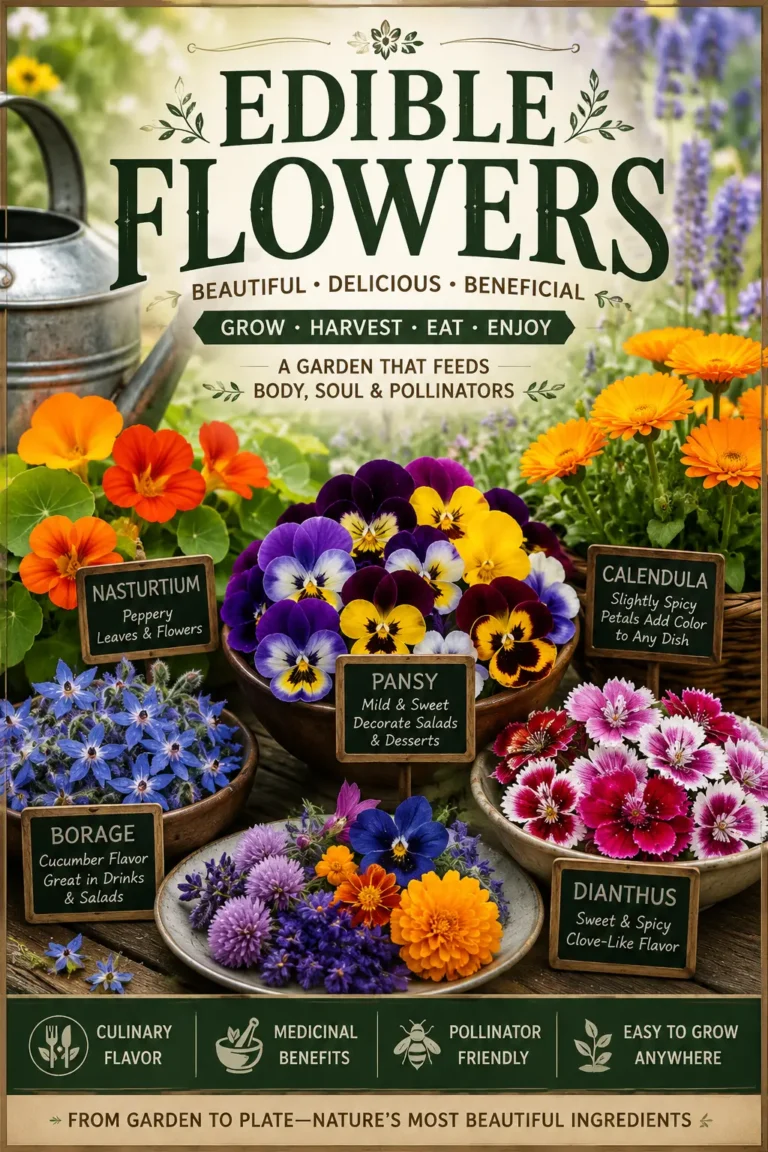
Herbs, hot peppers, garlic, onions, seed heads, edible flowers, some tea herbs.
Best Uses:
Herbal tea, seasoning, chile flakes, seed saving, pantry bundles.
Pantry Lesson:
Air drying teaches patience, airflow, and attention.
Fermenting: Flavor Through Controlled Transformation
Fermentation is not simply storing food.
It is transformation.
Cabbage becomes sauerkraut.
Napa cabbage and radishes become kimchi-style ferments.
Cucumbers become sour pickles.
Peppers become hot sauce.
Carrots become tangy snacks.
Garlic becomes mellow and complex.
Fermentation uses beneficial microbes, salt, time, and the right environment to create acidity and flavor. It can be one of the most rewarding preservation methods because the flavor becomes more complex than the original ingredient.
But fermentation also requires care.
Salt matters.
Clean tools matter.
Keeping food submerged under brine matters.
Temperature matters.
Mold, off smells, sliminess, and unsafe handling should not be ignored.
For sauerkraut, NCHFP guidance includes keeping cabbage covered with brine and fermenting under recommended temperature conditions for good quality.
Best Foods to Ferment:
Cabbage, cucumbers, carrots, radishes, turnips, peppers, garlic, onions, beets, green tomatoes, some fruit ferments.
Best Uses:
Sauerkraut, kimchi-style vegetables, fermented pickles, hot sauce, relishes, condiments.
Pantry Lesson:
Fermentation rewards control, patience, and trust in process.
Pickling: Brightness in a Jar
Pickling uses acid, salt, and often spices to preserve or transform food.
There are two broad home-kitchen categories:
Refrigerator pickles are stored cold and eaten relatively soon.
Canned pickles are processed using tested recipes for shelf-stable storage.
Pickling is excellent for cucumbers, onions, carrots, radishes, beets, green beans, peppers, garlic, okra, cabbage stems, and eggs when handled correctly for refrigeration.
The most important safety point is that canned pickles depend on correct acidity.
Do not reduce vinegar in a shelf-stable pickle recipe unless the tested recipe allows it.
Do not guess at brine strength.
Do not pack jars differently from the tested recipe in ways that change heat penetration or acidity.
Best Foods to Pickle:
Cucumbers, onions, beets, carrots, radishes, peppers, green beans, garlic, okra, cabbage stems, eggs for refrigerator storage.
Best Uses:
Sandwiches, salads, snacks, relish trays, charcuterie boards, tacos, rice bowls, pantry condiments.
Pantry Lesson:
Pickling preserves crunch, brightness, and appetite.
Cold Storage: The Quiet Pantry
Cold storage includes root cellaring, cool basement storage, dry pantry storage, and refrigerator storage.
This method is especially important for potatoes, onions, garlic, winter squash, apples, carrots, beets, cabbage, sweet potatoes, and other storage crops.
The trick is that crops want different conditions.
Potatoes need cool, dark, ventilated storage.
Onions and garlic need dry, ventilated storage.
Carrots and beets need cold humidity.
Winter squash needs cool, dry storage, not cold damp storage.
Sweet potatoes need warmer storage than many root crops.
Cold storage is preservation without a recipe.
It requires curing, sorting, ventilation, darkness, humidity management, and regular checking.
Best Foods for Cold Storage:
Potatoes, onions, garlic, winter squash, pumpkins, apples, carrots, beets, cabbage, turnips, rutabagas, parsnips, sweet potatoes.
Best Uses:
Winter meals, soups, stews, roasting, baking, root cellar cooking.
Pantry Lesson:
Some foods are preserved by being left whole and treated correctly.
What to Preserve
A preservation pantry becomes strongest when it is built around the foods you actually eat.
Do not preserve twenty jars of something your family does not enjoy.
Do not dry herbs you never cook with.
Do not can salsa if you never open salsa.
Do not freeze shredded zucchini without a plan for muffins, soups, fritters, sauces, or breads.
Preserve what you love.
Preserve what you use often.
Preserve what your garden produces well.
Preserve what turns future meals into something easier.
Fruits
Berries, apples, peaches, cherries, grapes, citrus, plums, pears, figs, and some melons can become jams, jellies, frozen packs, dehydrated snacks, fruit leather, syrups, sauces, pie fillings, and desserts.
Fruits are often the friendliest entry into preservation because many are naturally acidic, freeze well, dry well, and make excellent jams.
Vegetables
Tomatoes, peppers, green beans, carrots, corn, squash, cabbage, cucumbers, beets, onions, greens, okra, and peas each have different best methods.
Tomatoes are especially versatile: sauce, salsa, paste, dried slices, roasted freezer packs, canned tomatoes, soup base, and powder.
Cucumbers are best as fresh eating, refrigerator pickles, fermented pickles, canned pickles, or relish.
Green beans freeze well, pickle well, and can be pressure canned when plain.
Cabbage is one of the great fermenting crops.
Herbs
Basil, oregano, thyme, rosemary, sage, mint, parsley, dill, cilantro, chives, lemon balm, and tarragon can be dried, frozen, blended into sauces, preserved in vinegar, turned into herb salts, or used in compound butters.
Herbs are preservation multipliers because a small jar of dried herbs can improve hundreds of meals.
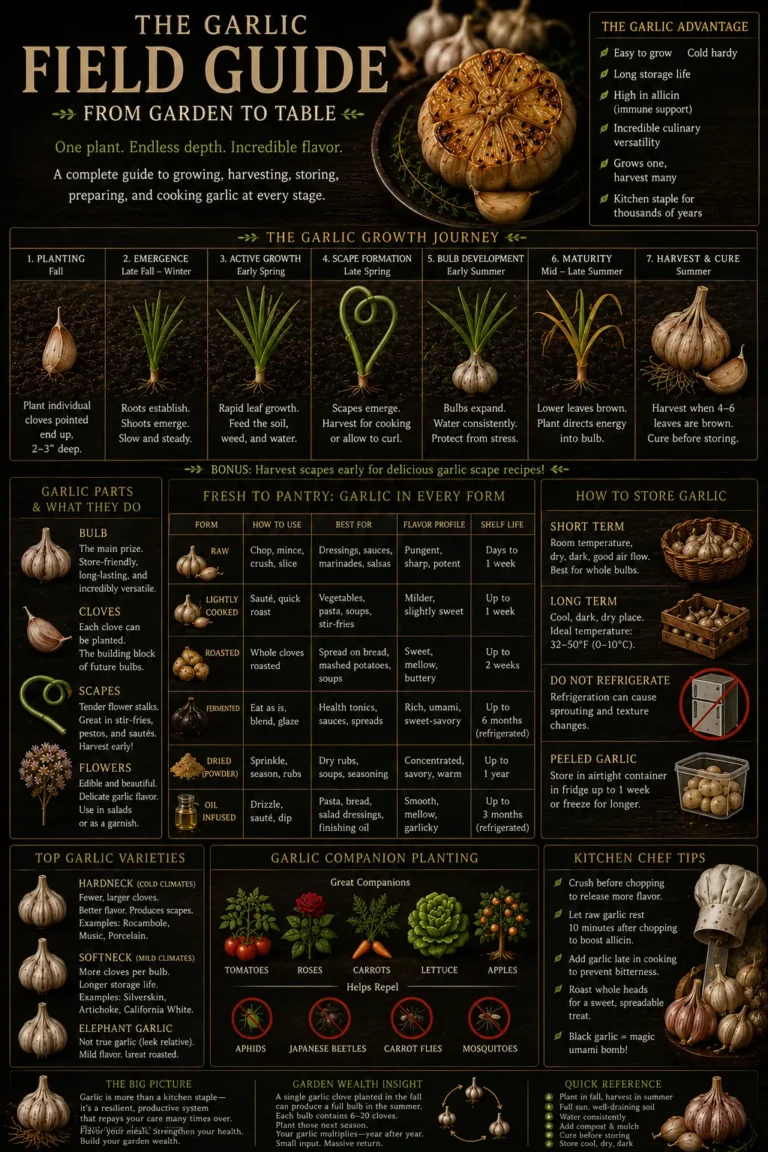
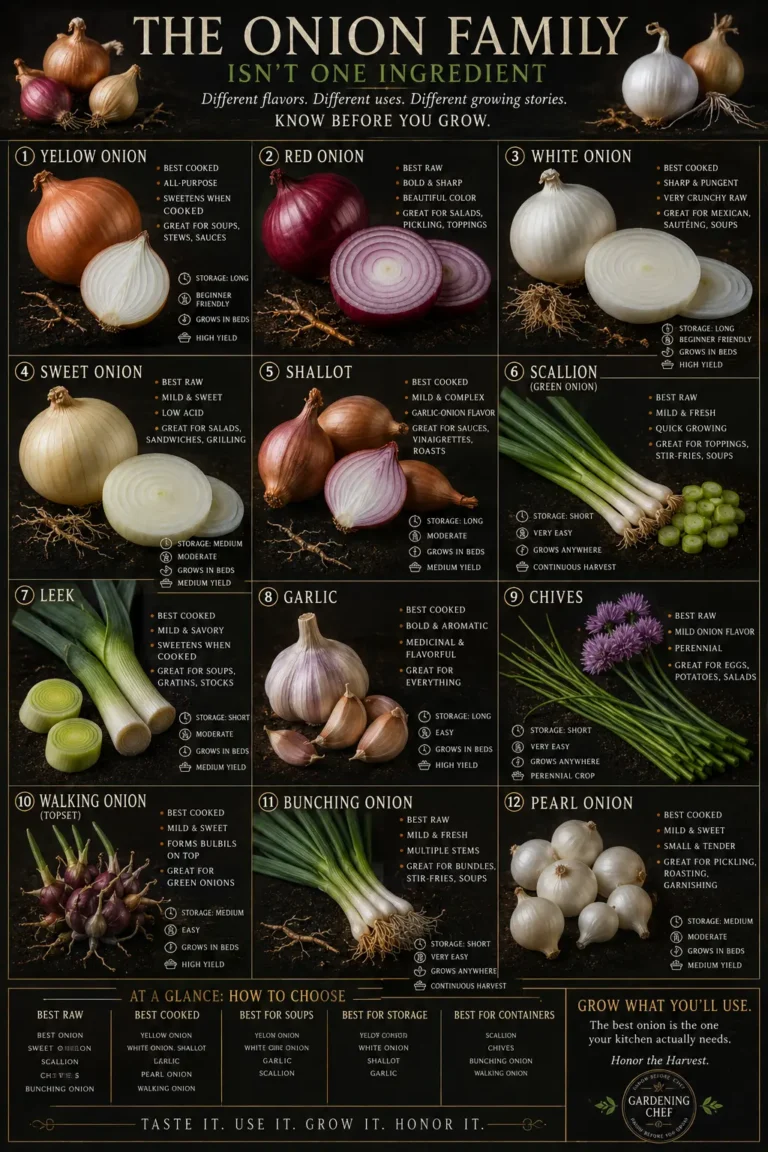
Alliums
Garlic, onions, shallots, leeks, scallions, and chives can be dried, cured, frozen in cooked preparations, pickled, fermented, or turned into powders.
Alliums are the backbone of savory preservation.
A pantry with onions, garlic, dried herbs, beans, and tomato sauce already has the foundation for countless meals.
Staples
Beans, lentils, grains, flours, nuts, seeds, honey, salt, vinegar, oils, and dried mushrooms are not always garden harvests, but they belong in the preservation pantry because they turn preserved produce into complete meals.
A jar of tomatoes is useful.
A jar of tomatoes plus beans, dried herbs, onions, garlic, and grain becomes dinner.
Storage Reference Guide
A pantry is not one environment.
It is a set of storage zones.
| Storage Zone | Temperature Idea | Best For | Pantry Notes |
|---|---|---|---|
| Cool and Dark | Often cooler than room temperature, crop-dependent | Canned goods, jams, pickles, sauces, oils, dried herbs | Avoid heat, sunlight, and large temperature swings. |
| Refrigerator | Cold household storage | Ferments after active fermentation, opened jars, fresh herbs, cut produce | Slows spoilage but does not make food immortal. |
| Freezer | 0°F for safety and long-term frozen storage | Fruits, vegetables, meats, stocks, cooked meals, baked goods | Best quality depends on packaging and time. |
| Dry Room Temperature | Stable dry pantry conditions | Grains, beans, flours, salt, vinegars, honey, dry goods | Protect from moisture, pests, heat, and light. |
| Root Cellar / Cold Storage | Crop-specific | Potatoes, roots, onions, garlic, winter squash, apples | Different crops need different humidity and temperature. |
| Vacuum-Sealed Cool Storage | Varies by food | Dried foods, dry goods, freezer foods | Vacuum sealing is not a substitute for safe processing. |
The better the zone matches the food, the longer the food keeps its quality.
The Pantry Success Formula
A successful preservation pantry rests on four pieces.
1. Good Ingredients
Preserve at peak quality.
Preservation does not fix poor ingredients.
It captures what is already there.
Overripe, bruised, moldy, or low-quality produce rarely becomes excellent preserved food.
The better the ingredient, the better the pantry.
2. Smart Method
Use the method that fits the food.
Freeze what freezes well.
Dry what dries well.
Ferment what ferments well.
Pressure can low-acid shelf-stable foods.
Water-bath can only high-acid or properly acidified tested recipes.
Cold store crops that naturally keep whole.
The method is not decoration.
It is the bridge between the food you have and the food you want later.
3. Proper Storage
Even well-preserved food can decline if stored badly.
Heat, light, oxygen, moisture, pests, and time all reduce quality.
Cool, dark, dry storage is ideal for many shelf-stable goods.
Label and date everything.
The pantry should be readable.
4. Confidence and Freedom
The final product is not the jar.
The final product is peace of mind.
A stocked pantry gives you meal options, fewer emergency grocery trips, better use of harvests, seasonal flavor, and confidence that your work was not wasted.
Pantry Golden Rules
Preserve at Peak Freshness
The best preserved food begins with the best fresh food.
Harvest at the right time.
Sort carefully.
Use bruised or damaged produce quickly in fresh cooking rather than long-term storage.
Use Clean Tools and Containers
Cleanliness matters in every method.
Wash produce.
Clean jars, tools, counters, cutting boards, and hands.
Use proper equipment.
Follow Safe Methods and Tested Recipes
For canning especially, tested recipes are not suggestions.
They are the safety system.
Use trusted extension, USDA, or NCHFP guidance.
Label and Date Everything
Every jar, bag, pouch, and container should be labeled.
Include the food, method, and date.
Mystery jars do not build confidence.
Store Properly and Rotate Stock
Use older food first.
Place newer batches behind older ones.
Check seals, freezer condition, moisture, pests, and spoilage.
Use What You Have, Then Restock
A pantry is not meant to become a museum.
Eat from it.
Learn from it.
Restock what you actually use.
Common Preservation Mistakes
Mistake 1: Preserving Food You Do Not Eat
A pantry full of unwanted jars is not abundance.
It is clutter.
Start with meals you already cook, then preserve ingredients that support those meals.
Mistake 2: Waiting Too Long
Peak produce does not wait.
If you harvest tomatoes on Saturday and let them sit too long, you may lose quality by Wednesday.
Preservation requires timing.
Mistake 3: Treating Freezing as Forever
Frozen food kept continuously at 0°F remains safe, but quality declines over time. Freezer burn, poor packaging, and long storage reduce texture and flavor.
Use the freezer as a rotation system, not a forgotten archive.
Mistake 4: Guessing With Canning
This is the most serious mistake.
Do not guess.
Do not improvise shelf-stable canning.
Do not use untested internet recipes for low-acid foods.
Do not assume old recipes are still recommended.
Use tested guidance.
Mistake 5: Not Controlling Moisture in Dried Foods
Dried food that still contains too much moisture can mold.
Cool dried foods before packing, store them in dry insect-proof containers, and check for moisture or condensation.
Mistake 6: Forgetting the Meal
Do not preserve ingredients in isolation.
Think in meals.
Tomato sauce plus dried basil plus garlic plus pasta.
Frozen berries plus oats.
Dried peppers plus beans.
Fermented cabbage plus potatoes and sausage.
Pickled onions plus tacos.
Frozen pesto plus soup.
A pantry is strongest when it connects to dinner.
Preservation by Crop Type
Tomatoes
Tomatoes are one of the great preservation crops.
Best methods:
Freezing whole or chopped.
Roasting and freezing.
Making sauce.
Making paste.
Dehydrating slices.
Making tomato powder.
Using tested canning recipes.
Using tested salsa recipes.
Tomatoes are more complex than many people realize because acidity varies. For canning, use tested recipes and proper acidification when required. USDA and NCHFP resources include separate canning guidance for tomatoes because they require specific handling.
Pantry Lesson:
Tomatoes are the sauce, soup, salsa, and flavor base of the preservation pantry.
Peppers
Peppers preserve beautifully.
Best methods:
Freezing chopped peppers.
Roasting and freezing.
Dehydrating.
Smoking.
Pickling.
Fermenting into hot sauce.
Grinding into powder.
Sweet peppers freeze well for cooked dishes.
Hot peppers dry especially well and can become flakes, powders, vinegars, sauces, and seasoning blends.
Pantry Lesson:
Peppers turn fresh color into stored heat, smoke, sweetness, and spice.
Herbs
Herbs are pantry multipliers.
Best methods:
Air drying.
Dehydrating.
Freezing in cubes.
Pesto.
Herb salt.
Herb vinegar.
Compound butter for freezer storage.
Delicate herbs like basil often freeze or sauce better than they dry.
Hardy herbs like thyme, rosemary, oregano, and sage dry well.
Pantry Lesson:
Herbs are the flavor engine that keeps preserved food from tasting flat.
Berries
Berries are fragile and seasonal, which makes preservation essential.
Best methods:
Freezing.
Jams.
Syrups.
Fruit leather.
Drying.
Sauces.
Pie filling using tested recipes.
Freeze berries on trays first so they do not clump.
Pantry Lesson:
Berries turn short seasons into breakfast, baking, dessert, and winter color.
Cucumbers
Cucumbers are best preserved through pickling or fermentation.
Best methods:
Refrigerator pickles.
Fermented pickles.
Tested canned pickles.
Relish.
Quick pickles.
Fresh cucumber texture does not survive freezing well.
Pantry Lesson:
Cucumbers teach that some foods preserve best through transformation, not imitation.
Green Beans
Green beans are versatile but must be handled correctly.
Best methods:
Blanching and freezing.
Pickling.
Pressure canning for plain beans.
Fermenting.
Plain green beans are low-acid.
They require pressure canning for shelf-stable storage unless they are properly acidified in a tested pickle recipe.
Pantry Lesson:
Green beans teach the difference between freezer convenience, pickle brightness, and pressure-canned shelf stability.
Cabbage
Cabbage is one of the world’s great preservation vegetables.
Best methods:
Sauerkraut.
Kimchi-style ferments.
Refrigerator slaws.
Cold storage for storage varieties.
Freezing cooked cabbage dishes.
Fermentation turns cabbage into a long-lasting, tangy, useful food. For sauerkraut, keeping cabbage covered by brine is part of tested fermentation guidance.
Pantry Lesson:
Cabbage teaches that salt, time, and pressure can turn a humble head into a living pantry food.
Root Crops
Carrots, beets, turnips, radishes, and parsnips can be preserved in multiple ways.
Best methods:
Cold storage.
Pickling.
Fermenting.
Freezing after blanching or cooking.
Dehydrating for soup mixes.
Pressure canning when plain and low-acid.
Beets are especially good pickled, roasted and frozen, or pressure canned using tested methods.
Pantry Lesson:
Root crops teach winter resilience: some store whole, some pickle bright, some become soup later.
Onions and Garlic
Onions and garlic are pantry foundations.
Best methods:
Curing and dry storage.
Dehydrating.
Powdering.
Pickling.
Fermenting.
Freezing in cooked bases.
Do not store homemade garlic-in-oil mixtures at room temperature. Oregon State University Extension warns that herbs and vegetables in oil must be stored correctly to prevent botulism food poisoning; commercial garlic-in-oil products are acidified, and home acidification procedures must be followed exactly where tested.
Pantry Lesson:
Alliums are flavor foundations, but oil preservation demands respect.
Winter Squash
Winter squash stores well whole when mature and cured.
Best methods:
Cool dry storage.
Roasting and freezing purée.
Dehydrating cooked purée into powders with proper method.
Pressure canning cubed squash using tested recipes.
Do not can mashed or puréed pumpkin or squash unless following a tested safe method. Home canning guidance generally uses cubed squash because density affects heat penetration.
Pantry Lesson:
Winter squash teaches that some preservation begins with maturity, curing, and proper storage before any recipe is involved.
The Preservation Pantry as a Meal System
A pantry should not only be organized by jars.
It should be organized by meals.
Soup System
Pressure-canned broth.
Dried herbs.
Frozen greens.
Root cellar carrots.
Potatoes.
Onions.
Garlic.
Dried mushrooms.
Beans.
This system turns scraps, roots, legumes, herbs, and stored flavor into comfort.
Pasta System
Tomato sauce.
Dried basil.
Garlic powder.
Frozen pesto.
Dried peppers.
Dehydrated tomatoes.
This system turns preserved summer into a weeknight dinner.
Breakfast System
Frozen berries.
Dried apples.
Jams.
Oats.
Nuts.
Seeds.
Honey.
This system turns the pantry into mornings that feel less rushed.
Taco and Bowl System
Pickled onions.
Fermented hot sauce.
Canned beans.
Dried peppers.
Salsa.
Frozen corn.
Herbs.
This system turns preserved ingredients into fast, flexible meals.
Winter Comfort System
Root cellar squash.
Potatoes.
Onions.
Garlic.
Frozen stock.
Dried herbs.
Canned tomatoes.
Fermented cabbage.
This system turns winter food into warmth.
The goal is not to have random preserved foods.
The goal is to have meal pathways.
The Preservation Pantry as a Wealth Garden Crop
In the Wealth Garden system, preservation is the conversion layer.
The garden produces value.
The kitchen transforms value.
The pantry holds value.
Without preservation, abundance has a deadline.
With preservation, abundance becomes flexible.
This is why preservation belongs near the center of the $10,000 Garden idea.
It captures value that would otherwise disappear.
It reduces waste.
It replaces future purchases.
It creates giftable products.
It builds skill.
It supports small sales where legally allowed and properly produced.
It helps the household eat better with less panic.
A tomato eaten fresh is food.
A tomato preserved as sauce is future food.
A tomato dried into powder is flavor stored in almost no space.
A tomato sauce given as a gift is relationship value.
A tomato product sold at a market, where legally allowed and properly produced, becomes exchange value.
That is the pantry multiplier.
The same harvest can become many kinds of value depending on how it is preserved.
The $10,000 Garden Insight: The Pantry Multiplier
Most people measure a garden by what they eat fresh.
That misses a large part of the value.
The preservation pantry is where temporary abundance becomes durable wealth.
A basket of tomatoes may be worth one week of meals.
A shelf of tomato sauce may be worth months of convenience.
A bag of frozen berries may replace winter grocery purchases.
A jar of dried herbs may improve hundreds of dishes.
A crock of fermented cabbage may turn one harvest into weeks of flavor.
A pantry of beans, dried vegetables, sauces, pickles, herbs, frozen produce, and root crops may reduce the household’s dependence on constant shopping.
The value is not only in the food.
It is in the options.
Options reduce stress.
Options reduce waste.
Options make cooking easier.
Options create resilience.
This is how a garden becomes more than a season.
It becomes a pantry.
And a pantry is proof that you planned for tomorrow and honored today.
Designing a Beginner Preservation Pantry
Do not try every method at once.
Build the system in layers.
Layer 1: Freeze
Start with berries, herbs, chopped peppers, roasted tomatoes, pesto, soup bases, shredded zucchini, and blanched vegetables.
This gives fast success with low risk.
Layer 2: Dry
Dry herbs, peppers, apple slices, tomatoes, mushrooms, citrus slices, and greens.
This builds shelf-stable confidence without canning pressure.
Layer 3: Refrigerator Pickles and Ferments
Try refrigerator pickles, fermented carrots, sauerkraut, or simple fermented hot sauce.
This teaches brine, salt, acidity, time, and observation.
Layer 4: Water-Bath Canning
Start with tested jam, jelly, fruit, or pickle recipes.
Learn jars, headspace, lids, processing time, cooling, and seal checking.
Layer 5: Pressure Canning
Once comfortable, learn pressure canning for low-acid vegetables, beans, broths, meats if used, and soups using tested recipes.
This is the advanced pantry engine.
Best Preservation Choices by Goal
| Goal | Strong Choices |
|---|---|
| Best for Beginners | Freezing berries, freezing pesto, drying herbs, refrigerator pickles, simple jams from tested recipes |
| Best for Saving Money | Tomato sauce, frozen berries, dried herbs, beans, soup bases, frozen vegetables, root storage crops |
| Best for Flavor | Dried tomatoes, roasted peppers, fermented hot sauce, herb salts, pickled onions, sauerkraut, garlic, dried mushrooms |
| Best for Gifts | Jams, jellies, pickles, sauces, dried herb blends, fruit syrups, flavored salts, tea blends |
| Best for Emergency Pantry | Pressure-canned beans, broth, vegetables, meats if used, dried foods, grains, legumes, shelf-stable sauces, pickles, dehydrated soup mixes |
| Best for Small Spaces | Dried herbs, dehydrated vegetables, tomato powder, dried peppers, jams, pickles, vacuum-sealed dry goods |
| Best for Garden Surplus | Tomatoes, cucumbers, peppers, herbs, zucchini, berries, green beans, cabbage, apples, onions, garlic |
| Best for Fast Wins | Freeze fruit, dry herbs, make refrigerator pickles, freeze soup bases |
| Best for Advanced Skill | Pressure canning, shelf-stable soups, fermented hot sauce, dehydrated meal kits |
The 1% Pantry Rule
A preservation pantry does not require a heroic weekend every time.
Fifteen minutes can still build the system.
Fifteen minutes is enough to:
Label freezer bags.
Move older jars forward.
Pick herbs for drying.
Freeze berries on a tray.
Chop peppers for freezer storage.
Check onions and garlic.
Inspect ferments.
Start refrigerator pickles.
Inventory tomato sauce.
Pull older broth for soup.
Write a “use first” list.
Preservation is not only big-batch canning.
It is small, repeated stewardship.
The pantry grows when you keep touching the system.
A Quick Note About Pets and Children
A preservation pantry should be safe for the whole household.
Keep glass jars stable and away from edges.
Store vinegar, salt, alcohol ferments, and strong spices safely.
Do not allow children or pets to access fermenting vessels, sharp tools, dehydrator trays, hot canners, or cooling jars.
Keep onions, garlic, chives, and heavily seasoned foods away from dogs and cats.
Do not let pets eat spoiled produce, moldy foods, or fallen fermented fruit.
A pantry is a food system.
It should also be a safety system.
Frequently Asked Questions About Preservation Pantries
What is a preservation pantry?
A preservation pantry is a home food system that uses freezing, drying, canning, fermenting, pickling, cold storage, and pantry rotation to turn seasonal food into future meals.
What is the easiest preservation method for beginners?
Freezing is usually the easiest method for beginners because it is simple, flexible, and does not require shelf-stable canning knowledge. Drying herbs and making refrigerator pickles are also excellent starting points.
What is the safest way to start canning?
Start with tested high-acid recipes from trusted sources such as USDA, NCHFP, or your local extension office. Jams, jellies, fruits, and tested pickles are common beginner projects.
What foods need pressure canning?
Most low-acid foods need pressure canning for shelf-stable storage. This includes plain vegetables, beans, meats, poultry, seafood, broths, and many soups.
Can I water-bath can green beans?
Plain green beans are low-acid and should not be water-bath canned as a plain vegetable. They require pressure canning for shelf-stable storage unless they are made into a properly acidified tested pickle recipe.
Is frozen food safe forever?
Food stored continuously at 0°F remains safe, but quality declines over time. That means freezer storage is still a rotation system.
Why do vegetables need blanching before freezing?
Blanching slows or stops enzyme action that can cause loss of flavor, color, and texture in frozen vegetables.
Can I store homemade garlic in oil at room temperature?
No. Homemade garlic-in-oil mixtures require strict safety handling. Oregon State University Extension warns that herbs and vegetables in oil must be stored correctly to prevent botulism food poisoning.
What should I preserve first from my garden?
Start with what your household already eats. Good beginner choices include frozen berries, dried herbs, chopped frozen peppers, roasted frozen tomatoes, refrigerator pickles, simple tested jams, and frozen soup bases.
What is the biggest preservation mistake?
Guessing with canning. Shelf-stable canning should use current tested recipes and methods from trusted sources. A sealed lid does not automatically mean safe food.
Where This Connects
The Preservation Pantry Field Guide connects naturally to the rest of the Field Guide Library.
The Tomato Field Guide
Tomatoes are one of the greatest preservation crops: sauce, salsa, paste, frozen packs, dried slices, powder, and soup base.
The Pepper Library
Peppers move beautifully from fresh to roasted, dried, smoked, pickled, fermented, and powdered.
The Herb Flavor Multiplier Guide
Herbs are the pantry’s flavor engine. Dried herbs, frozen pesto, herb salts, and herb vinegars make preserved food taste alive.
The Root Cellar Field Guide
Root cellaring is preservation without a jar. Potatoes, onions, garlic, squash, carrots, beets, and apples belong in the preservation conversation.
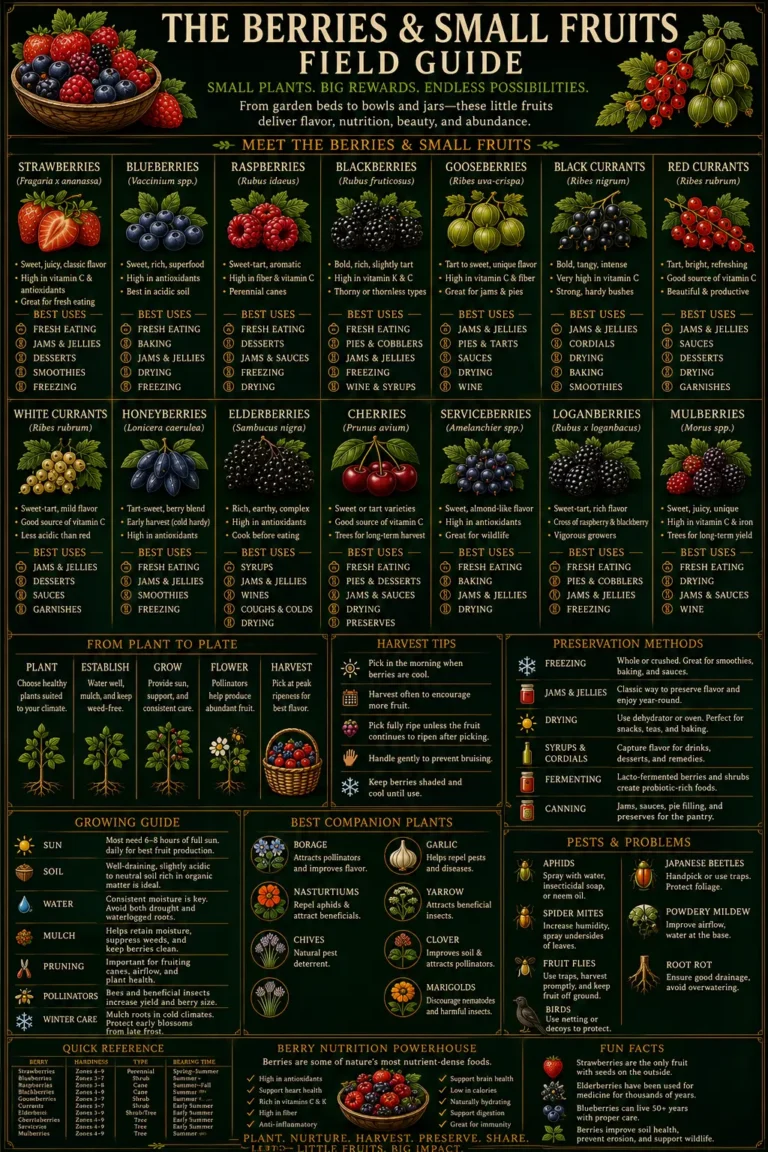
The Berries & Small Fruits Field Guide
Berries become freezer packs, jams, syrups, dried fruit, pie fillings, shrubs, vinegars, and sauces.
The Brassica Family Field Guide
Cabbage, mustard greens, radishes, turnips, and bok choy connect directly to fermentation, pickling, freezing, and cold storage.
The Beans and Peas Field Guide
Beans and peas connect to freezing, drying, pressure canning, seed saving, pantry meals, soups, stews, and long-term food security.
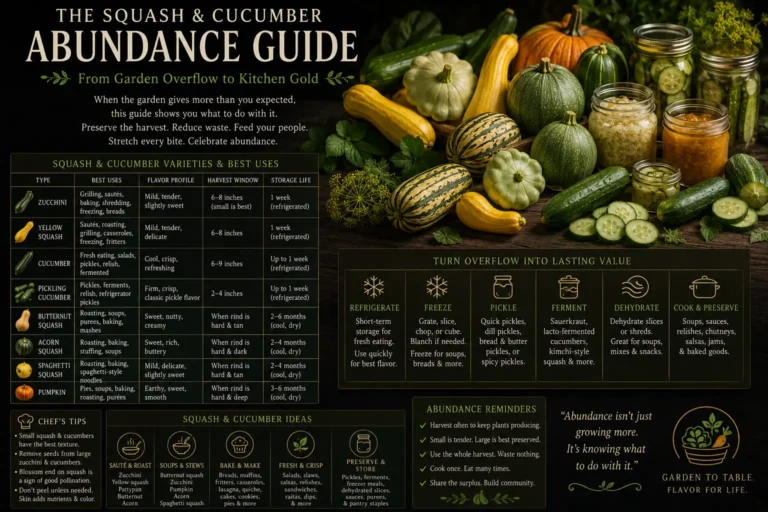
The Squash and Cucumber Abundance Guide
Cucumbers become pickles and ferments. Zucchini becomes freezer packs and baked goods. Winter squash becomes stored food and frozen purée.
This preservation guide is the bridge between the entire garden and the entire year.
Source Notes for Accuracy
This article expands your original Preservation Pantry Field Guide while keeping its core structure: the poster-preview safety warning, the “match the food to the method” principle, preservation method comparison, pantry storage zones, the pantry success formula, crop-specific preservation pathways, meal systems, and the Pantry Multiplier Wealth Garden insight. For safety-sensitive claims, the article leans on research-based sources: NCHFP and USDA home canning resources for tested recipes and preservation categories; Penn State Extension for scientifically tested home canning procedures; FSIS and FoodSafety.gov for freezer safety and quality guidance; NCHFP for blanching, drying storage, and sauerkraut guidance; and Oregon State University Extension for garlic-in-oil safety.
The Preservation Pantry Field Guide Lesson
A pantry is not a storage closet.
It is a memory system.
It remembers the day the tomatoes ripened all at once.
It remembers the basil before frost.
It remembers the peach season that felt too short.
It remembers the cabbage you salted and waited for.
It remembers the peppers you dried into winter heat.
It remembers the berries you froze when summer was generous.
The preservation pantry is where the garden learns to speak in future tense.
Not just:
What can we eat today?
But:
What can this become?
That is the real power of preservation.
It turns abundance into stability.
It turns harvest into options.
It turns seasonal food into household resilience.
It turns the garden into a year-round system.
Final Thought
Fresh food teaches urgency.
Preserved food teaches stewardship.
A ripe tomato says:
Use me now.
A jar of sauce says:
I will be here when you need me.
A bundle of herbs says:
The garden still has flavor after frost.
A freezer bag of berries says:
Summer can visit breakfast in January.
A crock of sauerkraut says:
Time can transform what salt begins.
A pantry shelf says:
You planned for tomorrow without wasting today.
That is the heart of The Gardening Chef.
Grow the food.
Catch the abundance.
Choose the method.
Store it wisely.
Eat from it often.
Preserve today.
Enjoy tomorrow.
Build the pantry.
Honor the harvest.

This is an overwhelming website…not in a bad way…in a good way as I am just a beginner homesteader. I wonder if you have all these information in a book…so that I can bring it with me when I garden, when I arrange my pantry, when I am in my garden sorting out my ducks, mangalista pigs, cattles, lambs and ewes, while thinking if I want to have mutton for dinner or a baby cow (veal) instead. OK…so much talkiing here…In the meantime, I gotta go and see if I can get my cat out of my large cooking pot or have him for soup instead….lol…
April,
This comment absolutely made my evening. Thank you!
And yes a book is very much in the works. What you described is actually a big part of what I want it to become: something you can carry from the garden to the pantry to the kitchen and use as a real reference, not something that just sits on a shelf.
I love hearing that you’re beginning your homesteading journey too. Ducks, Mangalitsa pigs, cattle, lambs and ewes… it sounds like you already have quite the living system growing around you! Congrats on that. I have some experience with similar work, and that is HARD and REWARDING work.
And as for the cat in the cooking pot… I think we’ll officially file that one under “do not preserve.” 😂
Thank you for taking the time to write this. Comments like yours help me understand what would actually be useful to readers as I continue building The Gardening Chef.
— Karel