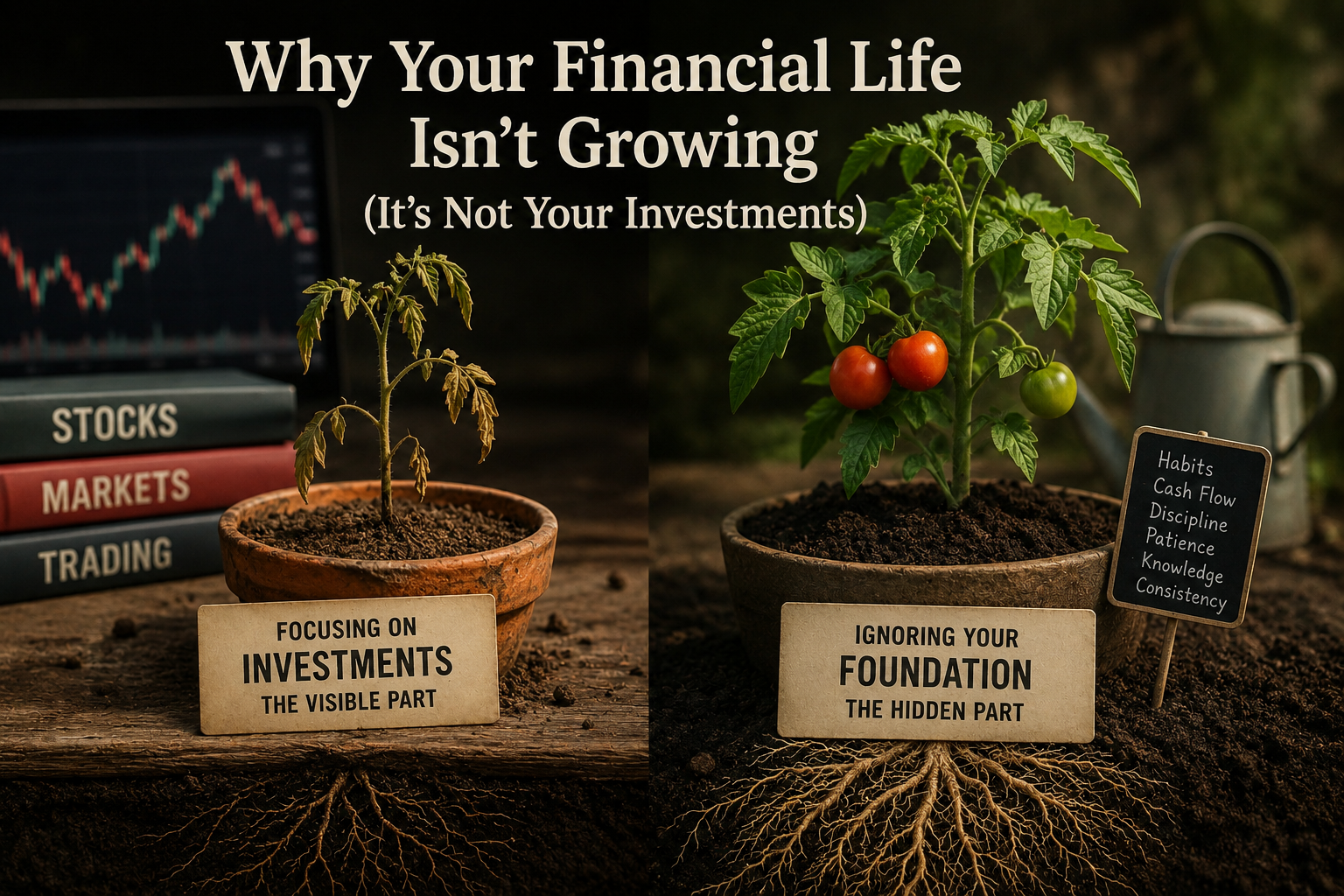
Why Your Financial Life Is Not Growing Even Though You Are Trying
Early one spring, a gardener planted two tomato plants.
They came from the same packet of seeds. They were planted on the same day, in the same yard, under the same sunlight. They were watered from the same hose and cared for with the same intention.
By every visible measure, they should have grown the same way.
But they didn’t.
One plant struggled almost from the beginning. Its leaves never quite reached the same deep green. Growth came in uneven bursts. The fruit, when it appeared, was small and inconsistent.
The other plant grew steadily. Its leaves thickened. Its stems strengthened. By midseason, it was producing more than expected and recovering quickly from heat, wind, and minor stress.
At first, the gardener assumed he had made a mistake.
Maybe he watered one too much. Maybe the sun hit them differently. Maybe one just “didn’t take.”
But when he looked closer, the difference became obvious.
It wasn’t the seed.
It wasn’t the timing.
It was the soil.
The Lesson Most People Miss
This is one of the first real lessons a gardener learns, and one of the easiest to forget.
From the surface, we tend to focus on what we can see. The plant. The growth. The result. We compare outcomes and assume the difference must come from something obvious.
But the real work of the system happens below the surface.
In the structure of the soil.
In its ability to hold water.
In the life inside it.
In the unseen foundation supporting everything above it.
And once you understand that, something shifts.
Because you begin to recognize the same pattern everywhere else.
The Financial Parallel
Most people approach their financial lives the same way new gardeners approach plants.
They focus on what is visible.
They look for the right stock.
The right investment.
The right timing.
The right strategy.
They assume that if they can just make a better choice at the surface level, everything else will improve.
But over time, many of them experience the same quiet frustration.
They try something new, but it doesn’t seem to grow the way they expected. They follow advice, but the results don’t match the promise. They feel like they are doing the right things, but nothing seems to stick.
So they look for a better seed.
A better investment.
A better opportunity.
A smarter move.
But the issue often isn’t what they’re planting.
It’s what they’re planting it in.
What “Soil” Actually Means
In a garden, soil is not just dirt.
It is structure.
It is storage.
It is life.
Good soil holds water when it rains and releases it slowly over time. It stores nutrients so plants can access them when needed. It supports root systems that anchor growth and protect against stress.
In financial life, your “soil” is not physical, but it functions the same way.
It is:
Your habits
Your consistency
Your discipline
Your understanding
Your ability to delay consumption
Your ability to follow through
These are not the things people like to talk about.
They are not exciting. They are not flashy. They don’t make headlines or go viral.
But they determine everything that comes next.
Why Good Seeds Fail in Bad Soil
A strong investment placed into a weak system rarely performs the way people expect.
Someone invests, but they withdraw early.
They save, but they spend inconsistently.
They learn, but they never apply.
They start, but they don’t continue.
From the outside, it looks like the strategy didn’t work.
But from the inside, the system never supported it.
This is why two people can take the same advice and end up in completely different places.
One builds quietly over time.
The other resets again and again.
The difference is not intelligence.
It is structure.
The Compost Lesson
Gardeners don’t fix struggling plants by constantly switching what they plant.
They improve the soil.
They add compost. They build organic matter. They increase the soil’s ability to retain water and nutrients. They focus on the part of the system that doesn’t show up in the harvest basket but determines what ends up in it.
At first, the results are not dramatic.
The soil looks slightly darker. It feels slightly richer. The changes are subtle.
But over time, everything above it responds.
Plants grow stronger. Yield increases. Recovery improves. The system begins producing more without requiring more effort.
The seed didn’t change.
The foundation did.
$10,000 Garden Insight
Most people measure the value of a system by what they can harvest right now.
But some of the most important value is stored in what they cannot see.
A garden that produces 20 pounds this year may produce 40 pounds in a few seasons—not because more money was spent, but because the soil improved.
Soil compounds.
The same is true in financial life.
When you improve your habits, reduce waste, increase consistency, and build understanding, your system begins producing more—even if your income does not immediately change.
The foundation multiplies the output.
→ Read: The $10,000 Garden
The Mistake Almost Everyone Makes
Most people are taught:
👉 Stocks before soil
They are encouraged to invest early, chase returns, and find opportunities before they are ever shown how to build a system that can support those decisions.
So they do what they are told.
They open accounts.
They try strategies.
They follow trends.
And then they wonder why it doesn’t feel like it’s working.
Because no one showed them the first rule.
Soil Before Stocks
If the foundation is weak, everything built on top of it becomes fragile.
If the foundation is strong, almost anything placed into it can grow.
This is why the order matters.
Soil comes first.
Then seeds.
Then growth.
Then surplus.
Most people try to skip ahead.
And they pay for it in time, frustration, and missed opportunity.
Where People Get Stuck
At this point, most readers understand the idea.
But they hesitate.
Because improving a system sounds overwhelming.
It feels like something that requires:
more time
more effort
a complete reset
But that’s not how it works.
The Smaller Beginning
Systems are not rebuilt all at once.
They are improved one decision at a time.
One habit adjusted.
One expense noticed.
One pattern corrected.
One behavior repeated.
That is where the real shift begins.
If you’re wondering how to actually do that in real life, this is where to go next:
→ Read: The 1% Garden Rule
What Happens When the Soil Improves
Once the foundation begins to change, something interesting happens.
At first, it feels slow.
Then it becomes steady.
Then it becomes noticeable.
Systems begin producing more than expected.
Not just financially, but across multiple areas of life:
More stability
More clarity
More control
More consistency
And eventually…
More output
That is when the system starts to resemble what we described earlier.
→ Read: The $10,000 Garden
The Shift That Changes Everything
There is a moment when a person stops asking:
“What should I invest in?”
And starts asking:
“What kind of system am I building?”
That question changes everything.
Because it moves attention from outcomes to structure.
From guessing to understanding.
From reacting to building.
Final Thought
The visible result is rarely the starting point.
It is the outcome of something deeper.
A plant does not fail because of the seed.
A financial life does not fail because of the investment.
In both cases, the foundation determines the future.
And once you begin to see that clearly, it becomes difficult to ignore.
Where This Connects
If you’re thinking:
“I understand this, but I don’t know where to begin…”
→ Read: The 1% Garden Rule
If you’re starting to see how a strong system could grow into something larger:
→ Read: The $10,000 Garden
This is just one piece of a much larger system.
The more pieces you connect, the clearer the picture becomes.
Closing Line
You don’t need better investments.
You need better soil.