Why Small Productive Systems Create More Wealth Than Most People Realize
The $10,000 Garden began for me with something remarkably ordinary.
When I was working as a butcher in a grocery store, I remember noticing a simple choice in the produce department that I would understand very differently years later.
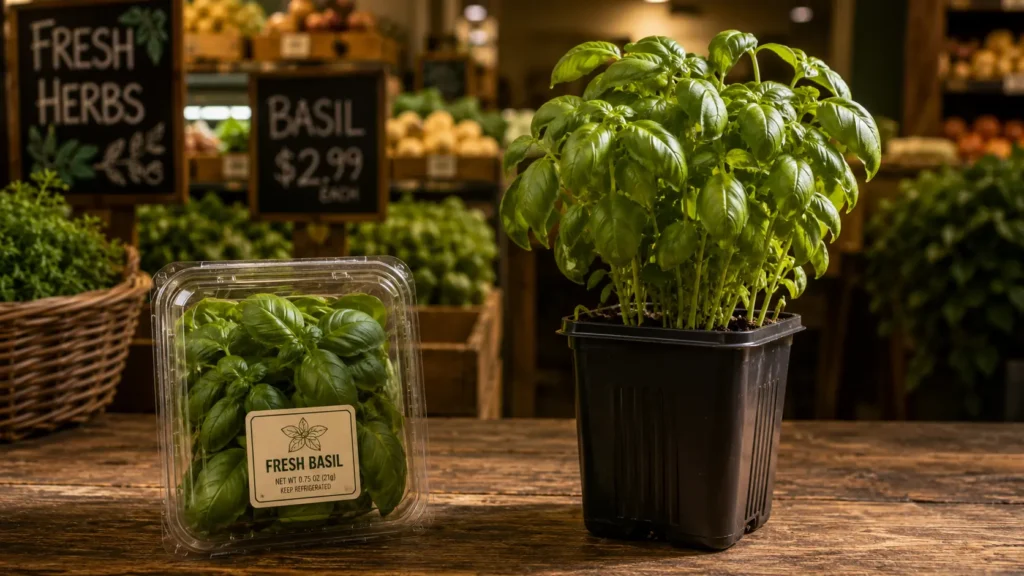
On the shelf sat a small plastic package of fresh basil, priced at $3.99—just enough for a meal.
A few steps away sat a living basil plant for $2.99.
It held roughly the same amount of usable basil, but there was one important difference.
One purchase would disappear that night.
The other could keep producing.
That small difference is the beginning of the $10,000 Garden.
The basil plant was not just an herb. It represented two different ways of thinking.
On one side is consumption.
On the other side is production.
Most of us spend much of our lives inside systems of consumption. We buy what we need, use it, and buy it again.
Food is eaten.
Money is spent.
Convenience is purchased and replaced.
There is nothing inherently wrong with that. It is simply the normal rhythm of modern life.
But sometimes we encounter something different—something that can keep producing after the first transaction is over.
A fruit tree can do that.
A compost pile can do that.
A skill can do that.
A well-built investment account can do that.
A healthy garden can do that.
And once you notice the difference between something you consume and something you can cultivate, it becomes difficult to unsee.
That is why the real question is not:
“Does a garden save money?”
The better question is:
“What kind of system have I built?”
Because a garden is not merely a substitute for grocery shopping.
It is one of the clearest productive systems an ordinary person can build.
You can watch sunlight become food.
You can watch a few dollars of seed become months of harvest.
You can watch scraps become compost and compost become future fertility.
You can watch small, repeated actions become surplus.
And that is where the story begins to change.
IN THIS GUIDE
Why garden value is bigger than grocery savings
How to measure Economic, Productive, and Capability Value
What happens when a garden creates surplus
How one harvest can become food, preservation, propagation, exchange, and knowledge
How to measure real financial value
The Replacement Value Test and Garden Value Ledger
Why the first season matters
How observation and adjustment improve the system over time
What a $10,000 Garden can actually look like
A practical small-space example and back-of-the-napkin calculation
The bigger wealth lesson
How productive systems connect gardening, resilience, stewardship, and compounding
Why Most People Measure the $10,000 Garden Too Small
When people try to decide whether gardening is “worth it,” they usually measure the easiest thing to measure.
They compare the price of a tomato at the store with one grown at home. They compare a bunch of basil with a basil plant. They look at a zucchini harvest and think in grocery receipts.
That makes sense.
But it measures only one part of what the system produces.
Money is one expression of wealth. For the purposes of the $10,000 Garden, a productive system can also create food, future production, skills, knowledge, resilience, and other useful returns over time.
But there is an important rule:
Not every kind of value should be forced into a dollar amount.
Some returns can be measured directly.
Harvest basil you genuinely would have purchased, and you may have avoided an expense.
Propagate a plant instead of buying another one, and you may have avoided another.
Sell genuine surplus, and that income can be recorded.
Other returns are real but harder to price honestly.
Learning when to harvest, improving the soil, preserving food, becoming a better cook, or understanding what grows well in your space all strengthen the system.
We do not need to invent a dollar value for those things to prove that they matter.
The $10,000 Garden becomes more credible, not less, when we measure what can be measured and describe the rest honestly.
A simple herb bed makes this easy to see.
It may reduce repeated herb purchases while also teaching harvesting, pruning, propagation, preservation, and seed saving.
If herbs are where you want to begin, explore The Herb Flavor Multiplier Guide for a deeper look at basil, rosemary, thyme, cilantro, and other fresh herbs.
Eventually, the relationship changes.
You stop seeing the garden only as a place where vegetables come from.
You begin seeing it as a system that produces.
And that requires a better way to keep track of what it is producing.
The Garden Value Ledger
When you begin measuring your own garden, keep three forms of value separate:
Economic Value — money genuinely saved, expenses actually replaced, or income actually earned.
Productive Value — food harvested, plants propagated, seeds saved, compost created, food preserved, and future production made possible.
Capability Value — skills, knowledge, improved soil, experience, resilience, relationships, and opportunities that make the system stronger over time.
Measure the dollars honestly. Track the other returns honestly. Do not turn every benefit into a dollar just to make the total look bigger.
The Backyard That Didn’t Look Like Much
Imagine an ordinary backyard.
Not a magazine spread. Not a hobby farm. Not ten acres in the country.
Just a normal yard behind a normal house.
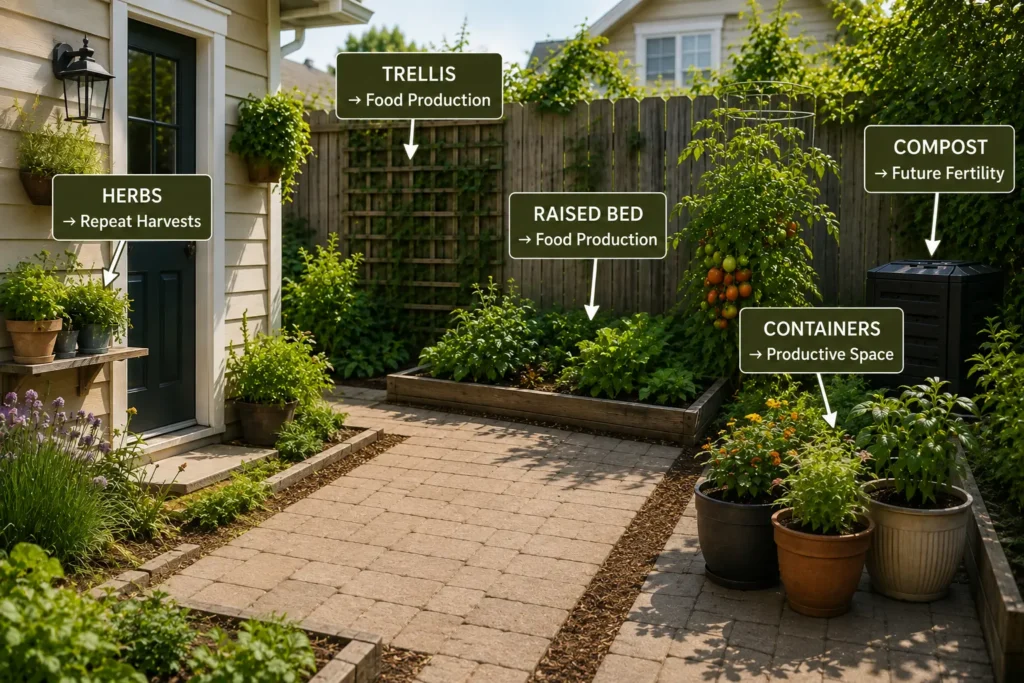
There is a raised bed near the fence. Herbs sit beside the kitchen door. Tomatoes claim one sunny corner. A couple of containers use the patio light. A compost bin works quietly in the background.
Nothing about it looks especially impressive.
Most people would not call it wealth.
But look more closely.
The herbs provide repeat harvests.
The raised bed turns a patch of soil into food.
The containers turn unused space into growing space.
The compost bin turns waste into future fertility.
None of those systems is dramatic by itself.
Together, they begin to behave differently.
Early in the season, it is mostly promise.
Seedlings. Soil preparation. Watering. Waiting.
Then the first returns arrive.
A handful of herbs. A salad. A few cherry tomatoes warm from the vine.
Nothing dramatic.
Just enough to make the gardener think, Maybe this really is working.
Then midsummer arrives.
The basil keeps producing. Tomatoes need support. Peppers arrive in waves. Beans keep coming.
And zucchini becomes a running joke because there is suddenly more of it than anyone planned for.
The counter fills.
The refrigerator changes.
The meals start changing.
And eventually a new question appears.
Not:
“Can this grow?”
That has already been answered.
The new question is:
“What do I do with the extra?”
And that is the moment when a garden starts becoming something larger than a garden.
When the $10,000 Garden Crosses the Surplus Threshold
There is a threshold in every productive system where survival gives way to surplus.
Before that threshold, everything feels fragile.
You are hoping the plants live. Hoping something ripens. Hoping the effort produces enough to justify the time.
After that threshold, something changes.
You have choices.
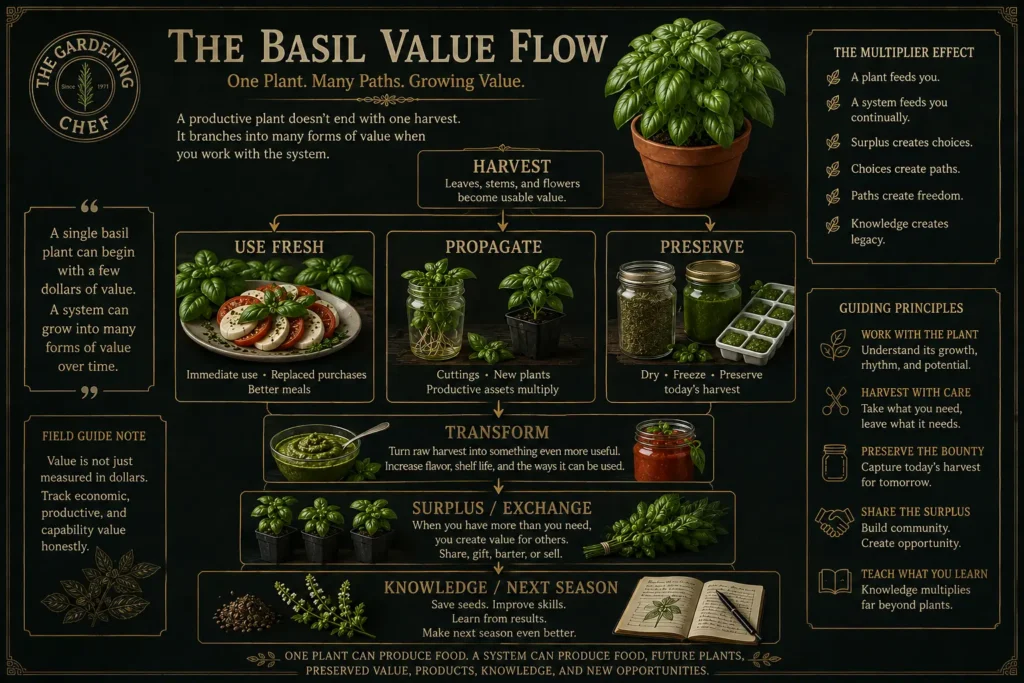
Extra basil can be eaten fresh, dried, frozen, turned into pesto, propagated, or allowed to produce seed.
Extra tomatoes can become dinner, sauce, salsa, preserved food, or gifts for neighbors.
A harvest that once had one destination suddenly has several.
Surplus creates options.
And options are where a productive garden begins branching into a larger system.
A basil plant makes this easy to see.
First, you harvest leaves.
Later, a cutting may become another plant.
Seed may become next season’s crop.
Surplus may be preserved, shared, or—depending on demand, skill, and local rules—eventually exchanged or sold.
The important word is eventually.
A plant does not automatically become a business simply because it grows well.
But production creates possibilities that consumption never does.
The $10,000 Garden Value Ladder
One harvest can move through several levels of value:
Use it → Preserve it → Multiply it → Transform it → Exchange it → Teach from it
Use it, and the garden may replace something you otherwise would have purchased.
Preserve it, and today’s harvest becomes future food.
Multiply it through seed or propagation, and one productive asset can become several.
Transform it into pesto, sauce, dried herbs, meals, or other useful forms, and the harvest gains more possible uses.
Exchange it through gifts, barter, or legal sales, and value begins moving outside the household.
Teach from it, and knowledge generated by the garden can become useful to someone else.
Notice what happened.
We did not assign six imaginary dollar values to one harvest.
We followed one productive asset as it branched.
The Garden Value Ledger still applies.
Money genuinely saved or earned belongs in Economic Value.
Plants, preserved food, seeds, compost, and future production belong in Productive Value.
Skill and knowledge belong in Capability Value.
We can track all three without pretending they are interchangeable.
That is why the title The $10,000 Garden matters.
It is not a promise that one basil plant becomes ten thousand dollars. It is a challenge to stop measuring a productive system at its first output.
A plant may begin by replacing a few dollars of groceries.
Over time, the larger system may also produce new plants, preserved food, better skills, useful surplus, and new opportunities.
Individually, those branches may remain small.
Connected and improved over time, they can become substantial.
That is the threshold.
The garden stops being something you merely harvest and becomes something you can direct.
And once that happens, the next question becomes unavoidable:
What kinds of value is this system actually producing?
The Seven Returns Hiding in the $10,000 Garden
This is where the Garden Value Ledger becomes useful.
A productive garden can create several kinds of return at the same time. Some can be measured in dollars. Others increase production or capability.
The mistake is not recognizing those returns.
The bigger mistake is pretending they are all the same thing.
1. Food
The most obvious return is the harvest itself.
Tomatoes, lettuce, herbs, peppers, beans, potatoes, cucumbers, onions.
When you grow food that you actually use instead of buying it, the avoided purchase has measurable Economic Value.
But the harvest may also have several possible destinations.
A basket of tomatoes can become dinner, sauce for winter, saved seed, or a gift carried across the fence.
The value begins with producing something useful.
2. Culinary Value
Fresh ingredients also change what the household can make.
Basil improves pasta. Rosemary changes roasted potatoes. Chives can finish eggs, soup, vegetables, or a baked potato.
We do not need to pretend every home-cooked meal replaced a restaurant meal.
The more defensible return is simpler:
The garden expands what the kitchen can do with ingredients already available.
That is capability.
And the cooking skill remains after the meal is gone.
3. Food Environment and Nutrition
A garden does not guarantee better health.
But herbs, vegetables, greens, berries, and other whole foods become much easier to use when they are already nearby.
They become visible.
They become convenient.
They change the question from:
“What should we buy?”
to:
“What is ready today?”
That change in the household food environment is real, even when we do not assign it a dollar amount.
4. Skill
Every season teaches.
When should this be harvested?
Does it need water?
Can I propagate it?
Should this surplus be eaten, frozen, dried, canned, or preserved another way?
Eventually, those questions become skills.
Gardening improves the harvest.
Cooking improves how the harvest is used.
Preservation extends it.
Observation improves the next season.
Capability begins improving production.
That is one of the first places where the system starts feeding itself.
5. Soil and Future Fertility
Some of the garden’s most important production happens beneath the harvest.
Compost, mulch, leaf mold, cover crops, and other organic matter can help create better conditions for future plants.
That is not imaginary income.
It is productive infrastructure.
A garden that begins producing some of its own fertility is becoming less dependent on starting from zero every season.
Healthy soil is to the garden what a strong foundation is to a wealth system.
6. Resilience
A household that can grow some food, cook it, preserve surplus, propagate plants, save appropriate seed, and adjust when conditions change has more options than it had before.
That is not absolute self-sufficiency.
It is capability.
And capability matters precisely because it gives the household more ways to respond when prices, weather, availability, or circumstances change.
We do not need to invent a dollar amount for resilience to recognize its value.
7. Surplus and Exchange
Eventually, production may exceed immediate household needs.
Then value can move outward.
Tomatoes can become a gift.
Herbs may be traded.
Propagated plants may find new homes.
Genuine surplus may eventually be sold where local rules and circumstances allow it.
Those outcomes are different.
A gift builds relationship.
A trade creates exchange.
A sale creates income.
Only the last one necessarily puts dollars in the ledger.
Put the Returns Back Into the Ledger
Now the picture is clearer.
Economic Value records money genuinely saved or earned.
Productive Value records food, plants, seeds, compost, preservation, and future production.
Capability Value records the skills, knowledge, experience, and resilience that make the system stronger.
We can track all three without pretending they are interchangeable.
That is the real lesson.
The garden is producing in several directions at once.
And once we can see those directions clearly, we can begin improving them without double-counting them.
That is the $10,000 Garden: a productive system creating useful returns over time.
The Garden Does Not Just Produce Food. It Produces Better Questions.
One of the most valuable things a garden produces is not something you can put in a basket.
It produces better questions.
At first, they are simple:
Can I grow this?
Will it survive?
Those questions matter. They are how participation begins.
But with experience, the questions change:
What does this plant continue to produce?
Should I eat this harvest, preserve it, propagate it, or save seed from it?
Where is food, time, fertility, or opportunity being wasted?
And eventually the questions begin following you beyond the garden:
What am I buying repeatedly that this system could produce?
What am I building that can keep producing after I have paid for it?
That progression matters.
The gardener is no longer simply trying to keep plants alive.
The gardener is learning to think like a steward—noticing what is producing, what is being wasted, what can be multiplied, and what deserves another season.
That is why the $10,000 Garden is bigger than a calculation.
The number gets our attention.
The questions change the system.
And gardens are unusually good places to practice this way of thinking because the feedback is visible.
A plant wilts.
Food spoils.
A bed underperforms.
A cutting roots—or it doesn’t.
The system responds.
Better questions lead to better decisions.
Better decisions create better systems.
And one of the first places those questions lead us is toward something surprisingly powerful:
the money we no longer have to spend.
The Hidden Economic Power of Replaced Spending
Not every economic return arrives as income.
Sometimes value appears because a purchase never has to happen.
Harvest basil you otherwise would have bought, and money stays in the household.
Propagate a plant instead of purchasing another one, and another expense may disappear.
Preserve summer tomatoes that later replace something from the grocery store, and the harvest continues creating economic value months after it was picked.
This is replacement value.
But it only matters if we measure it honestly.
Replacement Value Is Not Free Money
A homegrown tomato did not appear without inputs.
There may have been seed, soil amendments, water, fertilizer, containers, or other costs involved in producing it.
So we should not look at a $4 basket of tomatoes and simply declare that the garden “made” four dollars.
Ask instead:
What purchase did this harvest realistically replace, and what did it cost me to produce it?
That gives us a much more useful calculation:
THE REPLACEMENT VALUE TEST
Formula
Net Replacement Value = Purchase Avoided − Direct Production Costs
Example: One Basil Plant
Using the prices from the opening example, suppose you normally buy fresh basil for $3.99 per package.
Over several weeks, your basil plant produces enough usable leaves to replace four packages you genuinely would have purchased.
4 packages × $3.99 = $15.96 in purchases avoided
Now count the direct cost of producing that basil:
Basil plant: $2.99
For illustration, assume allocated soil, water, and fertilizer: $1.00
Total direct production cost = $3.99
Now apply the formula:
$15.96 − $3.99 = $11.97 Net Replacement Value
So in this example, the plant has created $11.97 of measurable economic value so far.
And if that same plant keeps producing, the calculation can continue.
Before counting it, ask:
- Would I actually have bought the basil?
- Did I actually harvest and use it?
- Am I counting my production costs?
- Am I avoiding counting the same value twice?
Count what was genuinely replaced—not what theoretically could have been.
That may sound less exciting.
It is actually more powerful.
Because now we are measuring something real.
The Quiet Power of Keeping Money
Income created and spending avoided can both improve a household’s financial position, but they are different paths.
One brings money in.
The other prevents money already in the household from leaving.
Neither should be exaggerated, and neither should be confused with the other.
Both belong in the Economic Value column of the Garden Value Ledger.
Small Purchases Are Easy to Miss
Replacement value becomes especially interesting with things purchased repeatedly in small amounts.
A package of basil.
A bunch of green onions.
A handful of herbs.
A container of cherry tomatoes.
None feels significant by itself.
But a productive system can begin removing some of those recurring purchases one at a time.
A harvest replaces a purchase.
A cutting replaces another plant.
A preserved harvest replaces something months later.
Small replacements accumulate.
This Is Where the Ledger Becomes Useful
The goal is not to convince yourself that everything you grow saves money.
The goal is to discover what actually does.
Harvested something you normally buy?
Record it.
Propagated a plant you genuinely would have purchased?
Record it.
Grew something nobody wanted and eventually threw it away?
Do not count it.
Spent $75 building a system that produced $20 worth of food in its first season?
Record that too.
The ledger is not there to make the garden look successful. It is there to tell the truth about the system.
That truth becomes increasingly useful over time because some costs may be concentrated in the first season while beds, tools, soil improvements, and knowledge continue into later ones.
The important thing is to keep measuring what actually happens.
Two Questions for the Ledger
Instead of asking only:
“How much money did my garden make?”
ask:
“What did my garden earn?”
and
“What did my garden allow me not to buy?”
Those are different paths to economic value.
And both are worth seeing.
The $10,000 Garden Is Really About Direction
The point of the $10,000 Garden is not to claim that every small garden automatically produces ten thousand dollars in cash value.
It is to notice whether the system is moving in a useful direction.
A productive asset may keep creating useful output when it is cared for well.
Not forever.
Not without cost.
Not automatically.
But potentially again and again.
That difference matters.
A garden may cost more than it produces in its first season. A skill may take time to become useful. A compost system may begin small before it starts supporting more of the garden.
The first result does not tell you everything about the system.
The direction does.
So ask:
Is the system becoming more productive?
Am I wasting less?
Are more of its outputs becoming useful?
Am I building something that can continue producing instead of starting from zero each time?
Those questions matter because wealth is rarely created by one dramatic event.
More often, it comes from systems that are pointed in a useful direction and improved over time.
That is why the $10,000 Garden is not really about chasing a number.
The number gets our attention.
The direction tells us whether we are actually building wealth.
And once we understand that, the garden begins revealing a pattern that reaches far beyond food.
Where This Fits in the Bigger Wealth Picture
The garden matters because its principles do not stay in the garden.
Watch a productive system long enough and familiar patterns begin appearing everywhere.
Good soil creates a stronger foundation.
Small actions compound.
Surplus creates options.
Diversity reduces dependence.
Reinvestment strengthens future production.
And stewardship determines whether what has been built continues.
Those are gardening principles.
They are also wealth principles.
This is the larger idea behind The Wealth Garden:
Wealth is not accumulated. It is cultivated.
Money is part of that system, but it is not the only productive asset we possess.
Knowledge can compound.
Skills can compound.
A well-designed household can reduce waste.
A garden can improve the soil supporting the next season.
Invested capital can produce additional capital.
The assets are different.
The question is remarkably similar:
What am I building today that can make tomorrow more productive?
That is why the garden is such a useful place to begin.
It makes the process visible.
You can see what happens when something is planted, cared for, harvested, reinvested, neglected, or allowed to multiply.
And once you recognize that pattern in one part of life, you begin recognizing it elsewhere.
What am I feeding consistently?
Where am I consuming everything instead of allowing something to multiply?
What am I building that can continue after me?
That is a larger definition of wealth than a single account balance.
And it leads to an important realization:
A productive system is not built in one season.
It is learned, corrected, strengthened, and improved.
Which means the imperfect first season may be more valuable than it looks.
What Most People Miss in the First Season
The first season of a garden is usually imperfect.
Spacing is off. Watering is inconsistent. Something gets too much sun while something else gets too little. Pests arrive. Weather changes the plan.
And you may discover that three zucchini plants were two zucchini plants too many.
That is normal.
The mistake is judging that first season only by its harvest.
If a garden cost $200 to build and produced $100 worth of food, it is reasonable to record:
“Economically, this garden lost $100 this season.”
The Garden Value Ledger should tell the truth.
But that is not everything the season produced.
The garden may also have created a reusable bed, improved soil, tools for next year, compost, saved seed, and—perhaps most importantly—experience.
Those belong primarily in Productive Value and Capability Value.
We should not turn them into imaginary dollars.
But we should not pretend they disappeared either.
The First Season Creates a Baseline
The first year answers questions a seed catalog cannot.
What grows well here?
What does the household actually eat?
What produces too much—or too little?
Where does water collect?
Which spaces deserve another crop?
Those answers mean the second season does not begin from zero.
It begins with information.
Maybe you plant fewer zucchini and more peppers.
Maybe the basil moves closer to the kitchen.
Maybe a trellis uses space that previously went unused.
Maybe the tomato surplus that overwhelmed you becomes sauce next year.
That is improvement.
Year Two Should Not Be Year One Repeated
A productive system should learn.
The first season gives feedback.
The next season responds.
Weather, pests, and life will still change the plan, but the gardener is no longer starting with the same knowledge.
Infrastructure may already exist.
Mistakes are easier to recognize.
Successful crops can be expanded.
Weak ones can be reconsidered.
And that is why a garden can become more productive without simply becoming larger.
Better is not always bigger.
Sometimes better means growing less of what gets wasted and more of what gets eaten.
Sometimes it means preserving what previously spoiled.
Sometimes it means improving the soil instead of adding another bed.
Sometimes it means knowing what not to grow.
The First Season Is Part of the System
So do not ask only:
“How much did I harvest?”
Also ask:
“What did this season teach me that will make the next one better?”
That gives us a simple improvement loop:
Grow → Observe → Measure → Adjust → Grow Again
FIRST-SEASON FIELD NOTES
At the end of the season, record:
What produced well?
What did we actually eat?
What went to waste?
What did I buy repeatedly anyway?
What should I grow more of?
What should I grow less of—or stop growing?
What infrastructure can I reuse next year?
What one change would make the system better?
Do not grade the first season only by its harvest. Use it to design the second.
That is how a garden stops being an annual experiment and starts becoming a system.
The first season teaches.
The second season adjusts.
The seasons that follow begin compounding what works.
And somewhere along that path, the gardener is no longer simply trying gardening.
They are building.
So What Would a “$10,000 Garden” Actually Look Like?
Probably not ten thousand dollars of tomatoes.
And probably not acres of land.
A better way to picture it is as many small productive spaces working repeatedly over time.
Three containers.
Two flower boxes.
Twenty feet of sunny fence.
A 20 × 20-foot patch of yard.
A compost pile.
A second crop planted after the first comes out.
Individually, none looks remarkable.
Connected together, they start becoming a system.
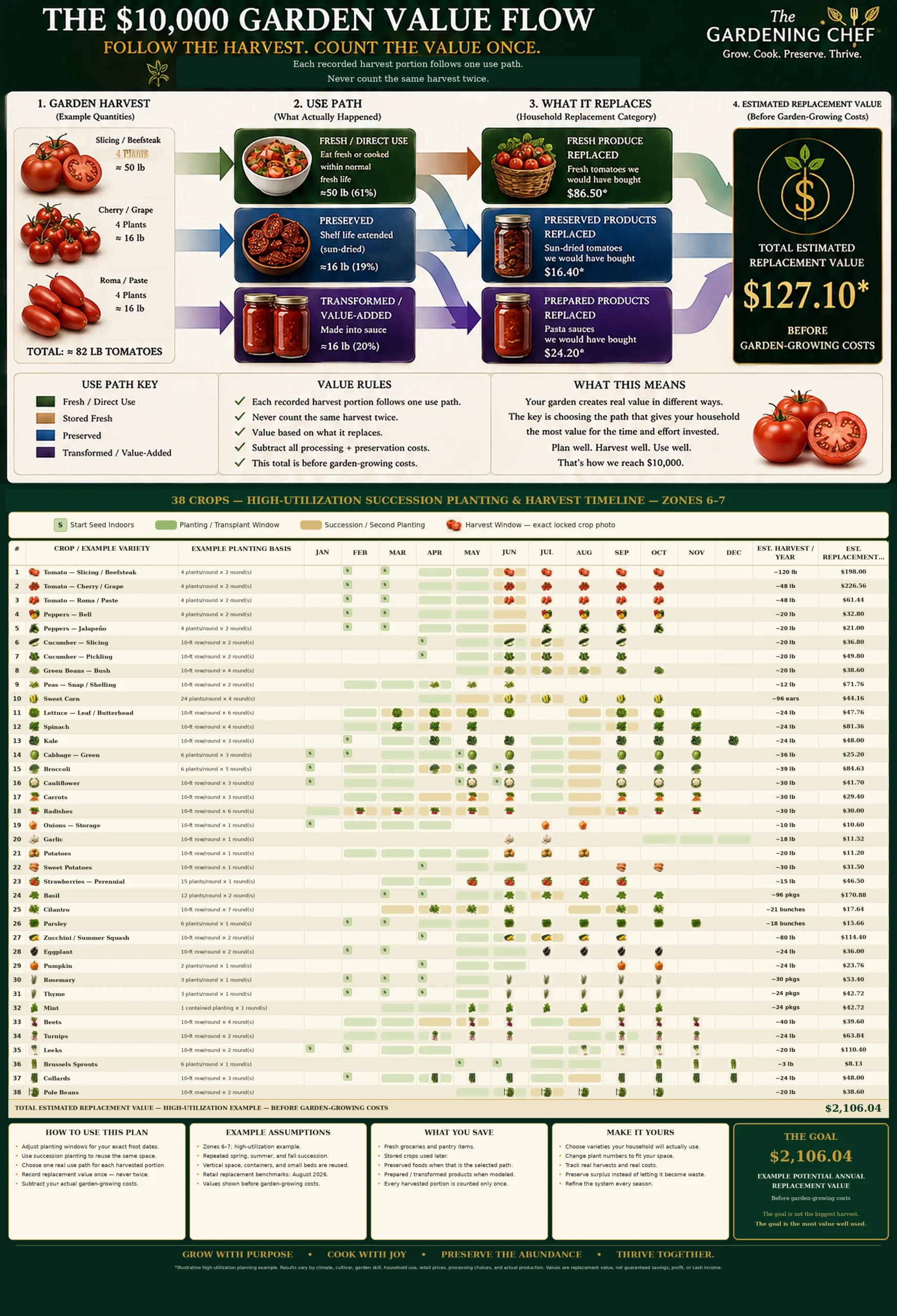
Methodology note: Planting dates, succession opportunities, and garden-spacing assumptions were informed by Virginia Cooperative Extension’s Home Garden Vegetable Planting Guide, which provides planting windows and recommended planting amounts by Virginia hardiness zone. Replacement-value estimates were benchmarked against USDA Agricultural Marketing Service retail produce reports, including advertised consumer prices for vegetables, herbs, potatoes, onions, and specialty crops. Actual harvests, prices, and growing seasons will vary by location, weather, variety, and management.
Back-of-the-Napkin Math
Start with what you already have:
3 containers
2 flower boxes
20 × 20 ft garden area
24 ft of sunny fence
Now give those spaces jobs.
Maybe the containers hold a cherry tomato, pepper, and basil.
Maybe the flower boxes grow spring lettuce, summer herbs, and fall spinach.
Maybe the fence supports peas early and cucumbers or pole beans later.
The important shift is that the same space does not have to perform only once.
A spring crop can leave room for a summer crop. A summer planting can give way to fall greens. A fence can support peas early, then beans or cucumbers once the weather warms.
That is how a relatively small garden begins producing more than its footprint suggests.
In the 38-crop high-utilization example above, those overlapping seasons, vertical spaces, containers, and succession plantings produce a modeled $2,106.04 in annual household replacement value before garden-growing costs.
That number is not created by counting the same tomato three different ways.
Each harvested portion gets one job.
Eat it fresh.
Store it fresh.
Preserve it.
Transform it.
Count it once.
That rule matters.
Then Look for the Value Outside the Harvest
The harvest is only one part of the larger garden system.
Ask:
Did saved seed replace a seed packet you otherwise would have purchased?
Did propagated herbs replace plants you would have bought?
Did homemade compost replace a bag from the garden center?
Did materials already on hand safely replace something you otherwise would have purchased?
Did succession planting turn an otherwise empty bed into another productive harvest?
These can create real economic value too.
But they should be counted only when they genuinely replace another expense—and only when that value has not already been counted somewhere else.
None of the individual numbers needs to be enormous.
That is the point.
The Quick Calculation
Start with the harvest:
Household Replacement Value = the value of purchases genuinely replaced by the harvest
Then, if you want to calculate the garden’s broader economic result:
Household replacement value
+ other non-overlapping purchases genuinely avoided
+ actual garden income
− direct growing and processing costs
= Net Economic Garden Value
The phrase non-overlapping matters.
If tomatoes are counted as replacing $25 worth of tomato sauce, those same tomatoes cannot also be counted as $25 worth of fresh tomatoes.
If basil becomes pesto, count the pesto path—not the basil again as a separate fresh-herb replacement.
One harvest portion.
One use path.
One value.
Then keep going.
One tomato harvest.
One batch of pesto.
One propagated plant.
One bag of compost you did not buy.
One second planting in a bed that otherwise would have sat empty.
The numbers do not have to be dramatic.
They have to be real.
Another season.
Another improvement.
Another productive loop.
The Kitchen Table Verdict
The $10,000 Garden does not ask:
“How do I grow one thing worth $10,000?”
It asks:
“How many useful little systems can I build, measure, reuse, and improve?”
Someone with three containers may start small.
Someone with two flower boxes may start small.
Someone working a productive 20 × 20-foot garden can move much faster. In the example above, that footprint—combined with containers, vertical growing, succession planting, and careful use of the harvest—crosses $2,100 in modeled annual replacement value before garden-growing costs.
But they can all play the same game:
Find the space.
Use the season.
Grow what you actually use.
Preserve what would otherwise be wasted.
Produce some of your own inputs.
Count each value once.
Then make the system a little better next year.
That is the back-of-the-napkin path toward a $10,000 Garden.
Not inflated numbers.
Not fantasy.
Small, real decisions that steadily turn unused capacity into productive value.
The Better Question
Most people begin with:
“Does it save money?”
That question is too small.
A better question is:
“What does this continue to produce?”
That question is large enough to notice food, skill, soil, surplus, compounding, and the systems connecting them.
And once you begin thinking that way, another lesson becomes obvious:
Not every productive system grows equally well.
In a garden, the difference often begins beneath the surface—with the soil.
→ Read next: Soil Before Stocks
And if building an entire productive system feels too large, begin smaller.
A little time, used consistently, can change the direction of a system.
→ Read: The 1% Garden Rule
Final Thought
The garden does not look like wealth to most people because we are accustomed to recognizing wealth only after it becomes money.
A garden teaches something different.
Wealth is not accumulated. It is cultivated.
It grows through stewardship, useful production, reinvestment, resilience, and the gradual shift from consuming everything to building something that can continue producing.
The $10,000 Garden may begin with something as ordinary as a basil plant.
But eventually the garden becomes a lens.
You begin seeing unused space differently.
Waste differently.
Skills differently.
Money differently.
And perhaps most importantly, you begin asking a question that reaches far beyond the garden:
What am I cultivating that can keep creating value tomorrow?
This is one piece of a much larger system.
The more pieces you connect, the clearer the picture becomes.