Fresh to Dried, Mild to Wild, Kitchen to Culture
A fresh-to-dried field guide for cooks, gardeners, preservers, and pepper lovers.
Types of peppers are often described by heat: mild, medium, hot, or dangerously hot.
But heat is only one chapter of the pepper story.
Before I understood peppers as a gardener, I met them as a cook.
Not as one ingredient, but as a table full of possibilities.
There were peppers so green and glossy they looked like they had just been picked that morning. There were red peppers with skins tight and bright as polished lacquer. There were tiny chiles no bigger than a finger joint, carrying more fire than their size seemed capable of holding. And then there were the dried ones — wrinkled, dark, leathery, and mysterious — peppers that looked less like vegetables and more like old letters from another kitchen.
At first, I thought I was learning names.
Jalapeño. Poblano. Serrano. Cayenne. Thai chile. Ancho. Chipotle.
But the deeper lesson was not identification.
It was transformation.
A pepper is not one ingredient. A pepper is an ingredient with chapters. It begins as seed, becomes leaf and flower, forms green fruit, ripens into color, and may eventually become smoke, powder, sauce, pickle, fermented heat, or preserved pantry flavor.
Once you see that, a pepper plant stops looking like a single crop.
It becomes a library.
Each stage has something different to teach.
The Pepper Library Promise
This is not just a pepper article.
It is a working kitchen-and-garden reference for people who want to grow with purpose, cook with more confidence, preserve the harvest safely, and turn one familiar crop into flavor, pantry value, gifts, products, and seasonal memory.
A chef can use it to choose the right form of heat.
A gardener can use it to decide what to plant and when to harvest.
A preserver can use it to route abundance into jars, powders, freezer packs, sauces, pickles, and ferments.
A creator can use it to see how a single plant becomes a content library, a printable poster, a market-table story, and a reason for readers to come back.
Save this guide if you want to:
Choose the right pepper for the meal.
Know when to harvest green, ripe, dried, or fermented peppers.
Build a beginner pepper garden that actually fits your kitchen.
Turn surplus into hot sauce, powders, pickles, roasted freezer packs, and gifts.
Connect peppers to tomatoes, onions, beans, greens, brassicas, squash, potatoes, herbs, fats, and preservation.
This field guide is designed to help cooks, gardeners, homesteaders, market growers, and food lovers stop treating peppers as one generic ingredient and start using them as a complete kitchen system.
Use it to decide which peppers to grow, when to harvest them, how to cook each stage, how to preserve the surplus, and how to turn one plant into fresh meals, pantry staples, sauces, powders, gifts, and products worth sharing.
Start Here: Choose Your Reading Path
If you are a chef or serious home cook, start with Which Pepper Should You Use? and Fresh Heat, Roasted Heat, Dried Heat, Smoked Heat, and Fermented Heat. You will learn which pepper form fits the dish and how heat changes with preparation.
If you are a gardener, start with Garden Planner: Choose Peppers by Household Goal and The Beginner Pepper Garden Plan. You will learn which peppers to grow for your actual meals, preserves, and household habits.
If you are a preserver, start with When the Pepper Harvest Hits: The Five-Basket System and The Pepper Preservation Ladder. You will learn how to route abundance into freezer packs, pickles, powders, sauces, and ferments.
If you are a beginner, start with The Fast Pepper Decision Guide and Best Peppers to Grow First. You will learn the simplest useful pepper system to start with confidence.
If you are a blogger, teacher, or creator, start with The Pepper Offer Stack and How Peppers Become Products. You will see how one crop becomes printables, recipe bundles, subscriber bonuses, market products, and repeat content.
If you are a flavor geek, start with For the Geeks: A Pepper Is Chemistry, Culture, and Time and Global Pepper Flavor Map. You will see why peppers change through ripening, drying, smoking, fermenting, fat, acid, and culture.
Why Peppers Deserve Their Own Field Guide
Most people think of peppers by heat.
Mild. Medium. Hot. Dangerous.
That is useful, but incomplete.
A chef does not look at peppers only by heat. A gardener does not either. A pepper changes as it grows. Its flavor changes. Its texture changes. Its sweetness changes. Its color changes. Its best use changes.
A green pepper may bring grassy sharpness and crunch. A ripe pepper may bring sweetness, fruitiness, and depth. A roasted pepper may bring softness and smoke. A dried chile may bring earth, raisin, tobacco, berry, or fire. A powdered pepper can season an entire pot. A fermented pepper can become sauce that lasts long after the plant is gone.
That is why the pepper deserves to be studied like a field guide plant.
Not because it is rare.
Because it is common enough to be overlooked.
The more familiar something is, the easier it is to stop seeing it clearly. Peppers sit in grocery bins, salsa jars, spice cabinets, freezer bags, garden beds, seed catalogs, hot sauces, and market baskets. They are everywhere, which is exactly why they deserve a closer look.
A good pepper guide should do more than list varieties.
It should help you understand what each pepper can become.
Fresh. Roasted. Dried. Smoked. Fermented. Pickled. Powdered. Sauced. Preserved.
That is the real field guide.
The Pepper Library: A Complete Kitchen System
The Pepper Library is built on one simple idea: peppers are transformation crops.
They begin as fresh vegetables, but they do not have to stay there. A pepper can become roasted sweetness, smoky depth, dried spice, fermented sauce, pickled crunch, chile oil, powder, paste, relish, seed stock, or a product people want to buy, gift, collect, taste, and talk about.
That is what makes peppers different.
They are not only grown for the harvest basket.
They are grown for what the harvest can become.
This guide will help you understand peppers as a complete kitchen-and-garden system: when to harvest them, how to use them, how to preserve them, and how to grow the varieties your kitchen will actually use.
The goal is not to grow every pepper.
The goal is to understand the pepper well enough to make better decisions.
Which pepper belongs in tonight’s salsa? Which one should be roasted? Which one should be dried? Which one should become hot sauce? Which one should be harvested green, and which one is worth waiting on until it ripens?
That is where the pepper becomes more than a crop.
It becomes a kitchen system.
The Pepper System at a Glance
A pepper plant can give you more than one harvest. It can give you a sequence of useful kitchen forms.
| Stage | Chef Value | Garden Value | Preservation Value |
|---|---|---|---|
| Green | Crunch, sharpness, fresh structure | Earlier harvest and steady production | Chop and freeze for cooked dishes |
| Ripe | Sweetness, color, fruitiness, roastability | Full expression of variety | Roast, freeze, sauce, pickle, ferment |
| Dried | Concentrated heat, earthiness, pantry depth | Extends the crop beyond the season | Powders, flakes, whole dried chiles, spice blends |
| Smoked | Memory, depth, savory backbone | Turns ripe harvest into specialty flavor | Chipotle-style chiles, smoked powders, sauces |
| Fermented | Acid, complexity, rounded heat | Uses ripe abundance efficiently | Hot sauce, pepper mash, relish, paste |
This is the central idea of the Pepper Library:
Every stage has a purpose.
The question is not only, “Is this pepper ripe?”
The better question is, “What do I want this pepper to become?”
Types of Peppers at a Glance
There are many types of peppers, but a kitchen gardener does not need to memorize every variety before getting started. It helps to begin with purpose.
Some peppers are grown for sweetness. Some are grown for heat. Some are grown for roasting. Some are grown for stuffing. Some are grown for drying. Some are grown for pickling. Some are grown because they are beautiful enough to sell the story before anyone tastes them.
| Pepper Type | Best Known For | Best Uses | Field Guide Note |
|---|---|---|---|
| Bell pepper | Sweetness, crunch, color | Stuffing, roasting, salads, fajitas, sauces | The beginner-friendly sweet pepper with high kitchen flexibility. |
| Banana pepper | Mild tang and pickling value | Pickles, sandwiches, pizzas, salads, relishes | A practical pepper for people who want flavor without much heat. |
| Jalapeño | Fresh green heat and chipotle potential | Salsa, poppers, pickles, hot sauce, smoking | One of the best peppers for learning fresh, pickled, ripe, and smoked stages. |
| Poblano | Mild depth and roasting power | Stuffed peppers, rajas, sauces, soups, ancho chiles | A chef’s pepper: mild enough for many people, complex enough for serious cooking. |
| Serrano | Clean, bright heat | Salsa, sauces, rice, beans, marinades | Sharper and often hotter than jalapeño, excellent when freshness matters. |
| Cayenne | Drying and powder | Chile flakes, cayenne powder, oils, rubs, hot sauce | A pantry pepper that turns easily into seasoning. |
| Thai chile | Small size, high heat | Curries, stir-fries, chile oils, condiments | Use carefully; a little can change the whole dish. |
| Sweet roasting pepper | Ripe sweetness and tender flesh | Roasting, freezing, sauces, sandwiches, antipasto | Often one of the best peppers for making people want the harvest. |
Bell peppers are the family-friendly sweet peppers. They bring crunch, color, and flexibility to salads, fajitas, stuffed peppers, roasted trays, sauces, and everyday meals.
Banana peppers are mild, tangy, and useful for pickling. They belong on sandwiches, pizzas, salads, relish trays, and snack boards.
Jalapeños are one of the best peppers for learning the full pepper story. They can be used green for salsa and poppers, pickled for sandwiches and tacos, ripened red for deeper sweetness, smoked into chipotle-style peppers, or turned into hot sauce.
Poblanos are one of the great cook’s peppers. They are mild enough for many people, but complex enough to matter. They can be roasted, stuffed, blended into sauces, folded into soups, or ripened and dried into ancho-style depth.
Serranos bring clean, bright heat. They are sharper and often hotter than jalapeños, making them excellent for salsa, rice bowls, marinades, beans, and quick sauces.
Cayenne peppers are pantry peppers. They dry well, grind well, and become flakes, powder, oils, rubs, hot sauce, and seasoning blends.
Thai chiles are small but serious. They bring intense heat to curries, stir-fries, chile oils, dipping sauces, condiments, and fermented preparations.
Sweet roasting peppers are often the peppers that make people fall in love with the harvest. When ripe and roasted, they become soft, sweet, colorful, and generous.
Once you understand these basic roles, the pepper aisle, seed catalog, and garden bed become easier to read.
The Life Stages of a Pepper Plant
Every pepper plant moves through a sequence. Each stage has a different kitchen purpose, garden lesson, and preservation path.
A pepper is not only a thing you pick.
It is a thing you time.
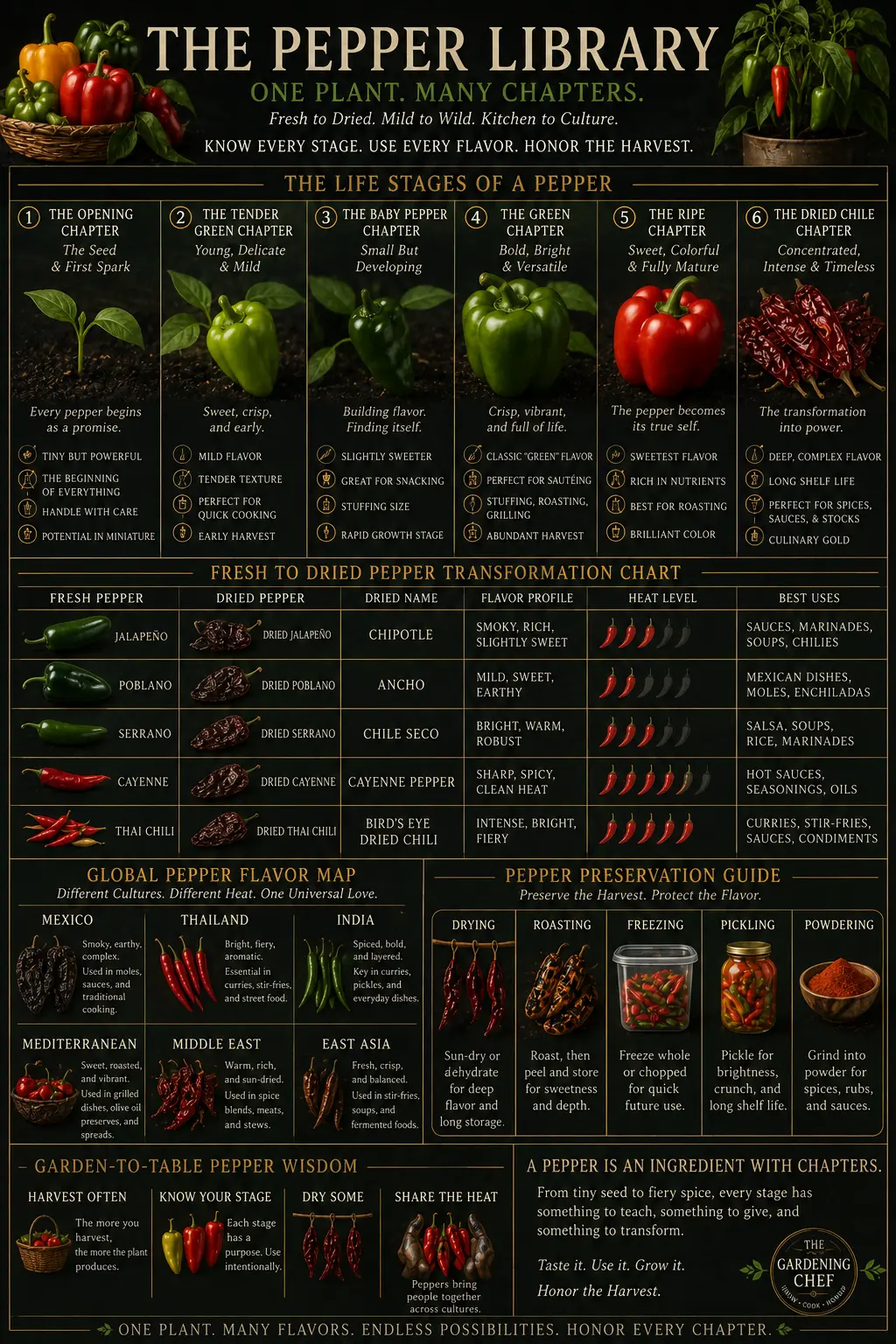
1. The Opening Chapter: Seed and First Spark
Every pepper begins as something almost weightless.
A seed.
Dry, pale, quiet, and easy to underestimate.
But inside that seed is the full design for a plant capable of producing fruit, flavor, heat, color, and future seeds. This is the opening chapter — the promise stage.
For the gardener, this is where patience begins. Peppers are not always the fastest crops to wake up. They like warmth. They like steady conditions. They often test beginners because they do not always reward impatience.
But once they begin, the story changes.
A pepper seed is not just the start of one fruit.
It is the beginning of a flavor system.
2. The Tender Green Chapter: Young, Mild, and Delicate
Before the pepper becomes bold, it becomes tender.
The early green stage is often overlooked because gardeners are waiting for size, color, or heat. But young peppers can be useful in the kitchen. They may be crisp, gentle, slightly grassy, and quick-cooking.
A young pepper can be sliced thin into stir-fries, sautéed lightly, folded into eggs, or used where you want freshness without the full weight of a mature fruit.
This is the chapter of delicacy.
The lesson here is simple:
Immature does not mean useless.
It means different.
3. The Baby Pepper Chapter: Small but Developing
This is the stage where the fruit has formed but has not yet reached its full size or maturity.
The pepper is no longer just potential. It has become visible. You can see the shape it wants to take. A bell pepper becomes blocky and broad. A jalapeño becomes smooth and tapered. A cayenne stretches long and thin. A poblano widens into its deep green form.
This chapter teaches recognition.
The plant is beginning to reveal its variety.
For the gardener, this is also a watchful stage. Water stress, heat stress, pest damage, and nutrient imbalance can all affect the final harvest. A pepper plant carrying young fruit is asking for consistency.
Not drama.
Consistency.
4. The Green Pepper Chapter: Crisp, Bright, and Useful
The green pepper chapter is not a lesser version of the ripe chapter.
It is its own ingredient.
Green peppers often bring firmness, brightness, sharpness, and structure. They can cut through richness. They can hold up to sautéing, roasting, stuffing, grilling, and chopping into fresh salsas.
This is where many peppers first become useful in everyday cooking.
Green bell peppers bring crunch and grassy sweetness. Green jalapeños bring clean heat. Poblanos bring depth without overwhelming fire. Serranos bring sharper brightness.
The green chapter is where the pepper is practical.
It is the stage of weeknight cooking, garden harvesting, and steady kitchen use.
5. The Ripe Pepper Chapter: Sweetness, Color, and Full Expression
When a pepper ripens, it becomes more than bigger.
It becomes itself.
Green turns to red, yellow, orange, brown, purple, or chocolate depending on variety. The flavor often becomes sweeter, fruitier, deeper, and more rounded. Heat may feel sharper in some varieties and softer or more complex in others.
This is the chapter of full expression.
A red bell pepper tastes different from a green one because it has had more time to develop sugar and depth. A ripe red jalapeño is not the same ingredient as a green jalapeño. A ripe chile can carry fruitiness that never appears in its earlier form.
This is where roasting becomes powerful.
Fire softens the flesh, loosens the skin, concentrates sweetness, and adds char. A ripe pepper roasted until blistered can become sauce, spread, soup, salsa, relish, or preserved treasure.
The ripe chapter is where color becomes flavor.
6. The Dried Chile Chapter: Concentrated, Timeless, and Powerful
Drying changes everything.
Water leaves. Flavor concentrates. Texture disappears. Shelf life expands. A fresh fruit becomes a pantry ingredient.
This is where peppers stop being temporary.
A dried chile can sit quietly in a jar for months, waiting to season a stew, enrich a sauce, color an oil, or become powder. Some dried peppers become smoky. Some become raisiny. Some become earthy. Some become fruity and bright.
This is why dried peppers often feel older than fresh peppers — not because they are lesser, but because they have been transformed.
The dried chile chapter is preservation, memory, and power.
Fresh-to-Dried Pepper Transformation Chart
Not every pepper gets a famous dried name, but many do. Some names describe a specific variety after drying. Others describe whether it was smoked, ripened, or processed in a certain way.
| Fresh Pepper | Dried or Smoked Form | Flavor Profile | Heat Level | Best Uses | Chef’s Note |
|---|---|---|---|---|---|
| Jalapeño | Chipotle, when ripe, smoked, and dried | Smoky, rich, slightly sweet | Medium | Sauces, marinades, beans, soups, chili | Use when you want smoke as much as heat. |
| Poblano | Ancho, when ripe and dried | Mild, sweet, earthy, raisin-like | Mild | Mole, enchilada sauce, stews, braises | One of the great dried chiles for depth without too much heat. |
| Serrano | Dried serrano / chile seco | Bright, sharp, clean heat | Medium-hot | Salsa, soups, rice, marinades | Best when you want a cleaner, sharper chile flavor. |
| Cayenne | Dried cayenne / cayenne powder | Sharp, hot, direct | Hot | Hot sauces, spice blends, oils, rubs | A classic heat builder. Use carefully. |
| Thai bird’s eye chile | Dried Thai chile | Fiery, bright, intense | Very hot | Curries, stir-fries, chile oils, condiments | Small pepper, serious force. |
| Anaheim / New Mexico chile | Dried red chile pods | Earthy, warm, mildly sweet | Mild-medium | Red chile sauce, stews, enchiladas | A backbone chile for Southwestern cooking. |
| Mirasol | Guajillo | Fruity, tangy, berry-like | Mild-medium | Mexican sauces, marinades, soups | Bright and beautiful in red sauces. |
| Chilaca | Pasilla | Dark, raisin-like, complex | Mild-medium | Mole, sauces, stews | Adds shadow and depth. |
A fresh jalapeño and a chipotle are not the same ingredient in practice. One brings bright green heat. The other brings smoke, depth, and memory.
That is why peppers are so powerful in the kitchen.
They do not only change by variety.
They change by time, fire, smoke, drying, and preservation.
When to Harvest Peppers: A Chef’s Garden-to-Kitchen Decision Guide
The best time to harvest a pepper depends on what you want from it.
| Harvest Stage | What You Get | Best Kitchen Use | Garden Note |
|---|---|---|---|
| Very young | Tender texture, mild flavor | Quick sautés, eggs, light stir-fries | Harvest sparingly so the plant can keep developing. |
| Full-sized green | Crunch, brightness, sharper flavor | Stuffing, grilling, salsa, stir-fries | Excellent everyday stage. |
| Fully ripe | Sweetness, fruitiness, color | Roasting, sauces, fresh eating, preserving | More flavor depth, but requires more time on the plant. |
| Overripe but sound | Deep sweetness, softer texture | Sauce, drying, fermentation | Use quickly before quality declines. |
| Dried | Concentrated flavor, long storage | Powders, sauces, soups, oils | Store airtight and away from light. |
A gardener asks, “Is it ready?”
A chef asks, “Ready for what?”
That second question is the better one.
If you want fresh structure, harvest green. If you want sweetness and color, wait for ripeness. If you want pantry value, plan for drying, roasting, freezing, fermenting, or sauce. The harvest stage is not only a timing decision.
It is an ingredient decision.
When the Pepper Harvest Hits: The Five-Basket System
Peppers often arrive in waves.
One week there are a few. Then suddenly there are more than the kitchen can use fresh. That is where many gardeners lose value. Not because they failed to grow peppers, but because they did not have a plan for what the peppers should become.
The five-basket system gives the harvest a direction.
| Basket | What Goes In | What It Becomes |
|---|---|---|
| Fresh Basket | Crisp green bells, jalapeños, serranos, banana peppers, poblanos | Salads, salsas, fajitas, omelets, stuffed peppers, stir-fries, snacks |
| Roast Basket | Ripe bells, poblanos, Anaheims, sweet roasting peppers | Roasted strips, freezer packs, sauces, soups, spreads, sandwich peppers |
| Pickle Basket | Jalapeños, banana peppers, cherry peppers, serranos, mixed slices | Quick pickles, sandwich toppers, taco peppers, relish, market jars |
| Dry Basket | Cayenne, Thai chiles, ripe jalapeños, serranos, thin-walled peppers | Chile flakes, powders, spice blends, seasoning jars, pantry heat |
| Ferment Basket | Ripe hot peppers, mixed sweet and hot peppers, garlic-pepper blends | Hot sauce, pepper mash, fermented paste, complex condiments |
This is how a pepper plant becomes more than a harvest.
It becomes a routing system.
Instead of asking, “What am I going to do with all these peppers?” you ask a better question:
Which basket does this pepper belong in?
That question saves food, builds pantry value, and turns overwhelm into options.
The Fast Pepper Decision Guide
Sometimes you do not need a long explanation.
You need a quick answer.
| If You Want… | Choose… | Why It Works |
|---|---|---|
| Crunch and fresh structure | Green bells, poblanos, jalapeños, serranos | They stay crisp, bright, and visible in the dish. |
| Sweetness and color | Ripe red, yellow, orange, or chocolate peppers | Ripening builds sugar, aroma, and visual appeal. |
| Smoky depth | Chipotle, roasted poblanos, smoked ripe peppers | Smoke turns heat into memory and gives sauces backbone. |
| Pantry power | Dried chiles, flakes, powders, fermented sauces | Preservation turns a temporary harvest into year-round flavor. |
| Beginner confidence | Jalapeño, banana pepper, bell pepper, poblano | They are useful in many meals and easy to understand in the kitchen. |
This is the practical heart of the Pepper Library.
Peppers are not only chosen by name.
They are chosen by job.
Chef’s Save-It Reference: What Pepper Does This Dish Need?
A pepper is not useful because it is hot.
It is useful because it gives the cook a choice.
| If the Dish Needs… | Use… | Example |
|---|---|---|
| Fresh snap | Green bell, jalapeño, serrano, banana pepper | Salsa, slaw, tacos, salads, stir-fries |
| Sweet roasted body | Ripe bell, sweet roasting pepper, poblano, Anaheim | Roasted pepper soup, pasta sauce, sandwiches, rajas |
| Mild depth | Poblano, ancho, Anaheim, paprika pepper | Stuffed peppers, enchilada sauce, soups, braises |
| Clean heat | Serrano, jalapeño, Thai chile | Fresh salsa, chile-lime dressing, stir-fry, rice bowls |
| Smoky backbone | Chipotle-style smoked jalapeño, smoked ripe peppers | Beans, chili, barbecue sauce, marinades |
| Pantry seasoning | Cayenne, dried Thai chile, paprika, chile flakes | Rubs, soups, eggs, potatoes, roasted vegetables |
| Complex condiment | Fermented ripe hot peppers | Hot sauce, pepper paste, finishing drizzle, marinades |
Fresh heat cuts through richness. Roasted heat softens and deepens. Dried heat concentrates and seasons. Smoked heat adds memory. Fermented heat brings acid, complexity, and lift.
The mistake is treating heat like a ladder where mild is low and hot is high.
A chef treats heat like a palette.
The better question is not, “How spicy is it?”
The better question is, “What kind of movement does this dish need?”
A taco may need fresh snap. A pot of beans may need smoke. A sauce may need dried fruit depth. A dressing may need fermented brightness.
Once you understand that, peppers stop being risky.
They become precise.
Peppers as Transformation Crops
For the Chefs: Heat Is Not a Number
Heat is not a number.
It is a movement.
A pepper does not simply make food hotter. It can make food brighter, deeper, sweeter, smokier, sharper, fruitier, richer, or more memorable.
Fresh peppers move quickly. They bring snap, crunch, and a sharp edge. Roasted peppers soften and warm the dish. Dried peppers concentrate and deepen. Smoked peppers add memory. Fermented peppers bring acid, complexity, and lift.
That means a pepper can wake up a taco, deepen a pot of beans, round out a sauce, sharpen a dressing, or become the backbone of a stew.
The cook’s job is not to prove toughness.
The cook’s job is to place heat where it belongs.
For the Gardeners: The Harvest Stage Is the Ingredient
Gardeners often ask when a pepper is ready, but peppers challenge that question.
A green jalapeño is ready for salsa.
A red jalapeño is ready for sweetness, smoke, or sauce.
A poblano is ready green for stuffing and roasting, but ripe and dried it becomes an ancho-style pantry chile.
A bell pepper can be harvested green for structure or left to ripen for sweetness and color.
That means the harvest stage is not just timing.
It is ingredient selection.
If you want more production, harvest some peppers green. If you want deeper flavor, let selected fruit ripen. If you want pantry value, plan which plants will become dried, smoked, or fermented.
The best pepper garden is not the one with the most varieties.
It is the one where each harvest has a job before it leaves the plant.
For the Geeks: A Pepper Is Chemistry, Culture, and Time
The fascinating thing about peppers is that the same fruit can become several different ingredients because chemistry changes over time and through process.
Capsaicin, the compound most associated with heat, is concentrated mostly in the inner placenta and membranes, not simply in the seeds themselves, though seeds can carry heat because they touch those tissues.
Ripening changes color, sugar, aroma, and perceived flavor. Drying removes water and concentrates what remains. Smoking adds aromatic compounds that make the pepper taste deeper than heat alone. Fermentation brings acidity, microbial complexity, and a softer edge. Fat can carry chile aroma through a dish, while acid can sharpen it.
That is why a fresh jalapeño, a chipotle, a dried chile flake, and a fermented hot sauce do not behave like the same ingredient.
They are chapters in the same biological story.
For the Creators: The Pepper Is a Content Engine
One pepper plant can become far more than one harvest post.
It can become seed-starting content, variety comparisons, harvest videos, roasting tutorials, hot sauce experiments, drying logs, recipe cards, market labels, pantry labels, printable posters, preservation checklists, and seasonal challenges.
This is why the Pepper Library has commercial power. It teaches a system people can return to again and again.
A reader may arrive for “what pepper should I grow?” but stay for “what can I make, preserve, print, gift, sell, and learn next?”
That is the difference between content and a platform.
Content answers a question.
A field guide builds a world.
Fresh Heat, Roasted Heat, Dried Heat, Smoked Heat, and Fermented Heat
Heat is not one thing. The way a pepper is prepared changes how the heat feels and how the flavor moves through a dish.
| Heat Form | Flavor Character | Best Uses | Chef’s Lesson |
|---|---|---|---|
| Fresh heat | Bright, sharp, grassy, immediate | Salsa, stir-fries, tacos, marinades, fresh sauces | Use when you want the dish to wake up quickly. |
| Roasted heat | Softer, sweeter, deeper, slightly charred | Rajas, soups, sauces, spreads, stuffed peppers | Fire turns sharpness into warmth. |
| Dried heat | Concentrated, earthy, fruity, direct | Powders, flakes, stews, rubs, soups, beans | Drying turns a fresh crop into pantry strength. |
| Smoked heat | Deep, savory, woodsy, memorable | Chipotle sauces, chili, beans, marinades, barbecue | Smoke adds memory as much as heat. |
| Fermented heat | Tangy, complex, acidic, layered | Hot sauce, pepper mash, condiments, dressings | Fermentation makes heat taste alive and rounded. |
This is why two peppers with the same heat level can behave very differently.
One may brighten a salsa.
One may deepen a stew.
One may carry smoke through a pot of beans.
One may become the finishing note in a sauce.
The cook’s job is not to chase heat.
The cook’s job is to place it.
How to Use Peppers at Every Stage
Green Peppers: The Fresh Structure Stage
Green peppers are excellent when a dish needs shape, crunch, or freshness.
Use them when you want the pepper to remain visible and textural. They belong in fajitas, stir-fries, omelets, fresh salsas, stuffed peppers, garden salads, and quick sautés.
Green peppers also work well when paired with rich foods because their grassy edge cuts through fat. Sausage, cheese, eggs, beans, rice, and potatoes all benefit from that brightness.
The green pepper is not immature in the kitchen.
It is structural.
Ripe Peppers: The Sweet and Roasted Stage
Ripe peppers are where the plant gives you color and sweetness.
This is the stage for roasting, peeling, blending, and preserving. A red pepper roasted over flame or under a broiler becomes softer, sweeter, and deeper. Its skin blisters. Its flesh collapses slightly. Its flavor concentrates.
Use ripe peppers in sauces, soups, spreads, relishes, pasta dishes, pizza toppings, sandwiches, and composed salads.
This is the chapter where peppers become generous.
They give color to the plate and warmth to the meal.
Hot Peppers: The Heat Management Stage
Hot peppers are not just about pain.
They are about placement.
A little heat in the right place wakes up a dish. Too much heat in the wrong place takes it over. The goal is not to prove toughness. The goal is to use heat like seasoning.
Fresh hot peppers bring brightness and snap. Dried hot peppers bring depth and concentration. Smoked hot peppers bring memory. Fermented hot peppers bring acidity and complexity.
The best cooks learn to ask:
Do I want fresh heat, roasted heat, dried heat, smoky heat, or fermented heat?
Those are different tools.
Dried Peppers: The Pantry Stage
Dried peppers are one of the great bridges between garden and pantry.
They allow a summer crop to keep speaking in winter.
To use whole dried chiles, remove stems and seeds if desired, toast them briefly in a dry pan, then soak them in hot water until softened. From there, they can be blended into sauces, chopped into stews, or turned into pastes.
Powdered dried peppers are faster, but less dimensional. Whole dried chiles give you more control and often better flavor.
The dried pepper is not a backup plan.
It is a preserved chapter.
Garden Planner: Choose Peppers by Household Goal
The best pepper garden is not the one with the most varieties.
It is the one that matches your household.
| Goal | Best Pepper Choices | Why |
|---|---|---|
| Family-friendly cooking | Bell peppers, sweet roasting peppers, banana peppers | Low heat, high usefulness, good color, easy to serve often |
| Salsa and fresh heat | Jalapeño, serrano, poblano, cilantro-friendly peppers | Fresh, bright, flexible, easy to pair with tomatoes and onions |
| Roasting and freezing | Poblano, Anaheim, ripe bells, sweet Italian peppers | Roast well, freeze well, create future meal bases |
| Drying and powders | Cayenne, Thai chile, paprika peppers, thin-walled chiles | Dry efficiently and become shelf-stable seasoning |
| Hot sauce | Ripe jalapeños, serranos, cayenne, habanero, mixed hot peppers | Ferment, blend, cook, or bottle into value-added products |
| Market-table beauty | Colorful sweet peppers, ornamental edible chiles, ristras, specialty varieties | Visual abundance sells the story before the first taste |
This is where a pepper garden becomes intentional.
Instead of asking, “What peppers look interesting?” ask, “What peppers solve real problems in my kitchen?”
If your family eats fajitas, grow sweet peppers and poblanos.
If you make salsa every week, grow jalapeños and serranos.
If you want pantry seasoning, grow cayenne or Thai chiles.
If you want sauces, grow ripe hot peppers and roasting peppers.
If you want a beginner win, grow peppers you already know how to use.
Grow for use.
Then expand for curiosity.
The Beginner Pepper Garden Plan
If you only grow four pepper types, choose one for sweetness, one for everyday heat, one for roasting, and one for drying.
That gives the garden fresh eating, cooking value, preservation value, and pantry value without overwhelming the beginner.
Bell pepper or sweet roasting pepper: for color, sweetness, stuffing, roasting, and family-friendly cooking.
Jalapeño: for salsa, poppers, pickles, everyday heat, ripe red harvests, and chipotle-style smoking.
Poblano: for roasting, stuffing, rajas, soups, sauces, and dried ancho-style depth.
Cayenne or Thai chile: for drying, flakes, powder, hot sauce, chile oil, and concentrated pantry heat.
After that foundation, expand based on your kitchen.
Grow banana peppers for pickling, serranos for sharper salsa heat, Anaheims for roasting, paprika peppers for powder, habaneros for fruity fire, or specialty sweet peppers for market-table beauty.
The best pepper garden is not the one with the most varieties.
It is the one where each harvest has a job before it leaves the plant.
That is the difference between growing for novelty and growing for use.
Common Pepper Mistakes
One of the biggest pepper mistakes is treating heat as the whole story. Heat matters, but sweetness, smoke, fruitiness, crunch, aroma, and preservation value matter just as much.
Another mistake is waiting too long to harvest everything. Some peppers are best green. Some are best ripe. Some should be harvested often to keep the plant producing.
A third mistake is drying thick-walled peppers casually. Moist peppers can mold if they are not dried completely before storage.
Hot peppers also require respect. Capsaicin can linger on skin and transfer to eyes, nose, or sensitive areas, so gloves are worth using when handling strong chiles.
But the deepest mistake is growing impressive peppers instead of useful peppers.
A shocking pepper is fun once.
A useful pepper earns its place every week.
The best pepper garden matches the meals, sauces, preserves, and products you actually want to make.
Do not wait until every pepper is red. Green peppers have their own value, and harvesting some early can keep plants productive.
Do not make shelf-stable hot sauce by guessing. Use tested preservation guidance when a product is meant to sit on a pantry shelf.
Do not forget the product path. Extra peppers can become powders, pickles, sauces, spice blends, gifts, posters, labels, stories, and reader-supported content.
A pepper harvest is not a problem.
It is inventory waiting for direction.
Common Pepper Problems and What They Usually Mean
Pepper plants do not need drama.
They need warmth, sun, steady moisture, balanced fertility, airflow, and attention.
| Problem | Likely Cause | What to Do |
|---|---|---|
| Few flowers | Too much nitrogen, not enough sun, young plants | Reduce heavy feeding, improve sunlight, give plants time. |
| Flowers drop | Heat stress, cold nights, water stress, poor pollination conditions | Water consistently, mulch, and protect plants from extremes when possible. |
| Small fruit | Stress, crowding, poor fertility, inconsistent watering | Improve spacing, soil health, and moisture consistency. |
| Blossom-end rot symptoms | Calcium uptake problems often linked to uneven moisture | Water steadily, mulch, and avoid extreme swings in soil moisture. |
| Sunscald | Fruit exposed to intense direct sun after foliage loss or sparse canopy | Maintain healthy foliage, avoid over-pruning, and provide light shade if needed. |
| Slow ripening | Cool weather, short season, heavy fruit load | Harvest some green peppers, protect from cold, and let selected fruit ripen fully. |
| Aphids or pests | Tender growth attracting insects | Inspect early, rinse pests off, encourage beneficial insects, and avoid panic spraying. |
| Weak flavor | Harvest stage, variety choice, too much water near harvest | Choose flavorful varieties and harvest at the stage that matches the intended use. |
The more consistent the system, the better the plant can write its chapters.
How to Preserve Peppers
Peppers often arrive in waves.
Dry some. Roast some. Pickle some. Freeze some. Turn some into sauce.
A pepper not preserved is often a pepper lost.
Preserving peppers is not only about saving food. It is about changing form. A fresh pepper becomes a future soup base. A roasted pepper becomes a freezer pack. A dried pepper becomes winter heat. A fermented pepper becomes hot sauce. A powdered pepper becomes seasoning that can wake up eggs, potatoes, beans, meat, soup, or roasted vegetables months later.
That is how the pepper harvest keeps speaking after the plant is gone.
Drying Peppers
Drying is the most direct way to turn peppers into pantry power.
Small thin-walled peppers dry more easily than thick-walled bells. Use a dehydrator, a warm dry space with airflow, or an oven on very low heat.
Peppers should be fully dry before storage. If they remain leathery or moist, they may mold.
Best for: cayenne, Thai chiles, serranos, small hot peppers, and thin-walled varieties.
Roasting and Freezing Peppers
Roasting brings out sweetness and makes peppers easier to use later.
Char the skins, steam briefly in a covered bowl, peel if desired, then freeze in portions.
A freezer bag of roasted peppers is not just storage. It is a future pasta sauce, soup base, sandwich topping, pizza layer, rice bowl addition, or weeknight shortcut.
Best for: bell peppers, poblanos, Anaheim peppers, and ripe red peppers.
Pickling Peppers
Pickling preserves brightness and crunch.
Vinegar, salt, garlic, herbs, and spices can turn extra peppers into sandwich toppers, taco companions, relish, or pantry condiments.
Pickled peppers are especially useful because they solve two problems at once: preservation and contrast. They bring acid, snap, and brightness to rich food.
Best for: jalapeños, banana peppers, cherry peppers, and serranos.
Fermenting Peppers
Fermentation turns peppers into living flavor.
Salt and time create acidity, depth, and complexity. Fermented peppers can become hot sauce, paste, relish, or seasoning base.
A fermented pepper sauce does not taste like raw heat. It tastes rounded, active, layered, and alive.
Best for: hot peppers, mixed ripe peppers, and garlic-pepper blends.
Powdering Peppers
Once peppers are completely dry, they can be ground into powders.
This is where the garden becomes seasoning.
A jar of homemade pepper powder is small, but powerful. It can season eggs, potatoes, soups, beans, roasted vegetables, rubs, sauces, marinades, and spice blends.
Best for: cayenne powder, paprika-style blends, chile flakes, and custom house spice mixes.
The Pepper Preservation Ladder
If you are new to preserving peppers, move up the ladder one skill at a time.
| Level | Method | Best Starting Point | What It Teaches |
|---|---|---|---|
| 1 | Freeze | Chopped sweet peppers or roasted poblanos | Convenience and low-risk preservation |
| 2 | Dry | Cayenne, Thai chiles, thin-walled peppers | Moisture control and pantry storage |
| 3 | Roast and freeze | Ripe bells, poblanos, Anaheims | Flavor transformation and future meal prep |
| 4 | Refrigerator pickle | Jalapeños, banana peppers, serranos | Acid, crunch, short-term preservation |
| 5 | Ferment | Ripe hot peppers and garlic-pepper blends | Salt, time, acidity, and complex flavor |
| 6 | Tested shelf-stable preserving | Pickles, relishes, sauces from reliable recipes | Precision, safety, and product confidence |
You do not have to master everything in one season.
Start with freezing. Try drying. Roast and freeze a batch. Make refrigerator pickles. Learn fermentation carefully. Then, when you are ready for shelf-stable preservation, use tested recipes and safe methods.
The point is not to rush.
The point is to build skill.
Food Safety and Hot Pepper Handling Notes
Peppers are generous, but preservation still requires care.
Use tested recipes for shelf-stable pickles, sauces, and fermented products. Refrigerate quick pickles and fresh sauces unless a reliable preservation method says otherwise. Make sure dried peppers are fully dry before storing them airtight.
When working with very hot peppers, wear gloves, avoid touching your face, and clean knives, boards, and counters carefully.
Remove seeds and inner membranes when you want less heat, but remember that heat can vary from pepper to pepper, even on the same plant. Add hot peppers in layers and taste before adding more. You can always increase heat. You cannot easily remove it once it takes over the dish.
The goal is not only strong flavor.
The goal is safe flavor that lasts.
Global Pepper Flavor Map
Peppers travel well because they adapt to culture.
In Mexico, dried chiles become sauces with layers of fruit, smoke, earth, and spice. Ancho, guajillo, pasilla, chipotle, and arbol can each play a different role in the same cuisine.
In Thailand, small hot chiles bring quick fire to curries, stir-fries, dipping sauces, and condiments.
In India, chiles work alongside cumin, coriander, turmeric, mustard seed, ginger, and garlic to create heat that is woven into a larger spice system.
In the Mediterranean, sweet peppers are roasted, preserved, stuffed, stewed, and paired with olive oil, garlic, herbs, grains, and seafood.
In the Middle East and North Africa, peppers appear in pastes, relishes, spice blends, stews, and grilled dishes, often balanced with smoke, oil, citrus, and warm spices.
In East Asia, fresh and dried chiles appear in oils, sauces, stir-fries, ferments, and pickles, where heat often works with umami, salt, sweetness, and acidity.
The pepper is global because it is adaptable.
It can be fresh or dried.
Sweet or hot.
Bright or smoky.
Raw or roasted.
A vegetable, a spice, a sauce, or a memory.
Garden-to-Table Pepper Wisdom
Harvest Often
Peppers respond to harvest. If fruit is left too long, the plant may slow production. Regular picking encourages the plant to keep working.
Know Your Stage
A green pepper and a ripe pepper are not the same kitchen decision. Harvest based on the meal you want, not just the calendar.
Preserve the Surplus
Peppers often arrive in waves. Dry some. Roast some. Pickle some. Freeze some. Turn some into sauce. A pepper not preserved is often a pepper lost.
Grow for Use
Do not grow only what looks impressive. Grow what you cook with. Grow what you will dry. Grow what you will turn into meals, sauces, gifts, or products.
Share the Heat
Peppers bring people into conversation. Someone always wants to know how hot it is, what variety it is, or what you plan to make with it.
That curiosity is part of the harvest.
Field Note: The Pepper as a Growth Crop
In the Wealth Garden system, peppers fit beautifully into the growth crop role: they take time, build through the season, and can create abundance when conditions are right.
That matters because peppers do not only feed a meal. They can become dried chiles, powders, hot sauces, pickles, roasted freezer packs, spice blends, fermented condiments, and garden-to-kitchen products.
A pepper plant is not just a plant.
It is a small production line.
The plant grows fruit.
The cook grows meals.
The preserver grows pantry value.
The creator grows stories, products, guides, and reasons for people to return.
That is why peppers are such a powerful field guide crop. They show how one plant can become many forms of value.
How Peppers Become Products
Peppers are one of the easiest garden crops to imagine as products because they move naturally from fresh harvest to preserved flavor.
A pepper plant can feed dinner, but it can also create jars, bottles, packets, labels, gifts, market-table displays, recipe cards, and printable guides.
Extra peppers can become:
Hot sauce from fermented or cooked peppers.
Dried chile flakes and custom pepper powders.
Pickled pepper jars and sandwich pepper blends.
Roasted pepper freezer packs or sauce bases.
Fermented pepper paste for cooking.
Garden salsa kits with tomatoes, peppers, onions, garlic, and herbs.
Ristras, wreaths, or visual pepper displays.
Seed packets from favorite open-pollinated varieties.
Recipe cards paired with the printable field guide poster.
That is what makes peppers such a strong bridge between garden, kitchen, pantry, and small product ideas.
They do not stop at harvest.
They keep becoming.
The Pepper Offer Stack: How One Guide Becomes a Content Business
The Pepper Library is more than one blog post.
It can become a printable poster, a downloadable kitchen reference, a seed-starting checklist, a hot sauce worksheet, a preservation planner, a recipe bundle, a market display card, a class handout, a subscriber bonus, and a seasonal challenge.
That is why strong field guides matter.
They do not only inform readers.
They give readers a reason to save, share, print, buy, and ask for the next one.
| Content Product | What It Could Include |
|---|---|
| Printable Field Guide Poster | Stages, pepper types, preservation paths, heat forms, best uses |
| Kitchen Decision Card | Fresh vs roasted vs dried vs smoked vs fermented heat |
| Garden Planner Page | Beginner four-pepper plan, harvest notes, variety tracking |
| Preservation Worksheet | Five-basket harvest routing, freezer packs, drying log, ferment notes |
| Recipe Bundle | Roasted pepper sauce, pickled peppers, hot sauce, chile oil, pepper hash |
| Market Table Kit | Product labels, recipe cards, variety story cards, bundle ideas |
| Subscriber Bonus | Seasonal pepper checklist and printable pantry labels |
A save-worthy field guide does three things at once.
It teaches the reader something they did not know.
It gives them a decision tool they can use immediately.
It makes them want the visual reference nearby when the real moment arrives.
This Pepper Library gives the cook a heat and flavor map, gives the gardener a planting and harvest plan, gives the preserver a routing system, and gives the creator a product ladder.
That combination is what turns content from interesting into useful, from useful into memorable, and from memorable into something readers want to support.
Pair Peppers With These Garden Ingredients
Peppers become even more useful when you understand what they connect to.
With tomatoes, peppers become salsa, chili, shakshuka, roasted sauce, fermented condiments, and preserved summer flavor.
With onions and garlic, peppers become sofrito, fajitas, soup bases, hot sauces, pickles, relishes, and marinades.
With herbs, peppers become brighter, more balanced, and more memorable. Cilantro, basil, oregano, parsley, thyme, dill, and mint can all change the direction of a pepper dish.
With beans and peas, peppers bring heat and brightness to chili, black bean soup, curries, bean salads, rice bowls, and pantry meals.
With leafy greens, peppers wake up stir-fries, braised greens, vinaigrettes, spicy soups, and greens-and-beans meals.
With squash and cucumbers, peppers become pickles, relishes, ratatouille-style meals, summer bowls, and grilled vegetable platters.
With potatoes, peppers become hash, breakfast skillets, roasted trays, stuffed peppers, soups, and comfort food.
That is why peppers belong in a field guide library.
They do not stand alone.
They connect.
The Gardening Chef Library Integration Map
The Pepper Library connects naturally to the rest of The Gardening Chef Field Guide Library.
With tomatoes, peppers become salsa, sauce, chili, fermented condiments, roasted summer meals, and preservation projects.
With onions and garlic, they become sofrito, fajitas, soup bases, hot sauces, pickles, relishes, marinades, and pantry meals.
With herbs, they become brighter, more balanced, and more memorable.
With beans and peas, they bring heat and brightness to chili, curries, black bean soup, rice bowls, and pantry meals.
With leafy greens, they wake up stir-fries, braises, soups, and vinaigrettes.
With squash and cucumbers, they become relishes, pickles, ratatouille-style meals, grilled platters, and summer bowls.
With potatoes, they become hash, roasted trays, stuffed peppers, soups, breakfast skillets, and comfort food.
With brassicas, they balance cabbage, kale, collards, cauliflower, mustard greens, and bok choy with heat and color.
With root cellar crops, dried peppers and pepper powders bring winter roots back to life.
With preservation pantry systems, peppers become one of the strongest crops for drying, freezing, pickling, fermenting, and powdering.
With cooking fats, peppers become chile oil, pepper butter, fat-bloomed spice, roasted pepper richness, and sauce depth.
With berries and small fruits, peppers become sweet-heat sauces, jams, glazes, shrubs, and condiments.
Each guide stands alone, but together they teach the larger system:
Grow with purpose.
Cook with intention.
Preserve the surplus.
Honor the harvest.
What Makes This Guide Worth Saving
The Pepper Library works because it helps people see what they usually miss.
Most people see peppers as a grocery item.
The field guide shows them as a sequence.
Seed. Leaf. Flower. Green fruit. Ripe fruit. Dried chile. Powder. Sauce. Culture.
That is the real magic of the Pepper Library.
It turns a familiar ingredient into a map.
And once someone sees that map, they start asking better questions:
Which stage do I want?
Which flavor do I need?
Which peppers should I grow?
Which ones should I dry?
Which ones become sauces?
Which ones belong in my kitchen every year?
That is what a good field guide should do.
It should not merely tell you what something is.
It should teach you how to see.
Do Not Waste the Pepper Harvest
Do not wait until every pepper is red. Green peppers have their own value, and harvesting some early can keep plants productive.
Do not dry thick-walled peppers casually. Moist peppers need proper airflow, heat, or dehydration so they do not mold.
Do not make shelf-stable hot sauce by guessing. Use tested preservation guidance when a product is meant to sit on a pantry shelf.
Do not treat all heat the same. Fresh, roasted, dried, smoked, and fermented heat solve different kitchen problems.
Do not grow novelty peppers without a plan. A shocking pepper is fun once. A useful pepper earns its place every week.
Do not forget the product path. Extra peppers can become powders, pickles, sauces, spice blends, gifts, posters, labels, stories, and reader-supported content.
A pepper harvest is not just a basket of produce.
It is a set of choices.
The better the choices, the more value the garden creates.
The Pepper Library Lesson
The reason this field guide works is that it helps people see what they usually miss.
Most people see peppers as a grocery item.
The field guide shows them as a sequence.
Seed. Leaf. Flower. Green fruit. Ripe fruit. Dried chile. Powder. Sauce. Culture.
That is the real magic of the Pepper Library.
It turns a familiar ingredient into a map.
And once someone sees that map, they start asking better questions:
Which stage do I want?
Which flavor do I need?
Which peppers should I grow?
Which ones should I dry?
Which ones become sauces?
Which ones belong in my kitchen every year?
That is what a good field guide should do.
It should not merely tell you what something is.
It should teach you how to see.
Closing: One Plant, Many Chapters
A pepper plant does not hand you one ingredient.
It hands you decisions.
You can harvest early for tenderness. Harvest green for crunch. Wait for ripeness and sweetness. Roast for depth. Dry for storage. Ferment for complexity. Grind for spice. Save seed for the next season.
Every stage has something to offer.
Every chapter has a purpose.
And the better you understand those chapters, the more useful the plant becomes.
That is the difference between simply growing peppers and truly knowing them.
Taste it.
Use it.
Grow it.
Preserve it.
Honor every chapter.
Wealth is not accumulated.
It is cultivated.
Have a Question?
Every garden, kitchen, household, and project is different.
If you have a question about applying something you found here, contact The Gardening Chef and tell us:
- What you are trying to grow, cook, preserve, build, or accomplish
- Your general location or relevant conditions
- The space, tools, ingredients, or materials available to you
- Any challenge or limitation you are facing
- The result you hope to achieve
Your questions help us understand what readers need most. They may also inspire future articles, recipes, Field Guides, videos, podcast episodes, seasonal resources, and practical tools for the Gardening Chef community.