The Garlic Field Guide Promise
This is not just a garlic article.
It is a working kitchen-and-garden reference for people who want to cook with more confidence, grow with purpose, store food wisely, reduce waste, preserve flavor, and understand how one small clove can become an entire kitchen system.
A cook can use this guide to decide whether a dish needs raw garlic, minced garlic, sliced garlic, gently cooked garlic, roasted garlic, dried garlic, garlic powder, black garlic, garlic scapes, or garlic oil.
A gardener can use it to understand how garlic grows from fall planting to summer harvest.
A preserver can use it to route garlic into curing, drying, freezing, roasting, powdering, and safe short-term preparations.
A beginner can use it to understand the difference between hardneck garlic, softneck garlic, elephant garlic, scapes, cloves, bulbs, and storage forms.
A creator can use it to see how one crop becomes a printable poster, a kitchen decision guide, a recipe series, a preservation worksheet, a market-table story, and a reason for readers to come back.
Garlic is small.
But it is not minor.
It is a flavor engine, a pantry crop, a storage crop, a replanting crop, and one of the clearest examples of garden compounding.
Save This Guide If You Want To
Choose the right garlic form for the meal.
Understand when to use raw garlic, cooked garlic, roasted garlic, dried garlic, black garlic, garlic scapes, or garlic oil.
Grow garlic with purpose instead of treating it as a mystery crop.
Know when to harvest garlic scapes.
Know when garlic bulbs are ready to harvest.
Cure and store garlic properly.
Avoid common garlic cooking mistakes, especially burning garlic.
Understand the difference between hardneck, softneck, and elephant garlic.
Use garlic safely in oil, preservation, freezing, and storage.
Connect garlic to tomatoes, onions, herbs, potatoes, peppers, beans, leafy greens, soups, sauces, breads, roasted vegetables, and pantry meals.
Stop treating garlic like one ingredient and start using it like a system.
Start Here: Choose Your Reading Path
| If you are… | Start with… | You will learn… |
|---|---|---|
| A home cook | The Garlic Decision Guide | Which garlic form fits which dish. |
| A beginner gardener | The Garlic Growth Journey | How garlic moves from clove to bulb. |
| A preserver | The Garlic Storage and Preservation Guide | How to cure, store, roast, freeze, dry, and handle garlic safely. |
| A flavor geek | Garlic in Every Form | Why raw, cooked, roasted, dried, black, and scape garlic taste so different. |
| A meal planner | Garlic Flavor Systems | How garlic connects soups, sauces, potatoes, beans, tomatoes, herbs, and pantry meals. |
| A creator or market gardener | How Garlic Becomes Products | How garlic becomes posters, recipe cards, powders, bundles, sauces, classes, and content. |
The Garlic Field Guide
One Clove. Endless Depth. Incredible Flavor.
Most kitchens treat garlic as if it is one thing.
You need garlic, so you grab a clove.
Maybe you mince it. Maybe you crush it. Maybe you throw it into hot oil because the recipe told you to. Maybe you roast a whole head until the cloves turn golden, soft, and sweet. Maybe you sprinkle garlic powder over potatoes, rub dried garlic into chicken, stir it into soup, or spread roasted garlic over bread without thinking much about what form of garlic you are actually using.
But the more you cook, the more you realize something important.
Garlic is not one flavor.
It is a whole timeline of flavor.
Raw garlic is sharp, hot, pungent, and immediate. Lightly cooked garlic becomes savory and fragrant. Slowly cooked garlic becomes round and mellow. Roasted garlic becomes sweet, soft, and spreadable. Dried garlic becomes concentrated and pantry-friendly. Black garlic becomes dark, sweet, tangy, and deeply savory. Garlic scapes bring a green spring version of garlic before the bulb is even ready.
That is why garlic deserves its own field guide.
Garlic should be seen the way a chef sees knives, heat, salt, herbs, onions, and peppers. Each form has a job. Each stage changes the result. Each preparation moves the dish in a different direction.
Once you understand that, you stop asking:
“Should I add garlic?”
You start asking a better question:
What kind of garlic does this dish actually need?
Why Garlic Deserves Its Own Field Guide
Garlic is one of the great foundation ingredients of the world.
It may not always be the main ingredient in a dish, but it often decides whether the dish tastes alive.
A little garlic in olive oil can become the beginning of pasta sauce. Garlic rubbed into meat can make a roast feel complete. Garlic in soup can deepen broth. Garlic in butter can transform bread, potatoes, steak, fish, mushrooms, or vegetables. Garlic in a dressing can wake up greens. Roasted garlic can turn a simple piece of toast into something people remember.
That is the quiet power of garlic.
It does not merely add flavor.
It changes direction.
A dish without garlic may taste clean, gentle, or incomplete. A dish with raw garlic may taste bright and assertive. A dish with gently cooked garlic may taste savory and grounded. A dish with roasted garlic may taste sweet, rich, and comforting. The same plant can move a meal from sharp to mellow, from rustic to refined, from background to unforgettable.
In professional kitchens, cooks learn quickly that garlic is powerful but sensitive. Add it too early over high heat and it can burn. Add too much raw garlic and it can dominate. Add it at the right moment, in the right form, and it becomes one of the most useful flavor tools in the kitchen.
That means garlic also matters in the garden.
Garlic stores. Garlic multiplies. Garlic improves food. Garlic can be replanted. Garlic creates a harvest from a small beginning.
This is where The Gardening Chef system begins:
Grow what you will actually use.
A garden is not just a place to grow plants.
It is a way to build a kitchen system.
And garlic is one of the best crops for proving that idea.
Field Guide Poster Preview
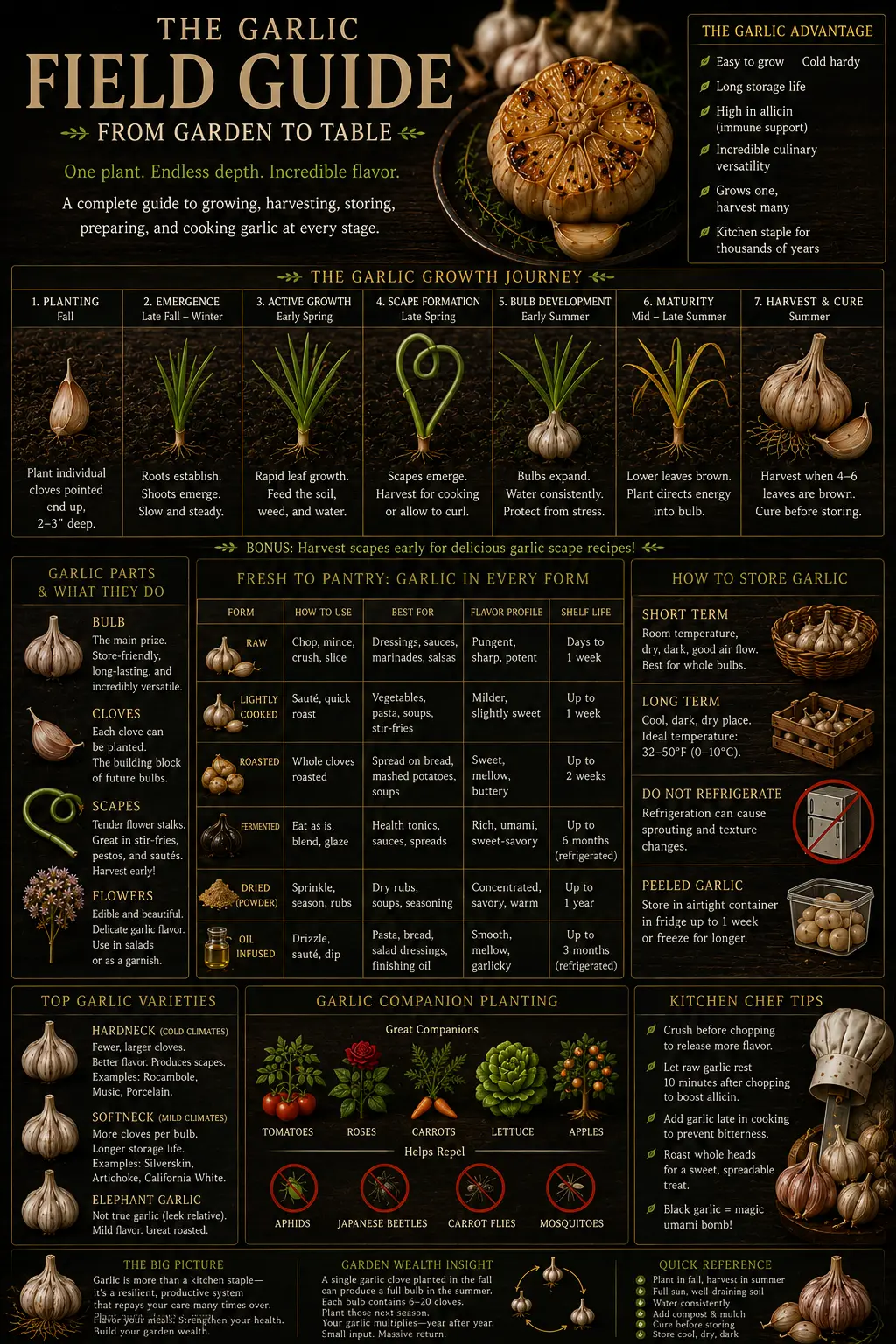
The Garlic Field Guide poster is designed as a visual kitchen and garden reference for cooks, gardeners, meal planners, preservers, and anyone who wants to understand garlic from planting to plate.
Use it when you need to remember:
When to plant garlic.
How garlic grows from clove to bulb.
When garlic scapes appear.
When to harvest garlic.
How to cure garlic.
How raw, cooked, roasted, dried, black, and infused garlic behave differently.
Which garlic forms fit which dishes.
How to store garlic safely.
Which garlic types are best for flavor, storage, scapes, or mild cooking.
This kind of guide belongs in a kitchen, pantry, garden binder, seed-planning notebook, root cellar shelf, meal-planning station, cooking class, or market booth.
Download the Printable Garlic Field Guide Poster
Launch price: $0.99
[Button: Download the Garlic Field Guide Poster]
Garlic Is a Bulb With Memory
A garlic bulb looks simple.
It sits quietly on the counter, wrapped in papery skin, waiting for the knife.
But inside that bulb is a record of time.
It remembers the fall planting. It remembers winter roots. It remembers spring leaves. It remembers rain, soil, stress, sunlight, and patience. Each clove is both food and future. Each one can season a meal, or it can be pressed back into the soil and asked to begin again.
That is what makes garlic different from many kitchen ingredients.
A carrot is eaten.
A tomato is sliced.
A pepper is chopped.
But garlic asks a deeper question:
Will you use me now, or will you multiply me?
A single clove can disappear into a sauce.
Or it can become an entire bulb.
That bulb can become many cloves.
And those cloves can become next year’s crop.
Garlic is not just an ingredient.
It is a memory system.
The Garlic System at a Glance
| Garlic Form | Kitchen Value | Garden Value | Preservation Value |
|---|---|---|---|
| Raw garlic | Sharpness, heat, brightness | Immediate kitchen use | Short-term fresh use |
| Minced garlic | Strong aroma and full-dish distribution | High-use daily cooking | Best used fresh |
| Lightly cooked garlic | Savory base and aroma | Connects to onions, herbs, beans, sauces | Can be frozen in cooked bases |
| Roasted garlic | Sweetness, softness, comfort | Turns extra bulbs into meal prep | Freezes well for later cooking |
| Garlic scapes | Green, fresh garlic flavor | Bonus harvest before bulbs mature | Pesto, butter, freezing |
| Dried garlic | Concentrated pantry flavor | Uses surplus or imperfect cloves | Long-term dry storage |
| Garlic powder | Even coverage and seasoning power | Turns harvest into pantry seasoning | Shelf-stable if fully dried |
| Black garlic | Sweet, tangy, umami depth | Value-added specialty product | Longer-lasting specialty form |
| Garlic oil | Aroma carrier | Kitchen technique value | Requires strict safety handling |
The Fast Garlic Decision Guide
| If the dish needs… | Use… | Why it works |
|---|---|---|
| Sharp brightness | Raw minced garlic | It wakes up dressings, sauces, dips, and marinades. |
| Deep savory foundation | Lightly cooked garlic | It blooms in fat and builds the base of soups, sauces, beans, and vegetables. |
| Sweet comfort | Roasted garlic | It becomes mellow, spreadable, and rich without harshness. |
| Green spring flavor | Garlic scapes | They bring fresh garlic flavor before the bulb harvest. |
| Even seasoning | Garlic powder or granulated garlic | It spreads evenly through rubs, blends, roasted vegetables, and popcorn. |
| Umami depth | Black garlic | It adds sweetness, tang, and savory complexity. |
| Pantry reach | Dried garlic | It stores well and seasons future meals. |
| Gentle background garlic | Sliced or smashed cloves | Less cell damage creates a softer garlic presence. |
| Strong garlic impact | Crushed, grated, pasted, or finely minced garlic | More cell damage makes garlic louder. |
The Garlic Growth Journey
Garlic teaches patience better than almost any crop in the kitchen garden.
You plant it when much of the garden is winding down. While tomatoes are finished, peppers are slowing, and leaves are falling, garlic begins its quiet work. It does not demand the attention of summer crops. It does not perform immediately. It settles into the soil and begins building below the surface.
That slow beginning is part of its lesson.
Garlic rewards gardeners who can think beyond the immediate season.
Garlic generally prefers well-drained soil, steady moisture, and a near-neutral soil pH; University of Minnesota Extension notes that garlic grows best in well-drained, moisture-retentive soil with a pH between 6.0 and 7.0 and is commonly planted in fall after the first killing frost in cold climates.
1. Planting: The Fall Beginning
Garlic usually begins with a single clove planted in fall.
The clove is placed pointed end up, covered with soil, and left to form roots before winter fully settles in. From above, it may look as if nothing much is happening. But below the surface, the clove is anchoring itself and preparing for the long season ahead.
This is one of garlic’s first lessons:
Not all growth is visible.
Some of the most important work happens before anyone sees a shoot.
For the gardener, planting garlic in fall feels like making a promise to the future. You are putting food into the ground when most people are putting the garden away. You are saying that next summer’s harvest begins now.
2. Emergence: The Quiet Green Signal
Depending on climate and timing, garlic may send up small green shoots before winter, or it may wait until early spring.
Either way, the first emergence of garlic is encouraging. Those green blades appear when much of the garden still feels asleep. They are not dramatic. They are not flashy. But they are a signal.
The system is alive.
Garlic does not need constant interference at this stage. It needs protection, patience, drainage, and a healthy foundation. Mulch can help buffer winter conditions. Good soil drainage matters because garlic dislikes sitting in soggy ground.
Like many strong systems, garlic wants support more than disturbance.
3. Active Growth: The Spring Push
In spring, garlic becomes more visible.
The leaves stretch upward. The plant begins gathering energy. This is when the gardener’s attention matters. Weeds compete with garlic. Water becomes important. Soil fertility begins to show. Strong spring growth helps support strong bulb development later.
Garlic leaves are not decoration.
They are solar panels.
Each leaf helps feed the developing bulb below. If the plant is stressed too heavily during active growth, the final bulb may be smaller. This is one of the reasons garlic teaches stewardship so well.
You are not only waiting for harvest.
You are protecting the plant’s ability to build it.
4. Scape Formation: The Bonus Crop
Hardneck garlic produces scapes, the curling flower stalks that rise from the center of the plant.
Scapes are one of the great hidden gifts of garlic growing.
They taste like garlic, but greener, fresher, and less intense than the bulb. They can be chopped into stir-fries, blended into pesto, grilled, roasted, sautéed, added to eggs, folded into compound butter, or used anywhere you want a gentle garlic note with a spring vegetable feel.
Harvesting scapes can also help redirect the plant’s energy back toward bulb development.
This is one of the moments where garlic gives the gardener a gift before the main harvest. The bulb is not ready yet, but the plant still feeds the kitchen.
That matters.
A good kitchen garden does not only produce at the end.
It produces along the way.
5. Bulb Development: The Hidden Expansion
As the season progresses, the bulb begins to swell underground.
This is the stage where garlic’s work becomes hidden again. The leaves may still look strong, but the real value is forming below the soil. Each clove is developing inside the bulb. The plant is converting months of growth into a storage crop.
This is also a stage where stress matters.
Too little water can limit bulb size. Too much water can encourage rot. Poor soil can weaken the harvest. Heavy weed pressure can steal energy from the crop.
Garlic reminds us that storage crops are built slowly.
You do not get a strong pantry crop by accident.
6. Maturity: Reading the Leaves
Garlic tells you when it is nearly ready.
The lower leaves begin to brown while the upper leaves remain green. This is the signal many gardeners watch for. Harvest too early and the bulbs may be underdeveloped. Wait too long and the outer wrappers may deteriorate, which can reduce storage quality.
This is where garlic teaches observation.
The plant is speaking, but not loudly.
A gardener learns to read the leaves, feel the season, and choose the right moment.
7. Harvest and Cure: Protecting the Value
Harvesting garlic is not the final step.
It is the beginning of storage.
Garlic should be lifted carefully, often with a fork or spade, so the bulbs are not bruised or cut. After harvest, the bulbs need to cure in a dry, shaded, well-ventilated place. The wrappers dry. The necks tighten. The skins become papery. The garlic becomes ready for storage.
This matters because uncured garlic is fragile.
Curing turns harvest into pantry value.
University of Minnesota Extension notes that curing helps garlic and onion necks and outer skins dry before long-term storage, which helps extend shelf life and reduce storage problems.
A garlic bulb pulled from the soil is food.
A garlic bulb properly cured is stored wealth.
Garlic Parts and What They Do
Garlic gives the kitchen more than one usable part.
Most people focus on the bulb, but the plant has other gifts if you know when to look.
The Bulb: The Main Prize
The bulb is the part most people recognize.
It is the storage organ, the pantry crop, the thing that sits in a basket or cellar and waits for the kitchen. A good bulb contains multiple cloves wrapped in protective layers. It can be cooked fresh, stored for months, replanted, dried, roasted, or transformed into sauces, spreads, and seasonings.
The bulb is garlic’s main form of stored value.
It is the harvest most gardeners plant for.
The Clove: The Building Block
Each clove is a decision.
You can chop it, mince it, crush it, roast it, preserve it, or plant it.
That is what makes garlic such a powerful crop in The Wealth Garden system. The clove is both an ingredient and a seed unit. It can feed you once, or it can become the beginning of a new harvest.
This is the compounding lesson of garlic.
One clove becomes one bulb.
One bulb becomes many cloves.
Many cloves become next year’s crop.
The clove is small, but it carries the entire system forward.
The Scape: The Spring Bonus
Garlic scapes are tender, curling stalks produced by hardneck garlic.
They are one of the best reasons to grow garlic yourself because they are not always easy to find in ordinary grocery stores. Their flavor is garlicky but green, fresh, and slightly grassy. They are excellent in pesto, eggs, soups, stir-fries, compound butter, grilled vegetables, and sauces.
Scapes are a perfect example of hidden garden value.
The grocery store sells the bulb.
The garden gives you the whole plant.
The Flower and Bulbils: The Future Layer
If left alone, some garlic scapes eventually form flower structures and small bulbils.
Most kitchen gardeners harvest scapes before that point because they want larger bulbs. But if you allow some to mature, bulbils can be used for propagation. They take longer to become full-sized garlic, but they reveal garlic’s deeper reproductive strategy.
This is not usually the beginner’s main path.
But it is a reminder that garlic is not just a product.
It is a living system.
Fresh to Pantry: Garlic in Every Form
Garlic changes dramatically depending on how it is prepared.
This is where many cooks begin to understand that garlic is not one ingredient.
It is a family of forms.
Raw Garlic: The Sharp Spark
Raw garlic is the loudest form.
It is hot, pungent, biting, and immediate. A small amount can wake up a vinaigrette, aioli, salsa, pesto, hummus, tzatziki, marinade, or fresh sauce. It can also overpower a dish quickly.
Raw garlic is best when balanced by fat, acid, salt, herbs, or sweetness.
Think olive oil, lemon, vinegar, yogurt, tahini, tomato, parsley, basil, cilantro, roasted vegetables, or beans. Raw garlic needs a partner. Without balance, it can become harsh. With balance, it becomes electricity.
Use raw garlic when you want the dish to wake up.
Minced, Crushed, Grated, or Pasted Garlic: The Volume Control
Cut size changes garlic.
A whole clove is not the same as sliced garlic. Sliced garlic is not the same as minced garlic. Minced garlic is not the same as garlic paste.
The more garlic cells you break, the stronger the aroma and flavor become.
A smashed clove placed in oil gives a gentler background note. Sliced garlic gives visible garlic character. Minced garlic spreads flavor through a dish. Grated garlic and garlic paste become powerful very quickly.
The smaller the cut, the louder the garlic.
That is not a flaw.
It is a tool.
Lightly Cooked Garlic: The Savory Foundation
Lightly cooked garlic is one of the most useful forms in everyday cooking.
When garlic hits warm oil, butter, broth, or pan drippings, its sharpness begins to soften. The aroma blooms. The flavor becomes savory and rounded. This is the garlic of quick sauces, soups, beans, vegetables, rice dishes, stir-fries, greens, pasta, and weeknight meals.
But garlic is sensitive.
If the heat is too high or the garlic is left too long, it can burn and turn bitter. A good cook learns to control the moment. Sometimes garlic goes in after onions have softened. Sometimes it is added for only the last thirty seconds before liquid enters the pan. Sometimes it is cooked gently, slowly, and carefully.
Garlic rewards attention.
Roasted Garlic: The Sweet Transformation
Roasted garlic barely feels like the same ingredient.
The sharpness fades. The cloves become soft, golden, sweet, and almost buttery. A roasted garlic clove can be squeezed from its skin and spread on bread like a paste. It can be stirred into mashed potatoes, soups, sauces, compound butter, hummus, dressings, roasted vegetables, or pasta.
Roasted garlic is comfort.
It does not shout.
It melts.
Use roasted garlic when you want depth without aggression, sweetness without sugar, and richness without heaviness.
Garlic Scapes: The Green Garlic Chapter
Garlic scapes are the fresh spring chapter of garlic.
They taste like garlic growing upward instead of garlic stored underground. They are lighter, greener, and often easier to use generously than raw cloves.
A scape pesto can be bright and punchy. Sautéed scapes can bring fresh garlic flavor to eggs or vegetables. Grilled scapes can become smoky and tender. Chopped scapes can be folded into butter, biscuits, soups, stir-fries, dressings, and sauces.
Scapes remind us that growing garlic yourself gives you flavors the grocery store often hides from you.
Dried Garlic and Garlic Powder: The Pantry Form
Dried garlic is not a lesser form of garlic.
It is a different tool.
Garlic powder, granulated garlic, and dried minced garlic are useful because they distribute evenly and store well. They work beautifully in dry rubs, spice blends, roasted potatoes, popcorn seasoning, marinades, soups, sauces, breading mixes, salad dressings, and blends where fresh garlic would be inconvenient or too wet.
Fresh garlic gives brightness and aroma.
Dried garlic gives coverage and concentration.
A good kitchen uses both.
Black Garlic: The Deep Umami Form
Black garlic is garlic transformed through controlled aging.
It becomes dark, soft, sweet, tangy, and deeply savory. Its flavor can remind people of balsamic vinegar, molasses, tamarind, dried fruit, soy sauce, or slow-cooked umami. It is not used the same way as fresh garlic.
Black garlic belongs in sauces, glazes, dressings, compound butters, broths, steak sauces, mushrooms, noodles, roasted vegetables, and dishes where depth matters more than sharpness.
It is garlic after it has become something almost mysterious.
Garlic Oil and Infused Garlic: The Flavor Carrier
Garlic-infused oil can carry garlic flavor into bread, pasta, vegetables, dressings, marinades, roasted potatoes, beans, and finishing drizzles.
But garlic in oil deserves a serious food safety note.
Garlic is a low-acid ingredient, and homemade garlic-in-oil stored at room temperature can create conditions associated with botulism risk. The National Center for Home Food Preservation says garlic-in-oil should be made fresh, refrigerated at 40°F or lower for no more than four days, or frozen for longer storage.
Garlic flavor is wonderful.
Food safety matters more.
Garlic Forms at a Glance
| Form | Flavor Profile | Best Uses | Add When | Chef’s Note |
|---|---|---|---|---|
| Whole clove | Mildest, slow-release | Roasts, braises, soups, infusions | Early or during cooking | Best when you want gentle background garlic. |
| Sliced garlic | Visible, moderate, aromatic | Pasta, vegetables, sautés, oil-based dishes | Early to middle | Watch heat carefully. Thin slices brown fast. |
| Minced garlic | Strong, integrated, savory | Soups, sauces, beans, stir-fries | Middle or late | Add after onions soften to avoid burning. |
| Garlic paste | Very strong, even distribution | Dressings, marinades, garlic butter | Raw or late | Powerful; balance with fat, acid, and salt. |
| Raw garlic | Hot, sharp, pungent | Aioli, hummus, salsa, pesto, vinaigrettes | Raw or finish | Use less than you think at first. |
| Lightly cooked garlic | Savory, fragrant, rounded | Everyday cooking, sauces, soups, greens | After aromatics soften | Fragrant is ready; bitter means too far. |
| Roasted garlic | Sweet, mellow, spreadable | Bread, potatoes, soup, butter, sauces | After roasting | Ideal for garlic flavor without aggression. |
| Garlic scapes | Green, grassy, mild garlic | Pesto, eggs, stir-fries, grilling | Fresh or quick cooked | Seasonal bonus crop from hardneck garlic. |
| Dried garlic | Concentrated, pantry-friendly | Rubs, soups, potatoes, seasoning | Before or during cooking | Best for even coverage. |
| Black garlic | Sweet, tangy, umami-rich | Glazes, sauces, mushrooms, broths | Finish or blend | Think depth, not heat. |
Garlic Flavor Systems
The real power of garlic appears when it works with the rest of the kitchen garden.
A single clove can improve a dish.
A garlic system can define the whole meal.
The Tomato Sauce System
Tomato brings acidity and body.
Onion brings sweetness.
Garlic brings depth.
Basil and oregano bring direction.
Olive oil carries aroma.
Together, they become sauce, pizza base, soup, shakshuka, pasta, braise, and pantry comfort.
The Potato Comfort System
Potatoes bring stability.
Garlic brings depth.
Butter or olive oil carries richness.
Rosemary, thyme, parsley, or chives finish the dish.
Together, they become roasted potatoes, garlic mashed potatoes, garlic fries, potato soup, gratin, hash, and comfort food.
The Bean and Pantry System
Beans bring protein and substance.
Garlic brings aroma.
Onion brings sweetness.
Bay, thyme, oregano, cumin, chile, or parsley bring personality.
Together, they become soups, stews, chili, hummus, bean salads, rice bowls, and pantry meals that do not feel poor or plain.
The Herb and Garlic System
Garlic builds the foundation.
Herbs lift the finish.
Parsley makes garlic-heavy dishes feel brighter. Basil turns garlic and tomato into summer. Rosemary and thyme deepen roasted garlic. Cilantro and lime balance raw garlic. Chives soften garlic’s edge with a mild allium finish.
When garlic and herbs work together, simple food starts to taste intentional.
The Pepper and Garlic System
Peppers bring heat, sweetness, smoke, or color.
Garlic brings backbone.
Together, they become hot sauce, salsa, sofrito, chili, roasted pepper sauce, fajitas, marinades, pepper relish, and fermented condiments.
Garlic helps heat become flavor instead of just fire.
How to Choose the Right Garlic Form
The best garlic is not the strongest garlic.
The best garlic is the garlic that fits the job.
Best Garlic for Raw Brightness
Use raw minced, grated, or pasted garlic when you want sharpness, heat, and immediate aroma.
Best uses: vinaigrettes, aioli, hummus, salsa, pesto, tzatziki, yogurt sauces, fresh sauces, marinades, and dressings.
Raw garlic should be balanced. Pair it with acid, fat, herbs, salt, or sweetness so it supports the dish instead of attacking it.
Best Garlic for Everyday Cooking
Use lightly cooked garlic for soups, sauces, beans, vegetables, pasta, greens, stir-fries, rice dishes, and one-pan meals.
This is the garlic form most home cooks use constantly. It is fast, flexible, and deeply useful.
The main lesson is simple:
Do not burn it.
Garlic should smell fragrant, not scorched.
Best Garlic for Comfort Food
Use roasted garlic for mashed potatoes, bread, soups, roasted vegetables, compound butter, sauces, hummus, dressings, and spreads.
Roasted garlic is especially useful when cooking for people who find raw garlic too strong.
It turns garlic into sweetness, softness, and depth.
Best Garlic for Spring Cooking
Use garlic scapes for pesto, stir-fries, eggs, grilled dishes, compound butter, soups, sauces, and quick sautés.
They give you a fresh garlic note before the bulb harvest. For gardeners, scapes are a seasonal bonus that make garlic even more valuable.
Best Garlic for Pantry Cooking
Use dried garlic, garlic powder, and granulated garlic for dry rubs, spice blends, roasted potatoes, popcorn, soup mixes, marinades, breading mixes, and quick seasoning.
They are not replacements for fresh garlic in every dish.
They are essential pantry tools.
Best Garlic for Deep Flavor
Use black garlic and fermented garlic preparations for glazes, sauces, broths, mushrooms, roasted meats, noodles, dressings, and dishes that need sweetness and umami.
Use these when you want garlic to become depth instead of heat.
Garlic Varieties: Hardneck, Softneck, and Elephant Garlic
Not all garlic grows or cooks exactly the same.
For the kitchen gardener, the three big categories to understand are hardneck garlic, softneck garlic, and elephant garlic.
Hardneck Garlic: The Cold-Climate Flavor Garlic
Hardneck garlic is often favored in colder climates.
It usually produces fewer but larger cloves around a stiff central stalk. It also produces scapes, which makes it especially valuable for gardeners who want both a spring harvest and a summer bulb harvest.
Hardneck garlic is often known for strong, complex flavor. Some varieties can be spicy, rich, earthy, or deeply aromatic. Rocambole, Porcelain, and Purple Stripe types are examples often discussed by garlic growers.
Hardneck garlic may not store as long as many softneck types, but it often rewards the cook with outstanding flavor and the gardener with scapes.
Best Uses
Roasted garlic, fresh cooking, garlic-focused dishes, scapes, sauces, soups, and flavor exploration.
Garden Value
Hardneck garlic offers two harvests: scapes and bulbs. It also teaches seasonal patience and rewards careful curing.
Field Guide Lesson
Hardneck garlic is for gardeners who want flavor and a spring bonus crop.
Softneck Garlic: The Storage Garlic
Softneck garlic is the type most people commonly encounter in grocery stores.
It usually produces more cloves per bulb, often stores longer, and is well suited for braiding. Many softneck types do well in milder climates. Artichoke and Silverskin garlics are common softneck categories.
Softneck garlic may not always have the dramatic flavor complexity of some hardneck types, but it is extremely practical.
It is the pantry builder.
Best Uses
Everyday cooking, long storage, braiding, pantry systems, sauces, soups, roasted dishes, and frequent kitchen use.
Garden Value
Softneck garlic is valuable for gardeners who want storage, reliability, and long pantry life.
Field Guide Lesson
Softneck garlic is for gardeners who want garlic to carry the kitchen through the year.
Elephant Garlic: The Gentle Giant
Elephant garlic is not true garlic in the strict botanical sense. It is more closely related to leeks.
But in the kitchen, people often use it as a mild garlic-like ingredient.
The cloves are huge. The flavor is gentler, sweeter, and less pungent than true garlic. Elephant garlic is especially good roasted, grilled, sliced into gratins, or used when you want the idea of garlic without the same intensity.
Best Uses
Roasting, grilling, gratins, mild sauces, vegetable trays, dramatic presentation, and garlic-friendly dishes for people who prefer a softer flavor.
Garden Value
Elephant garlic is visually impressive, beginner-friendly in the kitchen, and useful for people who want a gentler garlic experience.
Field Guide Lesson
Elephant garlic gives you garlic’s shape and drama with leek-like softness.
Garlic Storage: Store the Harvest Right
Garlic is one of the best crops for teaching storage value.
But it must be handled correctly.
A garlic harvest that is not cured well may spoil. Garlic stored in damp conditions may rot. Garlic exposed to too much warmth or moisture may sprout. Peeled garlic behaves differently from whole bulbs. Garlic in oil has special safety concerns.
A good garlic guide should help people protect the value they grew.
Whole Cured Garlic
Whole cured garlic bulbs should be stored in a cool, dry, dark, well-ventilated place.
Airflow matters.
Dryness matters.
Darkness matters.
A basket, mesh bag, crate, or braid can work well if the space is appropriate. The goal is to keep the bulbs dry enough to store but not so hot or humid that they sprout or spoil quickly.
Whole bulbs are the best long-term garlic form for most home kitchens.
Peeled Garlic
Peeled garlic is convenient but more fragile.
Once garlic is peeled, it loses part of its natural protection. It should be treated as a short-term refrigerated ingredient, not a long-term pantry item.
Use it quickly and keep it clean and cold.
Convenience always has a storage cost.
Minced Garlic
Fresh minced garlic is powerful but short-lived.
It loses quality quickly, and it should not sit around casually. Mince garlic when you need it, or use safe storage methods if preparing ahead.
The fresher the mince, the brighter the flavor.
Roasted Garlic
Roasted garlic can be refrigerated for short-term use or frozen for longer storage.
It is excellent to make in batches because it can be added to so many meals. A tray of roasted garlic can become garlic butter, soup base, mashed potato flavor, pasta sauce depth, or a spread for bread.
Roasted garlic is one of the best meal-prep forms of garlic.
Dried Garlic
Dried garlic, garlic powder, and granulated garlic are pantry tools.
They should be kept dry, sealed, and away from heat and light. Their flavor fades over time, so old garlic powder may not bring the same power as a fresh jar.
If the aroma is weak, the flavor will be weak.
Garlic in Oil
Garlic in oil must be handled carefully.
Do not store homemade garlic-in-oil preparations at room temperature unless made through a tested safe method. Use reliable preservation guidance. When in doubt, make it fresh, refrigerate for short-term use, or freeze for longer storage. The National Center for Home Food Preservation specifically warns that garlic-in-oil mixtures stored at room temperature are a botulism risk.
This is one place where the romance of the kitchen has to bow to safety.
The Garlic Preservation Ladder
| Level | Method | Best Starting Garlic | What It Teaches |
|---|---|---|---|
| 1 | Fresh use | Whole bulbs, cloves, scapes | Daily kitchen value |
| 2 | Curing | Freshly harvested bulbs | Turning harvest into storage |
| 3 | Refrigeration | Peeled or prepared garlic | Short-term convenience |
| 4 | Roasting and freezing | Whole heads or cloves | Meal prep and comfort flavor |
| 5 | Freezing scapes | Fresh scapes | Seasonal rescue |
| 6 | Drying | Thin-sliced cloves or scapes | Moisture control and pantry storage |
| 7 | Garlic powder | Fully dried garlic | Turning harvest into seasoning |
| 8 | Garlic butter | Roasted garlic, scapes, herbs | Fat as flavor carrier |
| 9 | Black garlic | Whole bulbs | Specialty transformation |
| 10 | Garlic oil | Fresh garlic and oil | Technique plus food safety discipline |
Garlic Companion Planting
Garlic has a strong smell, and gardeners often use it as part of companion planting systems.
It is commonly placed near tomatoes, roses, carrots, lettuce, peppers, fruit trees, and other crops as a scent layer or pest-confusion tool. Some gardeners use garlic around roses and fruit trees because they believe it may help reduce certain pest pressures. Others tuck garlic around vegetable beds because it is compact, upright, and useful.
But companion planting should not be treated like magic.
Garlic is not a force field.
It is one layer in a larger system.
Healthy soil, diversity, airflow, observation, watering, crop rotation, and good garden timing still matter. Garlic can be part of an intelligent garden design, but it cannot compensate for a neglected system.
A good companion planting mindset does not ask:
“What plant solves everything?”
It asks:
What role does this plant play in the system?
Garlic’s role is useful because it can provide food, storage, scent, structure, scapes, and future planting stock.
That is a strong resume for one crop.
Garlic in the Kitchen: Chef Tips That Matter
Garlic rewards good technique.
It also punishes careless heat.
Crush Before Chopping for Stronger Flavor
Crushing garlic before chopping can create a stronger garlic character because more of the clove is broken and exposed.
For bold garlic flavor, crush, grate, paste, or mince it finely.
For gentler garlic flavor, slice it, smash it lightly, or cook whole cloves slowly.
The cut controls the volume.
Do Not Burn Garlic
Burned garlic turns bitter fast.
When cooking with onions, garlic often goes in after the onions have softened, not at the very beginning. In quick dishes, garlic may only need a short time in the pan before liquid, tomatoes, vegetables, or other ingredients are added.
The smell tells you what is happening.
Fragrant garlic is ready.
Acrid garlic has gone too far.
Salt Helps Make Garlic Paste
A pinch of coarse salt can help break garlic down into a paste on a cutting board.
This is useful for dressings, marinades, garlic butter, sauces, and dishes where you want the garlic evenly distributed.
A garlic paste is stronger and more integrated than rough chopped garlic.
Remove the Green Germ If Needed
Older garlic cloves sometimes develop a green sprout in the center.
It is not always a problem, but it can taste bitter or harsh. For delicate dishes, remove it. For long-cooked dishes, it may matter less.
This is a small detail.
But small details are often what make cooking feel polished.
Use Garlic in Layers
Some of the best garlic dishes use more than one form.
A soup might begin with cooked garlic, finish with garlic oil, and be served with garlic toast. A potato dish might include roasted garlic in the mash and chives or herbs on top. A sauce might use fresh garlic for brightness and black garlic for depth.
Garlic can be layered like music.
One note is good.
Harmony is better.
Common Garlic Mistakes
Mistake 1: Adding Garlic Too Early Over High Heat
Garlic burns faster than onions.
Add garlic after onions have softened or just before adding liquid, tomatoes, vegetables, or broth. Garlic should bloom, not scorch.
Mistake 2: Treating All Garlic Cuts the Same
Whole, smashed, sliced, minced, grated, and pasted garlic do not behave the same.
The smaller the cut, the stronger the garlic.
Use that deliberately.
Mistake 3: Thinking Roasted Garlic and Raw Garlic Are Interchangeable
Raw garlic brings heat.
Roasted garlic brings sweetness.
They are not substitutes for each other. They solve different kitchen problems.
Mistake 4: Forgetting About Scapes
Hardneck garlic gives a bonus crop before the bulb harvest.
Scapes can become pesto, butter, stir-fries, grilled vegetables, soups, and sauces. Do not waste them.
Mistake 5: Storing Garlic Like a Root Vegetable
Garlic is not a carrot.
It needs cool, dry, dark airflow after curing, not a cold, humid root bin. Treating all storage crops the same way can shorten the life of the harvest.
Mistake 6: Making Garlic-in-Oil Casually
Garlic-in-oil is not a shelf-stable pantry project unless prepared using tested safe methods.
Make it fresh, refrigerate briefly, or freeze. Do not guess.
Common Garlic Problems and What They Usually Mean
| Problem | Likely Cause | What to Do |
|---|---|---|
| Small bulbs | Poor fertility, weed competition, drought stress, small seed cloves | Plant large healthy cloves, control weeds, water consistently during active growth |
| Rotting cloves | Poor drainage, overly wet soil, disease pressure | Improve drainage, rotate crops, avoid soggy beds |
| Weak spring growth | Poor planting stock, low fertility, winter stress | Use strong cloves, mulch appropriately, support soil health |
| No scapes | Softneck type or non-scaping garlic | Grow hardneck garlic if scapes are a goal |
| Scapes left too long | Delayed harvest | Harvest scapes when tender and curling for best kitchen use |
| Bulbs splitting open | Harvest too late or wrapper deterioration | Harvest when several lower leaves are brown but wrappers remain intact |
| Poor storage life | Poor curing, damaged bulbs, humid storage | Cure well, store dry with airflow, use damaged bulbs first |
| Sprouting in storage | Too much warmth, moisture, or time | Move to better storage conditions and use sprouting bulbs soon |
| Bitter cooked garlic | Burned or overheated garlic | Lower heat, add garlic later, use liquid to stop browning |
| Weak garlic powder | Old or poorly stored dried garlic | Store airtight away from light and heat; replace when aroma fades |
Garlic as a Wealth Garden Crop
In the Wealth Garden system, garlic belongs in a special category.
It is a storage crop.
It is a flavor multiplier.
It is a compounding crop.
It is a pantry crop.
It is a replanting crop.
It is a high-use kitchen crop.
A single clove planted in fall becomes a bulb in summer. That bulb contains many cloves. Some can be eaten. Some can be saved. Some can be replanted.
This is the kind of crop that teaches people how systems grow.
You do not need to buy garlic forever if you learn how to plant, harvest, cure, store, and replant it.
That does not mean garlic will make you rich by itself.
It means garlic shows the pattern.
Small beginning.
Patient season.
Useful harvest.
Stored value.
Reinvestment.
Future crop.
That is not just gardening.
That is systems thinking.
$10,000 Garden Insight: The Garlic Compounding Effect
A garlic bulb from the store may cost only a few dollars.
Inside that bulb are cloves.
If those cloves are planted, each one can become a new bulb. Each new bulb contains more cloves. Some of those cloves can be eaten. Some can be saved. Some can be planted again.
At first, the value seems small: a few bulbs, a few meals, a little flavor.
But over time, the system changes.
You may stop buying garlic. You may begin curing your own bulbs. You may harvest scapes in spring. You may dry extra garlic for powder. You may roast and freeze batches for cooking. You may share bulbs with neighbors. You may save your best cloves for planting stock.
The value is no longer limited to the original harvest.
It begins to include storage, replacement, flavor, skill, preservation, and future production.
This is how a small garden system becomes meaningful.
Not all at once.
Clove by clove.
How Garlic Becomes Products
Garlic is one of the easiest garden crops to imagine as a product path because it moves naturally from fresh harvest to stored flavor.
A garlic crop can feed dinner, but it can also create bundles, braids, powders, butters, sauces, recipe cards, class handouts, printable guides, pantry labels, and market-table stories.
Possible garlic products include:
Fresh garlic bulbs.
Cured garlic braids.
Garlic scape bundles.
Garlic scape pesto.
Roasted garlic freezer portions.
Garlic compound butter.
Garlic herb salt.
Garlic powder.
Garlic rub blends.
Black garlic.
Garlic recipe cards.
Printable garlic field guide posters.
Garden garlic starter kits.
Seed garlic bundles, where appropriate and legal.
That does not mean every gardener needs to sell garlic.
But it does show something important.
Garlic is not just a kitchen staple.
It is a small flavor economy.
A Quick Note About Pets
Garlic and other alliums can be harmful to dogs and cats if eaten.
Keep garlic cloves, garlic scraps, garlic powder, garlic-heavy leftovers, compost access, and prepared foods containing garlic away from pets.
A good kitchen garden feeds the household.
It should also protect the household.
A Quick Note About Food Safety
Garlic is wonderful, but certain garlic preparations require care.
Be especially cautious with garlic stored in oil, low-acid mixtures, homemade preservation projects, fermented garlic preparations, and any product intended for shelf-stable storage. Use tested recipes and current preservation guidance. Do not assume that because something looks fine, it is safe.
The goal of The Gardening Chef is not just to make food more flavorful.
It is to make food wiser.
For garlic-in-oil specifically, the National Center for Home Food Preservation warns against storing homemade garlic-in-oil mixtures at room temperature and recommends fresh use, short refrigeration at 40°F or lower, or freezing.
What Makes This Garlic Guide Worth Saving
A save-worthy garlic guide does three things.
It helps you choose the right garlic form.
It helps you use garlic at the right moment.
It helps you see garlic as more than one clove in one recipe.
That is what this Garlic Field Guide is designed to do.
It gives the cook a flavor map.
It gives the gardener a growth plan.
It gives the preserver a storage pathway.
It gives the creator a product ladder.
Most importantly, it helps readers see garlic differently.
Most people see garlic as a kitchen staple.
This guide shows it as a system.
Raw clove. Minced clove. Roasted head. Scape. Dried powder. Cured bulb. Black garlic. Garlic butter. Garlic oil. Future planting stock. Next year’s harvest.
That is what a good field guide should do.
It should not merely tell you what something is.
It should teach you how to see.
Where This Connects
The Garlic Field Guide connects naturally to the rest of The Gardening Chef Field Guide Library.
| Pair Garlic With… | What It Becomes |
|---|---|
| Onions | Soup bases, sauces, sofrito, allium systems, pantry depth |
| Herbs | Garlic butter, pesto, chimichurri, dressings, roasted vegetables |
| Tomatoes | Pasta sauce, salsa, soup, shakshuka, bruschetta, preserved sauces |
| Peppers | Hot sauce, chili, fajitas, roasted pepper sauce, garlic-pepper ferments |
| Potatoes | Garlic mashed potatoes, roasted potatoes, garlic fries, gratin, potato soup |
| Beans and peas | Hummus, bean soup, chili, pantry meals, rice bowls |
| Leafy greens | Garlic kale, sautéed spinach, collards, mustard greens, bok choy |
| Squash and cucumbers | Pickles, yogurt sauces, roasted squash, summer salads |
| Cooking fats | Garlic oil, garlic butter, roasted garlic spread, fat-bloomed aromatics |
| Preservation pantry | Dried garlic, garlic powder, frozen roasted garlic, scape pesto |
Each guide stands alone, but together they teach the larger system:
Grow with purpose.
Cook with intention.
Preserve the surplus.
Replant the future.
Honor the harvest.
Download the Printable Garlic Field Guide Poster
If this guide helped you see garlic differently, the printable Garlic Field Guide is designed to live where real decisions happen: the kitchen wall, pantry shelf, garden binder, seed-planning table, root cellar notes, meal-planning station, market booth, or cooking class.
The printable guide includes:
The garlic growth journey.
Garlic parts and what they do.
Raw, cooked, roasted, dried, black, scape, and infused garlic forms.
Storage tips.
Hardneck, softneck, and elephant garlic notes.
Companion planting ideas.
Kitchen chef tips.
Food safety reminders.
Quick reference growing notes.
Use it to remember when to plant garlic, when to harvest scapes, how garlic changes in the kitchen, which garlic forms fit different dishes, and why one clove can become a whole system.
Launch price: $0.99
[Button: Download the Printable Garlic Field Guide Poster]
Final Thought: One Clove, Many Choices
Most people think garlic is just garlic.
But a cook knows better.
A raw clove can become heat.
A minced clove can become aroma.
A cooked clove can become foundation.
A roasted head can become sweetness.
A scape can become spring.
A dried powder can become pantry reach.
A black garlic clove can become umami.
A cured bulb can become winter security.
A saved clove can become next year’s harvest.
Garlic is not one ingredient.
It is a set of choices.
And the better you understand those choices, the better you cook, the better you grow, and the less you waste.
That is the heart of The Gardening Chef.
Plant it. Cure it. Roast it. Store it. Replant it.
Honor the Harvest.