A Complete Field Guide to Growing With Soil, Water, Fish, Air, Containers, Greenhouses, and Closed-Loop Food Systems
The Big Question
Most people ask the wrong question when they compare soil gardening, hydroponics, aquaponics, and aeroponics.
They ask:
Which one is best?
But the better question is:
Which growing system fits your life?
A backyard gardener with compost, sunlight, and room for tomatoes may not need hydroponics.
An apartment dweller who wants lettuce in winter may find hydroponics life-changing.
A systems thinker who loves fish, water chemistry, and feedback loops may fall in love with aquaponics.
A tech-minded grower who wants maximum control and precision may be drawn to aeroponics.
A busy beginner may need something much simpler: a pot of herbs, a salad table, a raised bed, or a passive Kratky jar.
The goal is not to choose the fanciest system.
The goal is to choose the system you will actually maintain.
Because a simple system that runs well will outperform a complex system that gets abandoned.
The Growing System Field Guide Promise
This guide is here to help you understand the real differences between:
Soil gardening.
Raised beds.
Container gardening.
Hydroponics.
Kratky passive hydroponics.
Aquaponics.
Aeroponics.
Greenhouses and controlled environments.
Indoor growing shelves.
Hybrid systems.
Most guides compare these systems as if they are competing technologies.
This guide treats them as different life designs.
Each one teaches a different lesson.
Soil gardening teaches foundation.
Hydroponics teaches input control.
Aquaponics teaches balance.
Aeroponics teaches precision.
Containers teach adaptability.
Greenhouses teach environmental protection.
A mature food system may eventually use more than one.
But every grower should begin by understanding what kind of system they are actually building.
Quick Answer: Which Growing System Should You Choose?
| Your Situation | Best Starting System | Why |
|---|---|---|
| You have a sunny yard and want vegetables, herbs, and storage crops | Soil garden or raised beds | Best all-around system for ecology, compost, outdoor abundance, and long-term soil building |
| You rent or have limited outdoor space | Containers or salad table | Flexible, movable, low-commitment, good for herbs, greens, peppers, compact tomatoes |
| You want indoor lettuce, basil, herbs, and greens | Hydroponics or Kratky | Fast, clean, compact, works well under lights |
| You want the simplest no-pump hydroponic starter | Kratky method | Passive, low-cost, good learning system for leafy greens and herbs |
| You enjoy fish, water testing, biology, and closed loops | Aquaponics | Combines fish, bacteria, plants, and water into a living system |
| You want high-tech precision and root-zone oxygen | Aeroponics | Advanced system for controlled growing, propagation, leafy greens, and vertical farming concepts |
| You want to extend the season outdoors | Greenhouse, cold frame, hoop house | Protects plants from frost, wind, and weather swings |
| You want maximum resilience | Hybrid system | Soil outside, herbs inside, some hydroponics, compost, storage crops |
| You are busy and overwhelmed | Start with one herb pot | The first system matters more than the perfect system |
The Core Lesson: There Is No Best System
There is no universal winner.
There is only fit.
A soil garden can grow tomatoes, potatoes, squash, herbs, beans, fruit trees, pollinator flowers, and compost-fed abundance in a way no countertop hydroponic unit can fully replace.
A hydroponic system can grow clean lettuce indoors in January when your outdoor garden is frozen.
An aquaponic system can teach you more about feedback loops than almost any beginner garden.
An aeroponic system can produce remarkable growth under controlled conditions, but it demands technical reliability.
A container garden can turn a balcony into a productive food space.
A greenhouse can turn a short season into a longer one.
The right question is not:
Which system is superior?
The right question is:
What are you trying to grow, where are you trying to grow it, and how much responsibility do you want the system to place on you?
Field Guide Map
| Section | What You’ll Learn |
|---|---|
| Soil Gardening | Why soil is the living foundation of traditional food growing |
| Raised Beds | How structure improves soil control and access |
| Container Gardening | Why small spaces can still produce meaningful food |
| Hydroponics | How plants grow in nutrient solution without soil |
| Kratky Hydroponics | The simplest passive hydroponic method for beginners |
| Aquaponics | How fish, bacteria, plants, and water form a living loop |
| Aeroponics | How roots suspended in air are fed by mist |
| Greenhouses | How controlled environments extend seasons and reduce risk |
| System Comparison | Cost, complexity, crops, maintenance, and failure points |
| Lifestyle Match | Which system fits your space, budget, and personality |
| Wealth Garden Insight | What each system teaches about money, resilience, and FIRE |
| Beginner Path | How to start without getting overwhelmed |
| FAQ | Practical answers to common questions |
Soil Gardening: The Living Foundation
Soil gardening is the original food system.
It is the method humans have relied on for thousands of years: seeds or plants growing in living soil, powered by sunlight, rain, minerals, organic matter, microbes, insects, fungi, and time.
Soil is not just something that holds plants upright.
Healthy soil is structure, storage, biology, water management, nutrient cycling, and resilience.
That is why soil gardening remains so powerful. It does not merely grow plants. It builds a living foundation that can improve over time.
The USDA Natural Resources Conservation Service describes core soil-health principles such as maximizing living roots, minimizing disturbance, maximizing soil cover, and maximizing biodiversity. Those principles matter because soil is a living system, not just a planting medium.
What Soil Gardening Does Best
Soil gardening is best for:
Tomatoes.
Peppers.
Beans.
Potatoes.
Corn.
Squash.
Cucumbers.
Garlic.
Onions.
Carrots.
Herbs.
Berries.
Fruit trees.
Nut trees.
Medicinal plants.
Pollinator gardens.
Storage crops.
Compost systems.
Outdoor soil gardening shines when you want a broad food system, not just fast greens.
It lets you grow calories, flavor, medicine, pollinator support, pantry crops, and long-term perennials in one living ecosystem.
The Wealth Garden Lesson
Soil gardening teaches one of the deepest wealth lessons:
Foundations determine output.
You can buy the best seeds in the world, but poor soil limits the harvest.
The financial parallel is obvious.
You can buy the best investment, join the best platform, read the best strategy, or follow the best expert — but if your personal “soil” is weak, the system struggles.
Your soil is your habits.
Your discipline.
Your knowledge.
Your savings rate.
Your attention.
Your health.
Your household systems.
This is why the Wealth Garden principle matters:
Soil before stocks.
Raised Beds: Soil Gardening With Structure
Raised beds are not a separate growing philosophy so much as a structured form of soil gardening.
A raised bed lets you improve drainage, control soil quality, define growing space, reduce compaction, and make the garden easier to manage.
For many beginners, raised beds are the bridge between wild backyard chaos and a productive food system.
They create boundaries.
And boundaries help systems function.
Raised Beds Are Best For
Beginners who want structure.
Small yards.
Poor native soil.
Heavy clay.
Compacted soil.
Better drainage.
Defined growing zones.
Kitchen gardens.
Square-foot gardening.
Intensive planting.
Accessible gardening.
Raised Bed Strengths
Raised beds warm faster in spring.
They are easier to amend.
They reduce foot traffic in growing soil.
They make crop rotation easier to visualize.
They create a clean, organized layout.
They allow gardeners to build a better soil environment over time.
Virginia Tech Extension notes that soil testing is the best first step for determining fertilizer needs, and that organic matter improves soil structure, water-holding capacity, and biological activity. That applies directly to raised beds, where the gardener has more control over the growing medium than in unmanaged native soil.
Raised Bed Weaknesses
Raised beds can dry out faster than in-ground beds.
They require upfront materials.
They still need soil care.
They can be overfilled with poor commercial mixes.
They do not eliminate pests.
They are not magic boxes.
A raised bed is not productive because it is raised.
It is productive because it lets you manage the foundation better.
Container Gardening: The Small-Space Power System
Container gardening is the gateway for renters, apartment dwellers, balcony growers, patio gardeners, and anyone who believes they do not have enough land to begin.
A container garden can be as simple as basil in a pot.
Or as serious as self-watering tubs, grow bags, vertical towers, and patio food systems.
Container gardening does not ask:
“How much land do you own?”
It asks:
“What productive system can you start where you are?”
Extension resources consistently frame containers as useful for limited spaces because gardeners can control container size, potting mix, light exposure, and placement. University of Maryland Extension specifically notes that containers give growers more control over growing conditions and can make watering, weeding, and plant care easier to monitor at small scale.
Container Gardening Is Best For
Apartments.
Balconies.
Patios.
Townhomes.
Renters.
Beginners.
Herbs.
Lettuce.
Radishes.
Compact peppers.
Cherry tomatoes.
Dwarf tomatoes.
Green onions.
Strawberries.
Small-space experimentation.
The Container Advantage
Containers are movable.
That matters.
If the plant needs more sun, move it.
If the weather gets too harsh, shelter it.
If you are renting, take it with you.
If one method fails, reset quickly.
Containers give you speed, feedback, and control.
That is a major beginner advantage.
Container Weaknesses
Containers dry out faster.
They have limited root space.
They depend on potting mix quality.
They require more frequent watering in hot weather.
Large crops may outgrow them.
Some crops are simply better suited to in-ground systems.
Virginia Tech Extension notes that container gardening can support limited spaces such as patios, balconies, and windowsills, and recommends space-efficient crops or crops that bear over time — such as lettuce, radishes, carrots, tomatoes, and peppers — for best use of container space.
Wealth Garden Insight
Container gardening teaches:
Start where you are.
The first system does not need to be large.
It needs to be real.
A single container herb garden can teach light, watering, harvest timing, pruning, regrowth, propagation, cooking, and grocery replacement.
That tiny system may not look like much.
But it changes the question from:
“Can I grow food?”
to:
“What else can I grow?”
That question is the beginning of cultivation.
Hydroponics: Growing With Water and Nutrients Instead of Soil
Hydroponics is the practice of growing plants without soil, using water and dissolved nutrients to feed the roots.
Instead of relying on soil biology and mineral cycling, the grower supplies nutrients directly through a solution.
That changes everything.
Hydroponics gives you more control.
But it also gives you more responsibility.
Miss the nutrient balance, pH, oxygen, water level, or pump function, and plants can decline quickly.
Oklahoma State Extension explains one of the key differences clearly: soil acts as a buffer for pH and electrical conductivity, but that buffer is absent in soilless culture, so the grower must artificially maintain the growing environment.
Hydroponics Is Best For
Lettuce.
Basil.
Mint.
Cilantro.
Parsley.
Kale.
Spinach.
Asian greens.
Microgreens.
Strawberries in some systems.
Small tomatoes in advanced systems.
Indoor growing.
Winter greens.
Controlled production.
Fast learning.
Common Hydroponic Systems
| Hydroponic System | How It Works | Best For | Difficulty |
|---|---|---|---|
| Kratky | Plant sits above nutrient solution; air gap forms as water drops | Lettuce, basil, herbs | Very beginner-friendly |
| Deep Water Culture | Roots hang in oxygenated nutrient solution | Lettuce, greens, herbs | Beginner to intermediate |
| Nutrient Film Technique | Thin film of nutrient solution flows past roots | Lettuce, herbs, commercial greens | Intermediate |
| Ebb and Flow | Tray floods and drains on a schedule | Greens, herbs, some fruiting crops | Intermediate |
| Drip Hydroponics | Nutrient solution drips into root zone | Tomatoes, peppers, larger crops | Intermediate to advanced |
| Wick System | Passive wick pulls nutrient solution to roots | Small herbs, experiments | Beginner but limited |
| Vertical Hydroponics | Plants stacked vertically under controlled delivery | Greens, herbs, space efficiency | Intermediate to advanced |
Hydroponic Strengths
Hydroponics can produce fresh greens indoors.
It can work without outdoor land.
It can reduce soil-borne disease pressure.
It can provide fast feedback.
It can be clean and compact.
It can be productive in winter under lights.
It teaches precise input management.
The University of Missouri Extension describes hydroponic nutrient solution as water plus fertilizers and emphasizes that water quality matters; testing the water source is the only way to know if it is suitable for hydroponics.
Hydroponic Weaknesses
Hydroponics requires nutrients.
It often requires grow lights indoors.
Many systems require pumps or aeration.
pH and EC matter.
Roots can suffer quickly if oxygen is low.
Power outages can become serious in active systems.
Fruiting crops are harder than lettuce.
Beginners often overcomplicate too soon.
Hydroponics is not “set it and forget it” unless the system is designed to be passive and forgiving.
Most hydroponics is better described as:
controlled, not effortless.
Kratky Hydroponics: The Beginner’s Doorway Into Soilless Growing
The Kratky method deserves its own section because it is one of the best entry points into hydroponics.
It is passive.
No pump.
No aerator.
No flowing water.
No complicated plumbing.
A plant is suspended above a nutrient solution. As the plant uses the water, the water level drops, creating an air gap that gives roots access to oxygen. University of Florida IFAS Extension describes the Kratky method as a passive hydroponic system that does not require pumps or aeration.
Kratky Is Best For
Lettuce.
Basil.
Asian greens.
Small herbs.
Beginner experiments.
Classrooms.
Apartment windowsills with light.
Simple indoor food systems.
Kratky Strengths
Low cost.
Low complexity.
No electricity required.
Easy to understand.
Great for teaching root growth.
Good for one-plant experiments.
Excellent first step before active hydroponics.
Kratky Weaknesses
Not ideal for large fruiting crops.
Nutrient solution must be mixed correctly.
Light still matters.
Water temperature can matter indoors.
Mosquito prevention matters if outdoors.
Containers need to block light to reduce algae.
Not every crop fits the method.
Wealth Garden Insight
Kratky teaches a powerful principle:
Reduce complexity until the system becomes usable.
Many people fail not because they lack ambition.
They fail because they build systems too complicated to maintain.
Kratky is a reminder that the best beginner system is often the one with fewer moving parts.
Aquaponics: Fish, Bacteria, Plants, and the Living Loop
Aquaponics combines aquaculture and hydroponics.
Fish produce waste.
That waste contains ammonia.
Beneficial bacteria convert ammonia into nitrite and then nitrate.
Plants use nitrate as a nutrient source.
The plants and biofilter help clean the water.
The water returns to the fish.
That is the loop.
Aquaponics is beautiful because it is not just a growing method.
It is a living economy.
But it is also more complex than soil gardening or basic hydroponics.
New Mexico State University explains that biofiltration is the link between the fish component and the plant-growing component of an aquaponics system; without a functioning biofilter, fish waste accumulates, plant nutrients are inadequate, and the system fails to perform properly.
Aquaponics Is Best For
System thinkers.
People who enjoy fishkeeping.
People willing to test water.
People interested in closed loops.
Greens.
Herbs.
Some fruiting crops in mature systems.
Educational systems.
Greenhouses.
Long-term hobbyists.
Urban growers with stable indoor space.
Aquaponics Teaches Balance
Aquaponics has three living parts:
Fish.
Bacteria.
Plants.
Each one has different needs.
Fish need clean, oxygenated water.
Bacteria need surface area, oxygen, and stable conditions.
Plants need nutrients, light, and root-zone support.
The grower must balance all three.
The FAO’s small-scale aquaponics manual focuses on common aquaponic methods such as media beds, nutrient film technique, and deep water culture, and explains aquaponics through concepts such as the nitrogen cycle, nitrification, bacteria, and system balance.
Aquaponic Strengths
Aquaponics recycles water.
It can produce plants and fish.
It teaches biology deeply.
It can become very efficient once balanced.
It reduces the need for synthetic nutrient solution.
It creates a circular system.
It can be beautiful and educational.
It gives the grower a true living feedback loop.
Aquaponic Weaknesses
It is not the easiest beginner system.
Fish can die if water chemistry fails.
Ammonia, nitrite, nitrate, pH, dissolved oxygen, and temperature matter.
The biofilter must mature.
You cannot treat plant problems casually if fish are in the loop.
Pesticides are usually not compatible with fish safety.
System balance takes patience.
Power outages can threaten oxygenation and water circulation.
The system can be incredibly rewarding.
But it is not forgiving of neglect.
Wealth Garden Insight
Aquaponics teaches one of the most important lessons in The Wealth Garden:
Everything is connected.
In a simple garden, a mistake may affect one plant.
In aquaponics, one imbalance can affect fish, bacteria, plants, and water quality.
That is exactly how financial systems work.
Debt affects cash flow.
Cash flow affects investment.
Investment affects future security.
Stress affects decisions.
Decisions affect the system.
Aquaponics is not just a food system.
It is a living lesson in feedback loops.
Aeroponics: Growing Roots in Air and Mist
Aeroponics is the most futuristic of the growing systems in this guide.
In aeroponics, plant roots are suspended in air and misted with nutrient solution.
The roots are not sitting in soil.
They are not submerged in water.
They hang in a highly oxygenated environment while nutrient mist feeds them.
NASA Technical Reports describe aeroponics as growing plants suspended in air without soil or media, with potential for clean, efficient, rapid food production and year-round planting and harvest under controlled conditions.
Aeroponics Is Best For
Advanced growers.
Tech-minded gardeners.
Controlled environment agriculture.
Propagation.
Leafy greens.
Herbs.
Vertical farming.
Research systems.
High-control growing.
People comfortable with pumps, nozzles, timers, and monitoring.
Aeroponic Strengths
Excellent root oxygen exposure.
High control.
Potentially fast growth.
Efficient use of space.
Clean root inspection.
Useful for propagation.
Strong fit for vertical systems.
Advanced educational value.
Aeroponic Weaknesses
High dependency on misting equipment.
Nozzle clogging can be serious.
Roots can dry out quickly if misting fails.
Power outages matter.
Water quality matters.
System design matters.
Maintenance matters.
It is usually not the best first growing system for beginners.
Aeroponics is powerful because it removes the buffer.
That is also why it is risky.
Soil buffers.
Water reservoirs buffer.
Aeroponics gives roots air and mist.
If the mist stops, the system has very little patience.
Wealth Garden Insight
Aeroponics teaches precision.
But it also teaches humility.
The more control you demand, the more responsibility you accept.
That is true in gardening.
It is true in investing.
It is true in business.
It is true in life.
Highly optimized systems can be incredibly productive.
But when they fail, they may fail quickly.
Greenhouses and Controlled Environments
A greenhouse is not exactly soil gardening, hydroponics, aquaponics, or aeroponics.
It is a protective environment.
A greenhouse can contain soil beds.
Containers.
Hydroponic channels.
Aquaponic tanks.
Seedlings.
Fruit trees.
Winter greens.
Propagation shelves.
Its purpose is not a specific growing medium.
Its purpose is climate control.
Greenhouses Are Best For
Season extension.
Seed starting.
Frost protection.
Controlled propagation.
Winter greens.
Protecting tender crops.
Growing citrus or figs in marginal zones.
Hydroponics.
Aquaponics.
High-value herbs.
A greenhouse changes the question from:
“What will this climate allow?”
to:
“What conditions can I create?”
Greenhouse Strengths
Extends growing season.
Protects from frost.
Reduces wind stress.
Improves seed starting.
Can support winter production.
Can integrate with hydroponics or aquaponics.
Creates a controlled microclimate.
Greenhouse Weaknesses
Can overheat quickly.
Needs ventilation.
Needs water management.
Can increase pest pressure if unmanaged.
May require heat in cold climates.
Can be expensive.
Can create false confidence.
A greenhouse is not automatic abundance.
It is controlled responsibility.
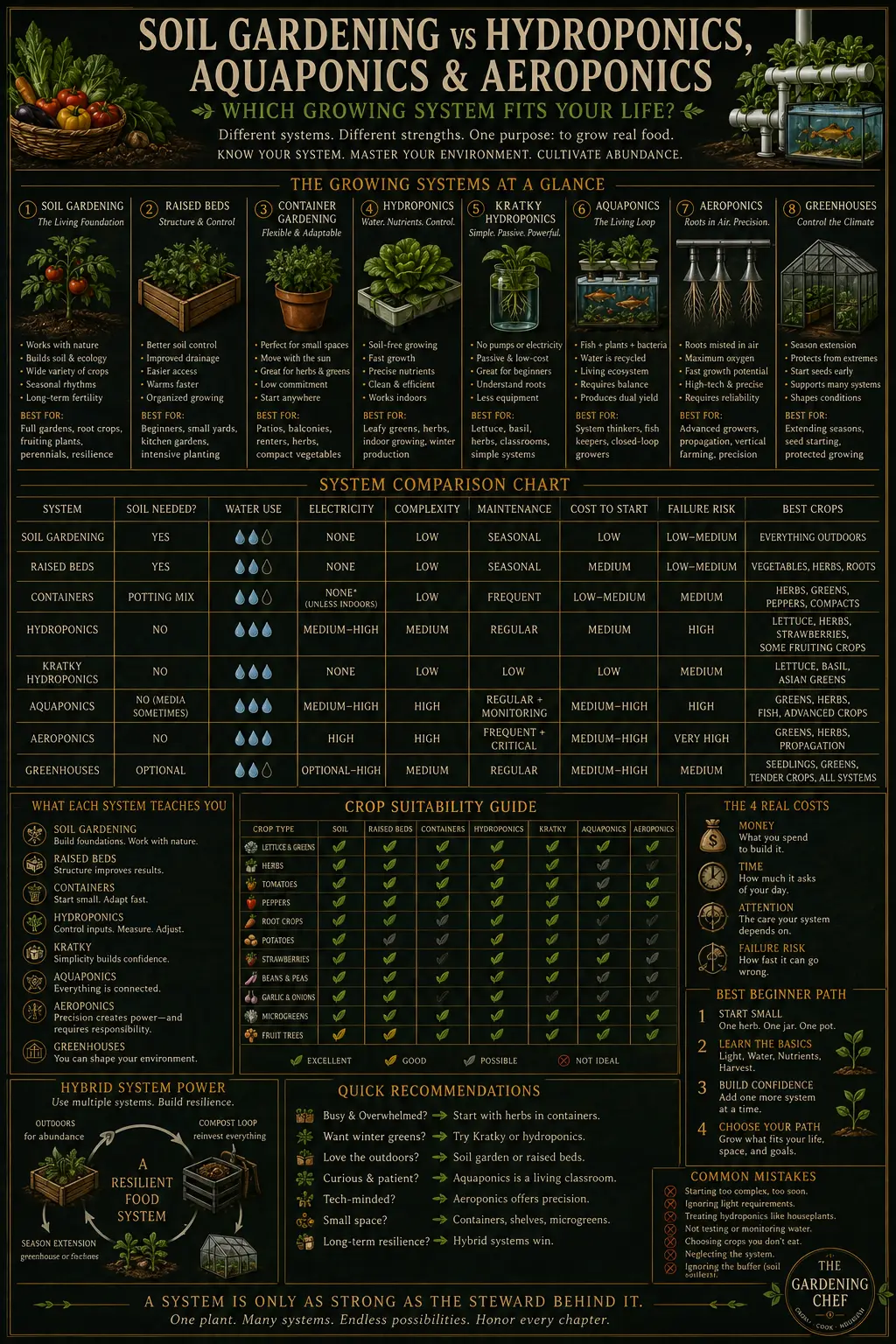
Master Comparison Chart
| System | Soil Needed? | Water Dependency | Electricity Dependency | Best Crops | Beginner Friendly? | Main Skill |
|---|---|---|---|---|---|---|
| In-ground soil garden | Yes | Medium | None | Broadest range: vegetables, herbs, roots, perennials | Yes | Soil building |
| Raised beds | Yes | Medium-high | None | Vegetables, herbs, roots, kitchen gardens | Yes | Soil control |
| Containers | Potting mix | High | None unless indoors | Herbs, greens, peppers, compact tomatoes | Yes | Watering consistency |
| Kratky hydroponics | No | High | None | Lettuce, basil, greens | Yes | Nutrient solution basics |
| Active hydroponics | No | High | Medium-high | Greens, herbs, strawberries, some fruiting crops | Intermediate | pH/EC and equipment |
| Aquaponics | No soil, but media possible | Very high | Usually high | Greens, herbs, fish, mature system crops | Intermediate-advanced | Biological balance |
| Aeroponics | No | Very high | High | Greens, herbs, propagation, vertical systems | Advanced | Precision control |
| Greenhouse | Optional | Medium-high | Optional to high | Seedlings, greens, tender crops, controlled crops | Intermediate | Climate management |
Which System Grows Which Crops Best?
| Crop Type | Soil Garden | Containers | Hydroponics | Aquaponics | Aeroponics |
|---|---|---|---|---|---|
| Lettuce | Excellent | Excellent | Excellent | Excellent | Excellent |
| Basil | Excellent | Excellent | Excellent | Excellent | Excellent |
| Mint | Excellent but aggressive | Excellent | Good | Good | Good |
| Tomatoes | Excellent | Good with large containers | Intermediate-advanced | Advanced | Advanced |
| Peppers | Excellent | Good | Intermediate | Advanced | Advanced |
| Potatoes | Excellent | Possible in grow bags | Not ideal for beginners | Not typical | Not typical |
| Carrots | Excellent in loose soil | Good in deep containers | Not typical | Not typical | Not typical |
| Garlic | Excellent | Possible | Not typical | Not typical | Not typical |
| Onions | Excellent | Possible | Not typical | Not typical | Not typical |
| Microgreens | Good | Excellent indoors | Excellent | Possible | Possible |
| Strawberries | Good | Good | Good | Possible | Possible |
| Beans | Excellent | Good | Intermediate | Possible | Less common |
| Squash | Excellent | Difficult in containers | Not ideal | Not typical | Not typical |
| Fruit trees | Excellent | Dwarf/container possible | No | No | No |
System Personality Test: Which Grower Are You?
Choose Soil Gardening If…
You like being outside.
You want the widest crop range.
You care about compost.
You want to build long-term fertility.
You want pollinators, flowers, herbs, vegetables, roots, and perennials.
You want a food system that can improve year after year.
You want to grow storage crops.
You want to connect gardening with cooking, preservation, and soil health.
Soil gardening is for the steward.
Choose Raised Beds If…
You want soil gardening with more structure.
You have poor native soil.
You like organization.
You want defined growing zones.
You want better drainage.
You want a beginner-friendly kitchen garden.
Raised beds are for the builder.
Choose Containers If…
You rent.
You have a balcony or patio.
You want to start small.
You need mobility.
You want herbs near the kitchen.
You want fast learning.
You do not want to commit to a permanent garden.
Containers are for the adapter.
Choose Hydroponics If…
You want indoor greens.
You like clean systems.
You enjoy monitoring inputs.
You want winter lettuce or basil.
You have access to grow lights.
You do not have outdoor space.
You like controlled experiments.
Hydroponics is for the input manager.
Choose Kratky If…
You want hydroponics without pumps.
You want low-cost experimentation.
You are growing lettuce or basil.
You want to understand roots and nutrient solution.
You want to keep things simple.
Kratky is for the minimalist experimenter.
Choose Aquaponics If…
You like fish.
You enjoy biology.
You are willing to test water.
You like closed loops.
You want a living system, not just plant production.
You can tolerate a learning curve.
You understand that fish health comes first.
Aquaponics is for the systems thinker.
Choose Aeroponics If…
You are comfortable with technology.
You want high control.
You like precision.
You understand pumps, nozzles, timers, and failure points.
You are comfortable maintaining equipment.
You are not looking for the easiest first system.
Aeroponics is for the precision engineer.
Choose a Greenhouse If…
You want season extension.
You want to start seeds.
You want frost protection.
You want to shape climate.
You want to combine soil, containers, or hydroponics in one protected space.
A greenhouse is for the climate designer.
The Real Cost: Money, Time, Attention, and Failure Risk
People often compare these systems by setup cost.
That is useful, but incomplete.
A growing system has four costs:
Money.
Time.
Attention.
Failure risk.
A cheap system that requires daily rescue may not be cheap emotionally.
An expensive system that stabilizes production may be worth it for the right person.
A simple soil bed may outperform an elaborate hydroponic rack if the gardener actually tends it.
A small Kratky jar may teach more than a complicated aquaponics system that crashes after three weeks.
The real cost is not just what you buy.
It is what the system asks of you.
Cost and Complexity Guide
| System | Startup Cost | Ongoing Cost | Maintenance | Failure Speed | Best Beginner Version |
|---|---|---|---|---|---|
| In-ground soil | Low to medium | Low | Seasonal | Slow to medium | Small bed with compost |
| Raised beds | Medium | Low to medium | Seasonal | Slow to medium | One 4×4 or 4×8 bed |
| Containers | Low to medium | Medium | Frequent watering | Medium | Herbs + greens |
| Kratky | Low | Low | Occasional monitoring | Medium | Lettuce jar |
| Active hydroponics | Medium | Medium | Regular monitoring | Fast | Small DWC or countertop system |
| Aquaponics | Medium to high | Medium | Regular testing | Fast for fish | Established aquarium + herbs |
| Aeroponics | Medium to high | Medium | Frequent equipment checks | Very fast | Small propagation unit |
| Greenhouse | Medium to high | Medium-high | Climate management | Medium-fast | Cold frame or mini greenhouse |
Water Use and Water Responsibility
Soil gardens rely on soil structure, mulch, rainfall, irrigation, and organic matter to hold water.
Containers dry faster and often need more frequent watering.
Hydroponics recirculates water in many systems but requires clean nutrient solution and monitoring.
Aquaponics recirculates water but must protect fish health.
Aeroponics may use water efficiently, but roots depend on mist delivery.
The deeper lesson is this:
Water is not just an input.
It is a responsibility.
The more controlled the system becomes, the less room there is for neglect.
Failure Points: What Can Go Wrong?
Soil Garden Failure Points
Poor soil.
Compaction.
Bad drainage.
Too much shade.
Pests.
Weeds.
Drought.
Overwatering.
Nutrient imbalance.
Planting too early or too late.
Container Failure Points
Containers too small.
Poor drainage.
Heat stress.
Inconsistent watering.
Nutrient depletion.
Wrong potting mix.
Too little light.
Hydroponic Failure Points
Wrong nutrient concentration.
pH drift.
Low oxygen.
Pump failure.
Algae growth.
Root disease.
Poor lighting.
Water temperature problems.
Aquaponic Failure Points
Uncycled system.
Ammonia spike.
Nitrite spike.
Low dissolved oxygen.
pH instability.
Fish overfeeding.
Biofilter failure.
Temperature stress.
Plant deficiencies.
Aeroponic Failure Points
Nozzle clogging.
Pump failure.
Timer failure.
Roots drying out.
Water quality problems.
Nutrient imbalance.
High equipment dependency.
Greenhouse Failure Points
Overheating.
Poor ventilation.
Humidity problems.
Pest buildup.
Fungal disease pressure.
Frost if underheated.
Watering mistakes.
The Beginner’s Best Path
The best beginner path is not usually:
Buy the biggest system you can afford.
The best path is:
Start with a system that teaches quickly and forgives mistakes.
Here is the recommended progression.
Step 1: One Living Plant
Start with basil, parsley, mint, chives, lettuce, or microgreens.
Learn light.
Watering.
Harvesting.
Regrowth.
Observation.
Step 2: One Container Food System
Add a container tomato, pepper, salad box, or herb cluster.
Learn spacing.
Fertilizing.
Pruning.
Heat stress.
Daily care.
Step 3: One Soil Improvement Loop
Start compost.
Add mulch.
Use worm castings.
Improve one bed.
Learn foundation.
Step 4: One Simple Hydroponic Experiment
Try Kratky lettuce or basil.
Learn nutrient solution.
Roots.
Light.
Water level.
Step 5: Choose Your Direction
Now decide.
Do you want more soil?
More containers?
More indoor hydroponics?
A greenhouse?
Aquaponics?
Aeroponics?
You will make a better decision after you have touched the basics.
The Wealth Garden Framework: What Each System Teaches
| Growing System | Wealth Lesson | FIRE / Life Parallel |
|---|---|---|
| Soil gardening | Build foundations | Habits before investments |
| Composting | Reinvest waste | Retained earnings |
| Raised beds | Add structure | Budgeting and system design |
| Containers | Start where you are | Low-capital entry point |
| Hydroponics | Control inputs | Track money, energy, and effort |
| Kratky | Reduce complexity | Simple systems beat unused complex ones |
| Aquaponics | Balance loops | Income, spending, investing, and risk are connected |
| Aeroponics | Precision and fragility | Optimization increases responsibility |
| Greenhouse | Shape the environment | Career, location, and benefits as microclimates |
| Hybrid system | Resilience | Diversification across food, money, and skills |
Soil vs Hydroponics vs Aquaponics vs Aeroponics: The Deep Comparison
Soil Gardening Is a Living Foundation
Soil gardening is slower to control but richer in ecological depth.
The soil buffers.
The compost feeds.
The microbes work.
The mulch protects.
The roots explore.
The seasons teach.
Soil gardening is not just plant production. It is relationship.
You are not feeding the plant directly so much as building the conditions where the plant can feed itself.
That is the wealth lesson.
Build the conditions.
Then let the system work.
Hydroponics Is Direct Input Management
Hydroponics removes the soil and puts responsibility in the grower’s hands.
The grower manages water, nutrients, pH, light, oxygen, and cleanliness.
This can be incredibly productive.
But it also removes the buffer.
Hydroponics is a clean lesson in systems control:
What goes in determines what comes out.
Aquaponics Is the Circular Economy
Aquaponics is not just hydroponics with fish.
It is a living loop.
Fish feed bacteria.
Bacteria feed plants.
Plants clean water.
Water supports fish.
The grower supports the whole.
This is why aquaponics belongs in the Wealth Garden system.
It is one of the clearest demonstrations of circular value.
Waste becomes input.
Input becomes yield.
Yield supports the system.
Aeroponics Is Precision Growing
Aeroponics pushes control even further.
Roots are suspended.
Nutrient mist is delivered.
Oxygen is abundant.
Growth can be impressive.
But the system depends heavily on equipment reliability.
Aeroponics teaches a hard but important lesson:
Precision can create power.
But precision also reduces forgiveness.
The Best System by Goal
| Goal | Best System |
|---|---|
| Cheapest start | Herb pot, container, seeds, Kratky jar |
| Best for outdoor abundance | Soil garden or raised beds |
| Best for apartment food | Containers, microgreens, Kratky |
| Best for winter lettuce | Hydroponics under lights |
| Best for children and education | Soil + Kratky + small aquarium aquaponics |
| Best for closed-loop systems thinking | Aquaponics |
| Best for high-tech experimentation | Aeroponics |
| Best for long-term resilience | Soil garden + perennials + compost |
| Best for busy beginner | Containers or raised bed |
| Best for serious food production | Soil garden plus greenhouse/indoor support |
| Best for low-space production | Containers, vertical hydroponics, microgreens |
| Best for learning ecology | Soil gardening |
| Best for learning chemistry/control | Hydroponics |
| Best for learning biology/feedback | Aquaponics |
| Best for learning precision systems | Aeroponics |
A Practical Hybrid System for Real Life
The strongest home food system may not be one method.
It may be a hybrid.
Example:
Outdoor raised beds for tomatoes, peppers, garlic, onions, beans, squash, and herbs.
Containers for patio herbs and compact crops.
Indoor hydroponics for winter lettuce and basil.
Compost or vermicompost for fertility.
Cold frame or mini greenhouse for seed starting.
Rain barrel for water resilience.
A few perennials for long-term yield.
This is where the guide becomes real.
You do not need to be loyal to one method.
You need a system that fits your life.
The Four Levels of Growing System Maturity
Level 1: The Consumer
Buys all food.
No productive system.
No growing experience.
No food feedback loop.
Level 2: The Starter
Grows one or two things.
Herbs.
Microgreens.
Lettuce.
A container tomato.
Begins seeing production.
Level 3: The Grower
Has multiple productive systems.
Soil bed.
Containers.
Compost.
Preservation.
Some season extension.
Level 4: The System Builder
Combines methods.
Soil outside.
Hydroponics inside.
Compost loop.
Greenhouse protection.
Perennials.
Ledger.
Preservation.
Surplus.
This is where gardening becomes wealth.
The $10,000 Garden Insight: Systems Beat Methods
A tomato plant in poor soil struggles.
A lettuce plant under weak lights struggles.
A fish tank without a biofilter fails.
An aeroponic tower with clogged nozzles crashes.
The method is not enough.
The system matters.
A well-built soil garden can produce food, compost, seeds, meals, health, knowledge, and community.
A well-built hydroponic system can produce winter greens, learning, consistency, and indoor food security.
A well-built aquaponic system can produce fish, plants, biology knowledge, and circular thinking.
A well-built greenhouse can extend the season and protect production.
The $10,000 Garden is not one bed.
It is not one technology.
It is the layered value of systems that produce, teach, save, feed, and compound.
The question is not:
“How much did this lettuce cost?”
The question is:
“What system is this helping me build?”
Common Myths
Myth 1: Hydroponics Is Always Better Than Soil
No.
Hydroponics can be excellent for certain crops and spaces, especially greens and herbs indoors. But soil remains better for many outdoor crops, long-term fertility, perennials, roots, and full ecosystem development.
Myth 2: Soil Gardening Is Old-Fashioned
No.
Soil is one of the most advanced biological systems on Earth.
Compost, microbes, roots, fungi, minerals, insects, and organic matter form a living technology no plastic tower can fully replace.
Myth 3: Aquaponics Runs Itself
No.
A mature aquaponic system may become stable, but it does not become responsibility-free.
Fish, bacteria, plants, and water chemistry still need observation.
Myth 4: Aeroponics Is for Everyone
No.
Aeroponics can be powerful, but it is usually not the best first step for a beginner.
Myth 5: Containers Are Not Real Gardening
Wrong.
Containers may be small, but they are real productive systems.
A container herb garden can teach the same core lessons as a large garden: light, water, harvest, regrowth, observation, and care.
Myth 6: You Need Land to Begin
No.
You need a system.
A windowsill herb pot counts.
A microgreen tray counts.
A Kratky lettuce jar counts.
A balcony salad box counts.
The first system matters.
Common Mistakes
Mistake 1: Starting Too Complex
A beginner sees aquaponics online and tries to build a full fish-and-plant loop before understanding light, water, roots, or nutrients.
Start simpler.
Mistake 2: Ignoring Light
Indoor systems fail without enough light.
A hydroponic system is not magic.
Plants still need energy.
Mistake 3: Treating Hydroponics Like Houseplants
Hydroponics needs nutrient solution, oxygen, cleanliness, and monitoring.
Water alone is not enough.
Mistake 4: Treating Aquaponics Like Decoration
Fish are living creatures.
Water chemistry matters.
Biofiltration matters.
Patience matters.
Mistake 5: Forgetting the Buffer
Soil buffers mistakes.
Soilless systems often do not.
The more control you take, the faster mistakes can matter.
Mistake 6: Growing Crops You Do Not Eat
A system is only valuable if its output is used.
Grow what you eat.
Then expand.
Mistake 7: Buying Instead of Building Understanding
Equipment cannot replace understanding.
Start with the simplest version that teaches the principle.
Best Beginner Builds
Build 1: The Windowsill Herb Start
Best for:
Absolute beginners.
Renters.
Cooks.
Busy households.
What to grow:
Basil.
Parsley.
Chives.
Mint.
Cilantro.
What it teaches:
Harvesting.
Regrowth.
Light.
Water.
Flavor value.
Build 2: The Salad Box
Best for:
Patios.
Balconies.
Small yards.
What to grow:
Lettuce.
Arugula.
Spinach.
Radishes.
Green onions.
What it teaches:
Quick harvest.
Succession planting.
Fresh food cycles.
Build 3: The Kratky Lettuce Jar
Best for:
Hydroponic beginners.
Indoor experimenters.
Classrooms.
What it teaches:
Roots.
Nutrient solution.
Water level.
Soilless growing.
Build 4: The One Raised Bed Garden
Best for:
Homeowners.
Backyard beginners.
Families.
What to grow:
Tomatoes.
Peppers.
Basil.
Lettuce.
Garlic.
Beans.
What it teaches:
Soil building.
Plant spacing.
Seasonality.
Pests.
Surplus.
Build 5: The Fish Tank Herb Loop
Best for:
People who already keep aquariums.
What to grow:
Pothos for houseplant filtration.
Basil or herbs in carefully designed systems.
Leafy greens in more advanced setups.
What it teaches:
Water chemistry.
Fish waste.
Plant uptake.
Balance.
Build 6: The Cold Frame
Best for:
Season extension beginners.
What to grow:
Lettuce.
Spinach.
Kale.
Asian greens.
Seedlings.
What it teaches:
Climate protection.
Temperature.
Timing.
The Decision Matrix
Ask these questions before choosing a system.
1. Where Will It Live?
Outdoor yard?
Balcony?
Kitchen counter?
Basement?
Greenhouse?
Garage?
Classroom?
2. What Do You Want to Grow?
Leafy greens?
Herbs?
Tomatoes?
Storage crops?
Fish?
Perennials?
Fruit?
3. How Much Time Can You Give It?
Five minutes a day?
Fifteen minutes a day?
One hour on weekends?
Daily testing?
Full hobby commitment?
4. How Much Failure Can You Tolerate?
Can a lettuce plant fail?
Can a fish die?
Can a pump stop?
Can a crop be delayed?
Can you afford replacement parts?
5. What Do You Want to Learn?
Ecology?
Soil?
Chemistry?
Water?
Fish?
Precision systems?
Business?
Cooking?
Preservation?
6. What Output Matters Most?
Food?
Savings?
Fresh greens?
Education?
Resilience?
Income?
Beauty?
Experimentation?
A good system fits your answer.
The Best Recommendation for Most Readers
For most readers, the best path is not choosing between soil and hydroponics.
The best path is:
Start with soil or containers. Add simple hydroponics later. Explore aquaponics or aeroponics only when you enjoy the system enough to maintain it.
That keeps the learning curve sane.
It also builds a resilient food system.
A realistic household system might look like this:
Herbs on the windowsill.
Containers on the patio.
One raised bed outside.
Compost or worm bin.
Kratky lettuce indoors.
Eventually a greenhouse shelf or hydroponic rack.
Maybe aquaponics if fishkeeping appeals.
Maybe aeroponics if precision growing excites you.
That is not scattered.
That is layered.
The Growing Systems Ladder
Level 1: Herb Pot
One plant.
One lesson.
One harvest.
Level 2: Container Garden
Multiple plants.
More feedback.
More daily use.
Level 3: Raised Bed
Soil system.
Seasonal production.
Surplus.
Level 4: Compost Loop
Waste becomes fertility.
System begins feeding itself.
Level 5: Indoor Greens
Hydroponics or microgreens.
Winter production.
Year-round learning.
Level 6: Greenhouse
Climate protection.
Season extension.
Stronger starts.
Level 7: Aquaponics
Living loop.
Fish, bacteria, plants.
System balance.
Level 8: Aeroponics
Precision.
Optimization.
Advanced control.
You do not need to climb all levels.
You only need the levels that fit your life.
Field Notes From the Garden
Field Note 1: The Best System Is the One You Check
A neglected greenhouse fails.
A neglected hydroponic tank fails.
A neglected aquaponic system can fail badly.
A neglected soil garden may limp along, but it will not thrive.
The best system is not the most advanced.
It is the one you stay connected to.
Field Note 2: Soil Forgives, Water Reveals
Soil often hides mistakes for a while.
Hydroponic water reveals them faster.
Aquaponic water reveals them through fish, bacteria, and plants.
Aeroponics reveals them almost immediately.
The faster the feedback, the more skilled the operator must become.
Field Note 3: Food Systems Are Personality Systems
Some people love soil.
Some love clean indoor systems.
Some love fish.
Some love sensors.
Some love simple pots.
The right system should match your curiosity.
Curiosity is fuel.
Field Note 4: Complexity Is a Crop
Complexity grows too.
If you plant it, you must tend it.
Only add complexity when it produces more value than it consumes.
A Garden Wealth Side Note: Your Job Is Also a Growing System
This may sound strange, but the same logic applies to careers and finances.
A workplace can be a microclimate.
A good employer may offer:
401(k) match.
Pension.
Stock options.
Health insurance.
Legal benefits.
Gym discounts.
Education reimbursement.
Professional development.
Paid time off.
Those are not just perks.
They are nutrients in the system.
A person who ignores them is like a gardener ignoring rain, compost, and sunlight.
The lesson is the same:
Use the system you are in. Improve the system where you can. Build a better system when you must.
That is why growing systems matter beyond gardening.
They teach you how to see hidden value.
Frequently Asked Questions
Is hydroponics better than soil gardening?
Not universally. Hydroponics is excellent for controlled production of greens and herbs, especially indoors. Soil gardening is better for broad outdoor food systems, compost loops, roots, perennials, fruit trees, pollinator systems, and long-term fertility.
Is aquaponics good for beginners?
Aquaponics can be beginner-accessible if started very small, especially by someone who already understands aquariums. But compared with soil containers or Kratky hydroponics, aquaponics has more living parts and more serious failure consequences.
Is aeroponics worth it?
Aeroponics is worth exploring for advanced growers interested in precision, propagation, controlled environments, or vertical farming concepts. It is usually not the best first system for a beginner.
What is the easiest system to start with?
A pot of herbs, a salad container, microgreens, or a Kratky lettuce jar.
What is the cheapest system?
Seeds in soil are usually cheapest if you have outdoor space. For indoor soilless growing, Kratky is one of the simplest low-cost methods.
What grows best hydroponically?
Leafy greens and herbs are the easiest. Lettuce, basil, Asian greens, mint, and many greens do well in hydroponic systems.
Can tomatoes grow hydroponically?
Yes, but tomatoes need more light, support, nutrients, space, and management than lettuce or herbs. They are better as an intermediate or advanced hydroponic crop.
Can root crops grow hydroponically?
Some can, but they are generally less beginner-friendly than leafy greens. Carrots, potatoes, garlic, and onions are usually easier and more practical in soil or containers.
Do hydroponic vegetables taste the same?
Taste depends on variety, nutrients, light, maturity, freshness, and growing conditions. Soil does not automatically mean better, and hydroponics does not automatically mean bland. Flavor comes from the whole system.
Does aquaponics need fertilizer?
Aquaponics relies on fish waste processed by bacteria, but some nutrients may still need careful supplementation depending on crops and system balance. Any supplement must be safe for fish and the system.
Does aeroponics use less water?
Aeroponics can use water efficiently in controlled systems, but equipment reliability and design are critical. Efficiency is only valuable if the system stays functional.
Do I need a greenhouse?
No. A greenhouse is useful for season extension, seed starting, and controlled growing, but it is not required to begin. A cold frame, mini greenhouse, or sunny window may be enough for many readers.
What system is best for FIRE and resilience?
A hybrid system: soil garden for broad outdoor production, compost for reinvestment, storage crops for food security, containers for flexibility, and simple indoor greens for year-round production.
Source Notes for Accuracy
This field guide is built around the Wealth Garden framework we have been developing, especially the idea that hydroponics, aquaponics, greenhouses, and related systems are “engineered microclimates” where the grower moves from reacting to nature toward controlling or balancing the environment. That framing connects directly to the manuscript sections on microclimates, controlled environments, and hydroponics/aquaponics as circular systems.
For technical accuracy, this guide references university extension and institutional sources on soil health, container gardening, hydroponic nutrient solutions, pH/EC management, aquaponic biofiltration, Kratky hydroponics, and aeroponics. Key sources include USDA NRCS soil health principles, Virginia Tech and University of Maryland Extension gardening resources, University of Missouri and Oklahoma State hydroponic guidance, New Mexico State and FAO aquaponics materials, University of Florida IFAS Kratky information, and NASA Technical Reports on aeroponics.
Final Thought: Choose the System That Will Make You a Better Steward
Soil gardening is not outdated.
Hydroponics is not magic.
Aquaponics is not automatic.
Aeroponics is not a shortcut.
Containers are not lesser.
Greenhouses are not guarantees.
They are all systems.
Each one asks something different from the grower.
Soil asks you to build foundations.
Containers ask you to start where you are.
Hydroponics asks you to manage inputs.
Aquaponics asks you to balance a living loop.
Aeroponics asks you to respect precision.
Greenhouses ask you to design climate.
The best system is the one that fits your life, feeds your curiosity, and helps you keep showing up.
Because in the end, food systems do not thrive because they are trendy.
They thrive because someone tends them.
And that is the real lesson.
A garden is not merely something you build.
It is something you enter into.
A partnership.
A feedback loop.
A living system.
And once you understand that, the question changes forever.
Not:
Which system is best?
But:
Which system will help me cultivate the life I am trying to grow?
Wealth is not accumulated. It is cultivated.