From strawberries and blueberries to raspberries, currants, mulberries, and more, learn which berries fit your garden—and what to do with the harvest once it arrives.
Which Berry Belongs in Your Garden?
Berries have a way of making a garden feel generous.
A strawberry hides beneath its leaves. A raspberry slips from the cane when it is perfectly ripe. A blackberry darkens from tart to rich. Blueberries gather by the handful. Currants hang like jewels. A serviceberry can feed the gardener and the birds from the same branches.
But these fruits do not belong in the garden in the same way.
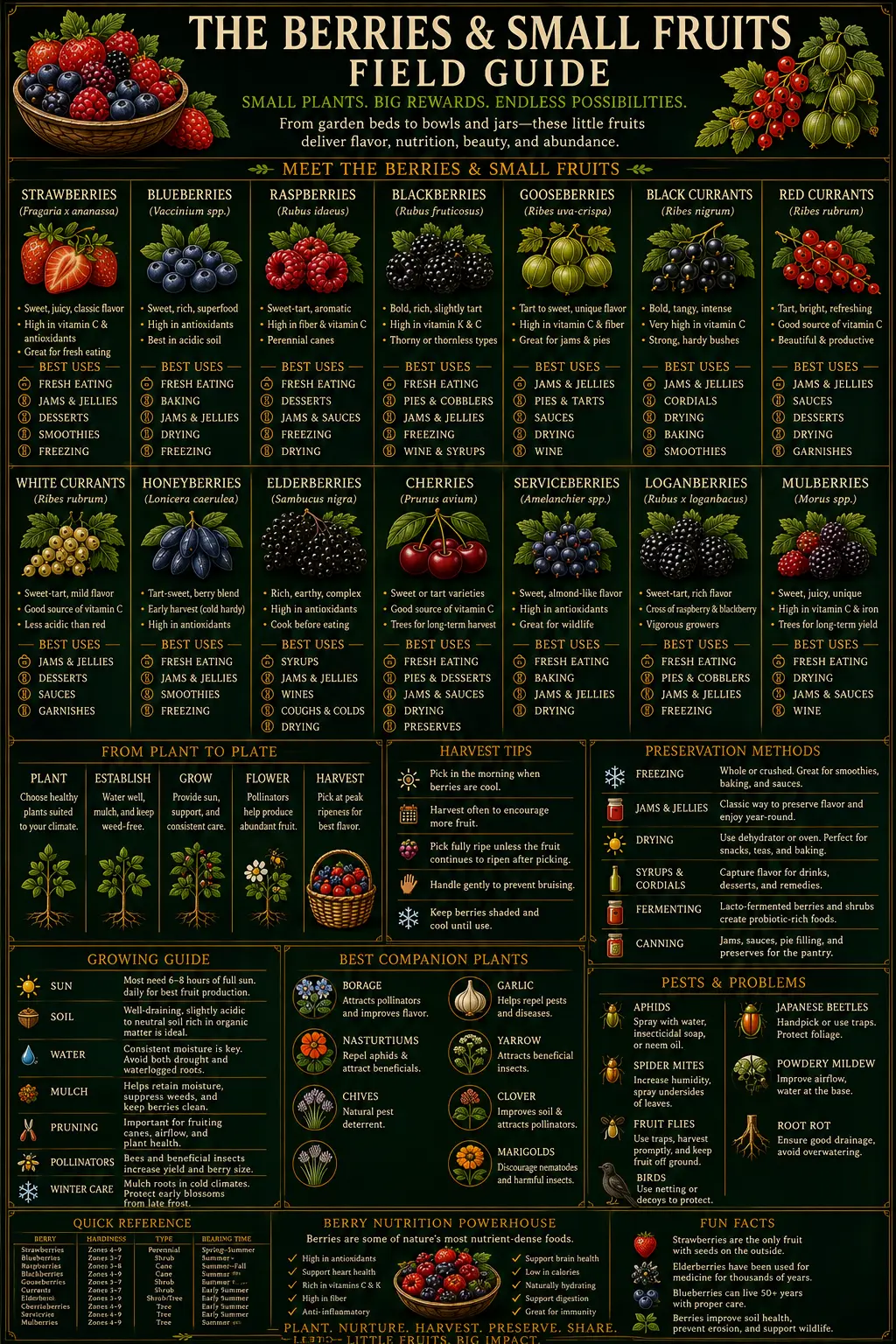
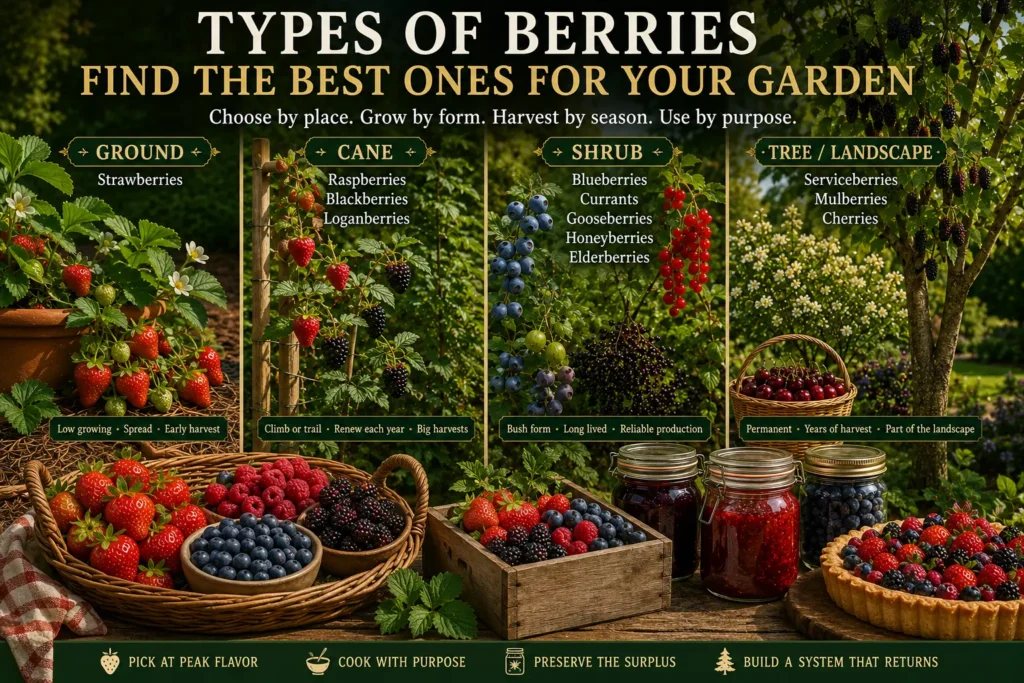
Strawberries stay close to the ground and can fill a bed or container. Raspberries and blackberries grow through canes that need room, pruning, and often support. Blueberries, currants, gooseberries, honeyberries, and elderberries become shrubs. Serviceberries, mulberries, and cherries can become lasting parts of the landscape.
That is why choosing among the many types of berries should begin with a different question:
What kind of fruit system do I want to build?
The berry you love most at the grocery store is not automatically the berry that belongs in your garden.
Before buying plants, run each choice through five filters:
- Climate — Will it thrive where you live?
Winter cold, summer heat, growing season, and local conditions quickly narrow the field. - Soil — Can you give it the conditions it needs?
Some berries are adaptable. Others, especially blueberries, ask for a much more specific soil environment. - Space — Where will it live when it is mature?
A strawberry container, raspberry row, blueberry hedge, and mulberry tree solve very different garden problems. - Time — How quickly do you want a return, and how much management are you willing to give it?
Some fruits offer relatively quick rewards. Others become more valuable as the planting matures. - Kitchen — What do you actually want to do with the harvest?
Fresh snacking, breakfast, pies, savory sauces, freezing, drying, jam, syrup, and preservation may point you toward different fruits.
The goal is not to grow every berry.
It is to choose the berries whose garden habits and kitchen uses fit your life.
That leads to one of the most useful rules in this entire guide:
The best berry is the one that fits your climate, soil, space, time, and kitchen.
Once you understand those five things, the nursery aisle starts looking very different.
You are no longer choosing between attractive plants.
You are deciding where each fruit belongs in the system you are building.
Start Here: Match the Berry to Your Garden
You do not need to know every berry before you begin.
Start with the space and purpose you already have, then narrow the choices.
| If you have or want… | Start by exploring… | Why |
|---|---|---|
| Containers, a patio, or very little space | Strawberries, compact blueberries, dwarf raspberries, patio blackberries | Big fruit value without dedicating permanent garden beds |
| A sunny fence or trellis | Raspberries, blackberries, loganberries | Cane fruits turn vertical space into a productive fruit row |
| Room for productive shrubs | Blueberries, currants, gooseberries, honeyberries, elderberries | Long-lived plants that can become hedges, borders, and pantry crops |
| An edible landscape | Serviceberries, blueberries, currants, gooseberries, dwarf cherries | Fruit can become part of the ornamental landscape instead of occupying a separate garden |
| Room for a long-term fruit tree | Mulberries, cherries, serviceberries | Greater commitment, but potentially years or decades of returning harvest |
| Mostly fresh snacking | Strawberries, blueberries, raspberries, serviceberries, mulberries, sweet cherries | Fruits that reward you for eating them close to peak ripeness |
| A preservation-focused kitchen | Blackberries, raspberries, currants, gooseberries, elderberries, tart cherries, strawberries | Strong choices for freezing, jam, jelly, syrup, sauces, drying, and other preservation |
| An early-season harvest | Strawberries, honeyberries, serviceberries | They can begin the fruit season before many summer crops reach full production |
| Cold-climate resilience | Honeyberries, currants, gooseberries, raspberries, serviceberries, many tart cherries | Several are well suited to colder growing regions when the cultivar fits the site |
| A fruit system that becomes more valuable with time | Blueberries, cane-fruit rows, serviceberries, mulberries, cherries, currants | These are the crops that most clearly demonstrate the power of perennial production |
The first decision does not have to be:
Which berry is best?
A better question is:
Which berry solves the problem my garden and kitchen actually have?
A patio may need strawberries.
A fence may be waiting for raspberries.
An empty shrub border may be the perfect place for blueberries or currants.
A sunny corner of the yard may have room for a fruit tree that could still be producing years from now.
Once you begin matching the plant to the place, the enormous world of berries becomes much easier to navigate.
The Berry Garden Game: Every Season Builds on the Last
A berry garden does not move in a straight line.
You plant. You learn. Weather interferes. Birds arrive. One plant struggles. Another thrives. Runners appear. Canes need pruning. The first handful becomes a bowl. The bowl becomes breakfast, jam, sauce, or something saved for later.
Then spring comes around again.
But something important has changed:
You are not starting over.
The plants are older. The roots are more established. The trellis is already there. You know where the birds arrive first. You know which fruit your family eats before it reaches the kitchen. You know which harvest belongs in the freezer and which one deserves a jar.
That is the idea behind The Berry Garden Game.
The board is not meant to tell you that one berry is better than all the others. It is meant to make you notice how many different decisions hide inside the simple question:
What berry should I grow?
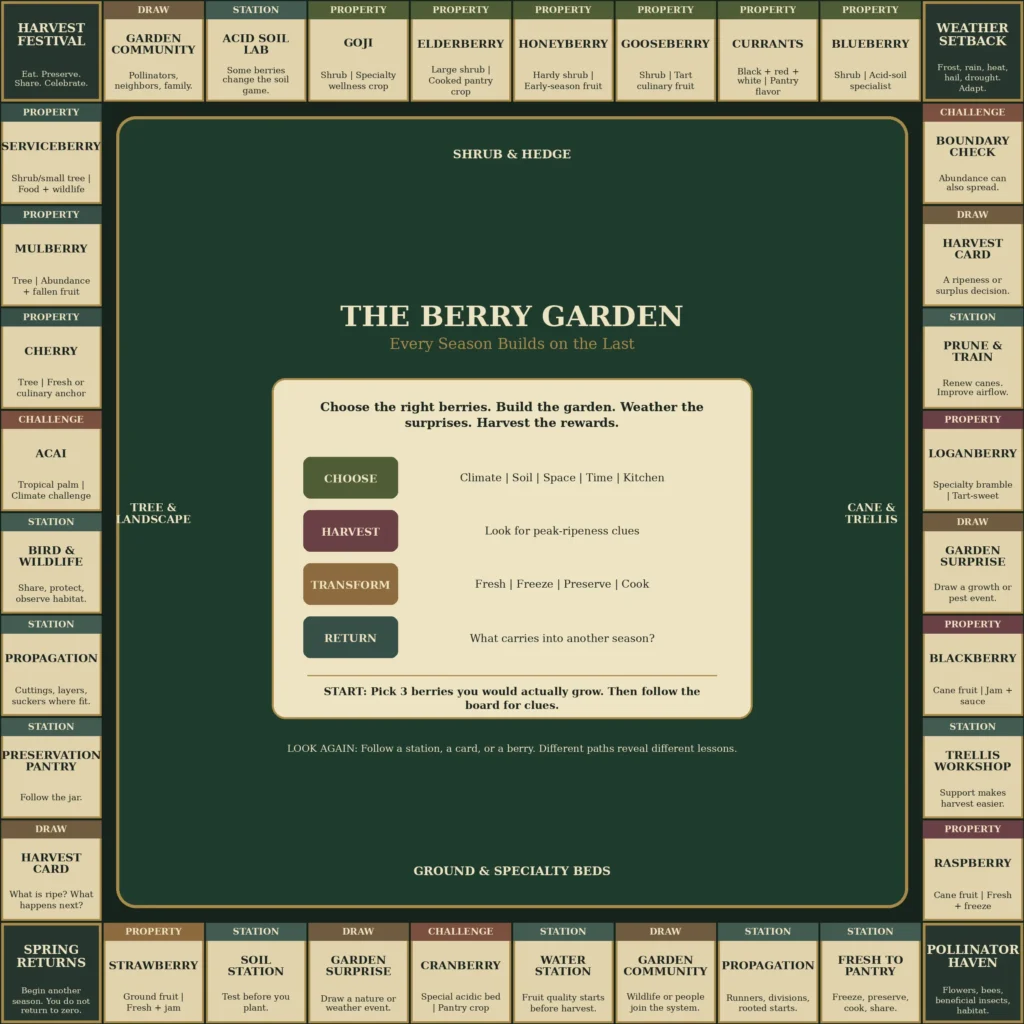
First Move: Choose Three Berry Properties
Before you roll dice or draw a card, choose three berries you would seriously consider growing.
Do not automatically choose your three favorite berries to eat.
Run each one through the five filters you met at the beginning of this guide:
Climate → Soil → Space → Time → Kitchen
If all three still make sense, keep them.
If one suddenly looks questionable, that is not failure.
That is the game already teaching you something.
A berry can be famous, delicious, expensive at the grocery store, or wildly popular online and still be the wrong plant for your particular garden.
Need a Hint? Use the Choose Your Berry Quick Guide
You do not need to memorize every property on the board.
This chart is your first hint sheet. It is deliberately simple: enough information to help you narrow a choice without replacing the deeper berry profiles later in this guide.
| Berry | Grows As | Strong Fit | First Thing to Notice |
|---|---|---|---|
| Strawberry | Low perennial crown | Containers, beds, small spaces | Runners and bed renewal |
| Blueberry | Shrub | Dedicated berry beds, edible hedges, suitable containers | Acidic soil comes first |
| Raspberry | Cane fruit | Sunny row, fence, trellis | Pruning, renewing canes, and spreading |
| Blackberry | Cane / bramble fruit | Trellis, fence line, productive edge | Training, pruning, and boundaries |
| Currants | Shrub | Pantry garden, shrub border, edible landscape | Black, red, and white currants have different kitchen strengths |
| Gooseberry | Shrub, often thorny | Preserve garden, shrub border | Thorns and regional Ribes considerations |
| Honeyberry / Haskap | Hardy shrub | Cold-climate, early-season fruit system | Pollination partners deserve planning |
| Elderberry | Large shrub | Pantry hedge, wildlife edge | Proper preparation matters |
| Serviceberry | Shrub or small tree | Edible landscape, wildlife garden | Birds may notice ripeness before you do |
| Loganberry | Trailing cane fruit | Managed trellis, specialty bramble patch | Support and bramble-management skills |
| Mulberry | Tree or large shrub | Roomy landscape, long-term fruit system | Mature size and fallen fruit |
| Cherry | Small tree, depending on type and rootstock | Fruit-tree layer, culinary landscape | Cultivar choice, pollination, birds, and disease pressure |
| Goji | Shrub | Sunny specialty-fruit planting | Give it room and plan for management |
| Cranberry | Low trailing specialty crop | Dedicated cranberry bed | Specialized growing conditions |
| Açaí | Tropical palm | Tropical climates; a climate-learning challenge for many readers | Climate suitability comes before popularity |
Look Again: Popularity Is Not Suitability
The three newer names on the board make this lesson especially useful.
Goji may be familiar as a dried fruit or wellness ingredient, but it can also lead to a completely different question:
Could this actually become a garden plant for me?
Cranberry creates another surprise. It is not automatically off-limits to the backyard gardener, but it asks you to think about a more specialized growing system than a strawberry bed or raspberry row.
And açaí may be one of the most useful teaching properties on the board precisely because so many people recognize it.
A fruit can dominate smoothies, bowls, recipes, wellness conversations, and internet searches without automatically belonging in your backyard.
The board does not ask:
Is this berry popular?
It asks:
Does this berry fit the system I can actually build?
There Is No “Best Berry” Space
That is intentional.
A strawberry may be extraordinarily valuable to someone with a patio.
A raspberry row may transform an unused fence.
A blueberry can be an outstanding long-term crop if you can provide the soil environment it needs.
A currant may become far more exciting when you think in jelly, syrup, sauce, or cordial instead of handfuls of fresh fruit.
A mulberry can provide tremendous abundance in the right location and become a frustrating mess in the wrong one.
And a crop that sounds exciting online may lose immediately when you run it through Climate, Soil, Space, Time, and Kitchen.
The winner is not the gardener who collects the most berry properties.
The winner is the gardener who builds the system that fits.
Look Between the Properties
Now look back at the board one more time.
It is easy to stare at Strawberry, Blueberry, Raspberry, or Blackberry and miss the spaces between them.
But those spaces may determine whether the berry succeeds.
Soil Station asks whether the ground actually fits the plant.
Water Station reminds you that fruit quality begins long before harvest day.
Prune & Train asks whether you are willing to manage canes and structure.
Propagation reminds you that some plantings can eventually become more plants.
Fresh to Pantry asks what happens when the harvest becomes larger than today’s appetite.
Those are not interruptions between the berry properties.
They are part of owning the property.
Try the First Berry Puzzle
Before you keep reading, look back at the board.
Can you find:
1. A familiar backyard shrub where soil chemistry can determine whether the planting thrives.
2. A famous berry whose popularity cannot overcome a major climate mismatch for many gardeners.
3. A fruit that can be grown at home but may ask you to build a specialized bed rather than simply tuck it into the ordinary garden.
4. A cane fruit where successful growth may eventually force you to think about boundaries.
5. A berry whose greatest value may become clearer when you stop asking, “Do I want to eat this by the handful?” and start asking, “What can I make from it?”
Try answering from the board first.
If you get stuck, go back to the Choose Your Berry Quick Guide and use the columns as clues.
And notice something important: some garden questions may have more than one reasonable answer.
That is not a flaw in the game.
It is part of the lesson.
Gardening rarely hands you one universal answer. It hands you a place, a plant, a season, and a decision.
Keep the three berries you chose in mind.
You are going to need them again.
Because now the garden gets a turn.
Then the Garden Starts Playing Back
You have chosen three berries.
Now imagine that you plant them.
For a moment, everything goes according to plan.
The beds are prepared. The plants are watered. The trellis is waiting. The mulch is down.
Then the garden begins doing what gardens do.
It starts making decisions of its own.
A frog moves beneath the berry plants.
Native bees discover the flowers.
A bird finds the serviceberries before you do.
Strawberry runners cross the edge of the bed.
A raspberry cane appears somewhere you did not put it.
Japanese beetles arrive for lunch.
And three days of rain appear in the forecast just as several fruits are approaching perfect ripeness.
Welcome to the second part of the Berry Garden Game.
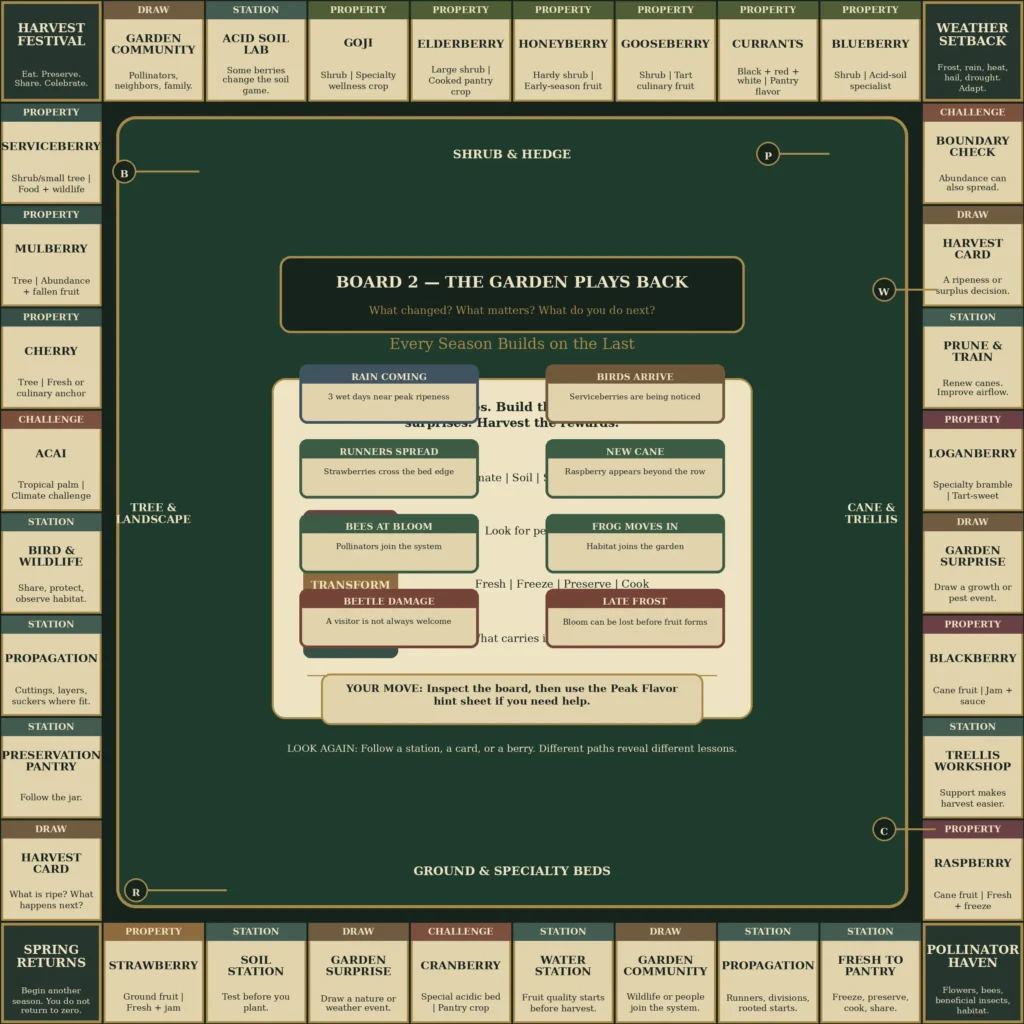
Look carefully at this board.
It should feel familiar.
The properties have not changed.
The situation has.
That distinction matters.
A successful garden is not one where nothing unexpected happens.
A successful gardener learns to recognize what changed, decide whether it matters, and respond before a small event becomes a large problem.
Garden Surprise: Rain Is Coming
Imagine this:
Your strawberries are nearly fully colored.
Several raspberries are beginning to release easily from the cane.
The blackberries are darkening.
Blueberries look blue.
And the forecast suddenly shows three wet days ahead.
What do you harvest?
What can wait?
Which crop deserves another taste before you decide?
And which fruit might fool you simply because its color looks finished?
This is where another reference tool becomes useful.
Pick at Peak Flavor: The Berry Harvest Hint Sheet
Color is useful.
But color alone is not always enough.
Some berries announce ripeness through color.
Others through softness, flavor, fragrance, or how easily they release from the plant.
Use this chart when the board asks:
Is it actually ready?
| Berry | Look For | Touch / Release | What to Do Next |
|---|---|---|---|
| Strawberry | Fully colored fruit with no white remaining | Tender but sound | Pick ripe fruit and use or cool promptly |
| Blueberry | Completely blue, including the underside | Slight springiness when gently squeezed | Taste before stripping a cluster; blue can appear before full ripeness |
| Raspberry | Full cultivar color | Releases easily with a gentle pull | Harvest promptly and handle gently |
| Blackberry | Fully black, plump fruit | Separates easily with a gentle motion | Harvest fully ripe fruit; protect quality with careful handling |
| Currants | Clusters reach the mature color for the type | Berries become fully developed and juicy | Harvest clusters when ripe; destination may influence timing |
| Gooseberry | Fruit reaches expected mature color and size | Fruit softens as it ripens | Pick riper for fresh eating; earlier/tarter fruit can suit some preserves |
| Honeyberry / Haskap | Blue exterior—but do not stop there | Fully ripe fruit softens; taste is important | Wait beyond the first color change; some fruit needs additional ripening time |
| Elderberry | Clusters of fully dark-purple ripe berries | Harvest the ripe cluster rather than scattered unripe fruit | Remove stems and unripe fruit; cook properly before eating |
| Serviceberry | Fruit changes from pink/red toward dark purple | Ripe fruit becomes tender and sweet | Taste and harvest promptly—birds are watching too |
| Loganberry | Deep, fully developed color | Like other cane berries, ripe fruit should release readily | Pick gently and use soon |
| Mulberry | Full mature color for the variety | Very ripe fruit becomes soft and releases or falls readily | Harvest promptly and expect delicate fruit |
| Cherry | Full mature color for the cultivar | Firm-ripe rather than shriveled or overripe | Pick ripe on the tree; cherries do not continue ripening after harvest |
| Goji | Mature orange-to-red fruit | Fruit remains delicate and does not necessarily detach easily | Hand-pick carefully to avoid bruising |
| Cranberry | Firm fruit with deep mature color | Firm rather than soft or damaged | Harvest sound fruit; color and cultivar timing both matter |
| Açaí | Mature purple fruit in its tropical production system | Not a typical temperate backyard harvest test | For most readers, solve the climate question first |
A useful rule:
Color tells you when to start paying attention. The plant, the fruit, and your taste tell you when to harvest.
For several of these crops, the cues above are deliberately conservative because cultivar, climate, intended use, and local conditions can change the ideal picking point. Extension guidance supports the major distinctions: fully red strawberries, completely blue blueberries, easy release for ripe raspberries and blackberries, dark-purple serviceberries, hand-picked goji, and firm deep-red cranberries. Cherries should be allowed to ripen on the tree because they do not continue ripening after picking, while honeyberries can require substantially more time after the first blue coloration appears.
Try the Weather Challenge
Now go back to the board.
You have three days of rain coming.
Your:
- strawberries are fully red,
- raspberries release with barely a pull,
- blueberries have just turned blue,
- blackberries are dark but still holding tightly.
Which ones are giving you the strongest harvest-now signals?
The chart gives you clues.
But the real lesson is larger:
The calendar does not decide when you harvest. The condition of the fruit does.
And sometimes the weather changes the cost of waiting.
A berry that would benefit from another day on the plant may be competing with rain, birds, heat, cracking, insects, or your own schedule.
That is why experienced gardeners inspect more often as harvest approaches.
They are not merely waiting for a date.
They are watching a decision develop.
Garden Community: A Bird Finds the Serviceberry
Now something different happens.
You walk outside and discover a bird eating your serviceberries.
Did you lose?
Not necessarily.
You may have learned several things at once.
The fruit is attracting wildlife.
The berries may be approaching peak ripeness.
Your landscape is providing habitat.
And if you want more of that harvest for yourself, you may need to change your strategy.
Maybe that means harvesting earlier in the day.
Maybe it means protecting part of the crop.
Maybe it means accepting that one plant serves both the kitchen and the ecosystem.
The bird is not simply a thief.
It is information.
Serviceberries are well documented as attracting birds and other wildlife, and their ripe fruit is dark purple.
Garden Surprise: The Strawberries Are Escaping
Now look at your strawberry property.
A runner has crossed the border.
Then another.
Is that good?
It could be.
A runner can become another rooted strawberry plant.
That may mean a larger patch without buying another plant.
But if every runner is allowed to decide where the strawberry bed ends, the same biological advantage can become crowding and maintenance.
So which is it?
Free propagation or a future problem?
The answer depends on what you are trying to build.
That is a pattern you will see repeatedly in this game:
The same event can be an asset in one system and a problem in another.
Garden Surprise: The Raspberry Moved
The raspberries teach the same lesson differently.
A new shoot appears beyond the row.
You could celebrate:
Another raspberry plant!
Or you could realize:
My raspberry row is starting to become my lawn.
Both statements can be true.
The important question is not whether the plant is productive.
It is whether the production is happening inside the system you intended to build.
That is why boundaries matter.
Abundance without management can eventually become another form of work.
Garden Community: A Frog Moves In
Then you notice movement under the leaves.
A frog has made itself comfortable in the patch.
There is no basket of berries attached to this event.
No jam.
No grocery savings.
No extra plant.
And yet it may be one of the most interesting developments on the board.
Because your garden is beginning to function as more than a collection of crops.
It is becoming habitat.
That does not mean every creature automatically helps every plant.
It means the system has become complex enough that other life has started participating in it.
The garden is no longer something you simply act upon.
It acts back.
Not Every Surprise Is Good
The board should not romanticize every visitor.
Japanese beetles can damage foliage.
Birds can remove fruit.
Persistent wet weather can increase fruit-quality and disease problems.
Poorly controlled runners and suckers can create crowding.
A late frost during bloom can change the harvest before a berry even forms.
Gardening is not successful because nature always cooperates.
It is successful because observation gives you time to respond.
That is one reason the board contains both Garden Surprise and Garden Community.
They are related, but they are not quite the same.
Garden Surprise asks:
What just happened to my garden?
Garden Community asks:
What has begun interacting with the system I built?
Sometimes the answer is welcome.
Sometimes it is inconvenient.
Sometimes you will not know which one it is until later.
Try the Second Berry Puzzle
Look at Board 2 again before moving on.
Can you find or identify:
1. A crop where the first blue color does not necessarily mean “pick everything now.”
2. A berry where easy release is one of the strongest clues that the fruit is ready.
3. A fruit where a bird taking the harvest may also reveal that you built useful wildlife habitat.
4. A crop whose ability to make new plants can be both an asset and a boundary problem.
5. An event that sounds bad at first but might actually tell you something useful about the health or complexity of the garden.
If you need help with the first two, use the Pick at Peak Flavor chart.
For the others, think about the system rather than searching for one perfect answer.
Because this time the board is testing something different.
The first board asked:
What should I grow?
This board asks:
What will I do when the garden does something I did not plan?
Keep your original three berry properties.
They are still yours.
But now they have weather, wildlife, ripening fruit, spreading plants, and unexpected visitors to deal with.
And one more problem is coming.
Eventually, something is going to ripen faster than you can eat it.
Follow the Jar
Eventually, every productive berry garden creates the same wonderful problem:
There is more fruit than you can eat today.
A handful is easy.
You eat it.
A bowl requires a decision.
Breakfast? Dessert? Sauce? Pie?
A basket changes the question completely.
Now you are deciding what deserves to be eaten at peak flavor, what can wait until tomorrow, what should go into the freezer, and what might become something entirely different.
That is another game hidden inside the Berry Garden board.
Follow the jar.
The trail does not always lead to jam.
Sometimes it leads to the freezer.
Sometimes to a pie.
Sometimes to a savory sauce.
Sometimes to syrup, jelly, drying, baking, or sharing half the harvest with somebody who will actually use it.
The important question is no longer:
What did I harvest?
It becomes:
What should this harvest become?
Fresh to Pantry: The Berry Transformation Hint Sheet
Use this chart when the garden gives you more fruit than today’s appetite can handle.
Instead of trying to memorize every preservation technique, think about the amount of fruit in front of you.
| Berry | If You Have a Handful | If You Have a Bowl | If You Have Too Much |
|---|---|---|---|
| Strawberry | Eat at peak ripeness | Shortcake, salad, breakfast, sauce | Freeze or make a tested jam/preserve |
| Blueberry | Snack fresh | Muffins, pancakes, sauce, breakfast | Tray-freeze for easy future use |
| Raspberry | Eat gently and quickly | Dessert, sauce, yogurt, baking | Freeze or turn into a tested jam |
| Blackberry | Eat fully ripe | Cobbler, pie, sauce | Freeze, jam, or cook into sauce |
| Currants | Taste, garnish, pair with cheese | Sauce, baking, syrup | Jelly, jam, syrup, or freezing |
| Gooseberry | Eat fully ripe varieties fresh | Pie, tart, sauce | Jam, freeze, or cook into preserves |
| Honeyberry / Haskap | Eat fresh | Smoothie, breakfast, sauce | Freeze or make jam |
| Elderberry | Cook before eating | Cook into a sauce, baked preparation, or other heated use | Use a research-based cooked preservation method |
| Serviceberry | Eat fresh before the birds do | Muffins, pancakes, pie | Freeze, dry, or cook into jam |
| Loganberry | Eat fresh | Pie, sauce, dessert | Freeze or make jam |
| Mulberry | Eat close to the tree | Bake, sauce, dessert | Freeze, dry, cook, or share quickly |
| Cherry | Eat ripe sweet cherries fresh | Pie, sauce, baking | Pit and freeze, dry, or use a tested preserve recipe |
| Goji | Taste ripe fruit where you grow it successfully | Add to cooked or dried-fruit uses | Dry, freeze, or process according to the variety and intended use |
| Cranberry | Usually more useful as a culinary fruit than a snacking fruit | Sauce, relish, baking | Freeze or use a tested conserve/preserve recipe |
| Açaí | Specialty tropical crop | Usually processed rather than treated as an ordinary backyard berry | For most readers, solve climate and production first |
Freezing deserves special attention because it is often the simplest way to buy yourself time. The National Center for Home Food Preservation recommends dry or tray packing for small fruits such as berries; tray freezing keeps individual fruits loose so you can remove only what you need later. University of Minnesota Extension likewise recommends freezing fruit at peak ripeness for best quality.
And shelf-stable preservation deserves the opposite lesson:
Do not improvise because the fruit is getting soft.
Research-based jam, jelly, and canning recipes specify the fruit, sugar or pectin system, acidity where needed, jar size, and processing method for a reason. The National Center for Home Food Preservation publishes tested berry jam and jelly methods for fruits including strawberry, raspberry, blackberry, blueberry, cherry, currant, gooseberry, loganberry, cranberry, and others.
The Freezer Is the Pause Button
Imagine you pick six pounds of raspberries.
They are beautiful.
They are perfectly ripe.
And you have absolutely no desire to make jam tonight.
That is not a preservation failure.
Freeze them.
A tray of berries can go into the freezer now.
Jam can happen later.
Sauce can happen later.
Smoothies can happen later.
Winter pancakes can happen much later.
The harvest does not have to become its final product on the same day it leaves the garden.
Sometimes the smartest transformation is simply:
Preserve the possibility.
That is why the freezer is one of the most useful spaces in the Berry Garden Game.
It gives you time.
The Currant Changes When the Destination Changes
Now imagine your basket contains currants instead.
If your only test is:
Which fruit do I most want to eat by the handful?
Currants may lose.
Change the destination.
Ask:
Which fruit would I like to turn into jelly, sauce, syrup, a tart glaze, or something sharp enough to balance a rich meal?
Now the property looks very different.
Nothing about the currant changed.
Your understanding of its possible destination changed.
That is why the board cannot rank every berry from best to worst.
A berry’s usefulness depends partly on what happens after harvest.
The same fruit can be ordinary in one kitchen and indispensable in another.
Elderberry Changes the Rules
Elderberry makes this lesson even clearer because transformation is not merely about flavor.
It is also about proper preparation.
Elderberries should not be treated like casual raw snacking fruit. Current University of Minnesota Extension food-safety guidance says raw or improperly prepared elderberries can cause illness and recommends removing stems, leaves, and unripe berries, cooking the berries thoroughly, and using research-based recipes for preserved products.
That means the Elderberry property carries a different instruction than Strawberry or Raspberry:
Know what the harvest requires before deciding what it is worth to you.
A plant can be useful and still demand skill.
Those two things are not opposites.
Try the Harvest-Basket Challenge
Return to your original three berry properties.
Imagine all three produced on the same weekend.
Now answer three questions.
1. Which one would you eat first?
Think about delicacy, peak flavor, and how quickly quality declines.
2. Which one would you freeze first if you ran out of time?
Remember that freezing can preserve good fruit while postponing the larger kitchen project.
3. Which one becomes more valuable when you stop thinking about fresh eating and start thinking about cooking or preservation?
That third question may completely change the way you look at a berry.
A tart fruit may suddenly become your favorite sauce fruit.
A fragile fruit may become a freezer staple.
A tiny currant may become a pantry concentrate.
A bumper crop may become six months of breakfasts.
A fruit that your household cannot finish may become something worth giving away.
Honor the Harvest
This is where one of the larger Gardening Chef principles belongs:
Honor the Harvest.
Growing food is only one part of the system.
Using it matters too.
If a berry was worth watering, pruning, protecting, watching, and picking, then it deserves a decision before it becomes compost by accident.
That decision does not always have to be elaborate.
Eat it.
Cook it.
Freeze it.
Preserve it safely.
Share it.
And yes—if it truly has gone past usefulness, return it to the system through compost rather than pretending every berry can or should be saved.
Honoring the harvest does not mean preserving everything.
It means noticing the value before it disappears.
Try the Third Berry Puzzle
Look back at the board and the Fresh-to-Pantry chart.
Can you identify:
1. A berry whose value may rise dramatically when the destination changes from fresh snacking to jelly or sauce.
2. A berry where cooking is more than a flavor choice—it is part of proper use.
3. A delicate crop where freezing the surplus may be smarter than waiting for the perfect preservation weekend.
4. A fruit that might be wonderful specifically because it rarely needs to survive the grocery-store supply chain.
5. One of your own three properties that you would now choose for a different reason than when you first selected it.
The board began by asking you to choose plants.
Then the garden forced you to react.
Now the kitchen has changed the value of the harvest again.
That leads to an important Gardening Chef rule:
The value of a crop changes when you know what it can become.
And not everything the berry garden produces belongs in a basket or a jar.
Some of its value has wings.
Some of it buzzes.
Some of it hides beneath the leaves.
Follow the Bee. Then Follow the Bird.
Not everything valuable in the berry garden ends up in your basket.
Some of it flies away.
Some of it buzzes from flower to flower.
Some of it hides beneath the mulch.
Some of it may even eat a berry you had planned to pick.
That does not automatically make it a loss.
The Berry Garden Game becomes more interesting when you stop looking only at what the garden produces for you and start noticing what the garden makes possible around you.
Follow the bee first.
A bee does not care about your jam.
It is looking for flowers.
But while moving among those flowers, it may also be helping the garden complete one of the steps necessary for fruit production.
That makes bloom time part of the harvest story.
The berry does not begin when the fruit changes color.
The berry begins much earlier—with a flower that successfully becomes fruit.
Now follow the bird.
The relationship becomes more complicated.
A bird may eat a serviceberry you wanted.
It may find your blueberries before breakfast.
It may sit in a shrub you planted primarily for food and treat it as shelter instead.
So is the bird helping or hurting your berry garden?
The answer may be:
Both.
That is exactly the kind of answer this game is built to teach.
Garden Community: Who Else Uses the Berry Patch?
Use this chart as another hint sheet.
This time, do not ask only:
What does this visitor do for me?
Ask:
What role is this garden now capable of supporting?
| Garden Visitor | What You May Notice | Possible Value | Possible Conflict |
|---|---|---|---|
| Bees and other pollinators | Activity around berry blossoms | Pollination and a more active flowering habitat | Blooming weeds or competing flowers may distract your attention even when they are part of the system |
| Birds | Fruit disappearing, perching, nesting, activity around shrubs and trees | Wildlife habitat, movement through the garden, possible insect feeding | They may harvest ripe berries before you do |
| Frogs and toads | Hiding beneath leaves, mulch, rocks, or damp cover | Another layer of garden habitat and insect activity | They need appropriate shelter and moisture; their presence is not a guarantee that pest problems disappear |
| Predatory and beneficial insects | Insects hunting or moving through flowers and foliage | A more complex food web around the crop | Not every insect is beneficial, so identification still matters |
| Butterflies and other flower visitors | Activity around companion flowers rather than the berries themselves | Pollinator habitat and seasonal biodiversity | Attractive habitat plants still need to fit the space and not overwhelm the fruit planting |
| People | Children picking fruit, neighbors asking questions, friends wanting cuttings or jam | Skills, traditions, sharing, propagation, community | A productive garden creates another management decision: what do you keep, and what do you share? |
This chart is intentionally different from the harvest charts.
There is no simple score.
No visitor gets an automatic:
GOOD
or
BAD
because the effect depends on the situation.
Habitat Is Not the Same as Surrender
A wildlife-friendly garden does not require you to hand every blueberry to the birds.
You can build habitat and protect part of the harvest.
You can grow flowering plants for pollinators while still managing competition around the root zone.
You can appreciate a bird using the garden and still decide that a particular blueberry bush needs protection.
You can welcome frogs and beneficial insects without pretending they will solve every pest problem.
That distinction matters.
A resilient garden is not one where the gardener stops managing.
It is one where management becomes more thoughtful.
Stewardship is not control of everything. It is knowing what deserves intervention.
Try the Pollinator Trail
Return to your three berry properties again.
This time, ignore the fruit.
Look for the flowers.
Ask:
When does this plant bloom?
What is visiting those flowers?
Is there something else flowering nearby?
Does the garden provide food before and after my berry crop blooms?
That last question changes the scale of the garden.
A single blueberry bush may be a crop.
A blueberry bush surrounded by a sequence of useful flowering plants becomes part of a longer seasonal system.
You are no longer thinking only about a harvest window.
You are thinking about what keeps the garden active between harvests.
Try the Bird Question Again
Earlier, a bird discovered your serviceberries.
At first the question was:
Did the bird steal my fruit?
Now ask a different set of questions.
Did the tree provide food?
Did it provide a perch?
Did it provide shelter?
Did the bird reveal that the fruit was ripe?
Do you want all of the harvest, some of the harvest, or enough fruit to intentionally share?
And if the answer is “I want most of those berries myself,” what should change next season?
Maybe the solution is protection.
Maybe it is faster harvesting.
Maybe it is choosing a different planting location.
Maybe it is growing enough that competition becomes tolerable.
Maybe the serviceberry’s value to you includes both food and wildlife.
The point is not that there is one correct answer.
The point is that you are now making the decision deliberately.
Garden Community Includes People Too
There is one more visitor we have not put enough attention on.
People.
A child discovers the raspberry row.
A neighbor asks what those strange berries are.
Someone tastes a serviceberry for the first time.
A friend wants one of your strawberry daughter plants.
A jar of blackberry jam leaves your pantry and appears on somebody else’s breakfast table.
A plant division moves across a property line.
A cutting becomes another person’s first berry plant.
That is also a form of propagation.
Not just propagation of plants.
Propagation of knowledge.
The garden can reproduce in more ways than one.
A plant can spread.
A recipe can spread.
A skill can spread.
A tradition can spread.
A person who never considered growing fruit can taste something from your garden and begin asking:
Could I grow this too?
That is another kind of return the board should eventually reward.
The Harvest You Do Not Put in a Jar
This gives us a second definition of harvest.
There is the obvious harvest:
Fruit.
But there are also things the berry system produces that are harder to weigh.
Pollinator activity.
Wildlife habitat.
New plants.
Knowledge.
Recipes.
Observation skills.
Something beautiful outside the kitchen window.
A reason for someone to walk into the garden.
A child learning what ripe means.
A neighbor learning that currants exist.
A friend leaving with a strawberry runner.
These do not replace the food.
They are additional forms of value created by the same system.
That is why some of the most important spaces on the Berry Garden board do not need a basket, freezer, or jar.
Try the Fourth Berry Puzzle
Look back at the board again.
Can you identify:
1. A visitor that may contribute to fruit production before the fruit exists.
2. A visitor that can create both habitat value and harvest competition.
3. A garden resident whose presence can be interesting and useful without magically eliminating every pest.
4. A crop that could function simultaneously as food for your household and part of an edible landscape or wildlife planting.
5. Something your berry garden can produce that cannot be measured in pounds of fruit.
That last one is deliberately open.
Maybe your answer is:
another plant.
Maybe:
knowledge.
Maybe:
habitat.
Maybe:
a jar you give away.
Maybe:
a family memory.
The first board asked you to choose.
The second forced you to observe.
The kitchen taught you to transform.
Now the living garden has shown you that value can move in directions you did not originally plan.
And eventually, after enough of those decisions, something else happens.
You reach the beginning again.
But it is no longer the same beginning.
The Most Important Space Is the One You Pass Twice
Eventually you come back around to Spring Returns.
You recognize the corner.
But the garden on the other side of it is not the garden you started with.
Your blueberry bush is still there.
The strawberry patch may be larger.
The raspberry row has changed.
The trellis is already standing.
The mulch has broken down.
You know where the birds arrive first.
You know which berries disappear before they ever reach the kitchen.
Your freezer may still contain last summer’s fruit.
Your pantry may still hold a jar from the harvest.
And you know things now that you could not have known when you first chose your three properties.
You have reached the beginning again.
But you are not beginning again.
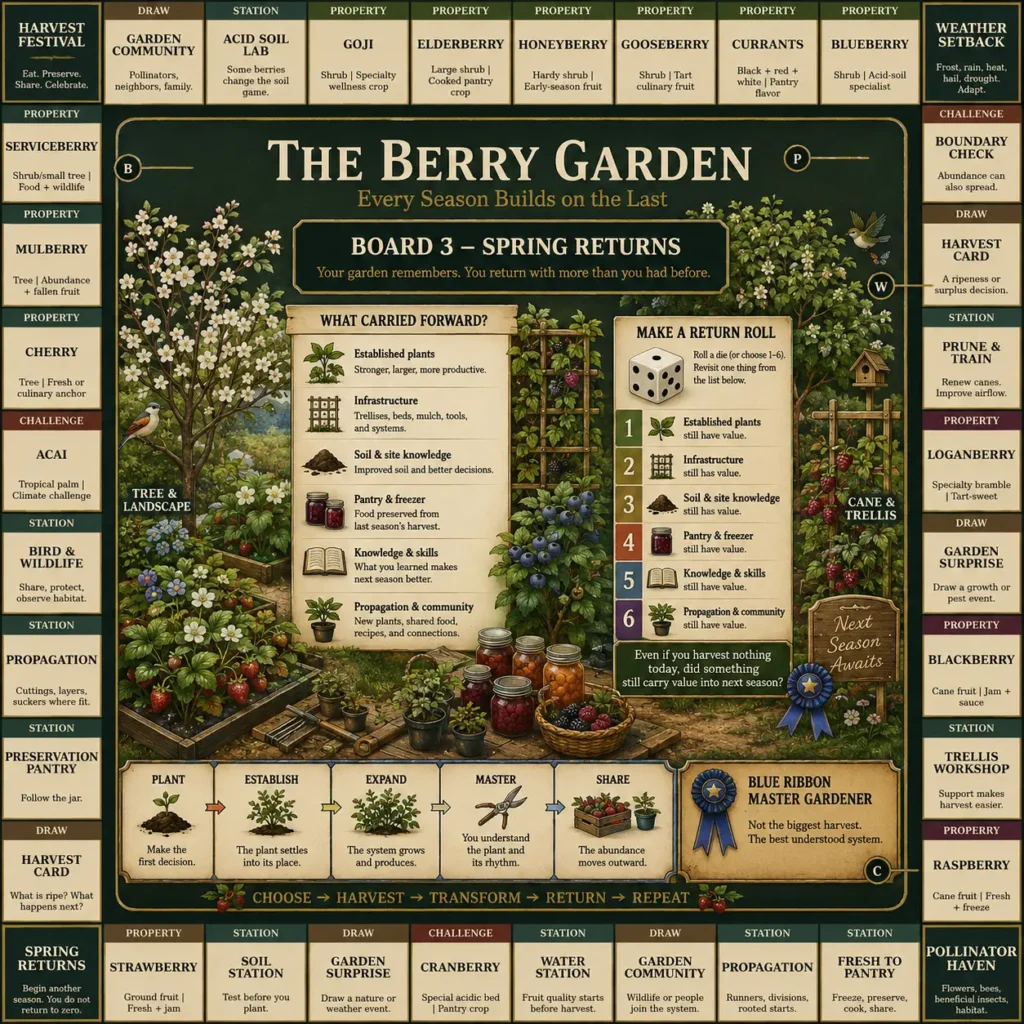
Spring Returns: What Carried Forward?
This is the final hint sheet in the first trip around the Berry Garden.
Instead of asking what you harvested, ask:
What still exists because I built this garden?
| What Carried Forward | What It Might Look Like | Why It Matters |
|---|---|---|
| Established plants | Strawberry crowns, rooted runners, berry shrubs, renewed canes, growing trees | The next season begins with living plants already in place |
| Infrastructure | Trellises, beds, edging, irrigation, mulch systems, protection structures | You do not have to rebuild every part of the garden from nothing |
| Improved soil and site knowledge | Organic matter, amended beds, drainage improvements, better understanding of pH and moisture | The site can become better matched to the crop |
| Preserved food | Frozen berries, jam, dried fruit, sauces, pantry products | Part of one season can continue feeding the household into another |
| Knowledge | Ripeness cues, pruning experience, bird pressure, weather patterns, timing | Even mistakes can become useful information |
| Propagation and community | Strawberry runners, cuttings, divided plants, shared recipes, gifted fruit, new gardeners | The system can expand beyond the original planting |
This is the part of the game that is easy to miss if you count only pounds of berries.
Some value is eaten.
Some value is frozen.
Some value remains rooted in the ground.
Some value becomes a trellis you will use again.
Some value becomes experience.
Some value leaves your property in the hands of somebody else.
Make a Return Roll
If you have a die nearby, roll it.
If not, just choose a number from 1 to 6.
Use the number to revisit one thing from the chart:
1 — Established plants
2 — Infrastructure
3 — Soil and site
4 — Pantry and freezer
5 — Knowledge
6 — Propagation and community
Now ask:
Would this still have value if I did not harvest another berry today?
That is a very different way of looking at a garden.
A trellis can still have value.
A rooted daughter plant can still have value.
A freezer full of blueberries can still have value.
Knowing exactly when your raspberries release from the cane can still have value.
Learning where the birds enter the patch can still have value.
And a neighbor who now wants to grow currants because they tasted yours represents something the scale cannot measure.
Look at Your Original Three Berries Again
At the beginning of the game, you chose three berries.
You chose them based on:
Climate → Soil → Space → Time → Kitchen
Now imagine those three plants after another trip around the board.
Ask yourself:
What is still alive?
What became easier?
What became harder?
What spread?
What needed boundaries?
What did the kitchen teach you?
What did you preserve?
What did wildlife teach you?
What would you change before the next spring?
And perhaps most importantly:
Would you still choose the same three berries?
If the answer changes, the game worked.
You did not fail the first decision.
You gained enough information to make a better second one.
The Returning Berry Patch
This is where perennial fruits become fundamentally different from a garden that must be completely rebuilt every season.
A strawberry patch can produce new daughter plants.
A raspberry planting can send up new canes.
A blueberry shrub can become larger and more established.
Currants and gooseberries can mature into permanent parts of the landscape.
Serviceberries, mulberries, and cherries can become structures in the garden rather than temporary occupants of it.
The important question is no longer only:
What can I harvest this year?
It becomes:
What can I plant now that may still be feeding me later?
That is the deeper value of a returning fruit system.
The first season may be heavy on planting, watering, mulching, pruning, observing, and learning.
Later seasons may bring better harvests.
Then preservation.
Then propagation.
Then traditions.
Not because every berry planting follows the same timeline.
It does not.
But because time allows something to happen that the first harvest alone cannot show you.
The system develops history.
Plant → Establish → Expand → Master → Share
That gives us another way to understand the properties on the board.
A berry planting can move through stages.
PLANT
You make the first decision.
ESTABLISH
The plant begins occupying the place you chose for it.
EXPAND
The patch, row, shrub, or system becomes more productive—or begins asking for more management.
MASTER
You understand when to prune, when to pick, what the plant needs, and what the harvest is best used for.
SHARE
The abundance moves outward: fruit, plants, recipes, skills, knowledge, or simply the experience of bringing somebody into the garden.
This is what the eventual blue ribbon on the game board should represent.
Not the gardener with the biggest pile of berries.
The gardener who understands the system.
The Blue Ribbon Question
Imagine two gardeners.
One harvests more berries.
The other harvests a little less—but knows exactly when they are ripe, freezes the surplus, manages the canes well, maintains healthy soil, shares daughter plants, attracts pollinators, and loses very little of the harvest through neglect.
Who has the better berry garden?
There is no score printed beside that question.
But by now, you probably understand why the answer is more complicated than:
Who picked the most fruit?
A garden can become more useful without simply becoming bigger.
That is one of the lessons hidden underneath the entire board.
Try the Final Berry Puzzle
Take one last look at the game before moving deeper into the field guide.
Can you identify:
1. Something the garden can carry into spring without being replanted.
2. Something you may build once and use through many harvests.
3. Something from summer that can still be feeding you in winter.
4. Something valuable that exists only because you made mistakes and paid attention.
5. Something from the garden that can leave your property and begin creating value somewhere else.
And now the hardest one:
6. What has become more valuable simply because you understand it better?
That answer may be a berry.
It may be the soil.
It may be the freezer.
It may be pruning.
It may be your own judgment.
The Four Moves of the Berry Garden
You have now made one complete trip around the board.
CHOOSE
Find the berry that fits your climate, soil, space, time, and kitchen.
HARVEST
Learn when the fruit is actually ready instead of relying on the calendar alone.
TRANSFORM
Decide what the harvest should become before abundance turns into waste.
RETURN
Notice what remains when the season comes around again.
That is the loop.
CHOOSE → HARVEST → TRANSFORM → RETURN
Then you go around again.
But never from exactly the same starting point.
You carry plants.
Infrastructure.
Food.
Knowledge.
Mistakes.
Skills.
Relationships.
And better questions.
That is why the most important space on the Berry Garden board may be the one you pass twice.
The season returns. Your garden does not return to zero.
How Berries Occupy the Garden
The Berry Garden Game organized the plants into neighborhoods for a reason.
Before you compare individual varieties, it helps to understand how each fruit wants to occupy space.
A strawberry and a mulberry may both give you fruit, but they are solving completely different garden problems.
One spreads close to the soil.
One may eventually become a tree.
One raspberry plant can become a row.
A blueberry may fit beautifully into a shrub border—but only if the soil fits the plant.
So before asking what a berry tastes like, ask:
What shape will this plant eventually take in my garden?
The Five Berry Garden Forms
| Garden Form | Berries to Explore | What the Space Must Provide | The First Management Question |
|---|---|---|---|
| Ground & Specialty Beds | Strawberry, Cranberry | Accessible planting area, appropriate soil and moisture, room for low growth | Will it spread, renew, or require a specialized bed? |
| Cane & Trellis | Raspberry, Blackberry, Loganberry | Sunny row, fence, trellis, or clearly defined edge | How will I support, prune, and contain the canes? |
| Shrub & Hedge | Blueberry, Currants, Gooseberry, Honeyberry/Haskap, Elderberry, Goji | Permanent shrub space with crop-appropriate soil, light, and spacing | What will this shrub need when it reaches mature size? |
| Tree & Landscape | Serviceberry, Mulberry, Cherry | Long-term placement with room for canopy, roots, harvest, and fallen fruit | Will I still like this plant in this location years from now? |
| Climate Challenge | Açaí | A climate capable of supporting the plant rather than simply a desire to grow the fruit | Does this plant belong in my growing environment at all? |
This is a more useful distinction than simply calling everything a berry.
Ground & Specialty Beds
Strawberries stay close to the ground.
They can occupy beds, raised beds, containers, hanging systems, and other small spaces. Their runners can also turn one planting into many plants, which means the edge of the patch eventually becomes a management decision.
Cranberries are also low-growing, but they teach a very different lesson.
Low-growing does not automatically mean easy to tuck into the ordinary garden.
A crop can occupy very little vertical space and still ask for a highly specific growing environment.
So even within the same physical layer, the site still matters.
A strawberry wants a patch.
A cranberry may ask you to build the patch around the plant.
Cane & Trellis Fruits
Raspberries, blackberries, and loganberries occupy space through canes.
That makes them fundamentally different from shrubs.
They renew.
They spread.
They lean.
They tangle.
And eventually they force the gardener to answer questions about pruning, support, access, and boundaries.
A productive cane fruit can be wonderful along a sunny fence precisely because the fence gives the plant somewhere useful to go.
Without a plan, the same growth can become a thicket.
A raspberry wants a row.
The row is not merely where the raspberries happen to be.
It is part of the management system.
Shrub & Hedge Fruits
Blueberries, currants, gooseberries, honeyberries, elderberries, and goji become more permanent pieces of garden structure.
That opens possibilities beyond a dedicated fruit patch.
They may become:
an edible hedge,
a pantry border,
part of an ornamental planting,
a wildlife edge,
or one layer in a larger food garden.
But shrubs ask you to think ahead.
The tiny plant at the nursery is not the plant you are designing around.
The mature plant is.
And each shrub brings its own requirements.
Blueberries make this particularly clear:
A blueberry wants acidic soil.
You cannot solve every plant problem simply by finding an empty place.
Sometimes the location must be able to provide the right environment.
Tree & Landscape Fruits
Serviceberries, mulberries, and cherries move the berry garden into another scale entirely.
They can become long-term landscape plants.
That means their value can grow—but so can the consequences of poor placement.
Think about:
shade,
mature size,
harvest access,
birds,
fallen fruit,
roots,
nearby structures,
paths,
patios,
and how the surrounding garden may change.
A mulberry planted beside a place where dropped fruit is welcome can be extraordinarily generous.
The same tree planted over a driveway may become something very different.
A mulberry wants the right place for a future tree.
Trees make you garden forward in time.
And Then There Is Açaí
Açaí earns its place in this guide because it exposes a mistake that gardeners can make long before they put a shovel in the ground.
Recognizing a fruit does not mean you can reasonably grow the plant.
Seeing it in recipes does not make it locally appropriate.
Finding it in a smoothie bowl does not change its climate requirements.
That is why Açaí remains our Climate Challenge property.
It forces the first filter back to the front:
Climate before curiosity.
Sometimes good gardening means learning that an interesting plant belongs on your plate—but not in your yard.
A Practical Note About the Word “Berry”
Botanically, the word berry means something more specific than it does in the kitchen.
Strawberries, raspberries, and blackberries, for example, are not true botanical berries.
Blueberries and currants are.
But that distinction is not the organizing principle of this guide.
The Gardening Chef question is more practical:
How does this fruit grow, where does it belong, and what will I do with the harvest?
That is why we group these plants primarily by the way a gardener must design around them.
Look at Your Garden Before You Look at the Nursery
Try this without naming a single berry.
Look around your own space and find:
one place that could support a low fruit crop,
one fence or edge that could support canes,
one area that could become a permanent shrub planting,
and
one place where a future tree could mature without becoming a problem.
You may not have all four.
That is useful information.
Because now the question is no longer:
Which berries do I want?
It becomes:
Which berry forms does my garden actually have room to support?
And once you know that, it is finally time to meet the plants themselves.
Meet the Berries & Small Fruits
Strawberries: The Gateway Fruit
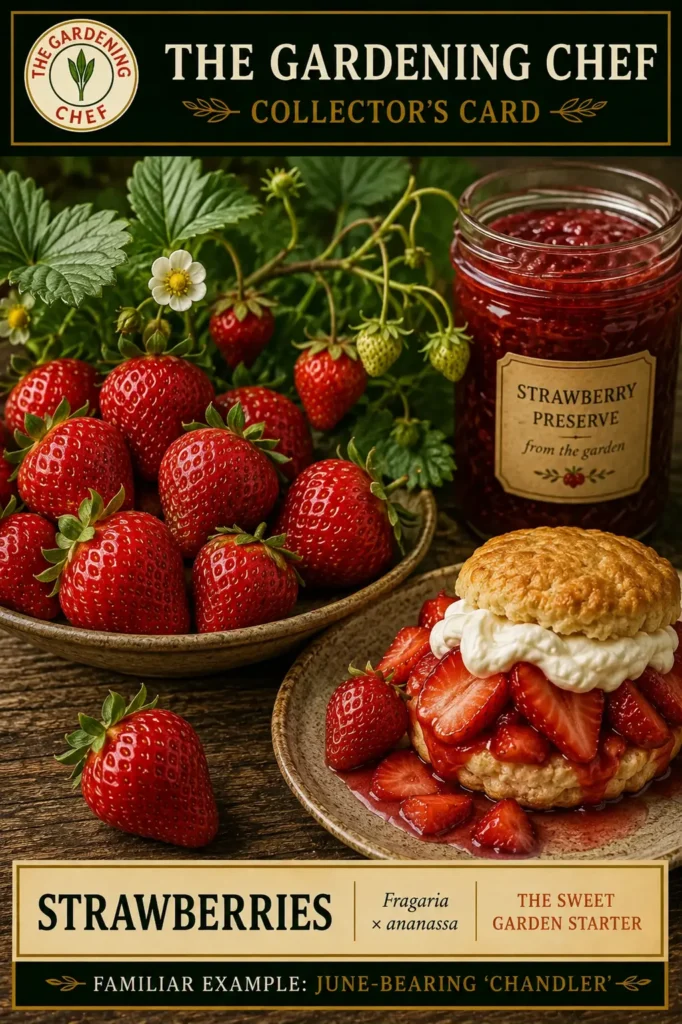
Strawberries are one of the easiest fruits to understand emotionally. You see a red berry beneath the leaves, pick it, eat it, and suddenly the idea of growing fruit at home makes sense.
But strawberries are more interesting than their familiarity suggests. They can teach ripeness, propagation, bed renewal, preservation, container growing, and the difference between fruit grown for shipping and fruit picked for flavor.
Strawberry Field Card
| Garden Fit | Beds, raised beds, containers, hanging systems, patios, and small gardens |
| Growth Habit | Low perennial crowns that can produce runners and daughter plants |
| Harvest Clue | Pick when fully colored, fragrant, and genuinely ripe |
| Kitchen Strength | Fresh eating, shortcake, breakfast, salads, sauces, jam, freezing, syrup |
| Watch For | Crowding, wandering runners, moisture problems, birds, slugs, overripe fruit |
| Why Grow It | Fast satisfaction in relatively little space with both fresh and preservation value |
What Makes Strawberries Different?
Strawberries can provide a relatively quick introduction to perennial fruit without requiring room for a shrub row or tree.
They also come in different fruiting patterns.
June-bearing strawberries concentrate much of their harvest into a major seasonal crop.
Everbearing types generally offer multiple flushes.
Day-neutral strawberries can produce across a longer part of the growing season when conditions cooperate.
That choice changes the rhythm of the garden.
A concentrated crop asks:
What am I going to do with all these strawberries?
A longer-producing crop asks:
How often do I want fresh strawberries coming from this space?
Neither is automatically better.
The right answer depends partly on your kitchen.
The Runner Is Both a Gift and a Question
A healthy strawberry may send out runners.
A runner can root and become another strawberry plant.
That sounds like free abundance.
Sometimes it is.
But if every daughter plant stays wherever it lands, the patch can become crowded, harder to harvest, and more difficult to manage.
So the runner creates a better question:
Do I actually want another plant here?
Propagation becomes useful when it supports the system you intended to build.
Pick for Flavor, Not Shelf Life
Strawberries are one of the clearest examples of Grocery vs. Garden Harvest Reality.
A berry intended for shipping has to survive picking, packing, transportation, refrigeration, display, and the trip home.
Your garden strawberry may travel only a few feet.
That means you can let the fruit ripen for your kitchen rather than the supply chain.
Color matters.
But so do fragrance, texture, and flavor.
This is one crop where waiting for true ripeness can show you why growing food is not only about replacing something you could buy.
You may be gaining access to a version of the fruit that is difficult to purchase at all.
The Strawberry Kitchen
The first berries may never reach the house.
That is perfectly reasonable.
Once the harvest becomes a bowl, strawberries move easily into shortcake, yogurt, oatmeal, salads, sauces, desserts, basil and mint pairings, freezing, or a tested jam or preserve.
The goal is not to preserve strawberries simply because preservation exists.
It is to decide what form will let you use the harvest well.
Honor the Harvest: eat the best berries at their best—and give the surplus another destination before it becomes waste.
The Strawberry Lesson
Strawberries compress a surprising number of garden lessons into a very small plant.
They teach you to watch closely, pick at the right moment, control abundance instead of merely encouraging it, propagate deliberately, use what ripens, and prepare for another season.
If Strawberry was one of the three properties you chose in the Berry Garden Game, ask:
Do I want a few strawberries—or do I want to build a strawberry system?
Blueberries: The Acid-Loving Long Game
Blueberries are among the most appealing backyard fruits, but they make one demand that can override almost everything else: the soil must fit the plant.
Give blueberries the environment they need and they can become long-lived shrubs that provide fruit, flowers, seasonal color, freezer value, and permanent garden structure. Ignore that environment and even a beautiful planting can spend years struggling.
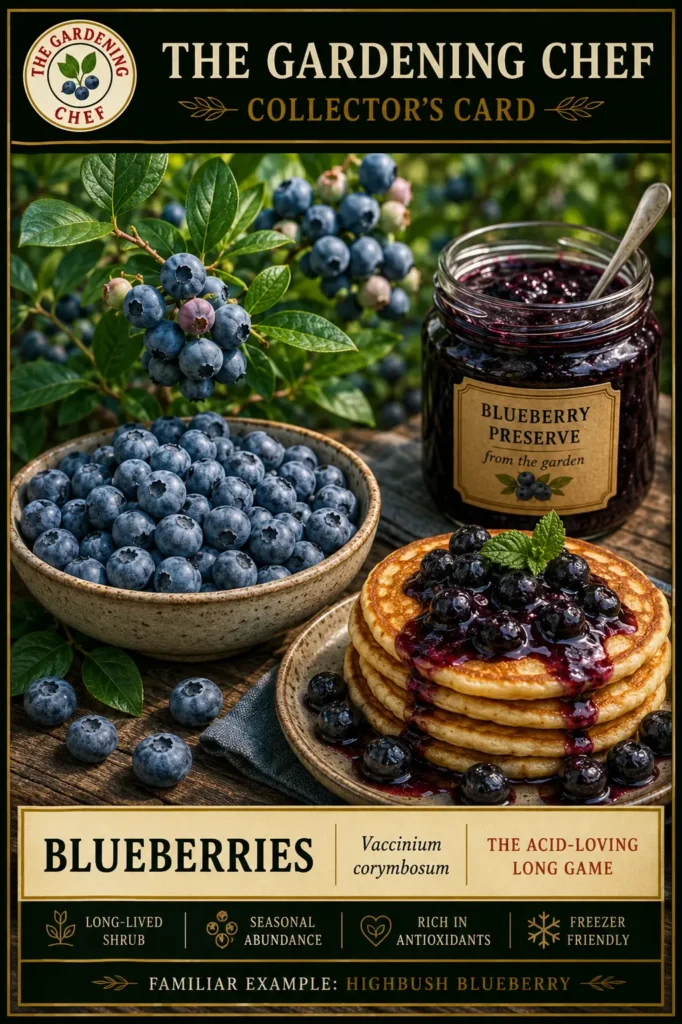
Blueberry Field Card
| Garden Fit | Dedicated berry beds, acidic shrub borders, edible hedges, and suitable large containers |
| Growth Habit | Long-lived woody shrub |
| Harvest Clue | Fully blue tells you to start checking; taste before stripping an entire cluster |
| Kitchen Strength | Fresh eating, breakfast, baking, sauces, freezing, smoothies |
| Watch For | Unsuitable soil pH, poor drainage, bird pressure, immature plants, cultivar fit |
| Why Grow It | Excellent fresh fruit combined with strong landscape, freezer, and long-term garden value |
The Soil Comes Before the Berry
Blueberries demonstrate one of the most useful rules in gardening:
The right plant in the wrong environment can still be the wrong plant.
They want a much more acidic root environment than most vegetables.
That means an empty space beside the tomatoes is not automatically a blueberry bed.
For some gardeners, the solution will be a dedicated acidic planting.
For others, it may be a large container where the root environment can be managed more deliberately.
And in some gardens, blueberries may simply require more intervention than another fruit would.
The important thing is discovering that before the shrub spends years telling you something is wrong.
This is one reason soil testing belongs near the beginning of the blueberry decision rather than after yellow leaves and weak growth appear.
The question is not merely:
Do I have room for a blueberry?
It is:
Can I create the root environment a blueberry needs in that space?
Blue Does Not Always Mean Finished
Blueberries also teach a surprisingly important harvest lesson.
A berry turning blue tells you:
Start paying attention.
It does not necessarily mean:
Pick the entire cluster immediately.
Fruit on the same plant may not ripen at exactly the same moment, and appearance can get ahead of peak flavor.
So taste.
Compare.
Notice.
Try a berry today and another from the same cluster later.
That tiny habit can teach you more about your particular plant than a calendar date ever will.
The gardener’s mouth is still one of the most useful harvest tools available.
Color tells you when to start checking. Flavor tells you when the berry has earned the basket.
The Blueberry Freezer
This may be one of blueberries’ greatest practical advantages.
A large harvest does not immediately force you into a complicated kitchen project.
You can eat some fresh.
Bake with some.
And freeze the surplus.
Tray-freezing allows the berries to freeze separately before they are transferred to bags or containers, which makes it possible to remove only what you need later.
Then a summer crop can quietly become:
winter pancakes,
muffins,
oatmeal,
smoothies,
yogurt,
sauces,
or a handful added to breakfast.
There is an important lesson hiding in that simplicity.
Preservation does not have to be elaborate to be valuable.
Sometimes the best preservation method is the one easy enough that you actually use it.
The freezer can turn a short harvest window into months of possibilities.
The Blueberry as Landscape
Blueberries also challenge the assumption that food plants need to live in a separate vegetable garden.
A well-placed blueberry shrub can become part of the landscape.
It flowers.
It fruits.
It provides seasonal foliage.
Pollinators visit the blooms.
Birds notice the fruit.
And the gardener gets food from a plant that can still look intentional beside other shrubs and perennials.
That makes blueberries particularly interesting for someone who does not have room—or desire—for a traditional berry patch.
A hedge can produce.
A border can produce.
A carefully managed container can produce.
The edible landscape becomes more powerful when the food plant does not feel like a compromise.
The Blueberry Bird Question
Of course, the moment the berries become valuable to you, they may become valuable to something else.
Birds can discover blueberries quickly.
That creates a choice.
Do you share?
Protect the entire crop?
Protect only part of it?
Plant enough that some loss is acceptable?
Harvest more frequently as ripening begins?
There is no universal answer.
But there is a better way of thinking about the problem:
Decide how much of the harvest you actually want before the birds make the decision for you.
That is stewardship rather than reaction.
The Blueberry Long Game
Strawberries can give a relatively fast sense of reward.
Blueberries ask for a different relationship with time.
The young shrub you plant is not the finished system.
It needs to establish.
Grow.
Branch.
Teach you how your soil behaves.
Show you where water collects.
Reveal where birds enter.
Gradually become something larger than the plant you brought home.
That slower development is not automatically a disadvantage.
It is part of what makes blueberries such a strong example of a returning fruit system.
Each season can begin with more plant, more knowledge, and more infrastructure than the season before.
The Blueberry Lesson
Blueberries reward preparation more than impulse.
Before asking:
Which blueberry should I buy?
ask:
Have I created a place where a blueberry can succeed?
If the answer is yes, the plant can become more than a seasonal crop.
It can become part of the garden’s permanent structure.
And if Blueberry was one of your original three Berry Garden properties, ask yourself one more question:
Am I choosing the berry because I love blueberries—or because my garden is actually ready to grow them well?
That distinction is where the long game begins.
Raspberries: The High-Value Cane Crop
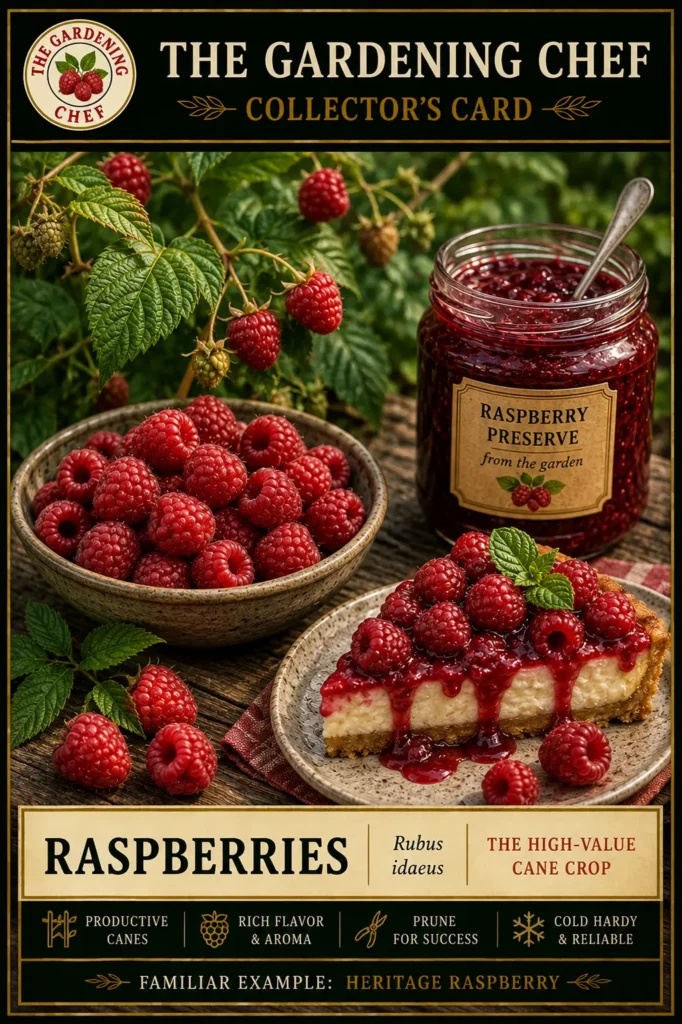
Raspberries are one of the great rewards of growing fruit at home because their fragility becomes an advantage when the kitchen is only a few steps from the cane.
But raspberries ask the gardener to understand the plant as well as the fruit. Canes renew, old growth must eventually leave, new shoots appear where you may not expect them, and a productive row can become either a beautifully managed system or a slowly expanding thicket.
Raspberry Field Card
| Garden Fit | Sunny rows, fences, trellises, dedicated cane-fruit beds, and productive garden edges |
| Growth Habit | Perennial root system producing renewing canes that may spread through suckers |
| Harvest Clue | Fully colored fruit that releases easily with a gentle pull |
| Kitchen Strength | Fresh eating, freezing, jam, sauces, baking, desserts, syrups, shrubs |
| Watch For | Wandering shoots, tangled canes, pruning mistakes, overripe fruit, poor airflow |
| Why Grow It | Exceptional fresh flavor combined with high garden value, strong preservation potential, and recurring production |
Understand the Cane Before the Crop
Raspberries become much easier to understand once you stop looking at the planting as one permanent mass of stems.
The root system persists.
The canes change.
Depending on the raspberry type, the timing of fruiting changes too.
Summer-bearing raspberries generally produce their main crop on second-year canes.
Primocane-bearing raspberries, often sold as fall-bearing types, can produce fruit on first-year canes.
That distinction affects pruning.
It also affects harvest timing and how you manage the row.
So before buying a raspberry simply because the fruit looks appealing, ask:
What kind of cane cycle am I agreeing to manage?
That may sound technical at first.
After one or two seasons, it becomes one of the most useful things you know about the plant.
The Best Raspberry May Never Reach the Kitchen
Raspberries expose one of the great advantages of growing food close to where you eat it.
They are delicate.
Perfectly ripe fruit does not need to survive a packing line, truck, warehouse, grocery display, refrigerator, and ride home.
Your raspberry may travel twenty feet.
That gives you permission to harvest for a completely different goal:
flavor.
When ripe, a raspberry should reach its mature color and release from the plant with very little persuasion.
You should not need to wrestle with it.
The fruit itself tells you something.
If the raspberry wants to stay on the cane, it may be asking for more time.
This is why the best raspberry harvest tool may simply be your fingertips.
The Row Needs Boundaries
Raspberries can spread.
That can feel wonderful at first.
A shoot appears nearby.
Then another.
The planting seems to be multiplying without another trip to the nursery.
But abundance creates a second question:
Where is the raspberry row supposed to end?
A sucker inside the intended row may be useful renewal.
A sucker three feet into a pathway may be work.
The biology did not change.
The location did.
That is why a raspberry planting benefits from some kind of deliberate boundary: a maintained row, mowed edge, path, trellis line, or another system that makes the intended footprint obvious.
The goal is not to stop raspberries from behaving like raspberries.
It is to give that behavior somewhere useful to happen.
A raspberry wants a row.
And the row is part of the crop.
Pruning Is Renewal, Not Punishment
Pruning raspberries can feel destructive when you are new to cane fruit.
You spent all season helping the plant grow.
Then someone tells you to start removing canes.
But raspberries teach a different way of looking at pruning.
The goal is not simply to make the plant smaller.
It is to help the planting renew intelligently.
Old, damaged, diseased, poorly positioned, or no-longer-useful canes can interfere with new growth, airflow, access, and harvest.
Correct pruning depends on the raspberry type you are growing, which is another reason to know whether you are managing summer-bearing or primocane-bearing plants.
The deeper lesson is simple:
Not everything that grew needs to remain.
Sometimes removal is what allows the productive part of a perennial system to continue.
The Raspberry Kitchen
The first destination is obvious.
Eat them.
A fully ripe raspberry close to the cane is one of the strongest arguments for growing fruit at home.
But the moment the harvest becomes larger than a handful, raspberries become extremely versatile.
They can move into:
jam,
sauces,
yogurt,
oatmeal,
baking,
desserts,
syrups,
vinegar shrubs,
or the freezer.
Raspberry also pairs naturally with chocolate, lemon, vanilla, cream, mint, almonds, and stone fruits.
And because the fruit is delicate, freezing becomes especially useful.
If you do not have time to turn a large harvest into jam today, you do not need to sacrifice the fruit while waiting for a better weekend.
Freeze it.
Preserve the possibility first.
Decide the final destination later.
Fragility Can Be an Advantage
At the grocery store, fragility is a problem.
In a backyard fruit system, fragility can signal opportunity.
The raspberry does not need to become tougher simply because modern distribution systems reward tougher fruit.
You can build the system around the berry instead.
Harvest frequently.
Handle gently.
Cool or use the fruit promptly.
Freeze the surplus.
And enjoy something the long supply chain has difficulty delivering:
fruit chosen at the moment you want to eat it.
That reframes the raspberry’s weakness.
What makes a berry difficult to ship can make it extraordinary to grow.
The Raspberry Lesson
Raspberries teach that recurring abundance still requires structure.
The root system returns.
New canes appear.
The row can expand.
Fruit comes again.
But the gardener still has to decide:
what stays,
what leaves,
where the row ends,
when the fruit is ready,
and what happens to the surplus.
If Raspberry was one of the three properties you chose in the Berry Garden Game, ask:
Do I want a raspberry plant—or am I prepared to manage a raspberry row?
That is the difference between simply owning the crop and building the system.
Blackberries: The Bold Bramble
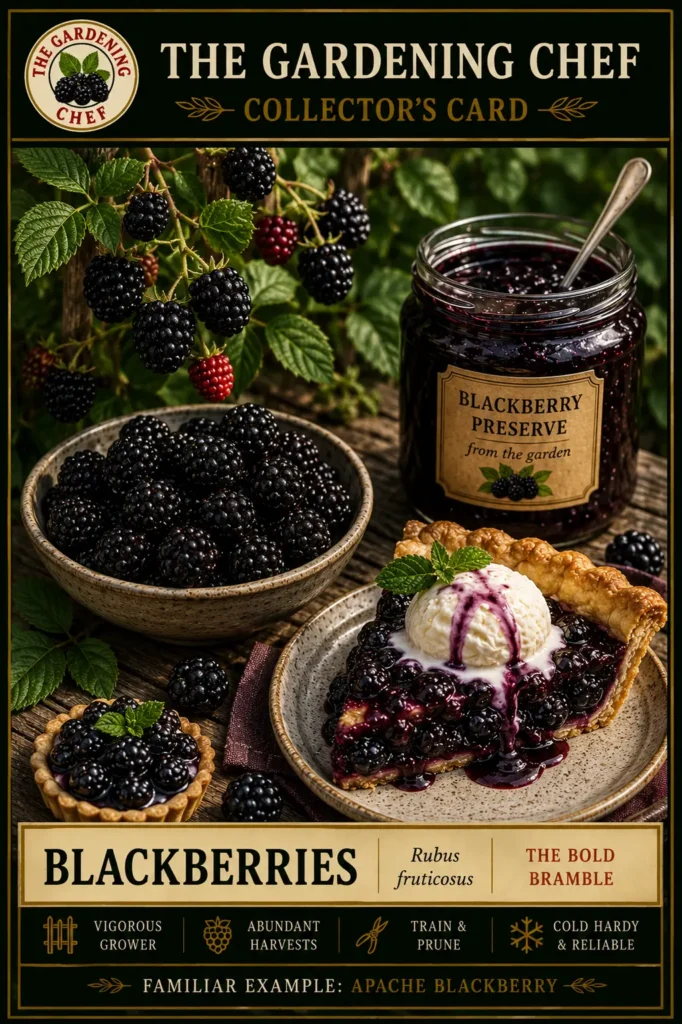
Blackberries are built for abundance. Give them sun, room, and a structure to grow against, and a few canes can become one of the most productive fruit plantings in the garden.
But that generosity comes with a condition: you need to decide where the bramble belongs before the bramble decides for you. Training, pruning, harvest access, and boundaries are not chores added to the blackberry system. They are part of the system itself.
Blackberry Field Card
| Garden Fit | Sunny fence lines, trellises, dedicated bramble rows, productive edges, and larger garden borders |
| Growth Habit | Perennial root system producing vigorous fruiting canes; habit varies from erect to semi-erect or trailing |
| Harvest Clue | Fully black, plump fruit that releases easily and tastes rich rather than sharply tart |
| Kitchen Strength | Fresh eating, cobblers, pies, jam, sauces, freezing, syrups, shrubs, savory reductions |
| Watch For | Tangled growth, thorny canes, poor pruning, wandering shoots, overripe fruit, difficult harvest access |
| Why Grow It | Heavy production, bold flavor, strong preservation value, and excellent use of fences and garden edges |
Structure Comes Before the Harvest
Blackberries can look simple when they are small.
A cane.
A few leaves.
A plant tucked beside a fence.
Then the plant begins doing what blackberries do.
It grows.
Branches.
Leans.
Produces new canes.
And suddenly the structure around the plant matters almost as much as the plant itself.
Some blackberry cultivars grow more upright.
Others arch.
Some trail enough that support becomes essential.
That means the question is not simply:
Where can I plant a blackberry?
It is:
Where can I comfortably train, prune, inspect, and harvest this plant when it becomes much larger?
A fence line or trellis can turn that vigor into an advantage.
Instead of fighting the cane, you give it a useful direction.
The support is not decoration. It is part of the crop.
Black Is Not Always the Finish Line
Blackberries teach one of the easiest harvest mistakes to make.
You see a black berry.
You assume:
Ready.
But color is only the beginning of the decision.
A blackberry can turn dark before it reaches its best combination of sweetness, richness, and softness.
So use more than your eyes.
Look for fully developed fruit.
Notice how it feels.
Give it a gentle pull.
Taste one.
A truly ripe blackberry should not require a struggle to leave the plant.
And the flavor should have moved beyond sharp tartness into something deeper and more rounded.
Black tells you to check. Flavor and release tell you to pick.
That distinction becomes especially important when a whole section of the bramble seems to darken at once.
Do not strip the plant simply because everything looks finished from ten feet away.
Thornless Changes the Relationship
Older blackberries earned part of their reputation from thorns.
A productive patch could become a place you approached carefully.
Modern thornless cultivars can change that relationship considerably.
That does not mean every thornless blackberry is automatically the right plant for every climate or garden.
Cultivar still matters.
Growth habit still matters.
Disease resistance still matters.
Winter hardiness still matters.
But removing thorns from the equation can make harvesting, pruning, training, and family access much easier.
That can change where the plant belongs.
A thorny blackberry may be perfectly reasonable along a distant property edge.
A thornless blackberry may be much easier to imagine beside a frequently used garden path or trellis.
This is a useful reminder that plant selection is not only about flavor.
Sometimes a cultivar changes the experience of managing the crop.
The Blackberry Kitchen
Blackberries have one of the broadest culinary personalities in the berry garden.
They can be eaten fresh when fully ripe.
But they are especially powerful when heat concentrates their dark fruit character.
Think:
cobblers,
pies,
crisps,
jam,
syrups,
sauces,
vinegar shrubs,
frozen fruit,
and reductions.
Blackberry also moves into savory cooking surprisingly well.
Its sweetness and acidity can work with pork, duck, venison, pepper, thyme, rosemary, vinegar, mustard, and red wine.
That makes blackberry different from a fruit that exists mainly for snacking.
A bowl can become dessert.
A freezer bag can become winter baking.
A jar can become breakfast.
A sauce can cross completely out of the dessert kitchen.
The darker the berry, the more interesting the question may become: sweet—or savory?
Preserve the Bumper Crop Before It Becomes the Problem
A good blackberry planting can produce quickly enough that the kitchen becomes part of the harvest plan.
The first handful disappears.
The first bowl becomes dessert.
Then the baskets begin arriving.
At that point, freezing becomes one of the simplest tools available.
You do not need to turn every blackberry into jam on harvest day.
Freeze good fruit while it is still good.
Then decide later whether it becomes:
a cobbler,
smoothie,
sauce,
pie,
jam,
or winter breakfast.
This is the same principle we used with raspberries, but blackberries add another lesson:
high production rewards preparation.
If you know a mature planting can overwhelm today’s appetite, give the harvest somewhere to go before it arrives.
When Abundance Becomes a Thicket
Blackberries can be extraordinarily generous.
That generosity is exactly why management matters.
A cane that arches into the path makes harvest harder.
A patch with no clear center becomes difficult to prune.
Old growth mixed with new growth can reduce airflow and access.
A planting that expands beyond its intended footprint can turn a productive crop into another maintenance problem.
This does not mean vigor is bad.
It means vigor needs architecture.
A useful blackberry system has:
a place,
a boundary,
a support,
an access path,
and a pruning rhythm.
Then the same biological energy that could create a tangled thicket becomes organized production.
Abundance becomes valuable when you can still reach it.
The Blackberry Lesson
Blackberries teach the difference between growing vigorously and growing usefully.
A huge bramble is not automatically a better bramble.
The better system is the one you can train, prune, harvest, preserve, and live beside comfortably.
If Blackberry was one of the three properties you chose in the Berry Garden Game, ask:
Am I choosing a blackberry because I want the fruit—or have I also chosen where the future bramble will live?
Because with blackberries, the plant you bring home is only the beginning.
The real crop is the productive structure you build around it.
Gooseberries: Tartness Is a Tool
Gooseberries are one of those fruits that can make a gardener stop and ask, “What is that?” The translucent green, pink, red, or purple fruits hang from a compact shrub and can look almost like tiny striped lanterns beneath the leaves.
Their greatest surprise may come in the kitchen. Gooseberries do not need to compete with strawberries for sweetness. Their acidity is their strength, giving pies, preserves, sauces, and desserts the kind of brightness that makes rich food taste better.
Gooseberry Field Card
| Garden Fit | Shrub borders, dedicated berry beds, edible landscapes, cottage gardens, and preservation-focused plantings |
| Growth Habit | Deciduous Ribes shrub; many cultivars have thorny stems |
| Harvest Clue | Fruit reaches full size and develops its mature color; ripeness and intended kitchen use determine when to pick |
| Kitchen Strength | Pies, tarts, crumbles, jam, preserves, sauces, chutneys, desserts, and some fresh eating |
| Watch For | Thorns, harvesting access, mildew and other local disease pressure, birds, and regional Ribes guidance |
| Why Grow It | Distinctive tart flavor, strong preservation value, compact shrub form, and a fruit difficult to replace with ordinary supermarket berries |
Meet the Fruit Before You Judge It
If you did not grow up around gooseberries, the fruit can be unfamiliar.
The berries may be green, yellow-green, pink, red, or deeper purple depending on the cultivar and stage of ripeness.
Some have visible pale veins or stripes beneath a somewhat translucent skin.
They grow on shrubs rather than canes, often tucked beneath leaves where the branches—and sometimes thorns—make the harvest feel more deliberate than picking blueberries.
The important thing is not to assume that every gooseberry is supposed to look or taste exactly the same.
Cultivar matters.
Ripeness matters.
And most importantly:
destination matters.
A gooseberry intended for pie may be useful at a different stage than one you hope to eat fresh.
That makes this fruit particularly interesting for the Gardening Chef.
You do not choose ripeness only by asking, “Is it ready?” You also ask, “Ready for what?”
Tartness Is Not a Defect
Modern fruit shopping can train us to think sweetness is the primary measure of quality.
Gooseberries challenge that assumption.
Their acidity can be exactly what makes them useful.
Think about what lemon does in a dish.
It brightens.
Balances.
Cuts richness.
Makes sweetness taste cleaner.
Gooseberries can play a similar role.
In a pie or crumble, their tartness pushes against sugar, pastry, custard, or cream.
In a sauce or chutney, acidity can balance richer foods.
In preserves, their distinctive character survives cooking rather than disappearing into generic sweetness.
That gives us the central lesson of this crop:
Tartness is not something the kitchen always needs to remove. Sometimes tartness is the tool.
Ripeness Changes the Job
Gooseberries are especially useful for understanding the relationship between ripeness and culinary purpose.
Less-ripe fruit is generally firmer and more tart.
As the fruit matures, it can soften, deepen in color, and develop more sweetness and complexity.
That means you may encounter two gardeners harvesting the same crop at different stages—and both may be correct.
One may want tart fruit for cooking.
Another may be waiting for fuller ripeness for fresh eating.
So instead of using one universal harvest rule, taste the fruit and think about its destination.
Ask:
Pie?
Jam?
Sauce?
Fresh eating?
The kitchen can influence the harvest decision before the berry ever leaves the shrub.
That is one of the most useful connections between gardening and cooking in this entire field guide.
The Thorn Changes Where the Shrub Belongs
Many gooseberries have thorns.
That does not make them bad garden plants.
But it does make placement more important.
A thorny shrub beside a narrow walkway is a different experience from the same shrub at the back of a productive border where you can approach it intentionally at harvest time.
Think ahead about:
harvest access,
children,
pets,
paths,
pruning,
and how close you want to work around the plant.
There are cultivars with reduced thorniness, so this is also another example of why cultivar selection changes more than flavor.
It can change how comfortably a plant fits into everyday life.
A productive plant should fit the gardener as well as the garden.
The Gooseberry Kitchen
This is where gooseberries become much more interesting than their relative obscurity suggests.
Their traditional strengths include:
pies,
tarts,
crumbles,
jam,
preserves,
compotes,
sauces,
and chutneys.
They also pair naturally with ingredients that soften or contrast their acidity:
cream,
custard,
vanilla,
ginger,
rich pastry,
and other sweet dairy preparations.
But gooseberries do not need to stay exclusively in dessert.
Their sharpness can also be useful alongside richer savory foods.
That is the Chef’s reason to pay attention.
You are not simply growing another sweet berry.
You are growing acidity.
And acidity is one of the fundamental tools used to create balance in cooking.
A gardener who understands that begins looking at the shrub differently.
Gooseberries Belong in the Pantry Conversation
Gooseberries also make more sense when you stop judging every fruit by how quickly it disappears from a fresh-fruit bowl.
Some crops earn their place because of what they become.
A basket of strawberries may disappear on the walk inside.
A bowl of blueberries may become breakfast.
A gooseberry harvest may be asking for a pie pan, preserving pot, freezer container, or sauce.
That is not a weakness.
It is specialization.
A fruit that becomes exceptional after cooking can be just as useful as one that is exceptional eaten raw.
Some berries are snacks. Some berries are ingredients. Gooseberries can be extraordinary ingredients.
That makes them particularly valuable in a garden connected to a serious kitchen.
Know the Ribes Question Before You Plant
Gooseberries belong to the genus Ribes, along with currants.
That matters because Ribes plants have a historical connection with white pine blister rust, and regulations or planting recommendations have varied by location and cultivar.
This is not a reason to automatically avoid gooseberries.
It is a reason to check before buying.
Your local Extension service or state agriculture guidance can tell you whether there are current restrictions, resistant-cultivar recommendations, or other considerations where you live.
This is exactly the kind of question that belongs in the Climate → Soil → Space → Time → Kitchen decision process.
The plant may fit the space.
The kitchen may love the fruit.
But local suitability still comes first.
A good garden decision includes the rules and ecology of the place where the garden actually exists.
The Gooseberry Lesson
Gooseberries teach us not to confuse familiarity with usefulness.
A fruit can be uncommon in the grocery store and still deserve a place in the garden.
It can be tart and still be delicious.
It can require cooking and still be valuable.
It can have thorns and still fit beautifully when placed thoughtfully.
And it can become much more interesting once the gardener understands what the kitchen can do with it.
If Gooseberry was one of the three properties you chose in the Berry Garden Game, ask:
Am I choosing fruit only for the way it tastes from my hand—or also for what it can become in my kitchen?
Because gooseberries reveal a larger truth about growing food:
sometimes the ingredient you did not know you needed is the one that teaches you the most.
Currants: Jewel Fruits for the Pantry
Currants hang from the shrub in translucent clusters that look almost ornamental—ruby red, pearl-white, or nearly black—but their real power is concentrated flavor. These are not simply miniature grapes or tiny blueberries. They bring a bright, sharp intensity that can transform jelly, syrup, sauces, baking, desserts, and preserves.
And “currant” does not describe just one kitchen experience. Red, white, and black currants may grow in similar-looking clusters, but once they reach the kitchen, they can behave like three different ingredients.
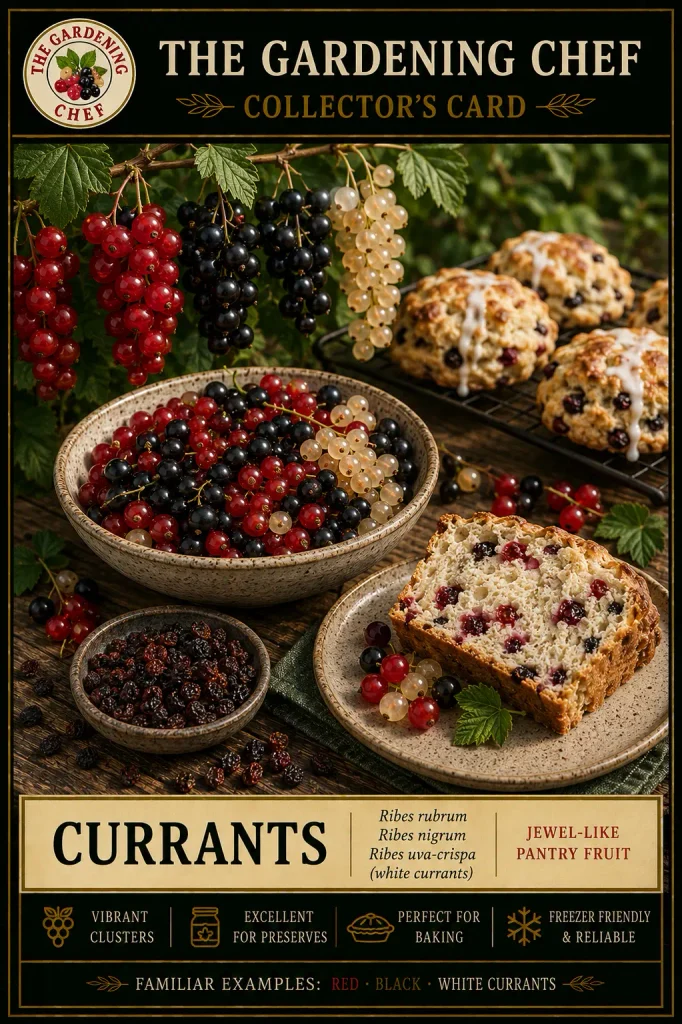
Currant Field Card
| Garden Fit | Shrub borders, edible hedges, dedicated berry beds, cottage gardens, pantry gardens, and productive landscape edges |
| Growth Habit | Deciduous woody Ribes shrubs; red and white currants belong to the red-currant group, while black currants are a distinct species |
| Harvest Clue | Clusters develop their mature color and berries become plump and juicy; intended kitchen use can influence harvest timing |
| Kitchen Strength | Jelly, jam, syrup, cordial, sauces, baking, desserts, garnishes, freezing, and savory pairings |
| Watch For | Bird pressure, local disease issues, pruning and airflow, and regional Ribes planting guidance |
| Why Grow It | Enormous flavor from a relatively compact shrub, excellent preservation potential, and fruit that can be difficult to find fresh in ordinary markets |
Three Colors, Three Kitchen Personalities
It is tempting to treat red, white, and black currants as interchangeable.
Do not.
Their similarities may be obvious in the garden.
Their differences become clearer in the kitchen.
Red currants are bright, tart, and visually striking.
Their translucent red berries make beautiful jelly, sauces, glazes, desserts, garnishes, and fruit combinations where you want acidity as well as color.
White currants are pale-fruited forms of the red-currant group.
They are often described as milder and less aggressively tart than red currants, which can make them particularly interesting for fresh eating, desserts, baking, and delicate preserves.
Then there are black currants.
Black currants have a much more assertive aroma and flavor.
They can be deep, tart, earthy, floral, and almost resinous depending on cultivar and ripeness.
That intensity makes them extraordinary for:
syrups,
cordials,
jam,
sauces,
desserts,
and concentrated fruit preparations.
So the useful question is not simply:
Do I want to grow currants?
It is:
Which currant belongs in the kind of kitchen I actually use?
Small Fruit Can Carry Enormous Flavor
Currants demonstrate that size tells you almost nothing about culinary importance.
A strawberry can dominate a plate through size and sweetness.
A currant does something different.
It concentrates.
Acid.
Color.
Aroma.
Fruit character.
That means you may need relatively little fruit to noticeably change a dish.
A spoonful of currant sauce can sharpen something rich.
A handful can transform a baked dessert.
A concentrated syrup can flavor an entire drink.
A jar of jelly can carry an intensity that would be difficult to achieve with a milder fruit.
That is why currants deserve the phrase:
pantry fruit.
Their value is not measured only by how many berries you can eat while standing beside the shrub.
Their value often appears after the fruit enters the kitchen.
Harvest the Cluster, Then Decide the Destination
Currants also teach a different style of harvesting.
The fruit grows in hanging clusters—often called strigs or racemes—rather than as isolated berries scattered across the shrub.
That changes how you see the crop.
Instead of asking whether one berry is ripe, you begin looking at the development of the cluster.
Has it reached mature color?
Are the berries plump?
What does one taste like?
Where is this harvest going?
A cluster headed toward fresh eating may deserve a different judgment from one destined for jelly or sauce.
And because ripe currants can be delicate, harvesting the cluster first and removing individual berries afterward can often be more practical than trying to pluck each fruit separately from the shrub.
This is another example of a larger Gardening Chef principle:
Harvest technique should fit what you intend to do with the food.
One Important Currant Naming Trap
There is a culinary detail worth learning because even experienced cooks can get caught by it.
Walk into an American grocery store and buy a box labeled:
dried currants
and you may not be buying currants from a Ribes shrub at all.
The small dark fruits commonly sold for baking as Zante currants are actually tiny dried grapes.
They belong to the grape family.
True red, white, and black currants are Ribes.
That does not mean true currants cannot be dried.
They can.
But when an old cake, bread, scone, stuffing, or baking recipe simply asks for dried currants, check what ingredient the recipe actually means.
This distinction is especially useful for a gardener.
The currant in your garden and the “currant” in a box of baking fruit may be two completely different plants.
That is exactly the kind of small piece of knowledge that turns a recipe follower into a more informed cook.
The Currant Kitchen
Currants come alive when you stop forcing them into the role of ordinary snacking fruit.
Red currants can become:
jelly,
glazes,
fruit sauces,
tarts,
cakes,
dessert garnishes,
and sharp accompaniments to rich foods.
White currants can be beautiful fresh, folded into desserts, baked, preserved, or used anywhere their more delicate color and flavor can remain visible.
Black currants belong in a more intense category.
Think:
jam,
syrup,
cordial,
fruit sauces,
desserts,
and deeply flavored preparations where a small amount of fruit can carry the dish.
Currants also have an important savory side.
Their acidity makes them useful beside rich meat, cheese, pâté-style preparations, roasted foods, and sauces where sweetness alone would become heavy.
The purpose is not necessarily to make the dish taste like dessert.
The fruit can function almost like another acid.
That gives currants a culinary role similar to the lesson gooseberries just taught us—but with a different personality.
Gooseberry says:
Use tartness.
Currant says:
Concentrate it.
The Jelly Makes Sense Once You Taste the Fruit
Currant jelly is not an accident of tradition.
Taste a tart currant and the logic starts becoming obvious.
Sugar softens the acidity.
Cooking concentrates the fruit.
The finished jelly captures color, aroma, and sharpness in something that can be spread, glazed, spooned, or used as the beginning of a sauce.
That does not mean every currant harvest belongs in a preserving kettle.
But it explains why currants remained valuable in kitchens long before most modern gardeners encountered them.
The fruit solves a problem.
It provides concentrated acidity and fruit flavor that can be stored and used later.
A jar on the pantry shelf may ultimately be more useful than the same quantity of berries sitting in a bowl.
Preservation is not always what happens to excess fruit. Sometimes preservation is the reason to grow the fruit.
That is especially true for pantry crops like currants.
A Shrub Can Be Part of the Landscape
Currants also offer something the large cane fruits cannot.
They remain shrubs.
That gives the gardener another design option.
A currant can potentially become part of:
an edible hedge,
a perennial border,
a fruit garden,
a cottage planting,
or a mixed edible landscape.
The plant does not need to occupy the same kind of trellis system as raspberry or blackberry.
But permanent placement still deserves thought.
Ask:
Can I harvest around it?
Can I prune it?
Will it have airflow?
Will nearby plants eventually crowd it?
Can birds access the fruit—and if they do, am I willing to share?
The small nursery shrub is temporary.
The space you choose for the mature plant is the real decision.
Know the Ribes Question
If the last profile was Gooseberry, this issue should sound familiar.
Currants and gooseberries both belong to the genus Ribes.
Historically, Ribes species became important in the story of white pine blister rust, because they can act as alternate hosts in the disease cycle.
That history led to restrictions, cultivar recommendations, and planting rules that have changed over time and can differ by location.
So do not rely on a decades-old gardening book—or another gardener several states away—to determine what applies where you live.
Check current state or local Extension guidance.
The useful lesson is larger than currants:
A plant can fit your kitchen and still require one more local question before it fits your garden.
That is why the first filter remains:
Climate and place before enthusiasm.
The Currant Lesson
Currants teach us that a crop does not need to dominate the fruit bowl to deserve garden space.
Some plants earn their place through concentration.
A few clusters can become a sauce.
A larger harvest can become jelly.
Black currants can become intensely flavored syrup or cordial.
Red currants can bring acidity and brilliant color to desserts and savory foods.
White currants can offer a more delicate version of the same fruit family.
The shrub becomes more useful as your understanding of the ingredient grows.
If Currant was one of the three properties you chose in the Berry Garden Game, ask:
Am I judging this fruit by how much I want to snack on—or by everything it could help me make?
Because the currant demonstrates one of the most important lessons in a garden connected to a kitchen:
sometimes the smallest harvest carries the biggest flavor.
Honeyberries: The Cold-Climate Early Bird
Honeyberries, also called haskaps, are among the earliest fruits to ripen in many cold-climate gardens.
Their flavor is often described as a mix of blueberry, raspberry, and tart grape, though it varies by variety.
They are hardy shrubs and can be a strong choice for gardeners in colder regions where other fruits struggle. They usually require more than one compatible variety for good pollination, so planning matters.
Honeyberries shine because of timing.
They can ripen before blueberries, giving the garden an early fruit harvest.
They are useful fresh, in jams, smoothies, sauces, and freezing.
Best Uses:
Fresh eating, smoothies, jams, sauces, freezing.
Garden Role:
Early-season fruit, cold-hardy shrub, niche berry crop.
Kitchen Lesson:
Use honeyberries where you would use tart blueberries, but expect more variation in flavor.
Wealth Garden Lesson:
Timing can be as valuable as volume.
Elderberries: The Cooked Pantry Fruit
Elderberries are powerful, useful, and deserving of respect.
They grow as large shrubs and can produce heavy clusters of dark berries. They are widely used for syrups, jams, wines, and cooked preparations.
The important safety note is that elderberries should be properly prepared before use. University of Minnesota Extension warns that raw or improperly prepared elderberries and plant parts can cause digestive symptoms, and that cooking significantly reduces the risk.
Do not treat elderberries like casual fresh-eating berries.
Remove berries from stems carefully.
Do not consume stems, leaves, or unripe parts.
Cook berries thoroughly when making traditional preparations such as syrups, jams, and reductions.
Elderberries are pantry berries.
Their value appears in syrups, cooked preserves, reductions, and wellness-style preparations.
They also serve wildlife and pollinators beautifully. Elderflowers are used in some culinary traditions, but they also require correct identification and preparation.
Treat the plant with respect and use research-based recipes.
Best Uses:
Cooked syrups, jams, wine, reductions, elderberry preparations.
Garden Role:
Pantry shrub, wildlife hedge, late-season fruit, pollinator plant.
Kitchen Lesson:
Useful plants require correct handling.
Wealth Garden Lesson:
Not every valuable crop is casual. Some crops become valuable because you learn the discipline to use them safely.
Serviceberries: The Edible Ornamental
Serviceberries are one of the best bridge plants between ornamental landscaping and food production.
They can grow as shrubs or small trees, bloom beautifully in spring, produce sweet edible fruit, and offer excellent wildlife value.
The fruit tastes somewhere between blueberry, cherry, and almond, depending on ripeness and variety.
It can be eaten fresh, baked into pies, dried, made into jams, or used in sauces.
Serviceberries are especially valuable because many people already plant ornamental trees and shrubs. Choosing one that also produces food changes the entire value equation.
Instead of a plant that only looks beautiful, you get beauty, fruit, pollinator support, bird habitat, and seasonal interest.
Best Uses:
Fresh eating, baking, jams, drying, sauces, pancakes, muffins.
Garden Role:
Edible ornamental, small tree fruit, wildlife plant.
Kitchen Lesson:
Pick promptly when ripe because birds often understand serviceberry timing before people do.
Wealth Garden Lesson:
Beauty and usefulness do not need to be separate.
Loganberries: The Specialty Cane Fruit
Loganberries are a raspberry-blackberry hybrid with a distinctive sweet-tart flavor.
They are less common than either parent fruit, but they can be excellent for gardeners who enjoy unusual flavors and preservation.
They are typically trailing cane fruits and often need support.
Their fruit can be used fresh, in pies, jams, sauces, freezing, syrups, and desserts.
The value of loganberries is specialty.
They are not the first fruit every beginner should plant, but they are an excellent second-layer crop for someone who already understands brambles and wants to expand flavor diversity.
Best Uses:
Pies, jams, fresh eating, sauces, freezing, syrups.
Garden Role:
Specialty bramble, flavor diversity crop.
Kitchen Lesson:
Use loganberries when you want berry flavor that feels familiar but not ordinary.
Wealth Garden Lesson:
Once the foundation is strong, specialty crops add richness.
Mulberries: The Tree That Feeds Everything
Mulberries are generous trees.
They can produce large quantities of fruit, often with very little care once established. The berries may be white, red, purple, or black depending on species and variety, with flavor ranging from mild honey sweetness to rich berry depth.
They are loved by birds, which can be a blessing or a challenge.
A mulberry tree can become a wildlife magnet and a long-term food source. The fruit is delicate and does not ship well, making it especially valuable as a homegrown crop.
Mulberries can be eaten fresh, dried, cooked into sauces, fermented into wine, or used in baked goods.
They can stain, drop fruit, and become messy in the wrong location, so placement matters. Plant them where fallen fruit will not create problems on patios, sidewalks, driveways, or play areas.
Check local guidance before planting, because species suitability and invasiveness concerns can vary by region.
Best Uses:
Fresh eating, drying, sauces, baking, wine, rustic desserts.
Garden Role:
Long-term tree fruit, wildlife crop, low-input abundance.
Kitchen Lesson:
Mulberries are best close to the tree. They are too delicate to behave like supermarket fruit.
Wealth Garden Lesson:
Productive trees must be placed with the future in mind.
Cherries: The Showcase Small Fruit Tree
Cherries are not always small plants, but dwarf and semi-dwarf cherries belong in this field guide because they can anchor a small fruit system beautifully.
Sweet cherries are prized for fresh eating.
Tart cherries are some of the best fruits for pies, preserves, sauces, drying, and baking.
Cherries require more care than many berries.
Birds love them.
Diseases can be an issue in humid areas.
Some sweet cherries require cross-pollination, while many tart cherries are self-fertile.
Variety selection is critical.
For the kitchen gardener, tart cherries may be the more broadly useful crop because they preserve beautifully and bring bright acidity to desserts and sauces.
Sweet cherries are wonderful fresh, but tart cherries often provide more culinary range.
Best Uses:
Fresh eating, pies, jams, sauces, drying, preserves, reductions.
Garden Role:
Culinary tree fruit, seasonal showcase crop.
Kitchen Lesson:
Sweet cherries are snack jewels. Tart cherries are kitchen workhorses.
Wealth Garden Lesson:
High-value fruit often asks for higher skill.
Choosing the Right Berry for Your Garden
The best berry is not always the one you love most at the grocery store.
The best berry is the one that fits your climate, soil, space, time, and kitchen habits.
If you have containers, begin with strawberries, compact blueberries, dwarf raspberries, patio blackberries, or container-friendly currants where climate allows.
If you have acidic soil or are willing to create it, blueberries can become a long-term treasure.
If you have a fence line, raspberries, blackberries, or loganberries can turn vertical structure into food.
If you want edible landscaping, consider serviceberries, currants, gooseberries, blueberries, elderberries, or dwarf cherries.
If you want preservation crops, prioritize blackberries, raspberries, currants, elderberries, gooseberries, tart cherries, and strawberries.
If you want early fruit, consider strawberries, honeyberries, and serviceberries.
If you want long-term abundance, consider blueberries, mulberries, cherries, serviceberries, established cane fruit rows, and currants.
A good berry system does not need every fruit.
It needs the right mix.
Soil and Site Requirements
Berries and small fruits are not all planted the same way.
Their soil needs differ significantly.
Blueberries
Blueberries require acidic soil, usually far more acidic than a typical vegetable bed. They also need consistent moisture without waterlogging. If your soil is not naturally acidic, blueberries may be easier in large containers or dedicated acidic beds than in mixed vegetable beds.
Strawberries
Strawberries prefer fertile, well-drained soil with steady moisture. They can work in beds, raised beds, containers, towers, and hanging systems, but they still need enough sun and water to produce quality fruit.
Raspberries and Blackberries
Raspberries and blackberries need good drainage, sun, airflow, pruning, and boundaries. Wet soil can quickly create root problems. Trellises or rows make management easier.
Currants and Gooseberries
Currants and gooseberries can tolerate some shade better than many fruits and can be useful in cooler garden positions. They may also require regional guidance because of white pine blister rust concerns.
Honeyberries
Honeyberries are cold-hardy and often perform best in cooler regions. They usually need compatible varieties for strong pollination.
Elderberries
Elderberries tolerate more moisture than many small fruits and can work in lower, richer areas if drainage is still adequate. They need space because they can become large shrubs.
Cherries
Cherries need full sun, good drainage, airflow, and careful variety selection. Dwarf and semi-dwarf trees can fit smaller landscapes, but they still require planning.
The key is not to force every berry into the same bed.
Match the plant to the place.
The Berry Garden by Space
Windowsill or Indoor Growing
Most berries are not ideal windowsill crops.
They need light, chilling, pollination, airflow, and outdoor seasonal rhythms that are hard to reproduce indoors.
But the berry system can still begin indoors with planning, propagation, seed starting for companion plants, jam making, freezing, and pantry work.
Alpine strawberries may be possible in very bright conditions, though outdoor containers usually perform better.
Balcony or Patio
A balcony or patio can still grow fruit.
Best choices include:
Strawberries.
Compact blueberries in acidic potting mix.
Dwarf raspberries.
Patio blackberries.
Container currants where climate allows.
Containers need more attentive watering because fruiting plants dislike drying out during flowering and berry formation.
The smaller the container, the more attention the plant needs.
Small Backyard
A small backyard can support a surprisingly complete berry system.
A strawberry bed.
A blueberry row.
A raspberry trellis.
A currant shrub.
A serviceberry.
A dwarf cherry.
A thornless blackberry on a fence.
The key is to design layers instead of scattering plants randomly.
Put long-term shrubs where they can mature.
Put brambles where they can be contained.
Put strawberries where you can harvest easily.
Put bird-prone fruits where netting can be managed.
Larger Homestead or Food Forest
This is where berries become layers.
Strawberries can act as groundcover.
Currants and gooseberries can form the shrub layer.
Cane fruits can occupy edges and trellises.
Elderberries can create hedges.
Mulberries, cherries, and serviceberries can become canopy or understory fruit trees.
In a larger system, berries are not just crops.
They are habitat, food, pollinator support, wildlife negotiation, and long-term structure.
Harvest Timing: Pick at the Right Moment
Berries teach patience because many do not continue improving much after harvest.
A berry picked too early may look beautiful but lack sweetness and aroma.
| Fruit | Harvest Signal |
|---|---|
| Strawberries | Fully colored, fragrant, and easy to pick without crushing. |
| Blueberries | Fully blue; best sweetness often comes after the berry has colored and hung briefly. |
| Raspberries | Ready when they release easily from the plant. |
| Blackberries | Fully dark, plump, duller than glossy, and easy to pull. Shiny blackberries may still be tart. |
| Currants | Harvest when clusters are fully colored. |
| Gooseberries | Pick tart for cooking or leave longer for fresh eating depending on variety. |
| Elderberries | Harvest dark ripe clusters, remove stems carefully, and cook berries thoroughly. |
| Serviceberries | Pick when ripe and sweet, often before birds take them all. |
| Mulberries | Ripe fruit often drops easily; harvest with sheets or gentle shaking where appropriate. |
| Cherries | Pick when fully colored and mature for the variety. |
The best berry harvest rule is simple:
Let flavor, not just color, guide you.
Color tells you to start checking.
Flavor tells you when to harvest.
Preservation Methods
Berries are one of the best fruit categories for preservation because they are flavorful, colorful, and often arrive in concentrated harvest windows.
Freezing
Freezing is the easiest preservation method for blueberries, raspberries, blackberries, strawberries, serviceberries, cherries, currants, and many other small fruits.
The National Center for Home Food Preservation notes that dry pack and tray pack freezing work well for small whole fruits such as berries. University of Minnesota Extension also recommends freezing fruit at peak ripeness for best quality.
Freeze berries on a tray first.
Then transfer them to bags or containers.
This prevents them from freezing into one solid block.
Best uses for frozen berries:
Smoothies.
Baking.
Sauces.
Oatmeal.
Yogurt.
Pancakes.
Winter desserts.
Pie fillings.
Freezing is not glamorous.
It is practical.
And practical preservation is one of the foundations of a working garden kitchen.
Jams and Jellies
Strawberries, raspberries, blackberries, currants, gooseberries, elderberries, and cherries are excellent preserve fruits.
Currants naturally lend themselves to jellies because of their tartness and pectin.
Jams and jellies are more than sweet spreads.
They are shelf-stable memory.
They carry summer into winter.
The National Center for Home Food Preservation explains that jams, jellies, preserves, conserves, and marmalades depend on fruit type, preparation, ingredient proportions, and cooking method; safe preservation should follow tested recipes.
Do not guess with shelf-stable jam.
Use reliable recipes.
Sugar, acidity, pectin, jar size, and processing time all matter.
Drying
Blueberries, cherries, serviceberries, mulberries, currants, and some strawberries can be dried.
Dried fruit is useful for:
Trail mixes.
Oatmeal.
Teas.
Baking.
Snacks.
Granola.
Rice dishes.
Sauces.
Stuffing.
Drying concentrates sweetness and extends shelf life.
It also reduces volume.
A bowl of fruit can become a small jar of pantry value.
The key is drying thoroughly and storing away from moisture.
Syrups and Cordials
Elderberries, black currants, raspberries, blackberries, and cherries are excellent for syrups.
These can be used in drinks, desserts, sauces, marinades, reductions, cocktails, mocktails, and wellness-style preparations.
Elderberry syrup requires particular care because elderberries should be cooked and properly strained or prepared according to reliable guidance.
A syrup is not just sweet liquid.
It is concentrated seasonal flavor.
Fermenting, Shrubs, Wines, and Vinegars
Berries can be used in fermented beverages, shrubs, wines, vinegars, and lacto-fermented fruit preparations.
This is more advanced, but it adds another layer of flavor and preservation.
Berry shrubs combine fruit, vinegar, and sweetness into a tart drink mixer.
Berry vinegars can become salad dressings, glazes, marinades, and finishing acids.
Berry wines and fermented beverages require more careful technique.
Fermentation is a transformation tool.
Use reliable methods and clean equipment.
Canning
Pie fillings, jams, syrups, and preserves can be canned when proper tested recipes and food-safety methods are followed.
Because acidity, sugar, processing times, and jar sizes matter, use reliable canning guidance rather than improvising.
A sealed jar is not automatically a safe jar.
The goal is not just to preserve berries.
It is to preserve them safely.
Berry Preservation Chart
| Preservation Method | Best Fruits | Best Future Uses | Key Note |
|---|---|---|---|
| Freezing | Blueberries, raspberries, blackberries, strawberries, cherries, currants, serviceberries | Smoothies, baking, sauces, pancakes, oatmeal | Tray freeze first for loose berries. |
| Jam | Strawberries, raspberries, blackberries, gooseberries, currants | Toast, yogurt, desserts, gifts | Use tested recipes for shelf-stable storage. |
| Jelly | Currants, grapes, crabapples, berry blends | Clear spreads, glazes, cheese boards | Currants are classic jelly fruits. |
| Drying | Blueberries, cherries, mulberries, serviceberries, strawberries | Trail mix, oatmeal, baking, snacks | Dry thoroughly before storage. |
| Syrup | Elderberries, black currants, raspberries, blackberries, cherries | Drinks, sauces, desserts, reductions | Elderberries require proper cooking. |
| Pie Filling | Cherries, blueberries, blackberries, raspberries | Winter desserts, pantry baking | Use tested canning methods if shelf-stable. |
| Shrubs and Vinegars | Raspberries, blackberries, currants, cherries, strawberries | Drinks, dressings, marinades | Acid and fruit become flavor tools. |
| Wine / Ferments | Elderberries, blackberries, cherries, currants | Specialty beverages | Use proper fermentation technique. |
Cooking With Berries and Small Fruits
Berries are often treated as dessert ingredients, but their best culinary use is broader than sweetness.
They bring acid, color, aroma, tannin, brightness, and balance.
A berry can sweeten breakfast.
But it can also sharpen a sauce.
Cut through fat.
Brighten a salad.
Lift roasted meat.
Color a vinegar.
Turn yogurt into a meal.
Make oatmeal feel seasonal.
Transform leftovers into dessert.
| Fruit | Best Pairings and Uses |
|---|---|
| Strawberries | Basil, mint, balsamic vinegar, cream, vanilla, shortcake, salads |
| Blueberries | Lemon, cornmeal, yogurt, oats, maple, cinnamon, pancakes |
| Raspberries | Chocolate, almonds, peaches, lemon, cream, vinegar |
| Blackberries | Pork, duck, cobblers, pies, pepper, thyme, red wine reductions |
| Gooseberries | Custards, cream, mackerel, pork, ginger, pastry |
| Currants | Game meats, sauces, jellies, scones, cheese boards |
| Elderberries | Cooked syrups, reductions, jams, wines, sauces |
| Serviceberries | Muffins, pies, pancakes, dried fruit blends |
| Mulberries | Fresh eating, dried fruit, sauces, rustic desserts |
| Tart Cherries | Pies, preserves, sauces, cocktails, savory reductions |
Berries are not just sweet.
They are balance.
Berry Flavor Systems
The Breakfast System
Berries belong naturally with oatmeal, yogurt, pancakes, waffles, muffins, granola, cottage cheese, smoothies, and breakfast breads.
This is one of the easiest ways to use frozen berries.
A freezer bag of blueberries can become breakfast for months.
The Dessert System
Strawberries, raspberries, blackberries, blueberries, cherries, gooseberries, and currants all belong in pies, cobblers, crisps, cakes, shortcakes, tarts, sauces, creams, and frozen desserts.
Dessert is where berries become memory.
The Savory Sauce System
Blackberries, currants, gooseberries, elderberries, and tart cherries can move into savory cooking.
They pair with pork, duck, venison, chicken, cheese, mushrooms, wine, vinegar, thyme, rosemary, pepper, mustard, and onions.
A berry sauce can turn simple meat into a seasonal meal.
The Preservation Pantry System
Jams, syrups, dried fruit, pie fillings, shrubs, vinegars, and frozen berries form the berry pantry.
This is where the harvest becomes longer than the season.
The Herb and Berry System
Herbs make berries more interesting.
Strawberry and basil.
Blueberry and thyme.
Blackberry and rosemary.
Raspberry and mint.
Gooseberry and elderflower.
Cherry and sage.
Currant and bay.
Herbs prevent berries from being only sweet.
They make them culinary.
Companion Plants for Berry Systems
Companion planting for berries should focus less on myths and more on functions.
Good companion plants support pollinators, reduce pest pressure, improve soil, occupy space wisely, attract beneficial insects, or help create habitat.
| Companion Plant | Useful Function |
|---|---|
| Borage | Attracts pollinators and supports a more active insect community. |
| Chives and other alliums | May help discourage some pests and add edible value. Keep spacing practical. |
| Yarrow | Attracts beneficial insects and fits well near perennial plantings. |
| Clover | Provides soil cover and supports pollinators. Manage competition carefully. |
| Nasturtiums | Attract pollinators and may serve as a distraction crop in some gardens. |
| Marigolds | Support beneficial insect diversity around annual beds. |
| Thyme, oregano, mint, lemon balm | Attract pollinators; spreading herbs should be contained so they do not invade berry beds. |
| Comfrey, where appropriate | Can serve as a chop-and-drop biomass plant, but needs containment and careful placement. |
| Native flowers | Support pollinators and beneficial insects across the season. |
The best berry companion system includes flowers, herbs, mulch, and habitat.
Not just random plants placed nearby.
Berry systems are perennial.
Their companions should be chosen with long-term behavior in mind.
A mint plant that helps pollinators but invades a strawberry bed is not good design.
A clover understory that competes too heavily for water may not be helpful.
A flower strip that brings pollinators and beneficial insects without overwhelming the fruit can be excellent.
Companion planting is not decoration.
It is function.
Common Pests and Problems
Berries are delicious, which means you are not the only one who wants them.
| Problem | Practical Response |
|---|---|
| Birds | Netting, scare tape, decoy crops like mulberries, and dedicated wildlife plantings can help. Install netting carefully so birds and small animals do not become trapped. |
| Japanese beetles | Can skeletonize leaves. Hand-picking, traps placed away from crops, and healthy plant management can reduce damage. |
| Aphids | Often appear on tender growth. A strong spray of water, insecticidal soap, and beneficial insect habitat can help. |
| Spider mites | Thrive in hot, dry conditions. Inspect leaf undersides and reduce drought stress. |
| Powdery mildew | Common where airflow is poor. Improve spacing, pruning, and base watering. Choose resistant varieties when possible. |
| Root rot | Many berries dislike wet feet. Good drainage is essential. |
| Cane diseases | Raspberries and blackberries need proper pruning, airflow, and removal of diseased canes. |
| Chlorosis in blueberries | Yellowing can signal soil pH problems. Blueberries need acidic conditions to access nutrients properly. |
| Overcrowding | Dense strawberries and brambles reduce airflow, increase disease risk, and make harvest harder. |
| Poor pollination | Plant flowers, avoid unnecessary pesticides, and choose compatible cultivars when cross-pollination is needed. |
| Fallen fruit mess | Place trees carefully, harvest promptly, and avoid planting messy fruit over hard surfaces. |
| Thorns | Use gloves, choose thornless varieties where appropriate, and place thorny plants away from narrow paths. |
The goal is not a pest-free fantasy.
The goal is a managed fruit system.
Good berry growing depends on airflow, mulch, pruning, site selection, netting, variety choice, and observation.
Safety and Practical Warnings
A good berry system is abundant, but abundance still needs stewardship.
Elderberries Require Special Care
Do not treat elderberries like casual fresh-eating berries.
Raw or improperly prepared elderberries and plant parts can cause illness, and cooking significantly reduces risk.
Use reliable recipes.
Remove stems carefully.
Do not consume leaves, stems, or unripe parts.
Cook berries thoroughly for traditional preparations.
Foraging Wild Berries Requires Certain Identification
Never eat wild berries unless you are completely certain of the plant and know the area has not been sprayed or contaminated.
Wild berry mistakes can be serious.
When in doubt, do not eat it.
Currants and Gooseberries Need Regional Awareness
Some regions have rules or recommendations related to currants and gooseberries because of disease concerns involving white pines. Check local extension guidance before planting.
Cherry Pits Should Not Be Crushed or Eaten
Cherry flesh is the food.
Pits are not.
Do not crush or consume cherry pits.
Be careful with children, pets, and kitchen processing.
Netting Must Be Used Carefully
Bird netting can protect fruit, but loose or poorly installed netting can trap birds, snakes, and small animals.
Use netting responsibly.
Check it often.
Secure it tightly.
Fallen Fruit Can Create Problems
Fallen fruit can ferment, attract wasps, feed rodents, stain surfaces, and create slippery messes.
Plant mulberries and cherries where dropped fruit will not become a household problem.
Pets and Children Need Protection
Not every garden plant, fruit preparation, seed, pit, stem, or spoiled fruit is safe for pets or small children.
Keep elderberry plant parts, cherry pits, fermented fallen fruit, spoiled fruit, thorny canes, and loose netting managed carefully.
A good berry system feeds the household.
It should also protect it.
Grocery vs Garden Harvest Reality
Berries reveal one of the clearest differences between grocery food and garden food.
Grocery berries are often bred, harvested, and handled for shipping, shelf life, firmness, and visual appeal.
Garden berries can be harvested for flavor.
That changes everything.
A berry picked fully ripe may be softer, more fragrant, sweeter, and more complex than one picked early for transport.
This is especially true for strawberries, raspberries, blackberries, mulberries, and serviceberries.
This does not mean grocery berries are bad.
It means they are solving a different problem.
The grocery system asks:
Can this fruit survive the supply chain?
The garden asks:
Does this fruit taste like the season?
That is why berries are such powerful home crops.
Their highest quality often exists close to the plant.
This is also why berries are strong “follow the blog” crops.
When readers understand that the best raspberry may never make it to the grocery store, they start to understand why growing food is not only about saving money.
It is about accessing quality that the market cannot always deliver.
Berries as Wealth Garden Crops
In the Wealth Garden system, berries and small fruits are perennial fruit-layer crops.
They are not primarily calorie crops like potatoes.
They are not protein crops like beans.
They are not daily rhythm crops like leafy greens.
They are not urgent abundance crops like zucchini.
They are returning-value crops.
They turn planting into future harvest.
A berry plant is not valuable only because of this year’s fruit.
Its deeper value comes from repeated production.
A blueberry bush planted once can produce for many years.
A raspberry row can renew itself through canes.
Strawberries can create daughter plants.
Currants and gooseberries can become permanent shrub assets.
Mulberries and cherries can produce for decades when well placed and cared for.
This is where the Wealth Garden idea becomes visible.
You are not just buying fruit.
You are building a fruit system.
The value appears in grocery replacement, better flavor, preserved food, skill development, plant propagation, wildlife support, beauty, pollination, and seasonal tradition.
Over time, a well-designed berry patch can become one of the highest-value parts of a home garden because it shifts fruit from something you repeatedly buy into something your system repeatedly produces.
Plant once carefully.
Harvest for years.
The $10,000 Garden Insight: The Perennial Fruit Layer
A packet of annual seeds is powerful.
But a well-placed perennial fruit plant teaches a different kind of wealth.
A strawberry patch can spread.
A raspberry row can renew.
A blueberry bush can mature.
A currant shrub can become a pantry tool.
An elderberry hedge can become syrups, wildlife value, and late-season harvest.
A serviceberry can feed people and birds while flowering beautifully in spring.
A mulberry tree can become summer abundance for decades.
The value is not only the fruit.
It is the recurring system.
The first harvest may be small.
The next harvest may be better.
The preserved harvest may carry into winter.
The daughter plants may expand the patch.
The pruning lessons may build skill.
The fruit may become family ritual.
That is how a berry system becomes more than a snack.
It becomes a living investment.
Annual vegetables often teach action.
Berries teach patience.
Both matter.
But if you want a garden that grows in value over time, you need at least one layer that returns.
That is the perennial fruit layer.
Designing a Beginner Berry System
For a beginner, do not plant everything at once.
Start with a simple layered system.
| Layer | Good Starting Choice |
|---|---|
| Quick Reward Crop | Strawberries |
| Long-Term Shrub | Blueberries if you can provide acidic soil, or currants/serviceberries if they fit your climate better |
| Cane Fruit | Raspberries or thornless blackberries |
| Preservation Fruit | Elderberry, currant, tart cherry, or blackberry |
| Wildlife or Legacy Plant | Serviceberry, mulberry, or cherry |
That combination gives you fresh eating, preservation, learning, seasonal spread, and long-term value without overwhelming the garden.
A simple first-year plan might look like this:
Start one strawberry bed or container.
Plant one or two compatible blueberry bushes only if you can manage acidic soil.
Add one raspberry row or thornless blackberry trellis.
Choose one future shrub or small tree, such as serviceberry or dwarf cherry.
Learn pruning before planting more cane fruit.
Freeze the first surplus before attempting complex preservation.
Keep notes.
The goal is not to create a perfect berry farm in one weekend.
The goal is to build a system that can grow with you.
Best Berry Choices by Goal
| Goal | Strong Choices |
|---|---|
| Best for beginners | Strawberries, raspberries, blackberries, serviceberries, and mulberries when matched to the site |
| Best for containers | Strawberries, compact blueberries, dwarf raspberries, patio blackberries, and some currants |
| Best for preserving | Blackberries, raspberries, currants, gooseberries, elderberries, tart cherries, and strawberries |
| Best for fresh eating | Strawberries, blueberries, raspberries, sweet cherries, serviceberries, mulberries, and ripe gooseberries |
| Best for wildlife | Serviceberries, elderberries, mulberries, currants, and cherries |
| Best for long-term value | Blueberries, mulberries, cherries, serviceberries, established raspberries, and currants |
| Best for cold climates | Honeyberries, currants, gooseberries, serviceberries, raspberries, and many tart cherries |
| Best for edible landscaping | Blueberries, serviceberries, currants, gooseberries, dwarf cherries, elderberries |
| Best for kid-friendly harvests | Strawberries, blueberries, raspberries, serviceberries |
| Best for pantry intensity | Black currants, elderberries, tart cherries, gooseberries, blackberries |
The Berry Harvest Calendar
Actual harvest timing depends on climate and variety, but the berry system often follows a useful seasonal rhythm.
Early Season
Strawberries.
Honeyberries.
Serviceberries in some climates.
Early currants.
This is the excitement layer.
The fruit garden wakes up before the main summer vegetable harvest fully arrives.
Midseason
Blueberries.
Raspberries.
Blackberries in warmer regions.
Gooseberries.
Currants.
This is the bowl layer.
Fresh eating, freezing, baking, and jam making begin to overlap.
Late Season
Fall raspberries.
Blackberries.
Elderberries.
Tart cherries depending on region and variety.
Late blueberries in some areas.
This is the pantry layer.
Syrups, sauces, freezing, and preservation become more important.
Long-Term Seasonal Value
Frozen berries.
Dried berries.
Jams.
Jellies.
Syrups.
Pie fillings.
Vinegars.
Shrubs.
Wines.
The berry season does not have to end when the fresh fruit ends.
Preservation is how the season continues.
Common Berry Mistakes
Mistake 1: Planting Before Understanding Soil
Blueberries need acidic soil.
Raspberries dislike wet feet.
Cherries need good drainage.
Elderberries can tolerate more moisture than many fruits, but still need appropriate site conditions.
Do not plant first and learn later.
Match plant to place.
Mistake 2: Ignoring Mature Size
A tiny nursery plant can become a large shrub, a thorny row, or a messy tree.
Plan for mature size, not purchase size.
Mistake 3: Forgetting Pruning
Raspberries, blackberries, currants, gooseberries, cherries, blueberries, and many other fruits need some kind of pruning or renewal.
No pruning plan means future problems.
Mistake 4: Letting Birds Take Everything
Birds are part of the system, but so are you.
Use netting carefully, plant enough to share, choose decoy crops, harvest promptly, and protect high-value fruit.
Mistake 5: Planting Brambles Without Boundaries
Raspberries and blackberries can spread.
Give them a row, trellis, mowing edge, barrier, or management plan.
A bramble without boundaries becomes a negotiation.
Mistake 6: Treating All Berries as Fresh-Eating Berries
Elderberries are not casual snacking berries.
Black currants may be better cooked.
Gooseberries may be best in pies or sauces.
Tart cherries are kitchen fruit.
Know the role.
Mistake 7: Not Preserving the Surplus
Berries can go from perfect to moldy quickly.
Freeze, dry, cook, jam, share, or preserve.
Do not let abundance rot because you waited for the perfect recipe.
Common Berry Problems and What They Usually Mean
| Problem | Likely Cause | What to Do |
|---|---|---|
| Blueberry leaves yellow | Soil pH too high, nutrient availability issue | Test soil, adjust acidity carefully, use blueberry-specific guidance. |
| Strawberries small or weak | Old plants, crowding, poor fertility, drought | Renovate beds, thin runners, water consistently, improve soil. |
| Raspberries spreading | Natural suckering habit | Create rows, mow edges, prune annually, contain the patch. |
| Blackberries tangled | Lack of training or pruning | Trellis and prune according to type. |
| Fruit disappears overnight | Birds or wildlife | Net carefully, harvest promptly, use wildlife strategy. |
| Berries mold quickly | Overripe fruit, wet harvest, poor airflow | Harvest dry if possible, cool quickly, use or preserve promptly. |
| Powdery mildew | Poor airflow, humidity, susceptible varieties | Prune, space plants, water at base, choose resistant varieties. |
| Root rot | Wet soil, poor drainage | Improve drainage, avoid low soggy spots for sensitive fruits. |
| Few berries | Poor pollination, young plants, pruning mistakes, frost | Plant compatible varieties, protect blooms, learn pruning. |
| Cane dieback | Disease, winter injury, age, poor pruning | Remove dead canes, improve airflow, follow local guidance. |
Frequently Asked Questions About Berries and Small Fruits
What are the easiest berries for beginners?
Strawberries, raspberries, thornless blackberries, serviceberries, and mulberries can be good beginner choices when matched to the site. Blueberries are excellent but require acidic soil, so they are easy only if their soil needs are met.
What berries grow well in containers?
Strawberries, compact blueberries, dwarf raspberries, patio blackberries, and some currants can work in containers. Containers need careful watering, appropriate soil mix, and winter protection where needed.
Do blueberries need acidic soil?
Yes. Blueberries need acidic soil, often around pH 4.0–5.5, which is much more acidic than many vegetable beds.
Do raspberries need pruning?
Yes. Raspberries need pruning based on whether they are primocane-bearing or floricane-bearing. University of Minnesota Extension recommends annual dormant pruning for both types.
Are elderberries safe to eat raw?
No. Elderberries should not be treated as casual raw berries. Raw or improperly prepared elderberries and plant parts can cause illness; cooking significantly reduces the risk.
Why are grocery strawberries different from garden strawberries?
Grocery strawberries are often harvested and handled for shipping and shelf life. Garden strawberries can be picked fully ripe for flavor, fragrance, and softness.
What berries are best for freezing?
Blueberries, raspberries, blackberries, strawberries, cherries, serviceberries, and currants freeze well. Tray freezing helps keep berries loose instead of frozen into a block.
What berries are best for jam?
Strawberries, raspberries, blackberries, currants, gooseberries, elderberries, and cherries are all strong jam or jelly fruits. Use tested recipes for shelf-stable preservation.
Are currants and gooseberries legal everywhere?
Rules and recommendations vary by region because of white pine blister rust concerns. Check your state or regional extension guidance before planting Ribes crops.
What berry should I plant first?
For most beginners, strawberries are the easiest first fruit. After that, choose based on site: blueberries if you can provide acidic soil, raspberries or thornless blackberries if you have a row or fence, and serviceberry if you want edible landscaping.
Where This Connects
If you are building the full Gardening Chef Field Guide Library, this Berries & Small Fruits guide connects naturally to the rest of the system.
The Herb Flavor Multiplier Guide
Berries pair beautifully with herbs. Strawberries with basil, blueberries with thyme, blackberries with rosemary, raspberries with mint, and cherries with sage show how herbs can make fruit more culinary.
The Preservation Pantry Guide
Berries are preservation crops. Freezing, drying, jams, jellies, syrups, shrubs, vinegars, pie fillings, and sauces all connect berries to pantry value.
The Root Cellar Guide
Berries do not store like root cellar crops, but they complete the winter pantry through jams, dried fruit, frozen fruit, and syrups.
The Leafy Greens and Bitter Greens Guide
Berries can brighten salads with arugula, spinach, kale, radicchio, and tender greens. Fruit and bitterness belong together.
The Brassica Family Guide
Currants, gooseberries, cherries, and berry vinegars can balance rich brassica dishes. A sharp berry sauce can wake up cabbage, Brussels sprouts, pork-and-greens meals, and winter vegetables.
The Beans and Peas Guide
Beans and berries may seem unrelated, but they both teach system value. Beans create protein and pantry strength; berries create fruit, preservation, and perennial return.
The Wealth Garden System
Berries are one of the clearest examples of cultivated wealth because they shift fruit from repeated purchase to repeated production.
This berry guide is one piece of a much larger system.
The more pieces you connect, the clearer the kitchen garden becomes.
Source Notes for Accuracy
This article expands your original Berries & Small Fruits Field Guide draft while keeping its core structure: berry types at a glance, growth habits, plant-by-plant notes, harvest timing, preservation, safety warnings, grocery-vs-garden reality, beginner berry systems, and the perennial fruit-layer Wealth Garden insight. Current extension and preservation guidance supports several key points: blueberries require acidic soil, generally around pH 4.0–5.5; raspberries need pruning based on cane type; elderberries require proper preparation and cooking; currants and gooseberries require regional awareness because of white pine blister rust history; and freezing or jam-making should follow research-based preservation guidance.
The Berries & Small Fruits Field Guide Lesson
Berries teach a different kind of abundance.
They are not usually the crop that fills the pantry with calories.
They are not the backbone of survival in the way potatoes, beans, or grains can be.
Their power is more subtle.
They bring color.
Flavor.
Nutrition.
Memory.
Joy.
They turn a walk through the garden into a treasure hunt.
They turn a simple breakfast into something seasonal.
They turn summer into jam, syrup, frozen fruit, dried fruit, pie filling, and family tradition.
And many of them return.
That is what makes berries and small fruits so special.
They reward patience.
They reward attention.
They reward the gardener who thinks beyond one season.
A berry patch is not just a place to harvest fruit.
It is a living pantry, a pollinator station, a preservation engine, a wildlife edge, a teaching tool, and a long-term investment in flavor.
Final Thought
A strawberry plant does not look like wealth.
A blueberry bush grows slowly.
A raspberry row needs pruning.
A blackberry cane needs training.
An elderberry shrub asks for respect.
A cherry tree asks for patience.
But year by year, these plants teach a lesson most gardens need:
Value does not always arrive all at once.
Sometimes it roots.
Spreads.
Flowers.
Fruits.
Returns.
And returns again.
That is the deeper promise of berries and small fruits.
Plant small.
Choose wisely.
Preserve the surplus.
Let the fruit return.
Wealth is not accumulated.
It is cultivated.