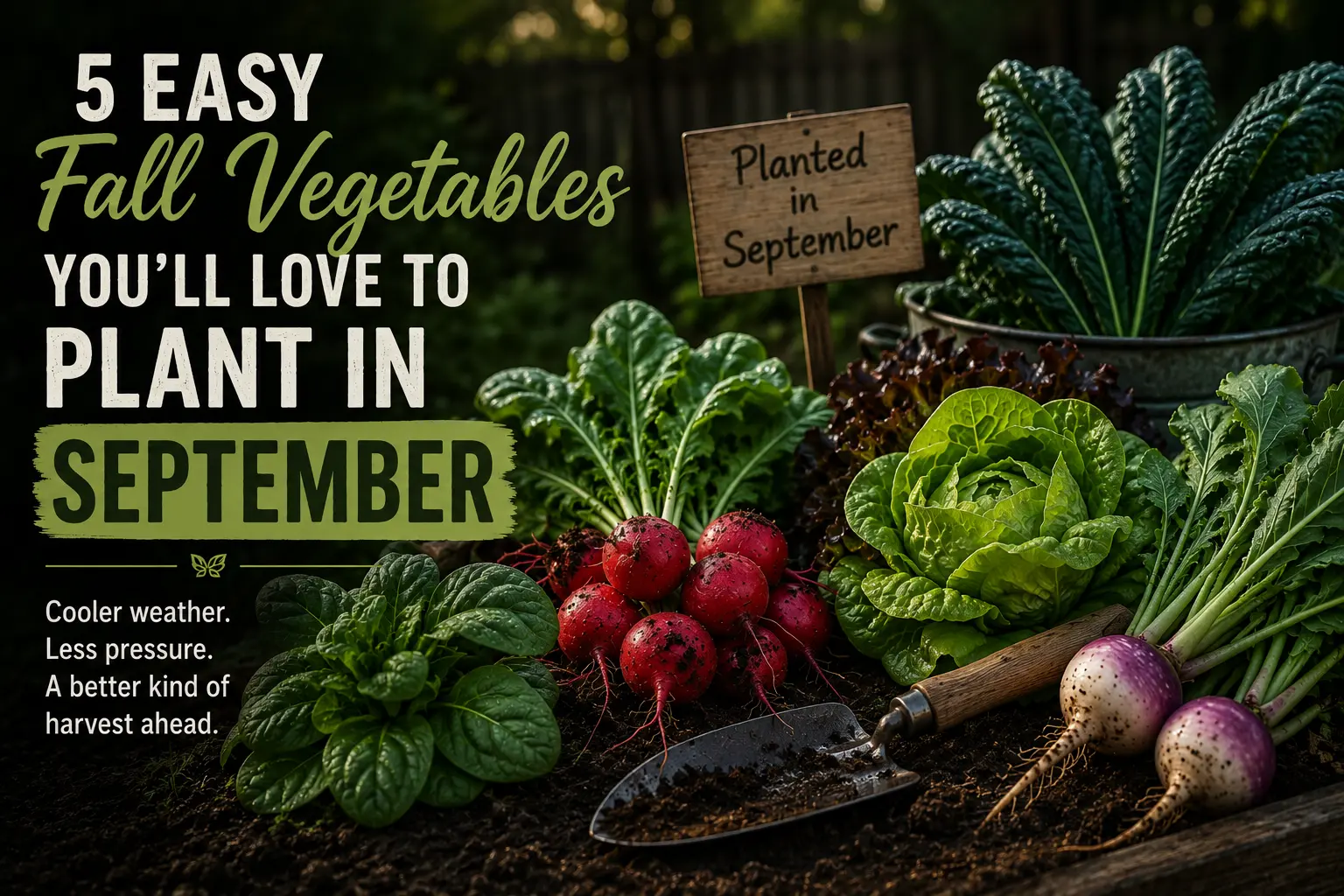
September does not have to mean the end of the garden. These five fall vegetables to plant in September take advantage of Central Virginia’s cooler nights without asking you to start another full-scale summer garden.
There is a strange moment in the September garden when it seems as though two seasons are occupying the same piece of ground.
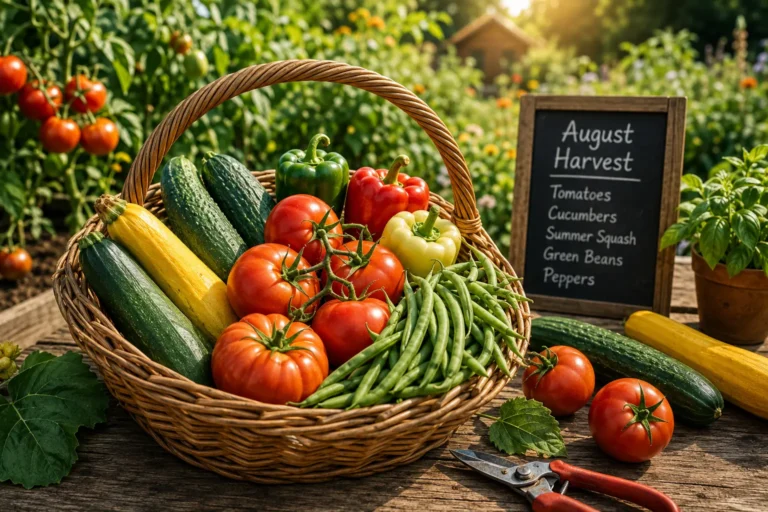
The tomatoes may still be hanging heavy on their vines. Peppers are coloring in the afternoon sun. Basil still perfumes your hands when you brush against it.
Everything says summer.
And then, a few feet away, you press spinach seed into the soil.
Radishes go into another short row. Lettuce follows. Somewhere else, turnips begin an entirely different kind of harvest that will eventually give you both greens and roots.
The garden has not ended.
It has changed direction.
September Has Its Own Kind of Busy
September also changes life outside the garden.
School starts again. Vacations end. Work settles back into its normal rhythm. Afternoons that seemed almost endless in June begin disappearing noticeably earlier, and suddenly there is a lot less daylight between getting home and getting dinner on the table.
I feel that change too.
As much as I enjoy working in the garden, I don’t want September to become another season where I am standing outside at dusk wondering how I’m supposed to fit another hour of garden work into a day that already feels full.
That is part of why I like these five crops.
They aren’t maintenance-free—nothing living really is. They still need water, thinning, observation and the occasional intervention. But spinach, radishes, lettuce and turnips can be direct-sown without turning September into another major construction project, and established kale or collards can continue producing as the weather cools.
We aren’t building another summer garden.
We are changing strategies.
The tomatoes and peppers may still need harvesting, preserving and cleaning up while these new crops quietly begin underneath them. So this month’s goal isn’t to create more work simply because the planting calendar says we can.
It is to choose a few crops that fit both the weather that is coming and the life we are actually living.
That gives us a slightly different September question:
What can we plant now that wants the weather that’s coming—and won’t ask us to spend every shortening evening tending it?
These are five of my favorites.
September Changes the Way We Think About the Season
September is one of those months that teaches a gardener to stop thinking about the growing season as a straight line running from spring to fall.
The summer garden may still be paying us back while the fall garden is just beginning.
And these five crops are not simply five more things to plant. Each one gives us a different way to work with the changing season—timing, succession, repeated harvests, multiple uses, and knowing when a planting window is beginning to close.
For our Central Virginia garden, roughly USDA Zone 7b, Virginia Cooperative Extension estimates the average first fall frost around October 25 to November 5, although elevation, slope, weather and individual microclimates can move that date considerably.
That gives us a useful planning window.
But it is not a guarantee.
Months do not grow vegetables. Conditions do.
The calendar simply helps us anticipate those conditions.
The September Planting Map
| Crop | Zone 7b Fall Window | September Priority | Why It Earns a Spot | Bigger Lesson |
|---|---|---|---|---|
| Spinach | Sept. 10–Oct. 20 | Wait for cooler conditions | Cooler weather brings spinach back into its preferred season | Timing + shoulder season |
| Radishes | Sept. 1–Oct. 10 | Plant now | Fast crop that works well in repeated sowings | Speed + feedback |
| Baby Lettuce | Sept. 1–Oct. 20 | Plant in small waves | Lets us spread salads across the month instead of creating one glut | Succession + harvest pipelines |
| Turnips | Aug. 20–Sept. 20 | Earlier is better | Greens and roots give us more than one useful harvest | Multiple value |
| Kale & Collards | Aug. 10–Sept. 20 | Window closing | Need time to establish before colder, shorter days slow growth | Planning ahead |
These planting windows come from Virginia Cooperative Extension’s Virginia’s Home Garden Vegetable Planting Guide, which provides recommended spring and fall planting ranges by Virginia hardiness zone. Think of them as useful planning ranges rather than exact deadlines—local conditions and your own garden history still matter.
1. Spinach: The Crop That Was Waiting for September
Spinach is one of the vegetables that makes the September garden make sense.
Try to force it through the wrong part of summer and the plant tells you quickly that something is off. Long days and high temperatures encourage spinach toward bolting, while cooler conditions favor the leafy growth we actually want.
Then September begins changing the equation.
Nights cool. The soil begins to cool with them. And spinach belongs in the garden again.
For Zone 7b, Virginia Cooperative Extension’s fall planting window begins around September 10 and continues into October, with more than one fall planting possible.
That makes spinach more than another vegetable on our list. It teaches one of the most useful lessons in gardening:
Sometimes good gardening means waiting for the environment to come back to the crop.
We spend a lot of time trying to change plants.
We change the fertilizer, add more water, amend the soil or try another variety.
But sometimes the plant is perfectly fine.
The season is wrong.
A Simple Spinach Planting Snapshot
| If You’re Planting Spinach | Start Here |
|---|---|
| How | Direct sow |
| Seed depth | About 1/2 inch |
| Plant spacing | Sow closely, then thin toward about 4 inches |
| Between rows | About 6–12 inches in a home garden |
| Fall strategy | More than one planting rather than one large sowing |
| Harvest | Baby leaves first or allow plants to mature |
Spinach gives us permission to stop fighting summer and simply return when its preferred growing conditions begin coming back.
You do not need to turn this into a large September project. A short row or a small patch is enough to learn how spinach behaves in your own fall garden. If it succeeds, sow another.
Think in Harvest Stages, Not One Harvest
Spinach does not have one imaginary moment when it suddenly becomes useful.
Young leaves can go into salads. Let the plants grow larger and those leaves can move into eggs, soups, sautés and pasta.
That gives us two decisions:
When do we want to eat it?
When should the next planting go in?
Sow another small section behind the first and the harvest begins spreading across time rather than arriving all at once.
Don’t just plant spinach. Begin building a spinach pipeline.
Field Note: September Is a Shoulder Season
Spinach also introduces an idea we’ll explore more deeply elsewhere.
September does not necessarily mark the end of the garden. It can become a shoulder season between summer abundance and the colder months ahead.
Simple protection such as floating row cover or a cold frame can push some fall crops farther into cooler weather.
You do not need any of that to plant spinach now.
Plant the spinach first.
But remember the possibility.
Instead of eventually asking:
“When does my garden season end?”
we may begin asking:
“How far could I extend it?”
We’ll come back to that.
Cooler weather can change more than the length of the season. It can change flavor, too. If you’re curious, read Why Carrots Taste Sweeter After Frost.
2. Radishes: The Fast Feedback Crop
If spinach teaches patience, radishes teach speed.
A September radish planting gives us something every gardener needs: fast feedback.
Seed goes into the ground. Seedlings appear. Roots begin forming. And comparatively quickly, we find out whether our timing, watering, spacing and soil are working.
That makes radishes useful for more than dinner. They are a great learning crop for new gardeners, children, experimental beds, or even an experienced gardener trying to understand a new patch of ground.
For Zone 7b, Virginia Cooperative Extension places the fall planting window roughly between September 1 and October 10, with repeated plantings recommended to extend the harvest.
And that last part is where radishes become much more interesting.
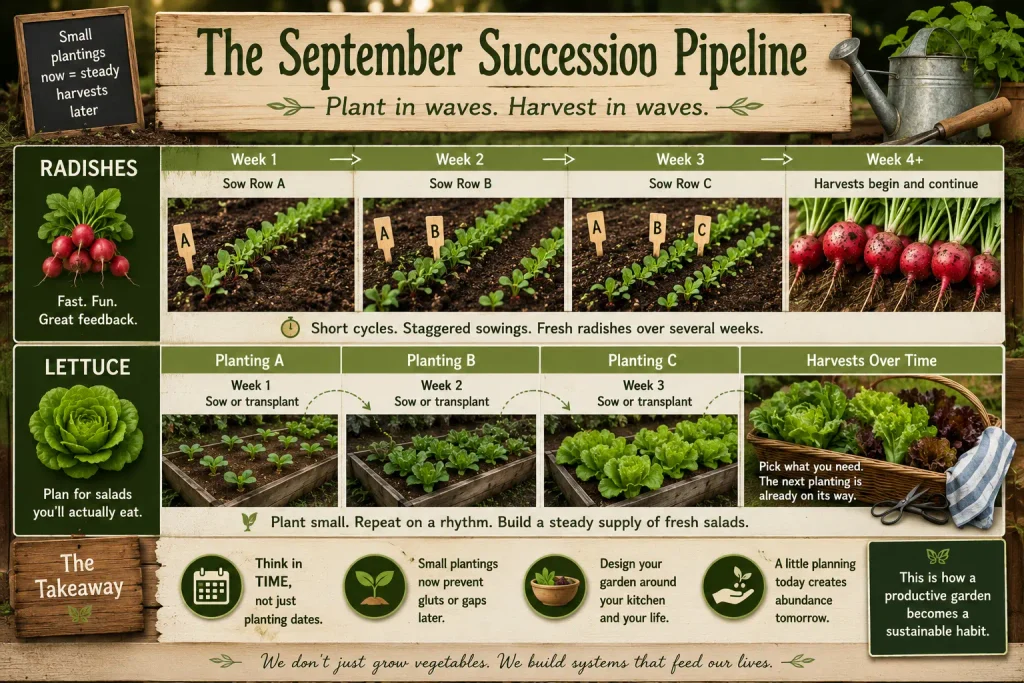
The September Radish Ladder
| September | What You Do | What It Creates |
|---|---|---|
| Week 1 | Sow Row A | First future harvest |
| Week 2 | Check emergence; sow Row B | Second crop follows behind |
| Week 3 | Thin/check Row A; sow Row C if needed | Harvests begin spreading across time |
| Week 4 | Evaluate growth and weather | Decide whether another succession makes sense |
Most people think about planting as an event.
A gardener begins learning to think about planting as scheduling.
We are not merely deciding what to grow.
We are deciding when food will become available.
Radishes may be one of the easiest crops for learning that rhythm.
Harvest Them When They’re Worth Eating
Bigger is not always better.
Leave some radishes in the ground too long and quality can decline as roots become oversized, pithy or unpleasant.
So don’t judge the crop by how enormous you can make it. Check the root shoulders, learn the normal size for the variety you’re growing, and taste along the way.
The goal isn’t maximum biological size. It’s maximum usefulness.
And usefulness includes the kitchen. Radishes can move straight into salads, become a quick pickle, or take on an entirely different character when roasted.
The kitchen is part of the growing plan.
3. Lettuce: Don’t Plant a Head—Build a Salad Pipeline
Lettuce takes succession planting one step farther.
Virginia Cooperative Extension gives Zone 7b gardeners a broad September planting window for baby salad lettuce, with repeated sowings recommended.
But instead of beginning with:
How much lettuce should I plant?
I prefer another question:
How much lettuce do we actually eat?
That question changes the garden.
Suppose your household likes two good salads each week.
You do not necessarily need twenty lettuce plants reaching maturity simultaneously.
You need a production system capable of delivering lettuce at roughly the rate you consume it.
That’s a very different objective.
And it reminds me of something I learned dramatically through aquaponics.
From My Garden: Six Heads at a Time
I learned this lesson clearly with romaine in my aquaponic system.
I had a 4-by-8-foot floating raft divided into roughly one-foot sections. Each section held six plants, and instead of filling the entire raft with lettuce at once, I could add another six plants on a schedule.
With roughly an eight-week growing cycle, the goal was simple: once the pipeline filled, six plants entering the system could eventually support roughly six mature heads coming out on that same rhythm.
The lesson had almost nothing to do with aquaponics.
It was about timing production to consumption.
Desired weekly harvest × weeks to maturity = active plants needed
A soil garden will not behave as mechanically as a controlled aquaponic system, and weather can change the schedule. But the planning principle still works:
Plant according to the harvest rhythm you actually want.
From My Garden: I Track the Planting, Not Just the Date
Succession planting can look very precise on a chart, but I don’t always manage it by staring at calendar dates.
In my own garden, I have been known to use simple colored markers—red, blue, green and white—or signs labeled A, B, C, D, E to tell one succession planting from another.
The sign does not have to tell me the planting date.
It only has to tell me which planting I am looking at.
When I put Planting C into the garden, for example, I record C in my garden journal along with the crop, date and whatever else I want to remember.
That frees the garden itself from becoming cluttered with dates and lets the journal hold the history.
Weeks later, I can look at a marker labeled B or C, check the journal, and know when it was planted, what I expected from it and how that planting actually performed.
The sign tells me which planting it is. The journal tells me its story.
It is a simple system, but that is often all I need to keep several plantings moving without trying to keep the entire schedule in my head.
A Simple September Lettuce Rhythm
You don’t need a 4-by-8 aquaponic raft to use the idea.
Sow a small patch of lettuce. Then put another small planting behind it rather than filling the entire bed at once.
As the first planting moves toward harvest, the second is developing behind it—and another can follow if your weather, appetite and available space justify it.
Suddenly the goal changes from:
“I grew lettuce.”
to:
“I built a system that gives us salads.”
Don’t plant vegetables. Plant future meals.
Baby Leaf or Full Head?
This is another place where gardeners have choices.
Baby lettuce lets you harvest earlier and can fit beautifully into repeated sowings.
Head lettuce asks for more time and space but gives you a different final product.
Neither approach is automatically better.
If you use handfuls of greens throughout the week, repeated baby-leaf sowings may fit your kitchen better. If you want complete heads for sandwiches, wraps or particular meals, let that goal determine the planting.
Which brings us back to a question I want to keep asking throughout The Gardening Chef:
What is the harvest supposed to become?
The answer should influence what we plant in the first place.
4. Turnips: One Planting, More Than One Harvest
Turnips are easy to overlook.
They do not have the glamour of a summer tomato or the almost ridiculous reputation zucchini has for productivity. But they have something I value in a productive garden:
they do more than one job.
For our Zone 7b garden, Virginia Cooperative Extension places the primary fall planting window roughly between August 20 and September 20. That makes early September useful planting time, but it also means this is one crop I would not keep postponing.
A Simple Turnip Planting Snapshot
| If You’re Planting Turnips | Start Here |
|---|---|
| How | Direct sow |
| September priority | Earlier is better; the window is narrowing |
| First useful harvest | Young greens |
| Later harvest | Roots |
| Kitchen possibilities | Sautéed greens, soups, roasted roots, mash, pickles |
| Big lesson | One planting can produce more than one useful harvest |
That last line is what makes turnips particularly interesting to me.
One Planting, More Than One Harvest
A turnip does not necessarily have to sit untouched until the root is ready.
Young greens can become an early harvest. Larger greens can move into soups, beans or a skillet. Meanwhile, the root continues developing below the soil for roasting, mashing, stews or pickling.
The balance matters. If the root is my primary goal, I do not want to repeatedly strip away all of the foliage helping the plant grow. I would rather harvest selectively, taking some useful leaves while leaving plenty of healthy growth behind.
That changes the question from:
What does this plant produce?
to:
How many useful harvests can this planting give me?
And that question reaches well beyond turnips.
A Little Extra: Look Above the Root
Here is something worth noticing if you have read this far.
When we call carrots, radishes and turnips root crops, it is easy to train ourselves to look only underground.
But there may already be food above the soil.
Radish greens are edible. Carrot tops are edible. Turnip greens can be an important harvest of their own.
University of Illinois Extension also has a useful guide to using the whole plant, including ideas for radish and turnip greens, carrot tops, and other parts of vegetables that are often overlooked.
That does not mean I want to strip a root crop bare just because the leaves are edible. Those leaves are still doing work for the plant.
Think more in terms of a careful cut-and-come-again mentality:
Take some.
Leave plenty.
Protect the growing plant.
Let it continue building the harvest you still want later.
The goal isn’t to take everything that is edible. It is to take something useful without sacrificing what comes next.
That is a very different way of looking at a vegetable.
From My Kitchen: Radish Greens Were Never Just Waste
Growing up, we did not automatically treat radish tops as something destined for the compost pile.
Sometimes we sautéed the greens in a little leftover bacon grease. Other times, a splash of apple cider vinegar gave them some of the sharp, tangy character I associated with mustard greens.
Nothing complicated.
Just another part of the harvest becoming food.
That memory is one reason I hesitate when a vegetable gets defined only by the part we normally see at the grocery store.
A radish may be sold for its root.
That does not mean the rest of the plant has no value.
Sometimes honoring the harvest begins by remembering what earlier kitchens already knew how to use.
And someday we’ll give those radish greens their own recipe.
5. Kale and Collards: Plant for the Weather That’s Coming
Kale and collards give September a different lesson.
A fall vegetable does not necessarily mean a vegetable we should wait until fall to plant.
For our Zone 7b schedule, the useful fall planting window for kale and collards is already narrowing in September. Virginia Cooperative Extension places it roughly between August 10 and September 20.
That means September is partly opportunity and partly deadline.
The plants need time to become established before colder weather and shorter days begin slowing growth.
So now we are no longer gardening only for today’s conditions.
We are planting for the conditions the crop will experience several weeks from now.
A Simple Kale and Collard Snapshot
| September Question | Think About |
|---|---|
| Do I already have plants started? | Prioritize getting them established |
| Is the planting window narrowing? | Don’t keep postponing |
| How will I harvest? | Useful leaves can be taken over time |
| What changes next? | Shorter days and colder weather slow growth |
| Big lesson | Plant for future conditions, not only today’s weather |
When I look at a young kale or collard plant in September, I try to imagine it several weeks from now.
Will it have enough roots established?
How much daylight will remain?
How cold will the nights be?
Will the plant be large enough to keep giving me useful leaves as growth begins slowing?
That leads to the question behind much of successful fall gardening:
Will this plant have enough time to establish before the environment changes?
Now we are gardening forward instead of backward.
The September Garden Clock
By September, I no longer think every crop on the planting list deserves the same response.
Some crops benefit from waiting for better conditions. Some can keep moving through small succession plantings. Others are approaching the point where postponing the job begins to matter.
And garlic is waiting just beyond September.
The five crops are not simply moving through the same month.
They are moving on different clocks.
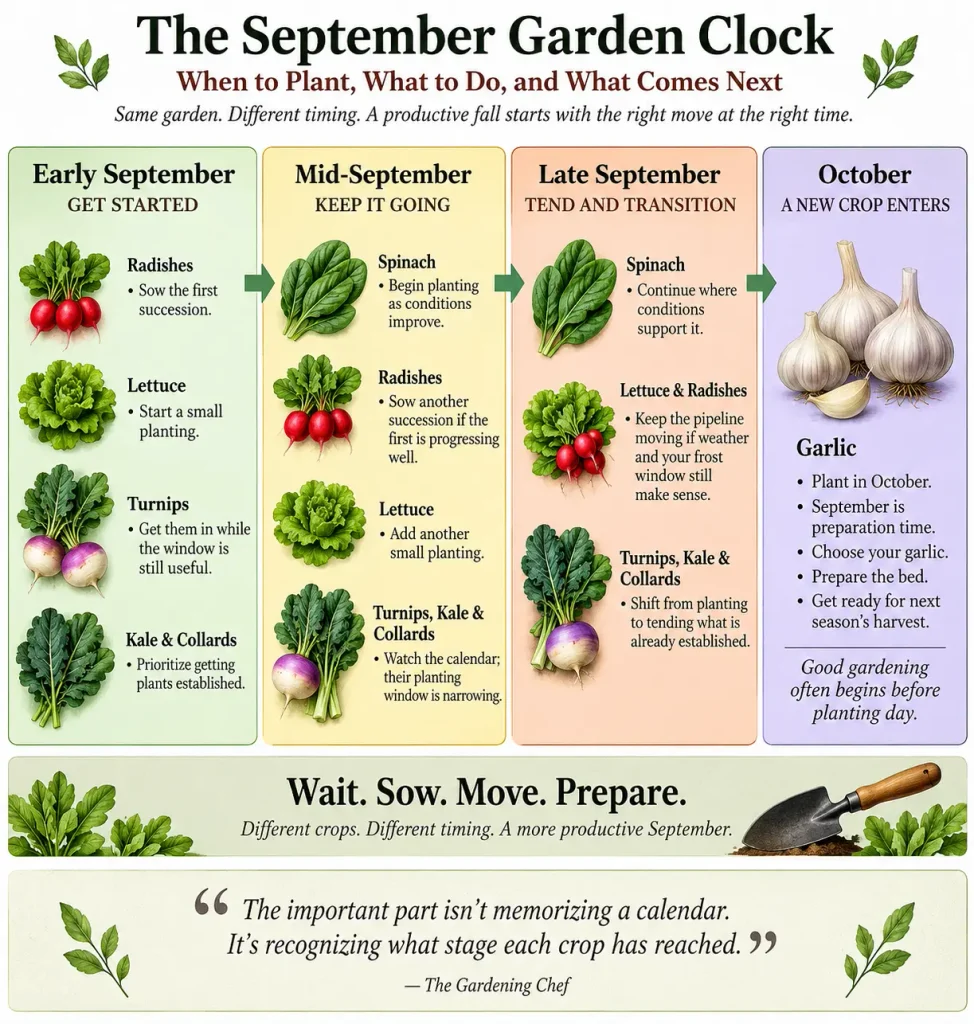
The important part isn’t memorizing a calendar. It’s recognizing what stage each crop has reached.
If one of these crops becomes part of your fall garden, you can explore The Gardening Chef Field Guide Library for deeper growing, harvesting and kitchen-use guides.
Coming Next: Garlic
Garlic almost made this September list.
I have grown both hardneck and softneck garlic, and it is one of those crops that teaches a completely different lesson: sometimes the most important thing to do this month is prepare for what you will plant next month.
For our Zone 7b garden, Virginia Cooperative Extension places the garlic planting window in October.
So September becomes preparation time.
I want to:
- choose the garlic I am going to plant
- obtain healthy planting stock
- decide where the bed will go
- prepare that space
- make sure I am comfortable giving that ground to garlic well into next year
Hardneck and softneck garlic also give us different garden experiences. Hardneck gives us the bonus harvest of scapes, for example, but that deserves more attention than I want to steal from this September article.
We will come back to garlic properly in October.
Good gardening often begins before planting day.
Before You Plant the Next Row
The Garden Clock is a plan, not an order to keep planting.
Before automatically sowing another succession, walk the garden.
What germinated?
What needs thinning?
Where did something fail?
Are the conditions still favorable?
And perhaps most importantly:
Does our household actually need another planting?
Sometimes the right decision is another row.
Sometimes it is filling a gap.
Sometimes it is harvesting what is already there.
And sometimes it is doing nothing yet.
If life gets busy and you miss the week you thought you were supposed to plant, you did not fail the garden.
Look at the conditions. Look at what is already growing. Then make the next useful decision.
The calendar is a guide. The garden gets the final vote.
One More Thing to Watch: Your Own Microclimate
Our Zone 7b designation is a guide, not a commandment.
Virginia Cooperative Extension notes that Virginia’s topography creates considerable local variation and that even slopes and other microclimates can change growing conditions.
One backyard can have its own little climate map.
A low area may collect colder air.
A south-facing wall may retain warmth.
A sheltered bed may behave differently from one exposed to wind.
This is why your own records become more valuable every year.
Write down:
- when you planted
- when germination occurred
- when you expected the first harvest
- when the first harvest actually arrived
- the last useful harvest
- what survived the first frost
- what struggled
- what surprised you
Next September, you won’t merely be following a planting guide.
You’ll also be following your garden’s history.
Those notes may look simple, but over time they begin turning a regional planting guide into your planting guide.
You will not only know what Zone 7b is supposed to do.
You will know what your bed beside the house, your low corner, or your sheltered patch actually did.
The calendar gives us an expectation. The garden gives us evidence.
And every season gives us another chance to compare the two.
September Is the Beginning of What Comes Next
By the end of September, the garden may look a little strange.
A tomato may still be ripening on one side of the garden while spinach is breaking through the soil on the other.
Radishes may be moving toward harvest while garlic is still waiting for October.
That is September.
One garden is still paying us back while another is beginning.
There can be past, present and future in the same garden bed.
We do not need to plant everything. We do not need to spend every shortening evening outside. And we do not need to follow a calendar blindly.
We need to recognize the window, choose what fits our lives, and make the next useful move.
Plant a little spinach.
Put in a short row of radishes.
Start enough lettuce for the salads you actually eat.
Give turnips and kale the time they still need.
Prepare the garlic bed for what comes next.
Then watch what happens.
Record it.
Learn from it.
And next September, come back a little wiser.
Summer and fall can occupy the same piece of soil.
And so can the harvest we are enjoying today and the one we are quietly preparing for tomorrow.
Sources Used for Planting Guidance
The planting windows and frost guidance in this article are grounded primarily in Virginia Cooperative Extension’s current Virginia’s Home Garden Vegetable Planting Guide and its 2026-reviewed Fall Vegetable Gardening guidance. VCE specifically notes that actual frost and planting dates vary with local conditions and that row covers and cold frames can extend some spring and fall windows.