How to Choose Grape Varieties Starts With Understanding Everything the Vine Can Produce
Choose grapes by what you actually want to eat, make, preserve, build, or learn from the vine.
I remember thinking grape leaves were a strange thing to eat. The grapes themselves made perfect sense. We harvested grapes for wine, and I even remember dandelion flowers being collected for winemaking. Those were things I could understand because I already knew people ate grapes, drank wine, made jelly, and turned fruit and flowers into something else.
At the time, I was not thinking much about grape varieties at all. I was learning something more basic: a grapevine could give us more than grapes.
But the leaves were different.
When the Vine Became More Than Fruit
My grandmother used grape leaves in Slovak cooking, including what we called galumpkis, and she also used them in pickle making. For years I thought using the leaves was unusual because I associated dishes like holúbky and galumpkis with cabbage. Cabbage is certainly the better-known wrapper in traditional Slovak holúbky, especially in eastern Slovakia. But that is not the only way stuffed-leaf dishes appear across Eastern Europe. In neighboring regional cuisines, cooks also used tender young grape leaves in place of cabbage leaves, wrapping much the same kind of filling of rice, meat, or both.
That makes my grandmother’s use of grape leaves much more interesting to me now. What seemed strange when I was younger was really another example of people knowing how to use what was growing around them. It also challenged something most of us probably learn without realizing we are learning it. We tend to identify a plant by the one product we have been taught to recognize. A grapevine gives us grapes, a tomato plant gives us tomatoes, and an apple tree gives us apples. That is usually where the lesson ends.
But what if the obvious harvest is only one part of what the plant can produce?
From Culinary School to the Vineyard
Years later, culinary school gave me another little grape surprise when I learned about the connection between grapes, winemaking, tartaric acid, and cream of tartar. Growing grapes myself taught me something entirely different. I was afraid to prune them too aggressively, and I had vines in locations I knew were not ideal. I was reluctant to dig them up and move them because they were perennials and I did not want to damage them. Looking back, that hesitation cost me growing time.
Then I had the opportunity to volunteer at a vineyard for a day and help with early-summer vine work. Seeing how grapes were handled there changed the way I looked at them. These were not fragile plants that had to be protected from every mistake. They were vigorous plants that needed to be trained, pruned, managed, observed, and understood.
That experience eventually led me to a much better question than simply asking which grape is best:
What jobs do I want this vine to do?
That is where Jobs on the Vine begins.
Don’t Choose a Grape Yet
Imagine walking into a nursery and asking, “What is the best grape?” I do not think that is really the question we should be asking because there is no single grape that is best for everyone. A grape that is fantastic for fresh eating might not give you the jelly you imagined. A wonderful wine grape may not be something you want to snack on while walking through the garden, while a vigorous vine that covers an arbor beautifully may create more maintenance than someone with a tiny backyard wants.
Virginia Cooperative Extension makes the same basic distinction when discussing grape selection. Grapes should be chosen with their intended use in mind. Some varieties can serve several purposes reasonably well, while others have been selected much more specifically for fresh eating, juice, jelly, wine, or another use.
What do you want your vine to do?
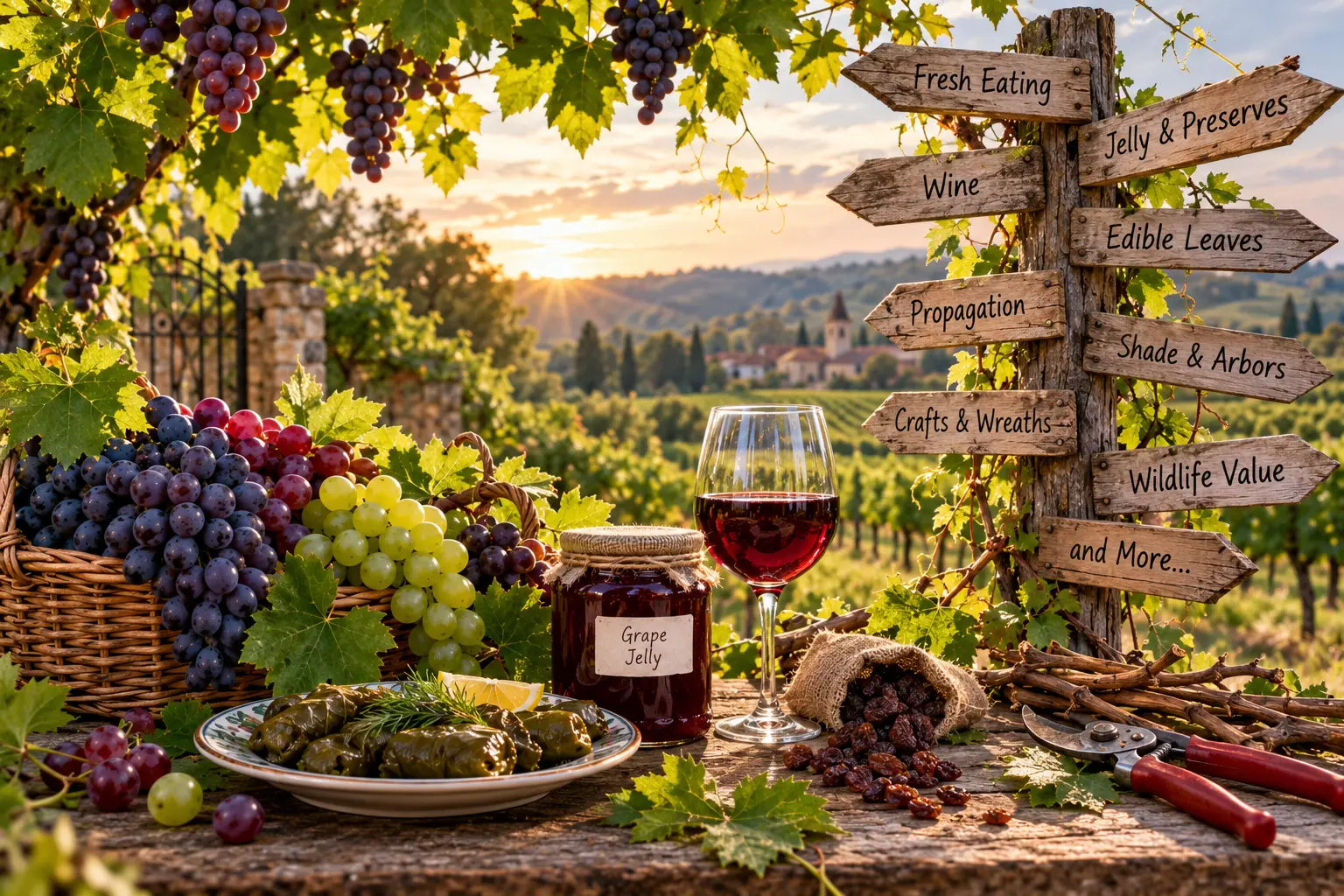
Before choosing a grape, I think it helps to decide what you actually expect the vine to give you. For one gardener, the answer may be as simple as walking outside and picking fresh grapes from the vine. Someone else may be thinking about jelly, juice, raisins, or eventually trying to make a little wine. In my case, the leaves matter too because I grew up seeing them used in the kitchen, and once you begin looking beyond the fruit, even the pruned canes start to look different.
A grapevine can provide much more than something to eat. It can cover an arbor and create shade, soften a fence, provide food for wildlife, or give you material for wreaths and other projects. Once you understand propagation, some of those pruned canes may even become new vines instead of going into a brush pile. With enough experience, you might eventually wonder whether some of what the vine produces could become part of a small legal business, although that opens another set of questions that deserve to be explored carefully.
The important part is that these are very different reasons for growing grapes. A vine chosen primarily because you want crisp fresh fruit may not be the same vine you would choose if your real goal is jelly, wine, or covering a large arbor. Even a good multipurpose grape does not have to be the best at every possible job.
That is why I would choose the jobs first and the grape second. The mistake is choosing the plant first and discovering the destination later.
Taste Before Time
This may be one of the most important ideas in the entire article: Taste Before Time.
A grapevine is a perennial, and that changes the cost of a poor decision. If I grow a radish I do not like, I have lost a few weeks. If I spend several years establishing and training a grapevine only to discover that I do not like the grape, the wine, the jelly, or whatever product I intended to make, I have made a much more expensive mistake.
Before choosing a grape because somebody tells you it is good for wine, jelly, raisins, juice, or fresh eating, find out whether you actually like the destination. If wine is the dream, taste wine made from that grape or at least from the style you are considering. For jelly, compare several grape jellies. Raisin lovers should try different styles, while anyone growing primarily for fresh eating should make an effort to find the actual grape or something close enough to provide a useful reference.
Pay attention to more than sweetness. Texture, skin, seeds, acidity, aroma, and the way the fruit feels in your mouth can all matter. What you enjoy fresh may be very different from what you enjoy after the grape has been cooked, fermented, dried, or preserved. That is why I have started thinking of tasting as part of garden planning instead of something that happens only after the garden succeeds.
Before choosing the vine, imagine walking through the life you want that vine to create. What do you see yourself eating, making, preserving, sharing, learning, or perhaps even selling?
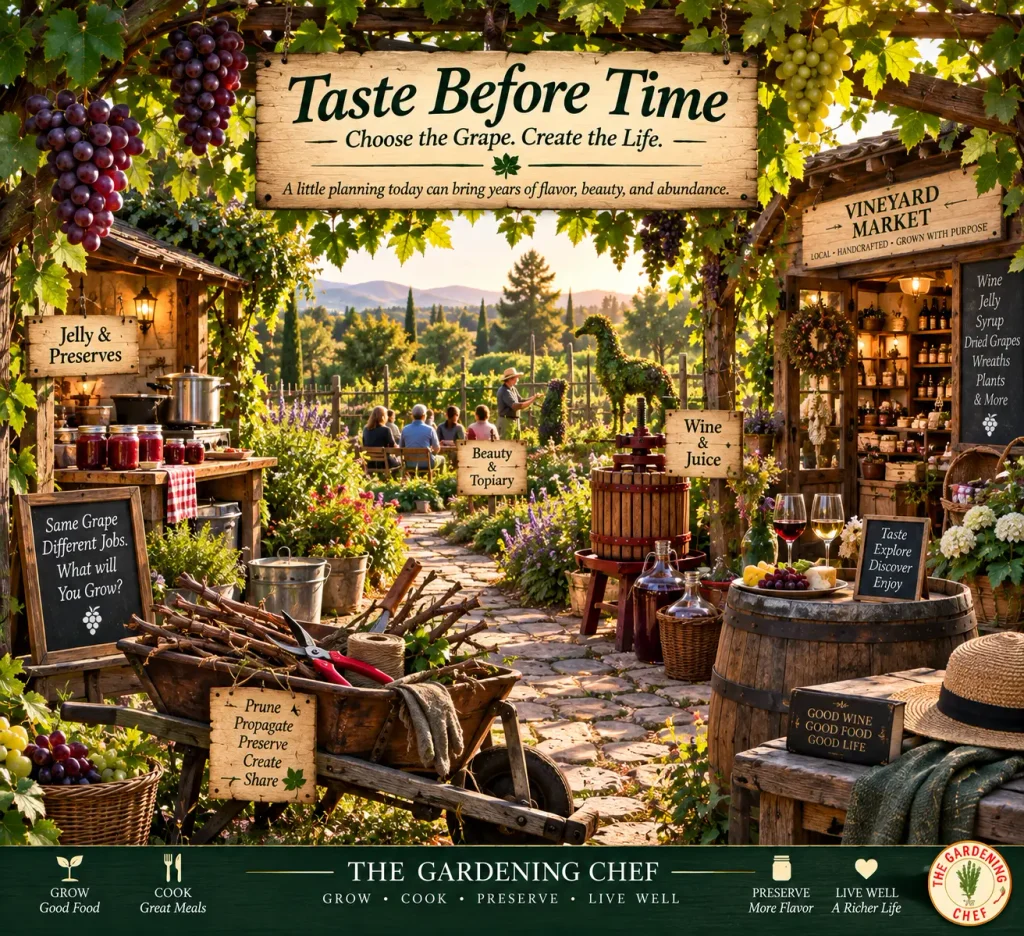
Now work backward. If that is the destination, what grape will actually get you there?
Taste the destination before you plant toward it
Wine regions give us an obvious example. If you are in or visiting the Finger Lakes, you can find wineries producing and pouring styles based on grapes such as Riesling, Cabernet Franc, Gewürztraminer, and many others. California gives you an even larger range of vineyards, tasting rooms, varieties, and finished wines.
You are not tasting the raw grape when you taste the wine, but that is not the point. You are tasting the destination. If you think you want to spend years growing toward that destination, it makes sense to learn whether you actually enjoy it first.
Raisins offer another good example of why a little investigation can save us from asking the wrong question. Golden raisins and dark raisins are not necessarily the result of starting with entirely different colored grapes. Commercial raisin styles can come from similar green grape varieties and end up very different because of how they are dried and processed.
So instead of asking, “What grape makes golden raisins?” the better question may be, “What exactly do I like about golden raisins, and how is that result actually produced?”
That is what Taste Before Time is supposed to do. It keeps us from spending years solving the wrong problem.
A Supermarket Grape and a Concord Grape Are Not the Same Kitchen Ingredient
This was one of the questions that helped start this whole idea. Why can a beautiful seedless supermarket grape be fantastic to eat but fail to give you the jelly you expected?
Part of the answer is that the word grape covers an enormous range of fruit. Grapes have been selected for different purposes and different qualities. A modern table grape may have been bred or selected for seedlessness, firmness, attractive clusters, shipping ability, storage, crisp texture, mild flavor, or some combination of those traits.
A Concord grape gives you a very different experience. It has that unmistakable aroma and flavor, softer flesh, seeds, and the slip-skin character many people associate with traditional grape juice and jelly.
One particularly interesting example is Thomcord, which USDA researchers developed by crossing Thompson Seedless and Concord. The goal was to bring together more of that Concord-like flavor with qualities people enjoy in a seedless table grape. Even the existence of a grape like Thomcord tells us something important: the characteristics we want depend heavily on what we plan to do with the fruit.
Jelly adds another layer because pectin, acid, sugar, skins, ripeness, flavor concentration, and processing all influence the finished product. Preservation guidance also notes that less-ripe fruit can contain more natural pectin than fully ripe fruit. So the question is not simply, Can I make jelly from this grape? A much better question is, Will this grape make the kind of jelly I actually want to eat?
Those are two very different questions.
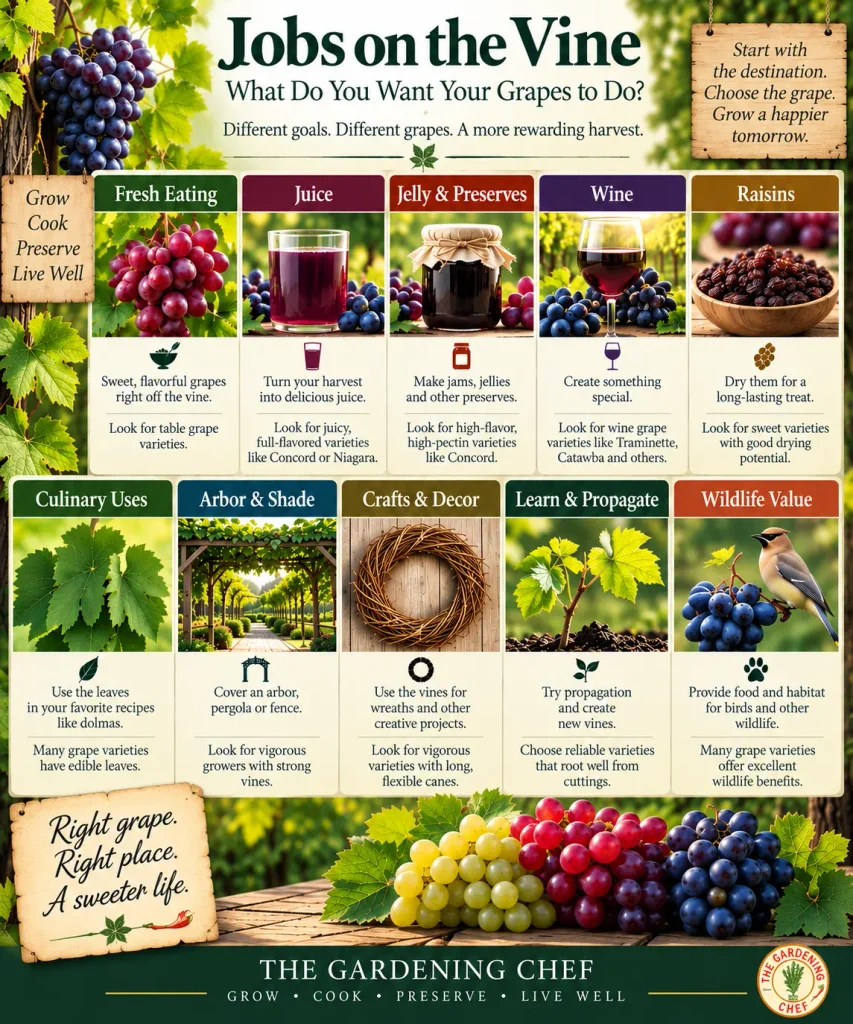
Jobs on the Vine
I like thinking about grape growing almost like a skill tree in a game, not because gardening itself is a game, but because learning becomes easier when you can see what each new skill allows you to do next. You begin with a plant and learn how to keep it alive. Then you learn to support it, train it, and prune it. With each skill, another set of possibilities becomes available.
The fruit is only one branch.
The Roots: How to Choose Grape Varieties for Your Site
Before the vine even goes into the ground, the first job is learning how to choose well. Climate, site, disease pressure, available space, intended use, and your own taste all matter. A grape that performs beautifully in one part of the country may struggle badly in another.
Cornell’s Finger Lakes guidance, for example, distinguishes among native American grapes, hybrids, and Vitis vinifera because cold tolerance, disease resistance, growing-season length, and other requirements can vary considerably. Here in Virginia, heat, humidity, and fungal disease pressure have to be part of the conversation too.
That means the first grape-growing skill is not buying the plant. It is matching the plant to the place and to the job you expect it to perform.
The Trunk: Learn to Manage the Vine
Once the right vine is in the right place, the basic work begins: planting, watering, supporting, training, pruning, protecting, and observing it over time. Of those skills, pruning was the one that made me most hesitant.
I would look at a healthy grapevine that had produced a tremendous amount of growth and think, “I cannot possibly be expected to cut most of that off.” But that is exactly where grape growing can surprise you. Extension guidance from Penn State explains that mature grapevines can produce far more wood than they need and that a very large percentage of the previous season’s growth may be removed during dormant pruning.
Grapes also bear fruit from shoots that arise from one-year-old wood, which is why understanding what to leave and what to remove becomes so important. That does not mean we should walk outside and start hacking away at a grapevine. Different varieties and training systems may use cane pruning, spur pruning, different bud counts, and different structures.
What I learned from my own hesitation is that being afraid to prune can become a grape-growing mistake too. The goal is not aggressive pruning. The goal is informed pruning, and there is a big difference between the two.
Job 1: Eat
Fresh eating is the job almost everyone recognizes first. You walk outside, cut a cluster, and eat the grapes. Even this simple job, however, opens a surprising number of decisions.
Some people care deeply about seedless fruit, while others do not mind seeds at all if the flavor is worth it. Crispness, slip-skin texture, sweetness, aroma, storage quality, disease resistance, and ripening time can all influence whether a grape feels like the right choice. If fresh eating is the main reason you are growing grapes, then those qualities should control the decision.
There is no reason to grow a grape you barely enjoy eating just because someone told you it is a good multipurpose variety.
Job 2: Preserve
Preservation is where the grape begins to stretch beyond the obvious fresh harvest. Juice, jelly, jam, raisins, and other preserved products can all come from the same general category of fruit, but that does not mean every grape will perform equally well in every form.
Concord is a familiar example because it has been used for fresh eating, juice, jelly, and some wine production. Niagara also has several potential uses, including fresh eating, juice, and wine. Grapes like these show why multipurpose varieties can be so useful, especially when space is limited.
Still, multipurpose does not automatically mean best. If jelly is the main reason you are planting grapes, choose with jelly in mind. If fresh eating matters ten times more than jelly, let fresh eating carry more weight. The vine does not need to win every category. It needs to do the jobs that matter most to you.
Job 3: Ferment
Wine opens an entirely different world because wine grapes are not simply table grapes with smaller berries. Cultivar, sugar, acidity, aroma, climate, ripening, harvest timing, fermentation, and winemaking technique can all influence the finished wine.
That makes wine one of the best examples of Taste Before Time. Go taste it. Compare dry and sweet wines, try different grapes, and if possible compare the same grape from different producers or regions. Take notes. If you discover that you dislike the destination, that is useful information because you may have just saved yourself years. If you discover that you love it, you now have a much better reason to investigate whether that grape can actually grow well where you live.
One very important legal distinction
Home winemaking and commercial wine are not the same thing. Federal rules allow qualifying adults to produce limited quantities of wine at home for personal or family use. The federal limit is generally 100 gallons per year for a household with one adult and 200 gallons for a household with two or more adults.
That exemption does not mean the wine can be sold. The Alcohol and Tobacco Tax and Trade Bureau distinguishes personal or family production from commercial production, and state or local requirements may add additional rules.
In other words, “I can legally make this amount for my household” does not mean “I can legally sell part of it.” If wine eventually becomes part of a business idea, that belongs on a different branch of the system with a different set of rules.
Job 4: Use the Leaves
This is the branch my grandmother helped me notice.
For a long time, I associated stuffed leaf dishes from my Slovak family background with cabbage. That is understandable because traditional Slovak holúbky are commonly made with cabbage leaves. But stuffed-leaf cooking across Eastern Europe was more flexible than I realized. In neighboring regional cuisines, tender young grape leaves were also used in place of cabbage to wrap fillings of rice, meat, or both. That helped me understand my grandmother’s cooking differently. What had seemed unusual to me as a child was part of a much larger tradition of cooks adapting the wrapper while preserving the basic idea of the dish.
Using grape leaves was not simply an odd kitchen trick. It belonged to a much older way of looking at the garden and landscape. If another edible leaf could perform the job, people knew how to use it.
From Stuffed Leaves to Pickle Jars
Grape leaves are used as wrappers in a number of traditional dishes, and they can also be used in pickle making. The National Center for Home Food Preservation discusses the traditional practice of putting grape leaves into pickle jars. Grape leaves contain compounds that can inhibit enzymes associated with softening, although modern pickling guidance also explains that removing the blossom end of a cucumber can address the same enzyme issue.
That little leaf changes how we look at the plant because the harvest is no longer only hanging in clusters. Some of it is growing all around them.
This deserves its own Field Note because there is much more to explore. Which leaves should you pick? When are they tender enough to use? How do you prepare them? Can they be preserved? Were they sprayed with anything that would make them inappropriate for food? Those questions deserve a proper article of their own.
For this article, the larger lesson is enough: the grape is not the only edible part worth noticing.
Job 5: Discover the Hidden Ingredients
Cream of tartar is another one of my favorite grape surprises because most people know it only as the little container of white powder sitting in the baking section. You may use it for meringue, candy making, sugar syrups, or leavening when it is combined with baking soda, yet it is easy to use it for years without thinking about where it came from.
Its story connects directly back to wine. Cream of tartar is potassium bitartrate, a salt of tartaric acid that can crystallize out of wine during winemaking and storage. Those crystals can then be processed into the familiar white powder used in the kitchen.
That does not mean a backyard winemaker should start scraping containers and trying to manufacture pantry ingredients. The point is the connection itself. You can stand in a grocery-store baking aisle holding cream of tartar and never once think about a vineyard.
Those hidden connections are exactly the kind of thing I want The Gardening Chef to uncover throughout the Field Guide Library.
Job 6: Multiply
Pruning begins to look different once you understand propagation. At first, a pile of pruned grape canes may look like nothing more than waste that needs to be hauled away. Then you learn that grapevines can be propagated from dormant hardwood cuttings.
Oregon State Extension describes hardwood cuttings as a practical way to reproduce table grapes. A cutting also preserves the characteristics of the parent vine in a way a seedling does not.
Once you understand that, the pruning pile changes meaning. A cane can become a rooted cutting, and a rooted cutting can become another vine. That new vine might replace an older plant, expand your own planting, become a gift for another gardener, or give you a way to practice a different training system.
Eventually, another question may appear: could propagated vines become something you legally sell? That possibility is interesting, but now we have moved into a different job with different rules.
Job 7: Create
A long grape cane is not automatically waste. It can also become craft material, and grapevine wreaths are probably the most obvious example.
This is where Jobs on the Vine becomes especially interesting because we can begin working backward from the thing we want. Instead of waiting until pruning day and asking what we can do with the pile of canes, we can ask ahead of time what kind of material a grapevine wreath requires and how collecting that material might fit naturally into a proper pruning cycle.
The health and management of the vine still come first. We should never make poor pruning decisions simply because we want craft material. But if the vine needs to be pruned anyway, finding another useful purpose for some of those canes gives us another kind of harvest.
Job 8: Build and Shape
A grapevine can also become part of the physical structure of a garden. It can cover an arbor or pergola, soften a fence, create a screen, provide shade, or become part of a decorative trellis system.
That changes the definition of the “best grape” again. If covering an arbor is one of the vine’s main jobs, vigor matters. Growth habit matters. The training system matters, and so does the amount of shade you actually want. Fruit may still be important, but it is no longer the only consideration.
Grapes can be trained into many forms, although they still need pruning and canopy management if you want healthy growth and useful fruit. Topiary-style grape training is another possibility I find interesting, but I would treat it as an experiment rather than something every gardener should expect to work beautifully with every grape.
That may be another Jobs on the Vine adventure for later.
Job 9: Work With Wildlife
Then there are the birds.
One of the fastest ways to discover that grapes have wildlife value is to watch something else harvest them before you do. That experience creates an interesting tension because you may want to support wildlife and protect your crop at the same time.
A gardener focused on maximizing household harvest may decide to use netting or another exclusion strategy. Someone else may consider wildlife part of what the vine is supposed to support. Another gardener may decide there is enough value in both goals to intentionally share a portion of the crop.
Once we see the choice that way, wildlife is not simply a pest-control problem. It becomes another design decision about what job we expect the vine to perform.
Job 10: Create Value
This is where I think we need to be careful with the word profit because a grapevine can create several different kinds of value. It may provide fruit you no longer need to buy, preserved food for later, homemade wine for household use, shade, craft material, new plants, gifts, enjoyment, and knowledge. It can also help build skills and connect you with other gardeners.
Some of those outputs may eventually become things you can sell, but savings, household value, education, enjoyment, and revenue are not the same thing. We should not add them together as though every form of value were cash income.
Could a grapevine become part of a small business?
Possibly, but the moment we begin selling things another set of rules enters the picture.
Propagation is a good example. In Virginia, grapevines and grape cuttings are considered nursery stock, and businesses that sell or distribute nursery stock are regulated by the Virginia Department of Agriculture and Consumer Services.
The selling platform can introduce another layer. Farmish, Facebook Marketplace, farmers markets, local plant sales, and other outlets can have their own terms and restrictions in addition to whatever federal, state, and local requirements apply.
That is why I would never reduce this idea to “Prune a grapevine and get rich selling cuttings.” That skips too many lessons. A more useful progression is to learn how to grow the vine, learn to prune it, understand propagation, understand the rules, and only then test whether there is actually a market.
The possibility is still interesting. We just need to earn our way to it.
One Vine or Two? How to Choose Grape Varieties for Limited Space
If you have room for only one grapevine, the decision becomes a matter of priorities. That vine does not need to be perfect at every possible job. It needs to be very good at the job that matters most to you and useful enough at the others to earn its space. If fresh eating is the reason you want grapes, start there. If jelly, juice, wine, or shade matters more, let that destination lead the decision.
A second vine changes the problem. Instead of asking one plant to do everything, you can allow the vines to specialize. One might be the grape you love to eat while the other earns its place through jelly, juice, wine, or another job. You might choose different ripening periods, very different flavors, or simply one dependable workhorse and one grape you grow because you love it. Two vines are not automatically better. They simply give you more freedom to divide the work.
Once the possibilities are placed side by side, the tradeoffs become much easier to see.
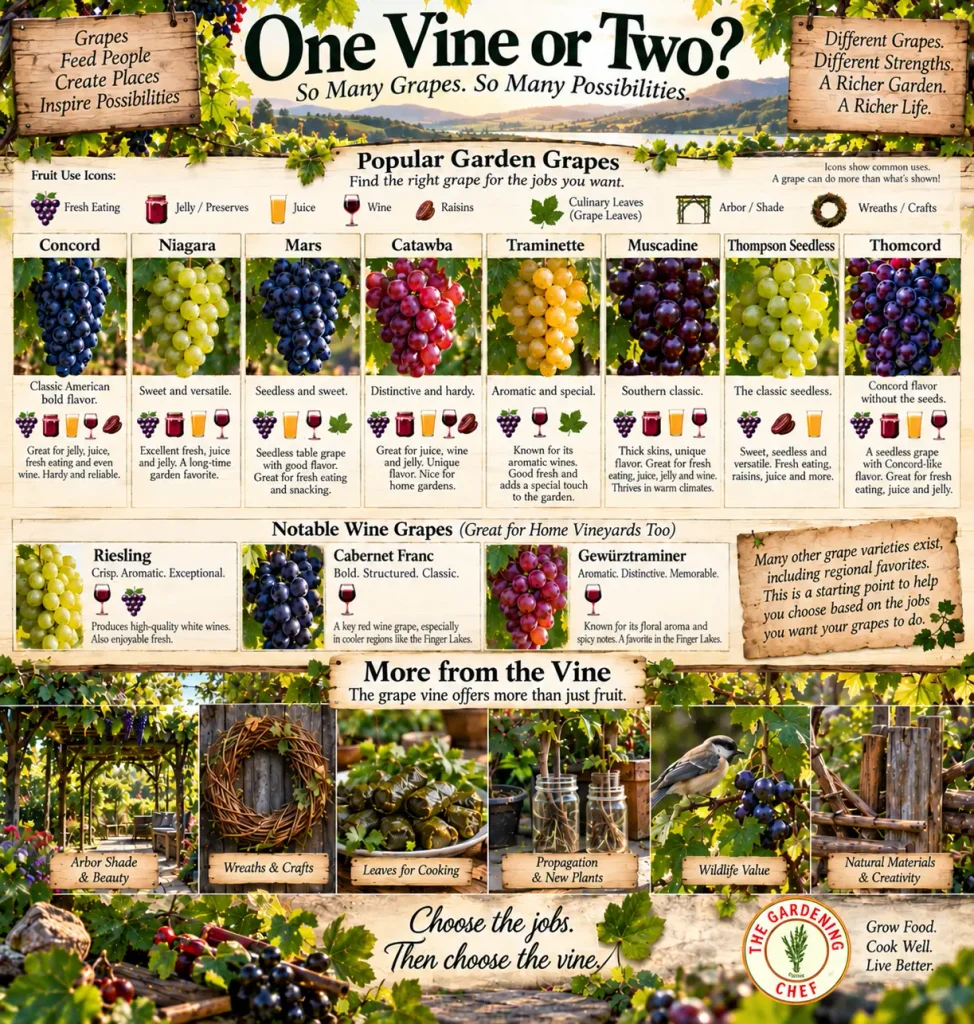
Now imagine standing in front of those vines at the garden center.
How to Choose Grape Varieties at the Garden Center
This is where all of this becomes real. You walk into Lowe’s, Home Depot, Ace, Tractor Supply, or a local garden center in the spring and find a small group of grapevines sitting together. One tag shows dark purple grapes. Another shows green grapes. Another has red or pink fruit. One says seedless. Another says Concord, and the name sounds familiar even if you are not entirely sure why.
I think this is probably how a lot of perennial buying decisions happen. We recognize a name, like the picture on the tag, prefer one fruit color over another, or see the word seedless and think that sounds better. There is nothing particularly foolish about that. The problem is that those quick visual clues tell us very little about what the vine will actually do for us over the next ten or twenty years.
A dark grape is not automatically the best grape for jelly. A green grape is not automatically the best fresh-eating grape. Two vines that both say they can be used for juice may produce very different kinds of juice. A grape that sounds wonderful because it is seedless may be a poor match for the climate where you live, while an old-fashioned variety you almost walked past may turn out to fit several of the jobs you actually care about.
That is a much bigger decision than choosing between a red grape and a green one.
Turn the Plant Tag Around
Before putting the vine in the cart, I would mentally turn the tag around and ask a different set of questions. What do I want to eat from this vine? Do I want jelly or juice? Am I interested in wine? Do I care about seedless fruit? Will the vine become part of an arbor? Does this variety handle my climate and disease pressure? Have I ever tasted the grape or the finished product I am planning to make from it?
Once you begin asking those questions, the colorful photograph on the plant tag becomes only the beginning of the decision.
That is when Jobs on the Vine stops being an interesting idea and becomes a shopping tool.
The next step is learning how the varieties sitting in front of you differ when we judge them by the jobs we actually want them to perform.
How to Choose Grape Varieties by Use
The garden center gives you names, pictures, colors, and a few words on a tag. What it usually cannot show you is how differently those vines may fit the life you are imagining.
That is where the jobs become useful. You do not need to memorize every grape or find one variety that wins every category. Start with the destination, then notice how quickly the choices begin to separate.
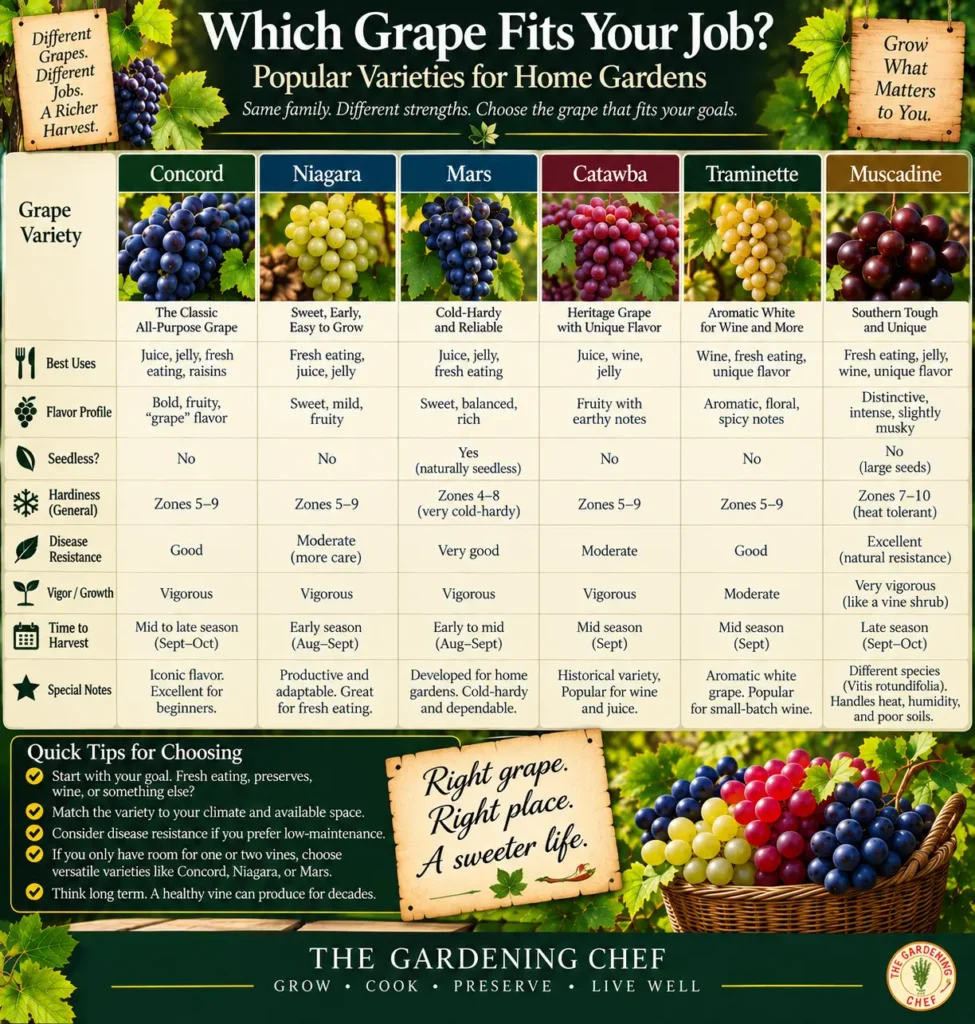
The picture gives you the map. The examples below show what happens when one job begins to matter more than another.
Concord or Niagara?
If you are imagining dark purple juice or the familiar flavor of traditional grape jelly, Concord rises quickly. If what you picture is a green-white grape for fresh eating and white juice, Niagara leads you somewhere different.
Both can perform several jobs, which is exactly why neither one is simply the “better grape.”
The job changed, so the winner changed.
What if seedless fresh eating comes first?
Now imagine that the most important thing is walking outside and eating seedless grapes straight from the vine. A grape such as Mars suddenly becomes much more interesting.
Jelly or juice may still be possible, but they no longer need to control the decision. A vine does not have to check the most boxes. Sometimes it only needs to be excellent at the box that matters most to you.
What if wine is really the destination?
Then I would stop requiring the vine to win the fresh-eating contest.
Traminette is a good example because its real attraction is the aromatic white wine it can produce. If that is the destination, this is where Taste Before Time matters most. Find the finished wine. Taste it. Decide whether that is really something you want to spend years growing toward.
The grape only makes sense when the destination does.
What if one vine needs to do several jobs?
This is where a multipurpose grape such as Catawba becomes interesting. If fresh eating, juice, and wine all matter, a vine capable of moving between those uses may earn its space better than a specialist.
Multipurpose does not automatically mean better. It becomes more valuable when several jobs matter almost equally.
That is very different from choosing a grape because one particular job matters far more than everything else.
Muscadines are their own decision
Muscadines are a good reminder that even a familiar grape category can hide another layer of choices. Different cultivars can be better suited to fresh eating or processing, and pollination can matter because some female cultivars need an appropriate pollinizer nearby.
So if muscadines fit your climate, the question is not simply, “Should I grow a muscadine?”
It becomes, “Which muscadine fits the job I want it to do?”
That is the larger lesson behind the whole comparison:
Start with the destination. Narrow the jobs. Check the climate. Taste what you can. Then choose the grape.
That is how to choose grape varieties without expecting one vine to be everything.
What About Vinegar?
Fermentation opens yet another branch because wine can become vinegar through the activity of acetic-acid bacteria. But this is also a good place to correct something that is easy to oversimplify.
Traditional balsamic vinegar is not simply a bottle of wine that sat around too long. Traditional Balsamic Vinegar of Modena PDO begins with grape must and follows a protected process of fermentation, aging, and refinement that takes at least 12 years. The Extravecchio version is aged for at least 25 years.
The correction makes the story more interesting rather than less. The more we understand what people have learned to make from grapes, the larger the vine becomes.
Build Your Own Jobs on the Vine Adventure
Up to this point, we have been exploring possibilities. Now it is your turn to make some decisions.
Before you buy a grapevine, work through these eight questions. You do not need perfect answers. The goal is simply to know what you are asking the vine to do before you give it years of garden space.
1. What do I actually want from this vine?
Fresh grapes, jelly, juice, wine, raisins, shade, edible leaves, propagation, wreath material, wildlife value, or something we have not even considered yet? Start with the possibilities that genuinely interest you.
2. Which job matters most?
Rank them. If fresh eating is the reason you really want the vine, that should carry more weight than a secondary possibility you may never use.
3. Have I tasted the destination?
This is the Taste Before Time checkpoint. Taste the grape, jelly, juice, raisin, wine, or other finished result whenever possible before you spend years growing toward it.
4. Will this grape actually grow well here?
Climate, humidity, winter cold, disease pressure, growing-season length, and the conditions in your own garden still get a vote. A grape that perfectly matches your wish list is not useful if it constantly struggles where you live.
5. How much am I willing to learn and manage?
Grapes ask for training, pruning, observation, and sometimes disease or wildlife management. Decide whether that sounds interesting to you or like another chore you do not want.
6. Would one vine do the job, or would two be better?
One multipurpose vine may fit beautifully. Two vines may let you specialize. Neither answer is automatically better.
7. What skill would unlock the next branch?
Perhaps it is pruning, propagation, jelly making, fermentation, trellis building, cooking with grape leaves, or protecting fruit from birds. You do not have to learn everything at once. Learn the next thing that opens a door you actually want to walk through.
8. What am I currently overlooking or throwing away?
Pruned canes, leaves, overripe fruit, seeds, mistakes, observations, and even failed experiments may contain another use or another lesson. Not everything needs to become a product. It is enough to become better at noticing what the system is already producing.
When you can answer those questions, the plant tag stops being the decision. It becomes evidence you can use to make the decision.
Start at the Beginning or Start at the Destination
There are really two ways into Jobs on the Vine.
If you already have a grapevine, begin with what is growing in front of you. Learn what the fruit can become, what the leaves can do, how the vine should be pruned, whether some of those canes can be propagated or turned into something useful, and what new skills the plant gives you a reason to learn. In that direction, the vine comes first and the possibilities unfold from it.
The other path begins with the destination. Perhaps you want a particular jelly, fresh seedless grapes, wine, an arbor covered in shade, or vines you can propagate. Start with that picture and work backward toward the grape, site, skills, and management required to create it.
For me, that is ultimately how to choose grape varieties: start with the life you want the vine to support, then work backward toward the plant.
Neither direction is wrong. Sometimes the plant teaches you what is possible; sometimes the possibility tells you what to plant.
The Real Harvest May Be Knowledge
When I was younger, the grapes made sense and the leaves did not. I saw the fruit as the harvest and everything else as something happening around it. Years later, the leaves, the connection to cream of tartar, my hesitation to move and prune my own vines, and that day working in a vineyard kept teaching me the same lesson from different directions: I had been looking at the vine too narrowly.
A grapevine can feed us in more than one form. The fruit can be eaten fresh, preserved, juiced, dried, or fermented. The leaves can enter the kitchen. Pruned canes can become craft material or new vines through propagation. The living vine can provide shade, structure, wildlife value, and years of practice in observing, pruning, deciding, and learning.
But perhaps the most durable thing it produces is knowledge.
I cannot recover the growing time I lost by being too hesitant to move a vine or prune it with confidence, but I can carry the lesson forward. What worked, what failed, what I harvested, what I actually enjoyed, and what I would do differently next time all become part of the record. When I pay attention, even the mistakes become part of the harvest.
That is why I no longer think “What is the best grape?” is a particularly interesting question.
The better question is the one that started this whole exploration:
What jobs do you want your vine to do?
Once you know that, you can work backward toward the grape, the skills, and the system that fit the life you actually want to create.
You do not really know a grape until you understand everything the vine can produce.
And sometimes the most valuable thing it produces is a better way of seeing.