A Kitchen Garden Field Guide for Cooks and Growers
Most kitchens treat the many types of onions as if they were all the same ingredient.
You need onion, so you grab an onion.
Maybe it is yellow. Maybe it is red. Maybe it is whatever was in the pantry, whatever was on sale, or whatever rolled loose in the bottom drawer of the refrigerator.
But the more you cook, the more you realize something important:
The onion family is not one ingredient.
It is a whole pantry of flavors.
Some onions are sharp and clean. Some are sweet and mellow. Some disappear into soups and sauces. Others stay crisp and bright when eaten raw. Some are meant to be cured and stored for months. Others are best snipped fresh from the garden and carried straight into the kitchen.
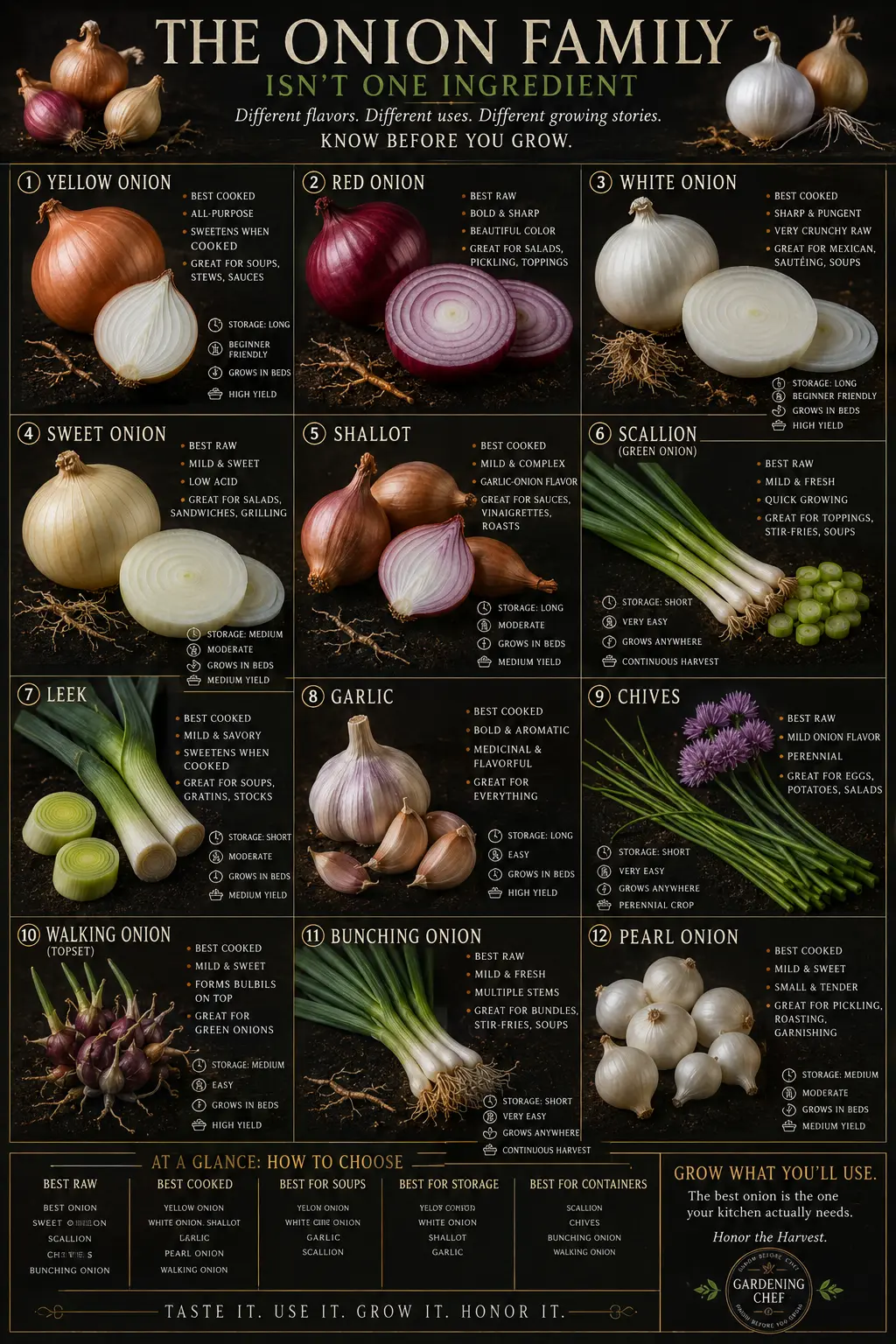
Garlic, shallots, leeks, scallions, chives, storage onions, sweet onions, and red onions may belong to the same broad family, but they do not perform the same job.
And that leads to a much better question than simply asking whether a recipe needs onion:
Which onion does this dish actually need?
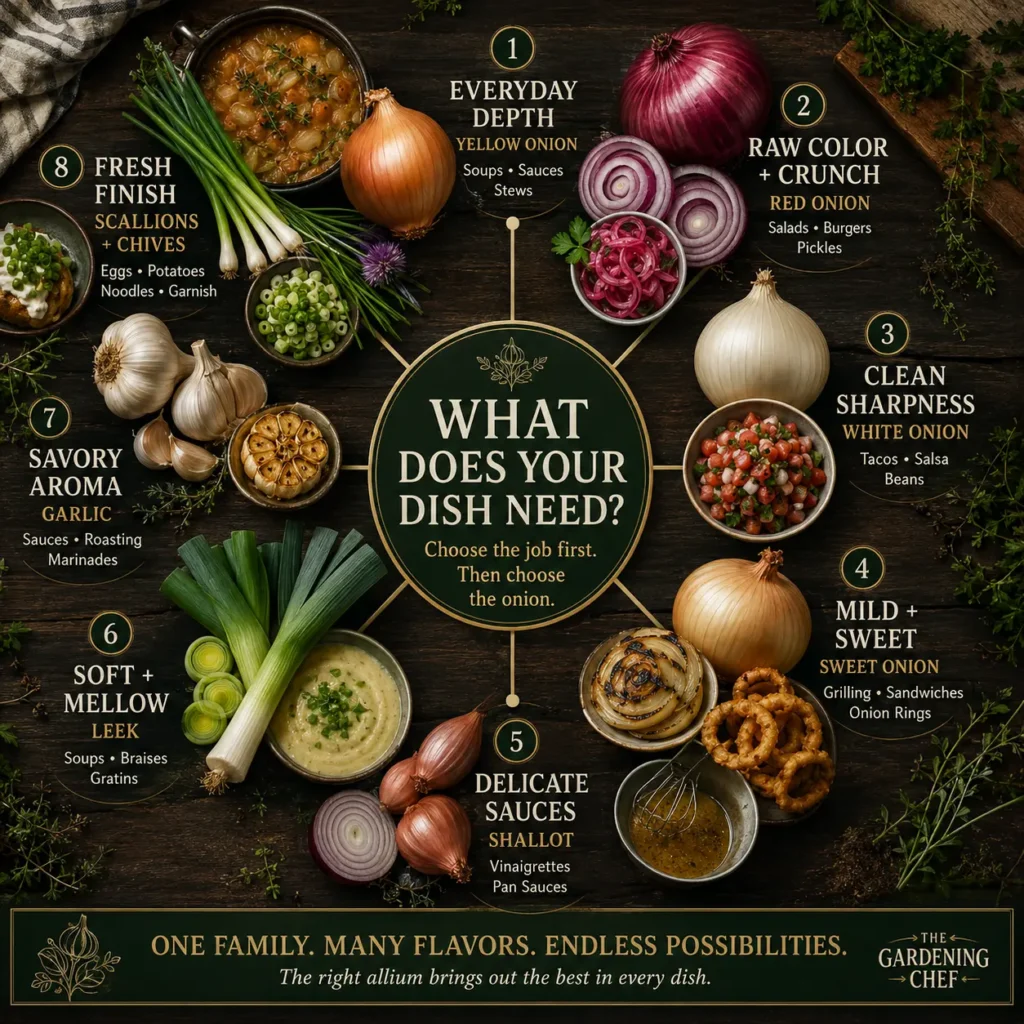
Types of Onions: Which Should You Use?
If dinner is already underway and you just need to know which onion or onion-family ingredient to reach for, start here.
| If you need… | Start with… | Why |
|---|---|---|
| An everyday cooking base | Yellow onion | Versatile, savory, and increasingly sweet as it cooks |
| Raw crunch and color | Red onion | Sharp, colorful, and excellent sliced thin or pickled |
| Salsa, tacos, and clean sharpness | White onion | Crisp onion flavor that works especially well in fresh preparations |
| A mild onion for eating raw or grilling | Sweet onion | Juicy, gentle, and less aggressive |
| Vinaigrettes and refined sauces | Shallot | Mild, complex flavor that does not overwhelm delicate dishes |
| Soup, stock, and mellow body | Leek | Soft onion flavor that becomes especially comforting when slowly cooked |
| Deep savory aroma | Garlic | A small amount can change the direction of an entire dish |
| A fresh finishing note | Scallions or chives | Bright, green onion flavor added near the end |
| Pickling or serving whole | Red or pearl onions | Good choices when acidity, crunch, color, or presentation matters |
| Longer pantry storage | Storage onions, garlic, or shallots | Useful when the goal is carrying the harvest beyond the growing season |
| Fast or repeated garden harvests | Scallions, chives, or bunching onions | Useful crops that can provide frequent kitchen-ready flavor |
| A self-renewing allium patch | Walking onions or chives | Alliums that can remain part of the garden rather than ending with one harvest |
Think of that chart as a starting point, not a set of culinary commandments.
A red onion can be roasted. A yellow onion can be eaten raw. Shallots can be fried until crisp. Scallions can be cooked. Garlic can move from fierce and raw to soft and sweet depending on what you do with it.
The important idea is not that every allium has only one use.
It is that different alliums are better suited to different jobs.
Cook Forward. Grow Backward.
A useful kitchen garden begins with the food you already cook.
If soups, stews, beans, sauces, and braises fill your table, yellow onions, garlic, and leeks quickly earn their space. If tacos, salsa, grilled food, and fresh toppings appear often, white onions, red onions, and scallions become more valuable. If potatoes, eggs, dips, and quick meals are common, a small patch of chives may contribute more than another row of storage onions.
The same principle works in reverse when you are cooking:
Choose the onion by the job you need it to do.
Some build depth at the beginning of a meal. Others bring crunch, color, or freshness at the end. Some cure for winter storage. Others can be harvested repeatedly from the garden.
That is why the onion family matters so much: it helps turn the rest of the harvest into dinner.
The goal is not to grow every onion.
Grow what your kitchen actually uses.
The Onion Family Guide
Yellow Onion: The Everyday Kitchen Workhorse
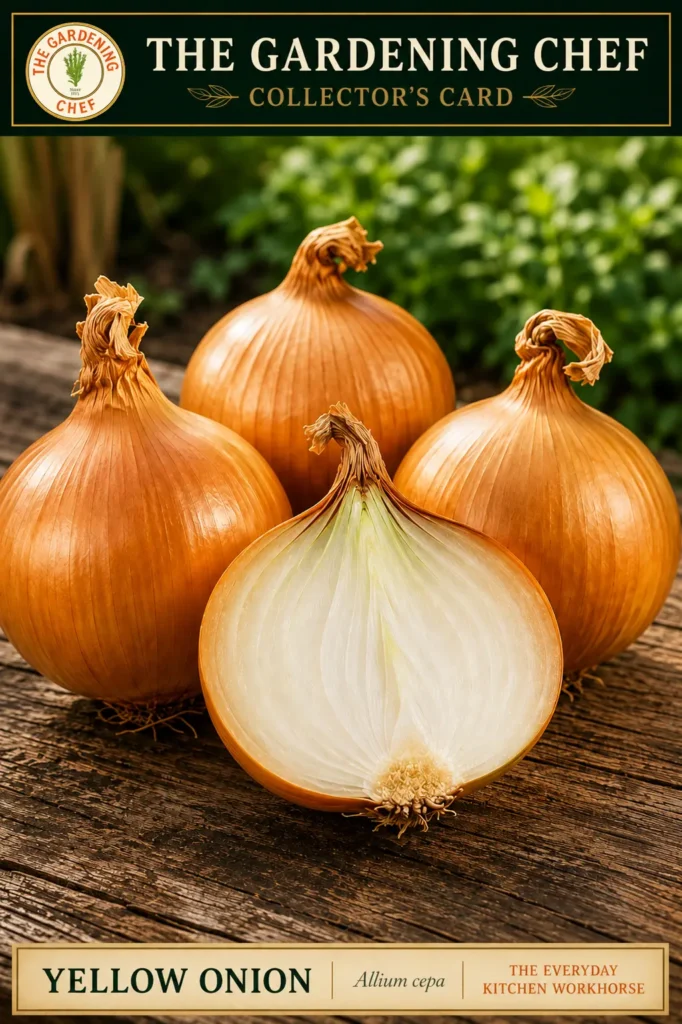
Yellow onion earns its place through versatility. Raw, it can be assertive and sharp. Give it heat and time and that character changes: the bite fades while sweetness and savory depth begin to emerge.
In the Kitchen
Flavor: Sharp and savory raw; mellow and sweeter when cooked
Best roles: Flavor base • roasting • caramelizing • stocks • soups
Pairs well with: Garlic • potatoes • tomatoes • beans • meats • root vegetables • herbs
Signature technique: Slow cooking to build sweetness and depth
In the Garden
Light: Full sun
Season: Cool-season crop
Start with: Seed • sets • transplants
Harvest: Mature bulb
Growing key: Match the onion’s day-length type to your region
The Gardening Chef Field Note
Grow yellow onions when your kitchen repeatedly begins with the words: “Cook the onions until softened.”
Think soup, chili, spaghetti sauce, beans, pot roast, gravy, or Sunday stew. If those meals already live at your table, the kitchen may be telling you what deserves space in your garden.
Red Onion: The Raw Color Builder
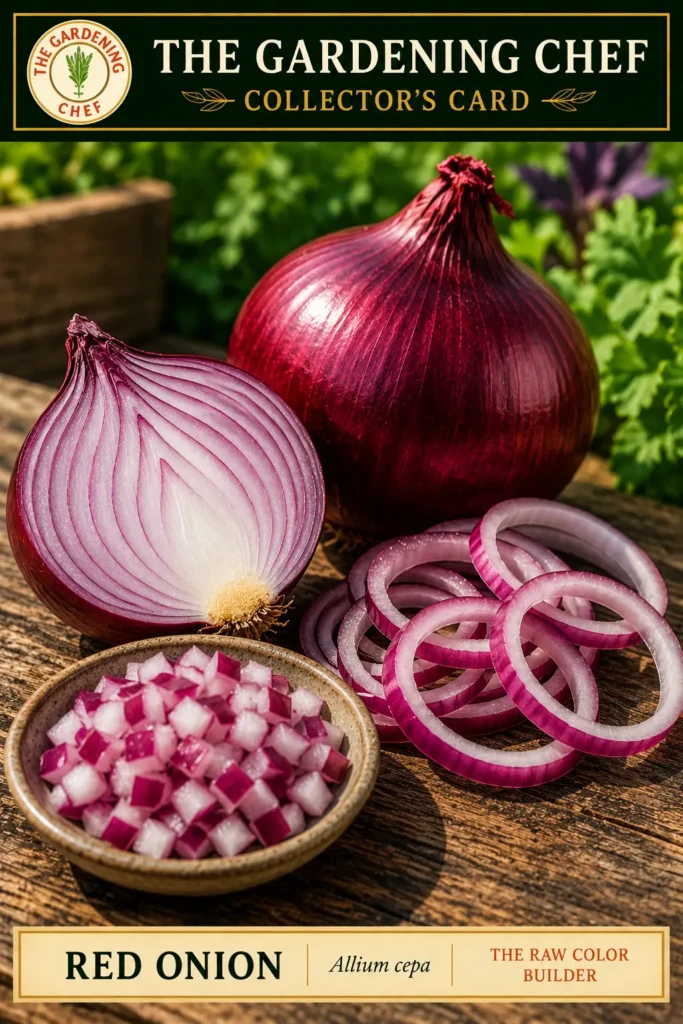
Red onion earns its place whenever a dish needs contrast. Its deep purple-red layers bring color before the first bite, while its crisp texture and sharpness can wake up foods that might otherwise feel rich, heavy, or one-dimensional.
In the Kitchen
Flavor: Sharp and crisp raw • softer and sweeter when cooked
Best roles: Salads • tacos • burgers • sandwiches • salsa • quick pickles
Pairs well with: Cucumbers • tomatoes • lime • vinegar • fresh herbs • grilled meats • cheeses
Signature technique: Slice thin or quick-pickle to soften the bite while keeping its color and crunch
In the Garden
Light: Full sun
Season: Cool-season crop
Start with: Seed • sets • transplants
Harvest: Mature bulb
Growing key: Match the onion’s day-length type to your region
The Gardening Chef Field Note
Grow red onions when your meals often need something crisp, colorful, and sharp enough to cut through richness.
Think cucumber salad, tacos, burgers, grain bowls, sandwiches, fresh salsa, or a jar of quick-pickled onions in the refrigerator. If those foods already appear regularly at your table, red onions give you a harvest that can move from garden to plate with very little between them.
White Onion: The Clean Sharp Onion
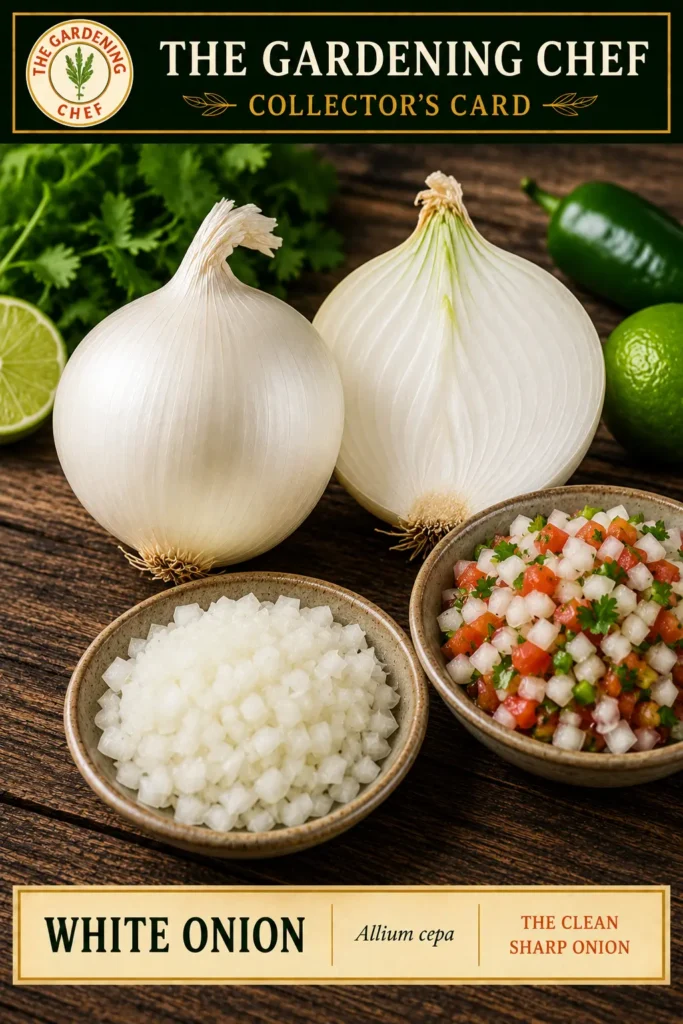
White onion brings a crisp, direct kind of onion flavor. It can be noticeably sharp when raw, yet that clean bite is exactly what makes it so useful beside rich meats, beans, grilled foods, tomatoes, chiles, lime, and other bold ingredients.
In the Kitchen
Flavor: Crisp and assertive raw • cleaner and sweeter as it cooks
Best roles: Tacos • salsa • pico de gallo • beans • grilling • fresh toppings
Pairs well with: Tomatoes • chiles • cilantro • lime • beans • avocado • grilled meats
Signature technique: Finely dice it for fresh dishes where you want onion flavor distributed through every bite
In the Garden
Light: Full sun
Season: Cool-season crop
Start with: Seed • sets • transplants
Harvest: Mature bulb
Growing key: Choose a day-length type suited to your region
The Gardening Chef Field Note
Grow white onions if tacos, salsa, beans, and grilled food show up at your table often enough that chopped onion is practically a condiment.
Think pico de gallo spooned over tacos, finely diced onion scattered over beans, fresh salsa beside grilled meat, or chopped onion with cilantro and lime. White onion earns its space when you want the onion to stay fresh, bright, and unmistakably present.
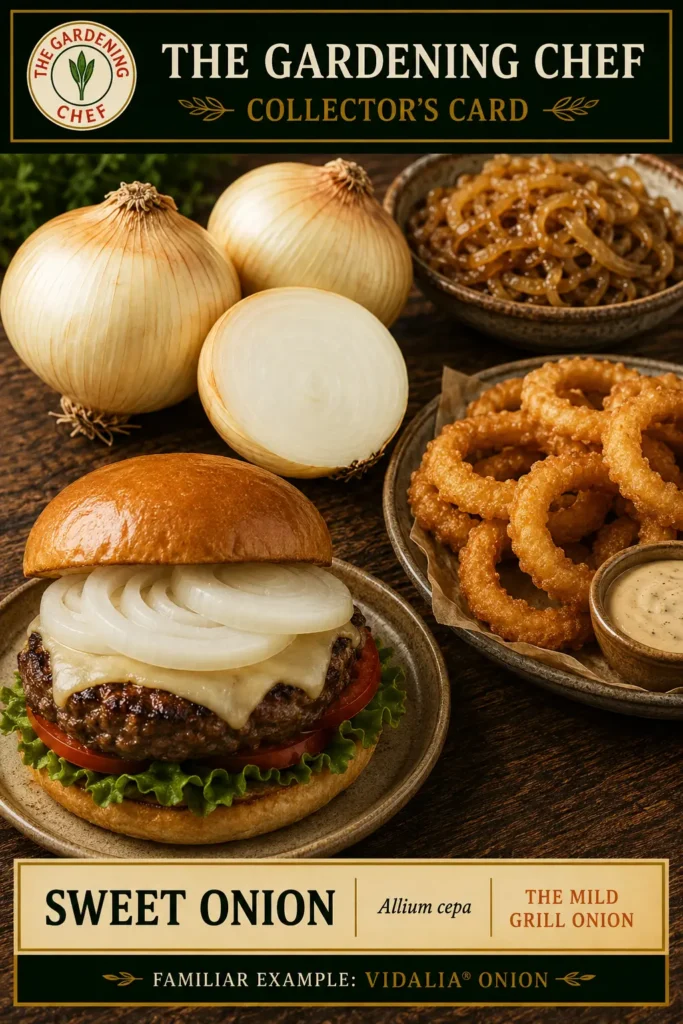
Sweet Onion: The Mild Grill Onion
Sweet onions bring a gentler kind of onion flavor to the kitchen. Their mild flavor makes them especially approachable raw, while cooking brings out even more sweetness and savory depth.
In the Kitchen
Flavor: Mild and juicy raw • mellow, savory, and increasingly sweet with heat
Best roles: Burgers • sandwiches • salads • grilling • roasting • onion rings • French onion soup
Pairs well with: Beef • cheese • tomatoes • peppers • balsamic vinegar • potatoes • fresh herbs
Signature technique: Cut into thick slices for grilling, or cook slowly until deeply browned and caramelized
In the Garden
Light: Full sun
Season: Cool-season crop
Start with: Seed • sets • transplants
Harvest: Mature bulb
Growing key: Choose a sweet-onion cultivar with the right day-length requirement for your region
The Gardening Chef Field Note
Grow sweet onions when you want onion flavor that is mild enough to enjoy raw and becomes especially sweet as it cooks.
If Vidalia immediately comes to mind, that’s no accident. It is one of the sweet onions Americans recognize by name, well suited to a thick raw slice on a burger, crisp onion rings, roasted wedges, a summer sandwich, or slowly caramelized onions headed toward French onion soup.
Shallot: The Delicate Sauce Builder
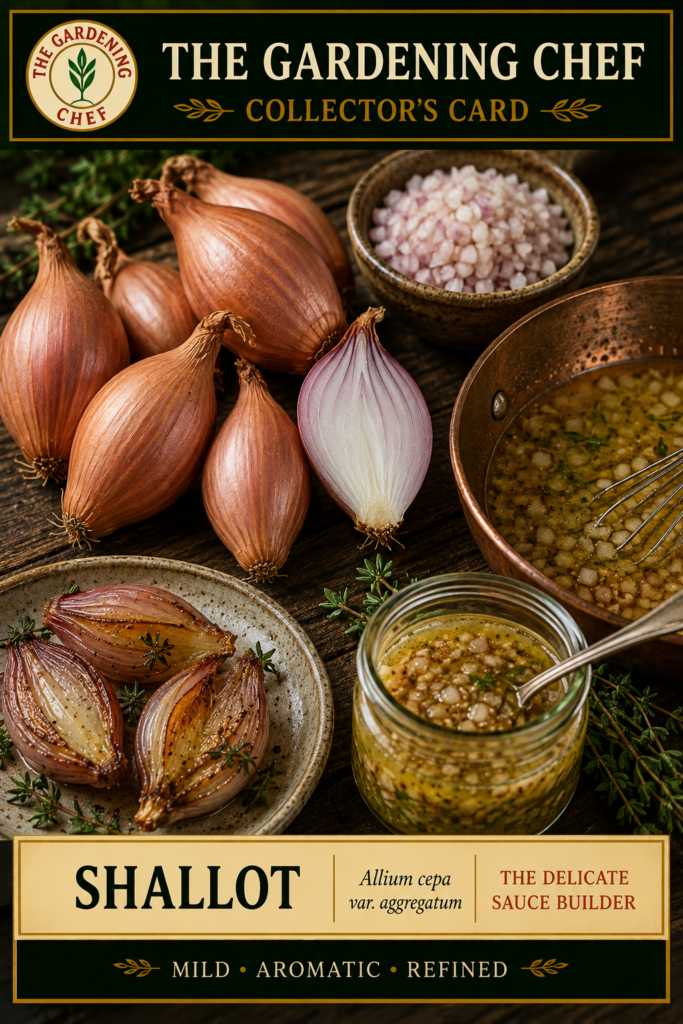
Shallots bring a refined, aromatic allium flavor to the kitchen. Smaller than most bulb onions and naturally suited to recipes that use them in modest amounts, they can add complexity without becoming the dominant flavor of the dish.
In the Kitchen
Flavor: Mild • aromatic • slightly sweet • delicate
Best roles: Vinaigrettes • pan sauces • roasting • sautés • garnishes
Pairs well with: Butter • wine • vinegar • mustard • mushrooms • fish • chicken
Signature technique: Mince finely for sauces or roast halves until tender and sweet
In the Garden
Light: Full sun
Season: Cool-season crop
Start with: Sets • bulbs • seed, depending on variety
Harvest: Mature clusters of bulbs
Growing key: A single planted shallot can divide underground and produce a cluster of new bulbs
The Gardening Chef Field Note
Grow shallots when a small harvest can make a big difference in the kitchen.
Recipes often need only one or two at a time, while a single planted shallot can multiply into a cluster—a useful crop that makes a modest garden harvest stretch across many meals.
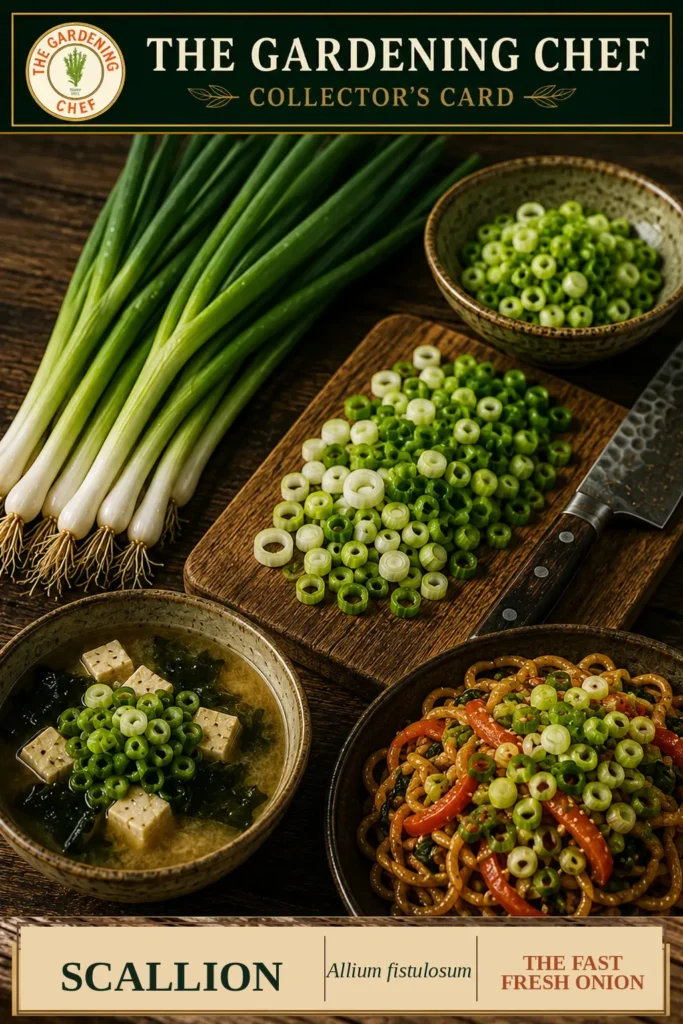
Scallion: The Fast Fresh Onion
Scallions, often called green onions, bring fresh onion flavor without waiting for a mature bulb. Both the white base and green tops are useful, making them especially convenient for quick kitchen harvests.
In the Kitchen
Flavor: Fresh • mild • grassy • gently onion y
Best roles: Garnishes • stir-fries • soups • eggs • noodles • dips
Pairs well with: Ginger • garlic • sesame • eggs • potatoes • rice • seafood
Signature technique: Slice thinly and add near the end of cooking to preserve their fresh flavor
In the Garden
Light: Full sun
Season: Cool-season crop
Start with: Seed • transplants
Harvest: Young stems before a large bulb develops
Growing key: Sow small batches in succession for a steady supply
The Gardening Chef Field Note
Grow scallions when you want an onion you can harvest a little at a time and use immediately.
A small bed or container can keep the kitchen supplied for eggs, soups, baked potatoes, noodles, and last-minute garnishes without requiring the space or waiting time of a full-sized bulb onion.
Leek: The Slow-Cooked Savory Onion
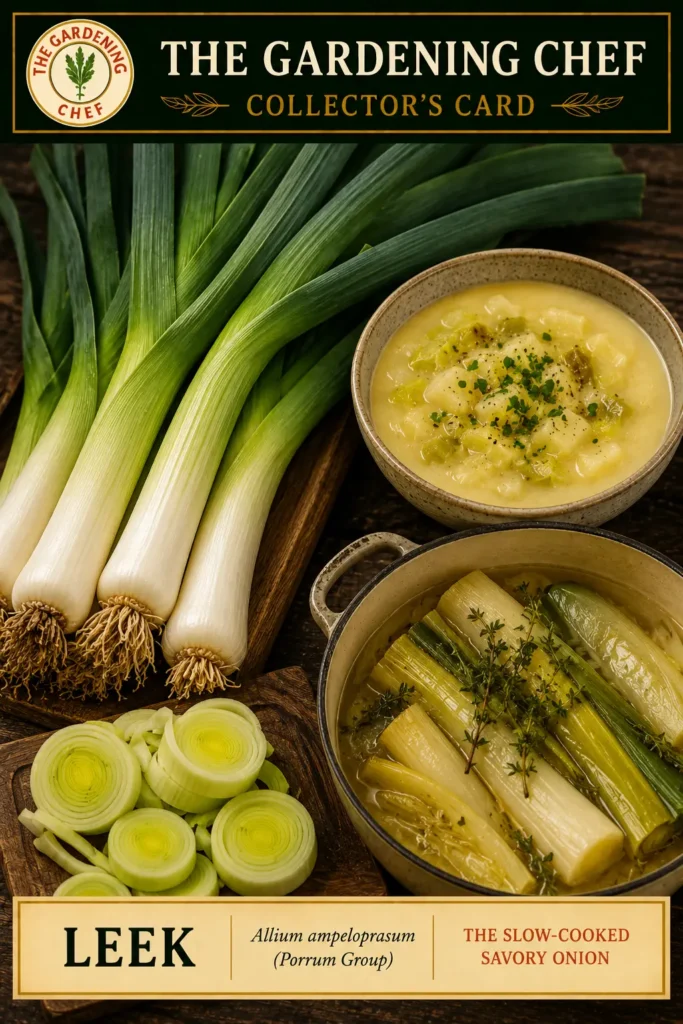
Leeks bring a mellow, savory onion flavor that becomes especially soft and silky with gentle cooking. Their broad layered stalks give soups, braises, and slow-cooked dishes body without demanding attention.
In the Kitchen
Flavor: Mild • savory • slightly sweet • mellow
Best roles: Potato-leek soup • stocks • braises • gratins • quiche • sautés
Pairs well with: Potatoes • butter • cream • thyme • eggs • chicken • fish
Signature technique: Split and rinse between the layers, then cook gently in butter or oil until tender rather than deeply browned
In the Garden
Light: Full sun
Season: Cool-season crop
Start with: Seed • transplants
Harvest: Thick mature stalks
Growing key: Keep soil around the lower stalk as it grows to encourage a longer, tender white section
The Gardening Chef Field Note
Grow leeks when you want an onion that rewards slow, gentle cooking.
That prized pale shank is partly a gardening creation: keeping the lower portion away from light helps it remain white and tender. And don’t automatically discard the tougher dark-green tops—they can still contribute excellent flavor to stocks and broths.
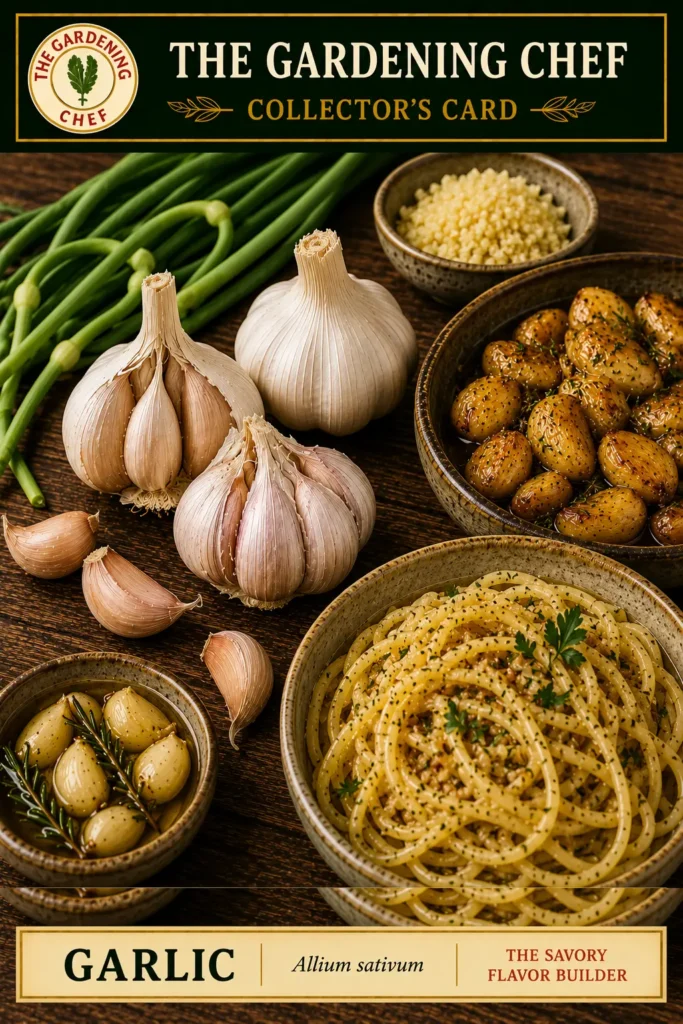
Garlic: The Savory Flavor Builder
Garlic brings concentrated aromatic flavor from a surprisingly small package. Raw it can be sharp and intense; cooking softens that edge and develops sweeter, deeper savory notes.
In the Kitchen
Flavor: Sharp raw • aromatic • savory • mellow and sweeter when cooked
Best roles: Sautés • sauces • roasting • marinades • soups • pesto
Pairs well with: Tomatoes • olive oil • butter • lemon • herbs • beans • meats
Signature technique: Cook chopped garlic gently—high heat can take it from fragrant to bitter very quickly
In the Garden
Light: Full sun
Season: Cool-season crop
Start with: Individual cloves
Harvest: Mature bulbs
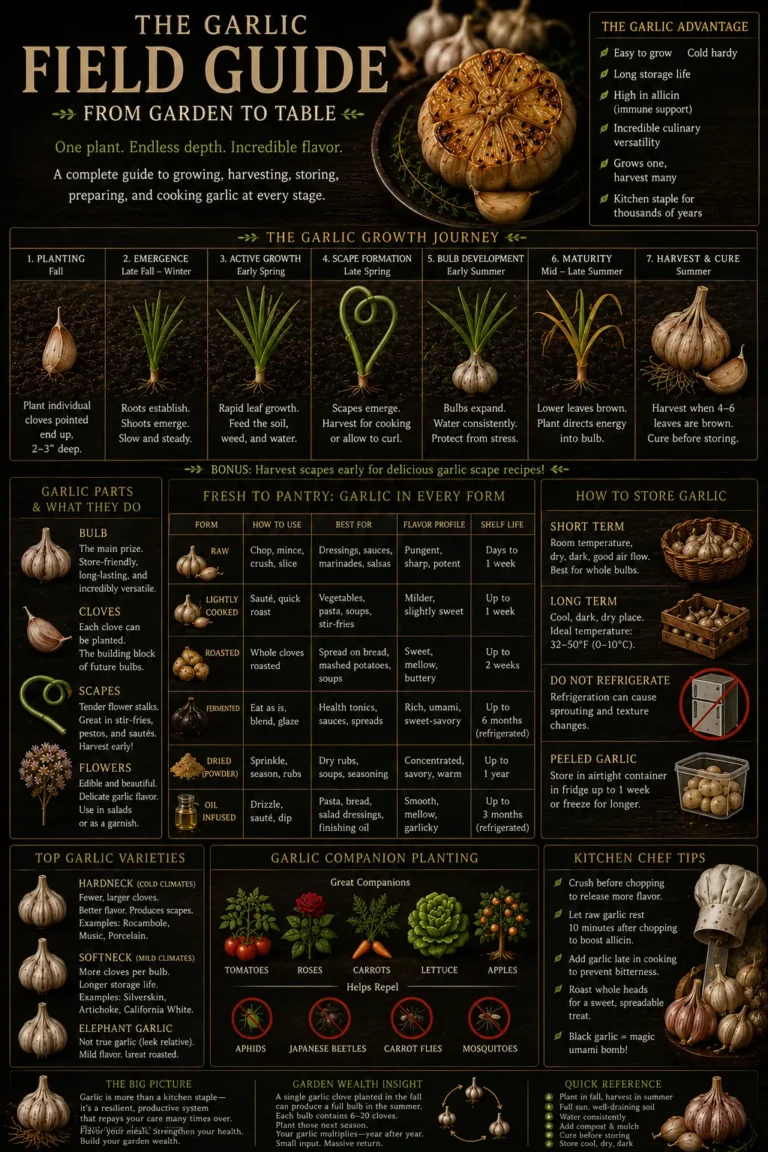
Growing key: Plant large, healthy cloves and allow harvested bulbs to cure before long-term storage
The Gardening Chef Field Note
Grow garlic when you want one planting to keep giving beyond a single harvest.
With hardneck garlic, the bonus begins before the bulbs are even ready: the curling flower stalks, called garlic scapes, can be harvested and cooked in early summer. Later comes the bulb—and some of its best cloves can become next season’s planting stock.
Chives: The Fresh Finishing Herb
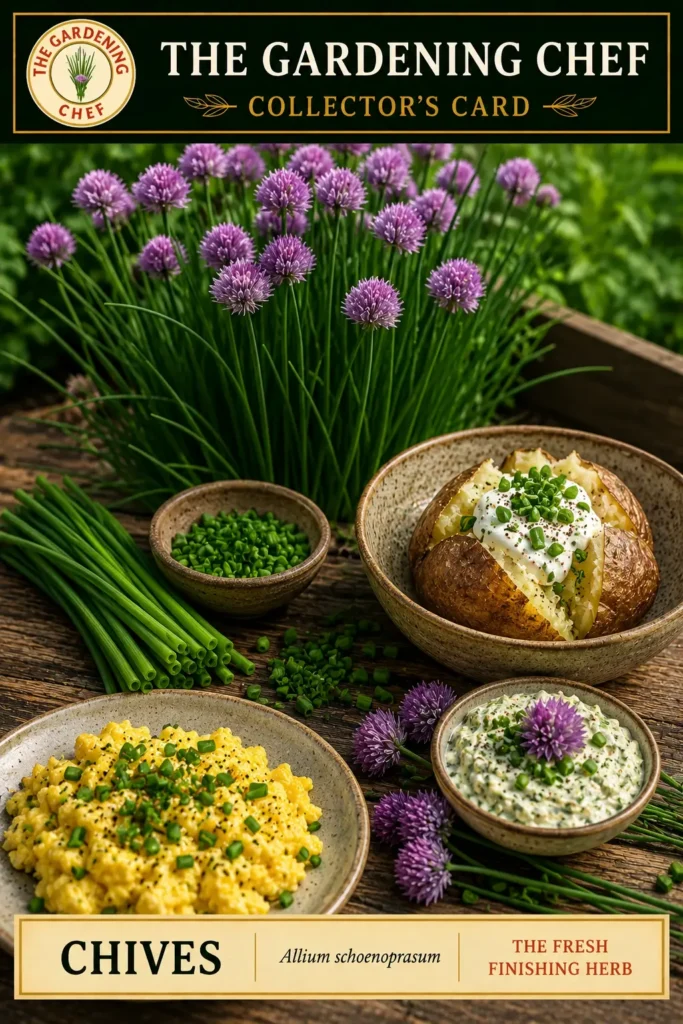
Chives bring gentle onion flavor in thin, tender leaves that can be snipped straight from the garden. Their delicate character is best preserved when they are added fresh or near the end of cooking.
In the Kitchen
Flavor: Mild • fresh • grassy • gently onion y
Best roles: Potatoes • eggs • soups • dips • salads • garnishes
Pairs well with: Butter • sour cream • cheese • lemon • fish • potatoes • eggs
Signature technique: Snip finely with scissors and add near the end so their fresh flavor stays bright
In the Garden
Light: Full sun
Season: Cool-season perennial
Start with: Seed • transplants • divisions
Harvest: Tender green leaves as needed
Growing key: Cut leaves near the base and established plants will continue producing fresh growth
The Gardening Chef Field Note
Grow chives when you want a perennial herb that can move from garden to plate in seconds.
And don’t overlook the purple blossoms. Chive flowers are edible too: pull apart the florets for salads, compound butter, or garnishes, or steep them in vinegar for a beautiful onion-scented infusion.
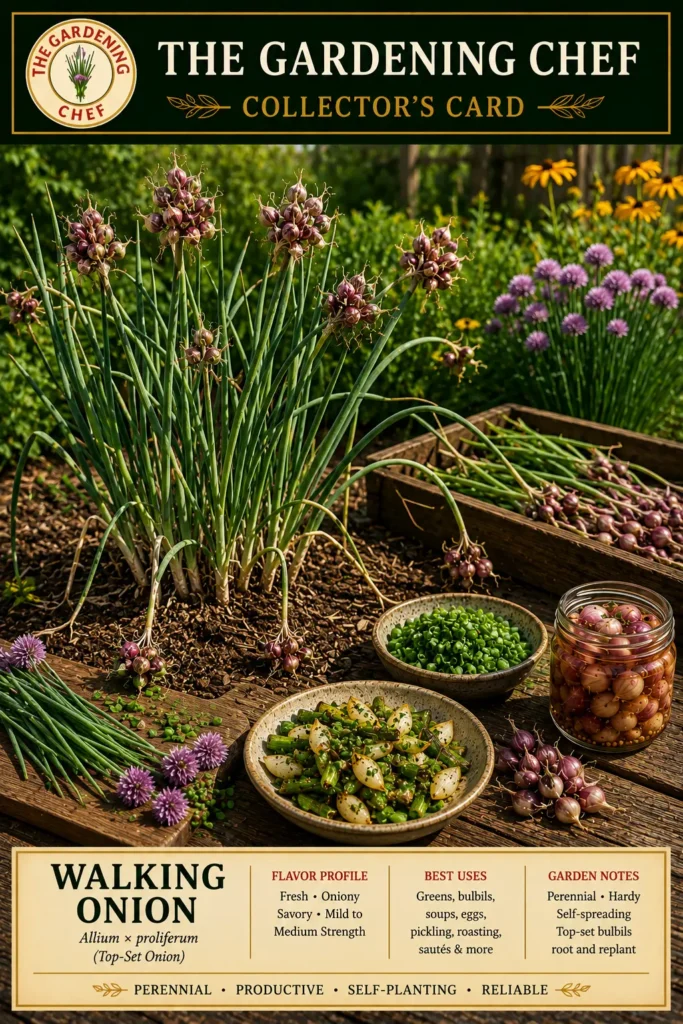
Walking Onion: The Onion That Plants Itself
Walking onions grow as perennial clumps, producing edible green shoots below and clusters of small bulbils high on their stalks. As those stalks bend toward the ground, the bulbils can take root and gradually move the patch outward.
In the Kitchen
Flavor: Fresh • oniony • savory • stronger as bulbs mature
Best roles: Green tops • soups • eggs • sautés • pickling • roasting small bulbils
Pairs well with: Potatoes • eggs • beans • butter • vinegar • herbs • meats
Signature technique: Use tender greens like scallions, or pickle and roast the small top-setting bulbils
In the Garden
Light: Full sun
Season: Hardy perennial
Start with: Top-set bulbils • divisions
Harvest: Green leaves • bulbils • underground bulbs
Growing key: Allow some top-set bulbils to touch the soil and root if you want the patch to expand naturally
The Gardening Chef Field Note
Grow walking onions when you want an edible onion patch that helps plant its own next generation.
Their unusual name comes from the way mature stalks can bend under the weight of their bulbils. When those bulbils reach the soil and root, a new clump begins a short distance from the parent plant—as though the onion has taken another step across the garden.
Bunching Onion: The Continuous Harvest Onion
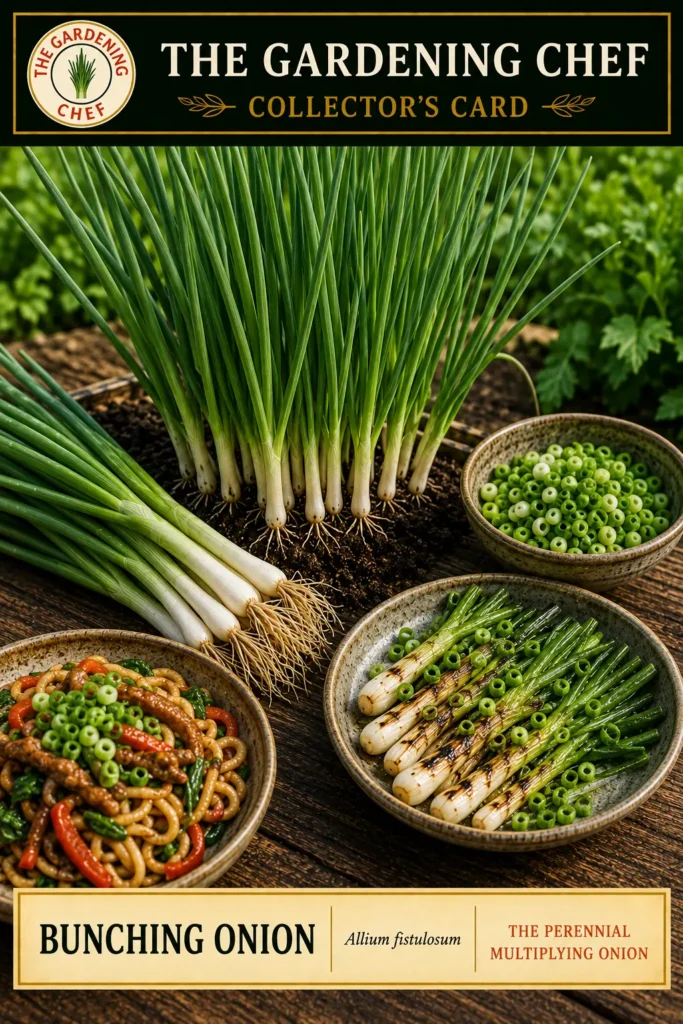
Bunching onions grow for their long white shanks and tender green tops rather than a round storage bulb. Leave the rooted base established, harvest the greens, and the plant can regrow while gradually developing into a larger perennial clump.
In the Kitchen
Flavor: Fresh • mild • savory • slightly stronger at the white base
Best roles: Stir-fries • soups • noodles • eggs • grilling • garnishes
Pairs well with: Ginger • garlic • sesame • soy • rice • eggs • seafood
Signature technique: Cook the thicker white shanks first and add the tender green tops near the end
In the Garden
Light: Full sun
Season: Perennial bunching onion
Start with: Seed • transplants • divisions
Harvest: Green tops and white shanks
Growing key: Leave the crown and roots established for repeated regrowth; mature clumps can expand and eventually be divided into additional plants.
The Gardening Chef Field Note
Grow bunching onions when you want an onion patch that gets more useful with time rather than disappearing with the harvest.
Instead of pulling the whole plant each time, cut what you need while leaving the established base growing. The greens return, and over time the base develops into a larger clump that can eventually be divided and replanted elsewhere. One planting can therefore become an ongoing kitchen supply rather than a one-season crop.
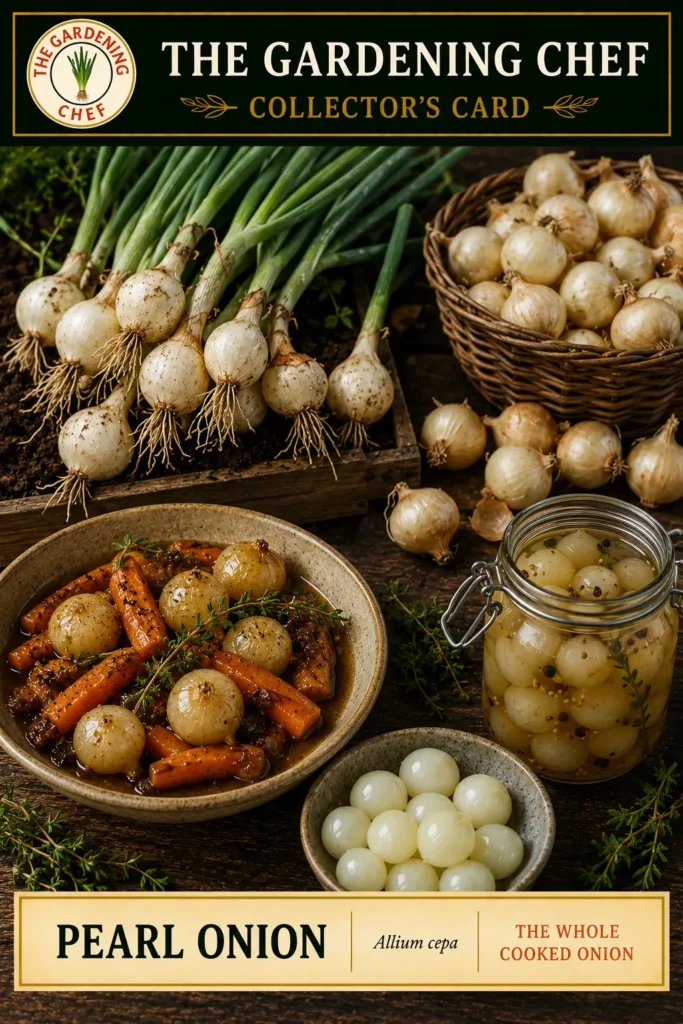
Pearl Onion: The Small Onion With a Big Role
Pearl onions are small, round bulbs prized for staying intact during cooking. Their size makes them ideal when you want the onion itself to remain visible on the plate rather than disappear into a dish.
In the Kitchen
Flavor: Mild • savory • gently sweet when cooked
Best roles: Braises • stews • roasting • glazing • pickling • pot roast
Pairs well with: Beef • chicken • butter • wine • carrots • mushrooms • herbs
Signature technique: Cook them whole—braise, roast, or glaze until the center becomes tender while the bulb keeps its shape
In the Garden
Light: Full sun
Season: Cool-season crop
Start with: Seed
Harvest: Small mature bulbs
Growing key: Pearl size comes from the cultivar and growing method; close spacing and early bulbing help keep the bulbs small. Oregon State notes that most commercial pearl onions are forms of Allium cepa.
The Gardening Chef Field Note
Grow pearl onions when you want an onion small enough to become a complete ingredient rather than simply part of one.
That little bulb can travel from the garden whole into a stew, braise, roasting pan, glazed vegetable dish, or pickle jar. And that is an important lesson for a new gardener: a pearl onion is not merely a regular onion harvested too soon. Variety, spacing, day length, and growing conditions all help determine that distinctive small bulb.
How Fat Changes Onion and Garlic Flavor
Choosing the right allium is only half the decision.
The next question is what happens when it meets the pan.
Onions, garlic, shallots, and leeks contain aromatic compounds that change dramatically with heat, time, and fat. Butter, olive oil, bacon fat, ghee, or another cooking fat does more than keep an onion from sticking. It helps carry aroma through the dish while giving the cook control over how quickly the allium softens, browns, and develops sweetness.
The same yellow onion can therefore become several very different ingredients.
Cook it gently over low heat and it softens without taking on much color, creating a quiet foundation for soups, sauces, beans, and braises.
Give it more heat and the edges begin to brown. Moisture cooks away, sweetness becomes more noticeable, and the onion starts contributing roasted, savory depth.
Give it enough time at controlled heat and it can move toward caramelization—dark, soft, concentrated, and almost jam-like.
Garlic moves through this progression much faster.
A little time in warm fat can make garlic fragrant and savory. Too much heat can turn those same small pieces brown and bitter before the rest of the dish has even begun.
That difference is why a recipe telling you to “cook the onions” is not really giving you enough information.
The better question is:
What do you want the allium to become?
If you want a gentle background, sweat it.
If you want savory depth, sauté or brown it.
If you want sweetness, give it more time.
If you want a fresh edge, skip the pan entirely and add the allium near the end.
The ingredient may be the same.
The technique changes its job.
The Onion Transformation Ladder
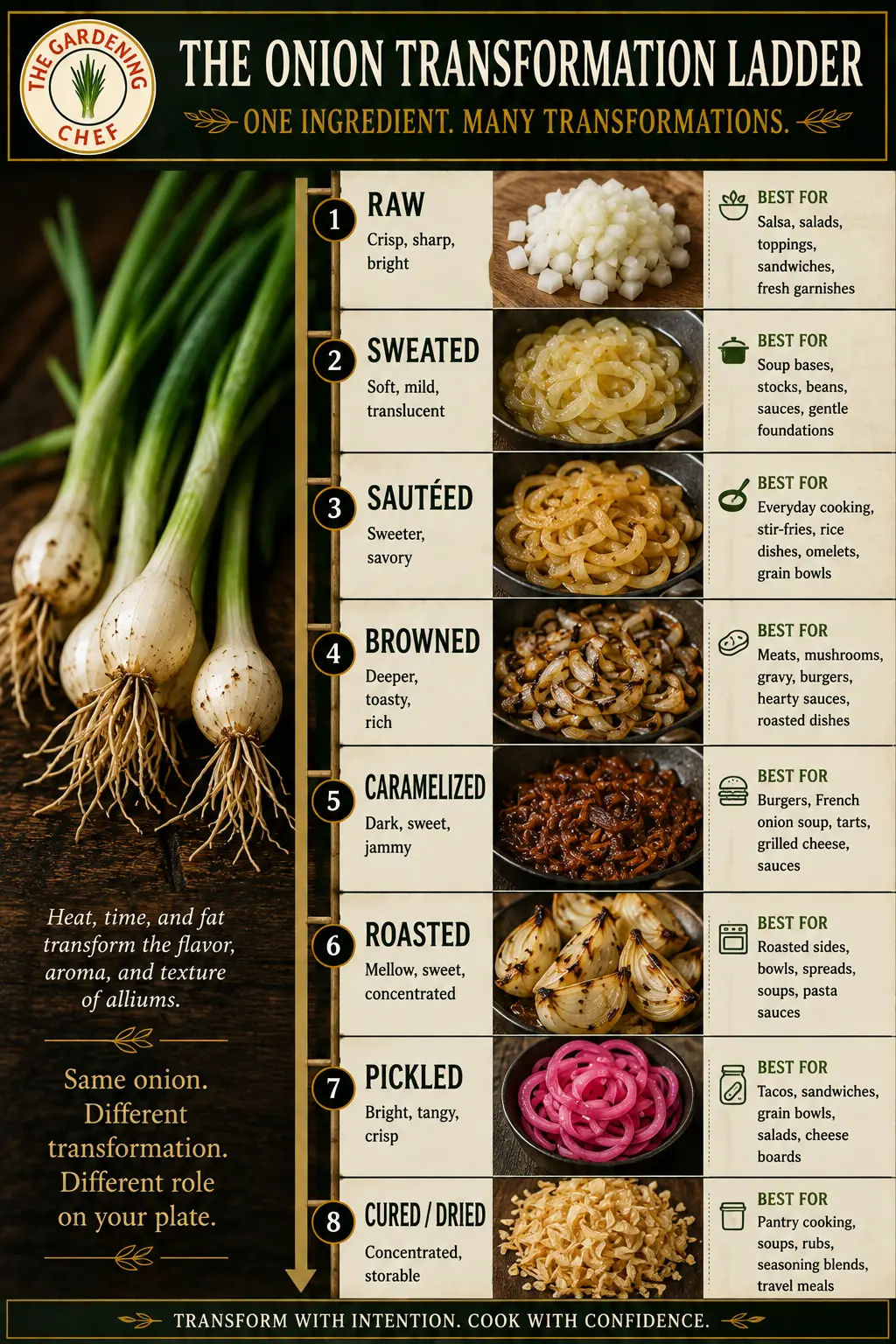
The important lesson is not memorizing eight techniques. It is recognizing that the same onion can become eight very different ingredients depending on what the meal needs.
Once you begin thinking this way, another possibility appears: instead of choosing just one allium, you can combine several of them to build flavor in layers.
Onion Family Flavor Systems
Once you understand what each allium does—and how cooking changes it—you can begin using them together.
The goal is not to add more onion flavor simply because you can.
It is to give different alliums different jobs.
One might begin the dish and nearly disappear into the background. Another may add aroma halfway through cooking. A third can arrive at the end with freshness, color, or acidity.
Think of it as building flavor in layers.
| Meal System | Foundation | Depth / Aroma | Fresh Finish | What It Creates |
|---|---|---|---|---|
| Soup & Stew | Yellow onion or leek | Garlic | Chives or scallions | Deep, mellow flavor with a fresh finish |
| Potato Comfort | Yellow onion or leek | Roasted or sautéed garlic | Chives | Richness without becoming heavy |
| Beans & Chili | Yellow or white onion | Garlic | Scallions or pickled red onion | Savory depth with brightness at the end |
| Stir-Fry & Noodles | Scallion whites or white onion | Garlic | Scallion greens | Cooked savory flavor plus fresh green contrast |
| Sauces & Pan Sauces | Shallot | Garlic, when appropriate | Chives | Delicate layers without overwhelming the sauce |
| Tacos & Fresh Salsa | White onion | — | Red onion, scallion, or pickled onion | Crispness, color, acidity, and contrast |
Build From the Bottom Up
The foundation allium usually enters first.
Yellow onion, leek, shallot, or the white portion of a scallion can soften in fat and become part of the structure of the dish.
Garlic often follows because it needs less time. Added too early, especially over high heat, it can burn before the foundation ingredients are ready.
Then comes the finish.
Chives, scallion greens, raw red onion, or pickled onion can bring back something cooking removed: freshness, crunch, color, or acidity.
That is why a bowl of potato-leek soup can begin with leek, deepen with garlic, and finish with chives without tasting like “too much onion.”
Each allium is doing a different job.
The Gardening Chef Rule
Do not ask how many alliums a dish contains. Ask whether each one has a job.
One can build the foundation. Another can deepen the aroma. A third can bring freshness at the finish.
Foundation. Depth. Finish.
When each allium has a purpose, layers become complexity rather than repetition.
Pantry Meal Systems
Onions, garlic, and their relatives do something especially valuable in a working pantry:
They help turn stored ingredients into different meals.
| Pantry Ingredient | Add | It Can Become |
|---|---|---|
| Beans | Yellow onion + garlic | Soup • chili • stew |
| Potatoes | Onion or leek + garlic + chives | Hash • soup • gratin |
| Canned tomatoes | Yellow onion + garlic | Sauce • soup • chili |
| Rice or noodles | Garlic + scallions | Fried rice • stir-fry • noodle bowl |
| Winter squash | Onion or shallot + garlic | Soup • roast • grain bowl |
| Eggs | Shallot • scallion • chives | Omelet • frittata • scramble |
| Root vegetables | Onion + garlic or leek | Roast • soup • stew |
A pantry does not become more useful only by storing more food. It becomes more useful when the ingredients on the shelf can move in different directions.
That is one reason onions and garlic earn so much space in a kitchen garden: they make the rest of the harvest easier to turn into dinner.
Onion Family Kitchen Problem Solver
If your dish tastes flat, add cooked onion or garlic for depth. If your dish tastes heavy, finish with chives, scallions, or pickled red onion. If your soup tastes thin, add leek or slowly cooked yellow onion for body. If your salsa tastes dull, add white onion for clean sharpness. If your sauce tastes rough, use shallot for refinement. If your pantry meals feel repetitive, add preserved onions, roasted garlic, or pickled alliums.
The Onion Family Life Cycle
Not every onion-family crop follows the same path.
Some are harvested fresh. Some are cured and stored. Others remain in the garden and produce again.
| Type | Examples | What Happens After Harvest |
|---|---|---|
| Fresh-use | Scallions • chives • leeks • sweet onions | Harvest and use while fresh |
| Storage | Yellow onions • garlic • shallots | Cure, store, and use over time |
| Repeat-harvest | Chives • bunching onions | Cut what you need and allow regrowth |
| Self-renewing | Walking onions | Harvest some while allowing the patch to reproduce |
Different parts can be useful too. Garlic produces edible scapes. Chive flowers can be eaten. Leek greens can flavor stock. Walking onions produce edible topsets as well as greens and bulbs.
Understanding what happens after harvest helps you decide whether a crop is feeding tonight’s dinner, stocking the pantry, or building next year’s garden.
A Regional Note About Bulb Onions
Bulb onions respond to day length, so choosing the right type for your region matters.
| Onion Type | Generally Best Suited For |
|---|---|
| Short-day | Southern regions with milder winters |
| Intermediate-day | Middle latitudes and transition regions |
| Long-day | Northern regions with long summer days |
This is different from simply choosing plants by USDA hardiness zone. Bulb formation is strongly influenced by the number of daylight hours the plant receives.
Choose the wrong day-length type and you may grow plenty of green leaves without getting the bulb you expected.
Scallions, chives, bunching onions, and walking onions are often more forgiving because their usefulness does not depend on producing a large storage bulb.
Before buying bulb-onion seed or sets, check whether the variety is short-day, intermediate-day, or long-day and whether it is recommended for your region.
Build a Simple Onion-Family Plan
You do not need to grow every type.
A small mix can cover most kitchen needs:
| Kitchen Need | Good Crop to Grow |
|---|---|
| Everyday cooking | Yellow onion |
| Fresh finishing flavor | Chives or scallions |
| Pantry storage | Garlic |
| Soups and slow cooking | Leeks |
| Repeated harvests | Bunching onions |
| Something unusual | Shallots, walking onions, or pearl onions |
Start with the foods you already cook.
If you make soups and sauces, grow onions and garlic. If tacos and salsa are common, add white onions and scallions. If potatoes and eggs appear often, chives may earn more garden space than another row of storage onions.
The goal is not to grow the most varieties. It is to grow the ones your kitchen will actually use.
When to Harvest Onions, Garlic, Leeks & More
Harvest timing depends on what you plan to do with the crop. Some onion-family plants are best picked fresh, while others need to mature fully before curing or storage.
| Crop | Harvest When… | Best Next Step |
|---|---|---|
| Scallions | Stems reach a useful size | Use fresh |
| Chives | Leaves are tender and actively growing | Snip as needed and allow regrowth |
| Bunching onions | Greens and white shanks are large enough to use | Harvest what you need and leave established plants to regrow |
| Leeks | Stalks reach the size you want for cooking | Harvest and refrigerate |
| Bulb onions | Tops fall over and outer skins begin drying | Cure before storage |
| Garlic | Several lower leaves have browned while upper leaves remain green | Harvest carefully, then cure |
| Shallots | Tops begin yellowing and falling over | Cure the bulb clusters |
| Walking onions | Greens, underground bulbs, or top-set bulbils reach usable size | Eat, pickle, or save bulbils for planting |
| Pearl onions | Small bulbs reach mature size | Use fresh, roast, braise, or pickle |
The important question is not only “Is it ready?”
It is also:
“Ready for what?”
A scallion headed for tonight’s dinner needs a different harvest strategy than an onion intended to last through winter.
Preserving and Storing Onions, Garlic & More
Different crops need different treatment after harvest.
| Method | Best For | Key Idea |
|---|---|---|
| Cure | Bulb onions • garlic • shallots | Dry the necks and outer skins before longer storage |
| Quick-pickle | Red onions • pearl onions | Adds acidity, color, and crunch |
| Freeze | Onions • cooked onion bases • garlic • chives | Useful when texture matters less than flavor |
| Dry | Onions • garlic • chives | Fully dehydrate before airtight storage |
| Replant | Garlic cloves • walking-onion bulbils • established perennial clumps | Carry part of the harvest into another growing season |
Storage onions and garlic need dry conditions and good airflow after curing. They are not ideal for the same humid storage area used for many root vegetables. Damaged, soft, or questionable bulbs should be separated and used first rather than stored with the rest.
Potatoes are another reason to think in storage zones rather than one general “root cellar.” Potatoes prefer darker, more humid conditions than onions and garlic, so storing them separately when possible gives each crop conditions better suited to it.
A Quick Food-Safety Note
Be especially careful with homemade garlic in oil. The National Center for Home Food Preservation warns against keeping garlic-in-oil mixtures at room temperature because of botulism risk. Their guidance is to refrigerate freshly prepared garlic in oil at 40°F or below for no more than four days, or freeze it for longer storage.
For preservation methods intended to sit safely on the pantry shelf, use a tested preservation recipe rather than improvising.
Common Onion Family Mistakes
A few simple mistakes can undo an otherwise good harvest or meal.
| Mistake | Better Approach |
|---|---|
| Treating every onion the same | Match the onion to the job: yellow for cooked depth, red for raw color, white for fresh sharpness, shallot for delicate sauces |
| Burning garlic | Add garlic later than onions and cook it gently |
| Skipping the leek wash | Split and rinse between the layers where soil can hide |
| Ignoring onion day length | Choose short-, intermediate-, or long-day bulb onions suited to your region |
| Growing only storage onions | Add scallions, chives, or bunching onions for fresh and repeated harvests |
| Storing onions like root vegetables | Cure them well and store them dry with good airflow |
Most onion-family problems come down to the same idea:
Know what the crop is meant to do—then cook, grow, harvest, and store it accordingly.
Frequently Asked Questions
Are garlic, leeks, shallots, scallions, and chives part of the onion family?
Yes. They all belong to the broader group commonly called alliums, although their flavors, growth habits, and kitchen uses differ.
What onion should a beginner grow first?
Scallions and chives are good choices for quick, forgiving harvests. Garlic is also beginner-friendly if you have time to let it mature.
Why does garlic turn bitter when cooked?
Garlic burns quickly. Add it after longer-cooking onions and use moderate heat so it becomes fragrant without scorching.
Why do leeks need so much washing?
Soil can collect between their tightly layered leaves. Split or slice leeks and rinse carefully before cooking.
Can onions and potatoes be stored together?
They are better stored separately when possible because they prefer somewhat different storage conditions.
What is the safest beginner way to preserve onions and garlic?
Start with curing, freezing, drying, or refrigerator quick pickles. For shelf-stable canning, fermentation, or garlic-in-oil preparations, follow a tested preservation method.
A Quick Note About Pets
Onions, garlic, leeks, chives, scallions, shallots, and other members of the onion family can be harmful to dogs and cats if eaten.
Keep raw and cooked onion-family foods, powders, scraps, and compost out of reach of pets.
Where This Connects
The onion family rarely works alone. If you want to keep exploring, these guides build naturally on what you just learned:
Garlic Field Guide — Go deeper into garlic, from cloves and scapes to curing, storage, and replanting.
Tomato Field Guide — Follow onions and garlic into sauces, salsa, soups, chili, and preserved summer meals.
Potato Field Guide — Explore one of the onion family’s strongest kitchen partners in soups, hashes, gratins, roasting, and storage meals.
Herb Flavor Multiplier Guide — Learn how herbs add freshness, aroma, and finishing flavor to the foundation onions and garlic create.
Cooking Fats Field Guide — Continue the Transformation Ladder by exploring how fat and heat affect flavor, browning, texture, and cooking technique.
Root Cellar Field Guide — Learn how onions and garlic fit into a larger winter-storage system.
Preservation Pantry Field Guide — Take pickling, drying, freezing, and safe preservation into the rest of the harvest.
Want to explore more? Visit the Field Guide Library
The Onion Field Guide Lesson
Most people think an onion is just an onion. But once you begin cooking and growing with intention, the differences matter.
A yellow onion is not better than a red onion; it is better for building cooked depth. Red onion brings color, crunch, and sharpness. Leeks bring softness. Shallots bring delicacy. Garlic brings concentrated savory flavor. Scallions and chives bring freshness.
The right choice depends on the job.
That is the larger lesson of the onion family: you do not need to grow every variety or memorize every rule. Learn what each ingredient does, choose the ones your kitchen actually uses, and treat the harvest in a way that brings out its best.
The onion family gives you more than bulbs. It gives you choices—fresh or stored, raw or cooked, sharp or sweet, planted once or harvested again and again.
Choose with purpose. Cook with intention. Grow what you use. Honor the Harvest.