The Squash & Cucumber Abundance Guide Promise
This is not just a squash article.
It is a working kitchen-and-garden reference for anyone who has ever planted one zucchini too many, found a cucumber hiding under the leaves, or watched a winter squash patch turn from green vines into months of future meals.
A cook can use this guide to choose the right squash or cucumber for salads, grilling, roasting, soups, casseroles, pickles, relishes, fritters, breads, freezer packs, sheet-pan meals, and pantry cooking.
A gardener can use it to understand when to harvest small, when to let fruit mature, when a crop is meant for immediate use, and when a crop becomes long-term storage.
A preserver can use it to route overflow into refrigerator pickles, fermented pickles, relish, shredded freezer packs, soups, purees, dehydrated slices, and cured winter squash.
A pantry builder can use it to distinguish between fresh abundance and storage abundance.
A Wealth Garden reader can use it to understand one of the most important lessons in any productive system:
Abundance without management becomes waste.
Squash and cucumbers are not quiet crops.
They do not politely wait until you are ready.
They arrive quickly, hide under leaves, grow overnight, and force the gardener to answer a practical question:
What are you going to do with all of this?
That question is the heart of this guide.
Save this guide if you want to:
Choose the best squash or cucumber for fresh eating, cooking, pickling, roasting, stuffing, baking, freezing, drying, or storing.
Know when to harvest zucchini, yellow squash, cucumbers, pickling cucumbers, pattypan squash, butternut, acorn, spaghetti squash, delicata, and pumpkins.
Understand the difference between summer squash and winter squash.
Turn zucchini overflow into meals, freezer packs, breads, fritters, casseroles, and shared food.
Turn cucumber overflow into pickles, relish, cold salads, yogurt sauces, ferments, and refrigerator jars.
Store winter squash properly so it becomes food for later instead of counter clutter.
Connect squash and cucumbers to tomatoes, peppers, onions, garlic, herbs, potatoes, preservation, pantry systems, and The Gardening Chef Field Guide Library.
Start Here: Choose Your Reading Path
| If you are… | Start with… | You will learn… |
|---|---|---|
| A home cook | Best Uses by Type | Which squash or cucumber belongs in salads, soups, roasting pans, pickles, casseroles, breads, and freezer meals. |
| A beginner gardener | The Harvest Window | Why small squash and cucumbers are usually better, and how oversized produce changes purpose. |
| A preserver | Turn Overflow Into Lasting Value | How to freeze, pickle, ferment, dehydrate, store, and cook ahead. |
| A pantry builder | Summer Squash vs Winter Squash | Which crops must be used quickly and which can become storage food. |
| A meal planner | Squash & Cucumber Kitchen Systems | How to keep abundance from becoming repetitive or wasteful. |
| A Wealth Garden reader | The Overflow System | How abundance becomes wealth only when it is directed. |
Squash & Cucumber Master Index
| Section | Use it when… |
|---|---|
| The Squash & Cucumber Promise | You want the big-picture reason this guide matters. |
| The Abundance Lesson | You need to understand why these crops require a system. |
| Varieties at a Glance | You want a fast comparison of best uses, harvest windows, and storage life. |
| Summer Squash vs Winter Squash | You need to know which crops are urgent and which are storage crops. |
| Deep Variety Guide | You want to understand zucchini, yellow squash, cucumbers, pickling cucumbers, pattypan, butternut, acorn, spaghetti squash, delicata, and pumpkins. |
| Harvest Window Guide | You want to avoid oversized, bitter, watery, or poor-storage harvests. |
| Preservation Ladder | You have more than you can eat fresh. |
| Chef’s Save-It Reference | You are cooking and need to route the harvest quickly. |
| Growing Notes | You want better production, pollination, trellising, and plant health. |
| Common Problems | Your vines are struggling and you need likely causes. |
| Food Safety Notes | You are preserving and need to avoid unsafe shortcuts. |
| Wealth Garden Connection | You want the deeper systems lesson behind abundance. |
The Squash & Cucumber Abundance Guide
Some crops whisper.
Squash and cucumbers do not.
They arrive like a flood.
One day you see yellow blossoms and feel hopeful. A few days later, there is a small zucchini tucked under a leaf. Then another. Then three more. Then a cucumber that somehow grew from polite to enormous overnight. Then a yellow squash hiding behind the stem that you swear was not there yesterday.
Then there is a basket on the counter.
Then another basket.
Then you start wondering whether your neighbors lock their doors because they know you are coming with zucchini again.
That is the cucurbit lesson.
Squash and cucumbers do not only teach you how to grow food.
They teach you how to handle abundance.
Tomatoes may build gradually. Garlic waits and stores. Herbs multiply flavor. Potatoes hide their value underground.
But squash and cucumbers teach urgency.
They ask:
Can you harvest at the right time?
Can you use what comes quickly?
Can you preserve the overflow?
Can you turn surplus into meals, pickles, freezer bags, breads, soups, sauces, relishes, gifts, and pantry value?
Can you receive abundance without letting it become waste?
Because abundance is not just growing more.
Abundance is knowing what to do with it.
Why Squash and Cucumbers Deserve Their Own Field Guide
Squash and cucumbers are among the most generous plants in the kitchen garden.
They grow quickly, produce heavily, and overwhelm beginners in both wonderful and frustrating ways. One plant can become more than a household expects. A few plants can create a weekly harvest rhythm. A bed of cucumbers or zucchini can turn into fresh meals, snacks, pickles, freezer packs, baked goods, soups, relishes, preserves, and shared food.
But this abundance comes with a warning.
Fresh squash and cucumbers are not all the same.
Some are meant to be eaten young and tender.
Some are meant to be picked small.
Some are meant to become pickles.
Some are meant to be cooked immediately.
Some are meant to mature and store for months.
Some become watery if handled poorly.
Some become tough if left too long.
Some turn from perfect to oversized almost overnight.
That is why people joke about zucchini.
The plant is generous, but it is not patient.
A cucumber left too long may become seedy and bitter. A zucchini left too long may become large, watery, and better suited for shredding than sautéing. A winter squash harvested too early may not store well. A pumpkin picked before maturity may never reach its full kitchen value.
The lesson is not simply:
Grow squash.
The lesson is:
Match the harvest to the use.
That is the heart of The Gardening Chef system.
Grow what you will use. Use what you harvest. Preserve what you cannot use today. Share what the system gives beyond your table.
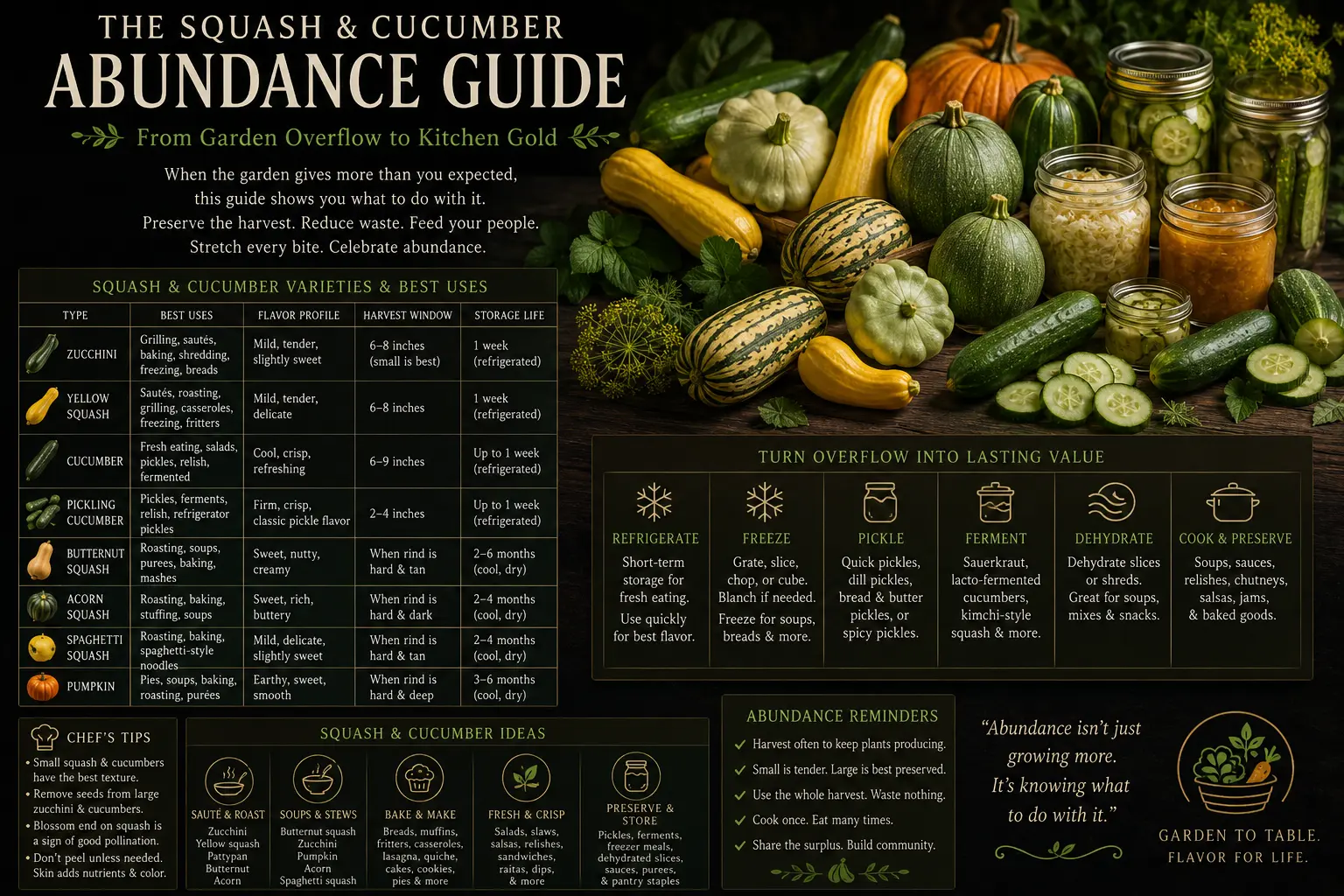
Field Guide Poster Preview
The Squash & Cucumber Abundance Guide poster is designed as a visual kitchen and garden reference for cooks, gardeners, pantry builders, and anyone who has ever looked at a pile of zucchini and thought:
What do I do with all of this?
Use the poster when you need to remember:
Which squash and cucumbers are best fresh.
Which are best cooked.
Which are best pickled.
Which are best stored.
Which should be harvested small.
Which can become winter pantry crops.
How to turn overflow into lasting value.
How to reduce waste.
How to cook once and eat many times.
How to treat abundance as a system.
This kind of guide belongs in a kitchen, pantry, garden binder, seed-planning notebook, preservation shelf, or harvest station.
Download the Printable Squash & Cucumber Abundance Guide — $0.99
[Button: Download the Squash & Cucumber Abundance Guide]
The Abundance Lesson
A small harvest is easy.
You pick a cucumber. You slice it into a salad.
You pick a zucchini. You sauté it with olive oil and garlic.
You pick a yellow squash. You grill it.
But abundance is different.
Abundance requires a plan.
A basket of cucumbers is not just fresh eating anymore. It becomes pickles, relish, cucumber salad, fermented cucumbers, refrigerator pickles, tzatziki, cold soups, sandwiches, infused water, and gifts.
A pile of zucchini is not just a side dish anymore. It becomes sautéed zucchini, shredded freezer packs, zucchini bread, fritters, lasagna layers, soups, casseroles, grilled slabs, muffins, pancakes, stir-fries, and sauce stretchers.
A winter squash harvest is different again.
Butternut, acorn, delicata, pumpkins, and spaghetti squash do not demand the same immediate response as zucchini. They become stored meals waiting in a cool, dry place.
They teach a different kind of abundance:
Stored abundance.
This is why squash and cucumbers are one of the most important guides in the Field Guide Library.
They teach that abundance has two faces:
Fresh abundance must be used quickly.
Storage abundance must be protected carefully.
Both are valuable.
Both can be wasted.
Both need a system.
Squash and Cucumber Varieties at a Glance
| Type | Best Uses | Flavor Profile | Harvest Window | Storage Life |
|---|---|---|---|---|
| Zucchini | Grilling, sautéing, baking, shredding, freezing, breads, fritters, casseroles | Mild, tender, slightly sweet | 6–8 inches; smaller is usually best | About 1 week refrigerated |
| Yellow Squash | Sautéing, roasting, grilling, casseroles, fritters, freezing | Mild, tender, delicate | 6–8 inches | About 1 week refrigerated |
| Slicing Cucumber | Fresh eating, salads, sandwiches, cold soups, yogurt sauces, infused water | Cool, crisp, refreshing | Usually 6–9 inches, depending on type | Up to 1 week refrigerated |
| Pickling Cucumber | Dill pickles, bread-and-butter pickles, ferments, relish, refrigerator pickles | Firm, crisp, classic pickle flavor | 2–4 inches for small pickles; larger for spears or relish | Up to 1 week refrigerated |
| Pattypan Squash | Roasting, stuffing, grilling, sautéing, mixed platters | Tender, mild, slightly nutty | Small and tender | About 1 week refrigerated |
| Butternut Squash | Roasting, soups, purées, mashes, baking, curries | Sweet, nutty, creamy | Mature, hard rind, tan color | Often 2–6 months cool and dry |
| Acorn Squash | Roasting, baking, stuffing, soups, grain bowls | Sweet, rich, slightly nutty | Mature, hard rind, deep color | Often 2–4 months cool and dry |
| Spaghetti Squash | Roasting, baking, noodle-style dishes, casseroles | Mild, delicate, slightly sweet | Mature, hard rind, yellow/tan color | Often 2–4 months cool and dry |
| Delicata Squash | Roasting, stuffing, sheet-pan meals, grain bowls | Sweet, creamy, edible skin when cooked | Mature, cream skin with stripes | Often 1–3 months cool and dry |
| Pumpkin | Pies, soups, baking, roasting, purées, seeds, decoration | Earthy, sweet, smooth depending on type | Mature, hard rind, deep mature color | Often 3–6 months cool and dry |
Summer Squash vs Winter Squash
The difference between summer squash and winter squash is one of the most important ideas in this guide.
Summer squash is harvested young and tender.
Winter squash is harvested mature and cured for storage.
That one difference changes everything.
| Type | Harvested When | Texture | Storage | Best Uses |
|---|---|---|---|---|
| Summer Squash | Young and tender | Moist, soft, quick-cooking | Short-term refrigerated | Sautéing, grilling, roasting, fritters, casseroles, quick meals |
| Winter Squash | Fully mature with hard rind | Dense, sweet, starchy | Longer-term cool, dry storage | Roasting, soups, baking, stuffing, purées, pantry meals |
Summer squash teaches speed.
Winter squash teaches patience.
Summer squash asks:
What will you do with this today?
Winter squash asks:
How will you protect this for later?
Both are abundance crops.
But they require different habits.
Zucchini: The Classic Overflow Crop
Zucchini may be the most famous abundance crop in the home garden.
It grows quickly, hides under leaves, and seems to double in size when you look away. A perfect zucchini is tender, mild, and small enough to use easily. An oversized zucchini is still useful, but it becomes a different ingredient.
This is the first lesson zucchini teaches:
Size changes purpose.
Small zucchini are ideal for grilling, sautéing, roasting, raw ribbons, stir-fries, and quick side dishes. Medium zucchini can be sliced, diced, stuffed, or added to soups and casseroles. Large zucchini are often better shredded for breads, muffins, fritters, pancakes, freezer packs, sauces, and baked dishes where texture matters less.
Zucchini does not have a strong flavor on its own.
That is not a weakness.
It is a canvas.
Garlic, basil, thyme, oregano, tomato, onion, pepper, lemon, Parmesan, olive oil, eggs, potatoes, beans, pasta, and bread all work with zucchini because zucchini allows other flavors to come forward.
It is one of the great stretchers of the kitchen.
A little zucchini can extend a pasta dish, bulk up soup, lighten a casserole, add moisture to baked goods, or turn a small meal into something more generous.
Best For:
Grilling, sautéing, roasting, baking, shredding, freezing, fritters, breads, muffins, casseroles, soups, stir-fries.
Kitchen Lesson:
Use small zucchini for tenderness. Use large zucchini for shredding, baking, stuffing, and freezer packs.
Garden Value:
Zucchini is valuable because it produces quickly and generously. It gives beginners visible success, but it also teaches harvest discipline. Pick often. Pick small. Use quickly.
Abundance Lesson:
Zucchini teaches that surplus must be directed. If you do not choose a use for it, it chooses waste.
Yellow Squash: The Tender Summer Cousin
Yellow squash is bright, tender, and cheerful.
It behaves much like zucchini in the garden, but in the kitchen it often feels more delicate. Its color alone makes a plate look warmer. Sliced yellow squash in a skillet with garlic and butter looks like summer. Grilled yellow squash with herbs feels simple and abundant. Mixed with zucchini, onions, peppers, and tomatoes, it becomes the backbone of easy garden cooking.
Yellow squash is best when harvested young.
As it gets larger, it can become seedy, watery, and less tender. That does not make it useless, but it changes how you should use it. Small yellow squash can be sliced and sautéed. Larger ones may be better for casseroles, soups, fritters, or shredding.
Yellow squash belongs in quick cooking.
It does not need a long simmer to prove itself. In fact, overcooking can turn it soft and watery. A good cook treats it gently, uses enough heat to develop flavor, and pairs it with herbs, garlic, onion, pepper, tomato, cheese, or breadcrumbs when more structure is needed.
Best For:
Sautéing, grilling, roasting, casseroles, fritters, soups, stir-fries, freezing, quick side dishes.
Kitchen Lesson:
Cook yellow squash quickly and avoid overcooking when you want it to keep texture.
Garden Value:
Yellow squash gives fast, colorful harvests and works well in summer meal planning. It is one of the crops that helps gardeners feel the abundance of the season.
Abundance Lesson:
Yellow squash teaches timing. Tenderness is harvested early.
Slicing Cucumbers: The Cool Fresh Crop
Cucumbers bring a different kind of abundance.
They do not ask to be cooked.
They ask to refresh.
A cucumber is cool, crisp, watery, and clean. It belongs in salads, sandwiches, cold soups, yogurt sauces, pickles, relishes, infused water, and quick snacks. A cucumber straight from the garden can feel like a drink and a vegetable at the same time.
But cucumbers demand timing.
Harvest too late and they can become large, seedy, watery, and sometimes bitter. A cucumber that looked small yesterday can become overgrown quickly in warm weather.
This is why cucumber plants teach daily attention.
The harvest window is short.
The reward is high.
Cucumbers are especially powerful because they can move from fresh eating into preservation. When the counter begins filling with cucumbers, the kitchen can shift into pickles, relish, fermented cucumbers, vinegar salads, tzatziki, and cold dishes.
A cucumber plant does not just produce snacks.
It produces choices.
Best For:
Fresh eating, salads, sandwiches, cold soups, pickles, relishes, ferments, yogurt sauces, infused water.
Kitchen Lesson:
Use cucumbers quickly after harvest for the best crispness and flavor. Salt and drain grated or sliced cucumber for yogurt sauces and some salads to prevent watery results.
Garden Value:
Cucumbers are high-value because they produce fresh, hydrating food and can become preserved pantry items. Trellised cucumbers also make excellent use of vertical space.
Abundance Lesson:
Cucumbers teach observation. The best harvest is often found by checking every day.
Pickling Cucumbers: The Preservation Crop
Pickling cucumbers are grown with a purpose.
They are usually smaller, firmer, and better suited to pickling than large slicing cucumbers. Their size, texture, and skin make them ideal for dill pickles, bread-and-butter pickles, refrigerator pickles, fermented pickles, spears, chips, and relish.
The pickling cucumber is one of the clearest examples of growing for a future use.
You are not only growing a vegetable.
You are growing a jar.
That changes how you harvest.
Small cucumbers become whole pickles. Medium cucumbers become spears or slices. Odd-shaped cucumbers can become relish. The harvest does not need to be perfect to be valuable.
Pickling cucumbers teach one of the central lessons of the preservation pantry:
A crop becomes more valuable when it has a plan before it arrives.
If you know you want pickles, you harvest differently. You plant differently. You prepare jars, salt, vinegar, garlic, dill, spices, and refrigerator space differently.
The crop and the kitchen begin working together.
Best For:
Dill pickles, bread-and-butter pickles, refrigerator pickles, fermented pickles, relish, spears, chips.
Kitchen Lesson:
Harvest small for whole pickles and larger for spears or relish. Keep them cool and process them promptly for best texture.
Garden Value:
Pickling cucumbers are excellent for gardeners who want to turn fresh abundance into stored value. They are one of the easiest crops for teaching preservation thinking.
Abundance Lesson:
Pickling cucumbers teach that preservation begins before the harvest.
Pattypan Squash: The Little Flying Saucer
Pattypan squash looks like it came from a storybook.
Round, scalloped, and sometimes pale green, yellow, or white, it feels more decorative than ordinary squash. But it is not just for looks. When picked small, pattypan squash is tender, mild, and slightly nutty.
Its shape makes it excellent for roasting, stuffing, grilling, sautéing, and serving whole or halved.
Pattypan is a good reminder that visual interest has value in the kitchen. A plate of roasted pattypan squash looks intentional. Stuffed pattypan squash can feel special without needing expensive ingredients. Even a simple sauté becomes more memorable because the shape catches the eye.
Like zucchini and yellow squash, pattypan is best harvested young.
Let it grow too large and it becomes tougher, seedier, and less delicate.
Best For:
Roasting, stuffing, grilling, sautéing, summer side dishes, mixed vegetable platters.
Kitchen Lesson:
Pick pattypan small for tenderness. Use larger ones for stuffing or longer cooking.
Garden Value:
Pattypan squash is valuable because it combines productivity with beauty. It is an excellent crop for gardeners who want meals to look as good as they taste.
Abundance Lesson:
Pattypan teaches that presentation is part of value.
Butternut Squash: The Winter Storage Workhorse
Butternut squash belongs to a different kind of abundance.
It does not flood the kitchen in the same way zucchini does. Instead, it becomes stored value.
A mature butternut squash with a hard tan rind can sit in a cool, dry place for months. That makes it a powerful pantry crop. It can become soup, purée, roasted cubes, mash, pasta filling, risotto, curry, bread, muffins, casseroles, or baby-food-style purée.
Butternut is sweet, nutty, creamy, and deeply useful.
It pairs beautifully with sage, thyme, rosemary, garlic, onion, brown butter, cream, coconut milk, ginger, maple, chili, sausage, beans, rice, pasta, and greens.
This is the squash of autumn and winter meals.
It teaches that not all abundance must be used immediately.
Some abundance should be cured, stored, and saved.
Best For:
Roasting, soups, purées, mashes, baking, curries, casseroles, pasta fillings.
Kitchen Lesson:
Use butternut when you want sweetness, creaminess, and storage value.
Garden Value:
Butternut squash is valuable because it stores well and feeds the kitchen long after the summer garden slows down. It is a bridge between harvest season and pantry season.
Abundance Lesson:
Butternut teaches stored abundance. The harvest does not have to be eaten today to be valuable.
Acorn Squash: The Built-In Bowl
Acorn squash is one of the most useful winter squashes for simple meals.
Its shape naturally creates a bowl. Cut it in half, scoop out the seeds, roast it, and it becomes a container for butter, herbs, grains, sausage, beans, rice, vegetables, nuts, maple, or savory stuffing.
That makes acorn squash a beautiful teaching crop.
It shows that a vegetable can be both ingredient and vessel.
Its flavor is sweet, rich, and slightly nutty. The texture can be tender and buttery when roasted well. It does not usually store as long as some winter squash, but it is still a valuable cool-season food.
Acorn squash is also approachable. It is not as large as a pumpkin or some winter squash varieties, which makes it easier for small households to use in one meal.
Best For:
Roasting, baking, stuffing, soups, grain bowls, savory or sweet preparations.
Kitchen Lesson:
Use acorn squash when you want the squash itself to become part of the meal design.
Garden Value:
Acorn squash gives gardeners a manageable winter squash that can become a complete meal with minimal processing.
Abundance Lesson:
Acorn squash teaches built-in meal design. Sometimes the crop already knows how it wants to be served.
Spaghetti Squash: The Noodle Trick
Spaghetti squash is unusual because of its texture.
When roasted, the flesh pulls into strands that resemble noodles. It does not taste like pasta, and it should not be forced to pretend it is pasta. But it does provide a mild, tender base for sauces, herbs, vegetables, meats, cheese, and roasted toppings.
The best way to use spaghetti squash is to respect what it is.
It is not a replacement for wheat noodles.
It is a vegetable that creates strands.
That difference matters.
Spaghetti squash works well with tomato sauce, garlic, herbs, pesto, Parmesan, olive oil, roasted vegetables, sausage, mushrooms, and even cold salad-style preparations.
Its mildness makes it flexible, but it needs seasoning.
Without flavor support, it can taste plain. With the right sauce and herbs, it becomes a useful and memorable vegetable.
Best For:
Roasting, noodle-style dishes, casseroles, vegetable bowls, pesto dishes, tomato sauce dishes.
Kitchen Lesson:
Do not use spaghetti squash because it is “just like pasta.” Use it because its strand texture gives you a different kind of vegetable base.
Garden Value:
Spaghetti squash is valuable because it gives gardeners a storage crop with a unique kitchen behavior. It creates variety in winter meals.
Abundance Lesson:
Spaghetti squash teaches texture creativity. A crop can be valuable because it behaves differently.
Delicata Squash: The Easy Roasting Squash
Delicata squash is one of the most beginner-friendly winter squashes in the kitchen.
It has sweet, creamy flesh and thin skin that is often eaten after cooking. That means less peeling, less struggle, and faster meal preparation. Sliced into half-moons and roasted, delicata becomes golden, tender, and beautiful.
It works well with olive oil, salt, rosemary, thyme, sage, maple, chili flakes, brown butter, grains, greens, nuts, sausage, beans, and roasted onions.
Delicata does not usually store as long as butternut, but it makes up for that with convenience and flavor.
This matters because convenience is a form of value.
A vegetable that is easy to use is more likely to be used.
And a crop that gets eaten is worth more than a crop that sits untouched.
Best For:
Roasting, stuffing, sheet-pan meals, grain bowls, salads, side dishes.
Kitchen Lesson:
Use delicata when you want winter squash flavor without the struggle of heavy peeling.
Garden Value:
Delicata is valuable for gardeners who want winter squash flavor with easier preparation. Its edible skin makes it especially practical.
Abundance Lesson:
Delicata teaches that ease increases use. A crop is more valuable when it fits real life.
Pumpkin: The Symbol and the System
Pumpkins are more than food.
They are symbol, decoration, ritual, seed crop, storage crop, dessert crop, soup crop, and memory crop.
That is why pumpkins matter.
A pumpkin can become pie, soup, bread, muffins, roasted cubes, purée, curry, ravioli filling, pancakes, seeds, decorations, compost, and seasonal celebration.
Not every pumpkin is ideal for every use. Large carving pumpkins can be watery and stringy, while smaller pie pumpkins often have better texture and flavor for cooking.
Pumpkins teach the difference between beauty and kitchen purpose.
A pumpkin grown for carving is not the same as a pumpkin grown for pie. A pumpkin grown for seed harvest is not the same as a pumpkin grown for soup. The category matters.
Still, pumpkins belong in this guide because they show how a single crop can carry cultural, emotional, culinary, and garden value.
That is rare.
Best For:
Pies, soups, baking, roasting, purées, seeds, seasonal dishes, decoration, compost.
Kitchen Lesson:
Choose pie pumpkins for cooking and carving pumpkins for display unless you know the variety is good for both.
Garden Value:
Pumpkins require space, but they can produce large, visible, emotionally powerful harvests. They are excellent for family gardens, children, seasonal rituals, and preservation projects.
Abundance Lesson:
Pumpkins teach that food value is not only calories. Sometimes value is memory, tradition, and participation.
The Harvest Window: Small Is Often Best
One of the most important rules for squash and cucumbers is simple:
Harvest small for tenderness.
This is especially true for zucchini, yellow squash, cucumbers, and pattypan squash.
A small zucchini is tender. A giant zucchini may be watery and seedy. A small cucumber is crisp. An overgrown cucumber may be tough, bitter, or full of seeds. A small pattypan is elegant. A large one may need stuffing or longer cooking.
This does not mean oversized squash are useless.
It means they need a different plan.
| Harvest Size | Best Use |
|---|---|
| Small squash | Sauté, grill, roast, raw ribbons, quick fresh use |
| Medium squash | Slice, dice, stuff, casserole, soup, stir-fry |
| Large zucchini | Shred, bake, freeze, fritters, breads, muffins |
| Oversized cucumbers | Peel, seed, relish, cold soup, compost if bitter |
| Mature winter squash | Cure, store, roast, soup, purée, baking |
| Immature winter squash | Use promptly if edible; do not expect long storage |
The harvest window is not just about size.
It is about quality.
A good gardener learns to harvest at the size that matches the meal.
The Fast Squash & Cucumber Decision Guide
| If you want… | Choose… | Why it works |
|---|---|---|
| Fresh crunch | Slicing cucumber, small pickling cucumber | Cool, crisp, hydrating, easy to use raw |
| Quick summer side dish | Small zucchini, yellow squash, pattypan | Tender, fast-cooking, mild |
| Best pickles | Pickling cucumbers | Firm texture and ideal size for jars |
| Best zucchini bread | Large zucchini | Shreds well and adds moisture |
| Best freezer packs | Shredded zucchini, cooked winter squash purée | Easy future use |
| Best soup base | Butternut, pumpkin, acorn | Sweet, creamy, dense |
| Best stuffed meal | Acorn, pattypan, zucchini, delicata | Shape holds filling well |
| Best sheet-pan squash | Delicata, butternut, acorn, zucchini | Roasts well with herbs and fat |
| Best visual impact | Pattypan, delicata, pumpkins, colorful squash | Shape and color create interest |
| Best long storage | Butternut, pumpkin, acorn, spaghetti squash | Mature rind protects stored value |
Turn Overflow Into Lasting Value
Abundance becomes valuable when it is directed.
The preservation section of this guide can be thought of as a decision map.
Refrigerate
Refrigeration is short-term protection.
Use it for fresh cucumbers, zucchini, yellow squash, pattypan, and other tender summer squash.
But refrigeration is not a long-term plan.
It buys time.
It does not solve abundance.
Use refrigerated squash and cucumbers quickly for best flavor and texture.
Freeze
Freezing is excellent for shredded zucchini, chopped squash, roasted squash, purées, soups, and future baking.
Zucchini can be shredded, drained, measured, and frozen in recipe-sized portions. This is one of the best ways to prepare for zucchini bread, muffins, fritters, soups, and casseroles later.
Some squash benefits from blanching before freezing, depending on the intended use. Winter squash can be cooked, mashed or puréed, and frozen for soups, baking, or side dishes.
Freezing turns urgency into future convenience.
Pickle
Pickling is one of the best uses for cucumbers and some squash.
Cucumbers become dill pickles, bread-and-butter pickles, spicy pickles, refrigerator pickles, relish, and fermented pickles. Zucchini and yellow squash can also be pickled, especially when sliced thin or made into relish.
Pickling turns crispness, acid, salt, spices, and time into a preserved product people actually want to eat.
A cucumber is good.
A jar of pickles is a system.
Ferment
Fermentation gives squash and cucumbers another path.
Fermented cucumbers can become classic sour pickles. Squash can be used in certain ferments, relishes, and mixed vegetable ferments. Fermentation creates acidity, complexity, and living flavor when done safely.
This method requires attention to salt, cleanliness, temperature, and storage.
Fermentation is not just preservation.
It is transformation.
Dehydrate
Dehydration removes water and concentrates value.
Zucchini chips, dried squash slices, shredded dried zucchini, and dehydrated cucumber slices can all become snacks, soup additions, seasoning blends, or pantry experiments.
Dried squash can be added to soups, stews, and mixes. Dehydrated zucchini can be used in breads or rehydrated in cooked dishes.
Dehydration is especially useful when freezer space is limited.
Cook and Preserve
Sometimes the best preservation method is to turn the crop into a finished or semi-finished food.
Zucchini bread.
Squash soup.
Butternut purée.
Pumpkin purée.
Relish.
Chutney.
Casseroles.
Sauces.
Freezer meals.
Soup bases.
This is one of the most important abundance principles:
Cook once. Eat many times.
Squash and Cucumber Kitchen Ideas
When the harvest begins to overflow, variety keeps people from getting tired of the crop.
Sauté and Roast
Best crops:
Zucchini.
Yellow squash.
Pattypan squash.
Butternut squash.
Acorn squash.
Delicata squash.
Sautéing is best for tender summer squash. Roasting is excellent for both summer squash and winter squash. High heat can bring browning, sweetness, and better texture. Garlic, herbs, olive oil, salt, pepper, onion, tomato, and Parmesan can all help squash become memorable.
Soups and Stews
Best crops:
Butternut squash.
Pumpkin.
Acorn squash.
Zucchini.
Yellow squash.
Spaghetti squash.
Winter squash makes creamy soups and purées. Summer squash can stretch soups and add body. Pumpkin and butternut work beautifully with ginger, garlic, onion, sage, thyme, curry, coconut milk, cream, beans, sausage, and grains.
Soup is one of the best ways to turn awkward amounts of squash into meals.
Bake and Make
Best crops:
Zucchini.
Pumpkin.
Butternut squash.
Yellow squash.
Zucchini bread is famous for a reason. Shredded zucchini adds moisture to breads, muffins, cakes, pancakes, fritters, and casseroles. Pumpkin and butternut can become pies, breads, muffins, pancakes, cookies, and purées.
Baking is where overflow becomes comfort.
Fresh and Crisp
Best crops:
Cucumbers.
Small zucchini.
Small yellow squash.
Tender pattypan.
Fresh herbs.
Cucumbers shine raw. Small squash can be shaved or sliced thin for salads, slaws, fresh relishes, and quick sides. Add vinegar, lemon, herbs, yogurt, garlic, onion, pepper, or salt to bring the dish alive.
Fresh preparations prevent abundance fatigue because they keep meals light.
Preserve and Store
Best crops:
Pickling cucumbers.
Cucumbers.
Zucchini.
Yellow squash.
Butternut squash.
Pumpkin.
Acorn squash.
Delicata squash.
Preservation is the abundance safety valve. Pickle cucumbers. Shred and freeze zucchini. Cook and freeze winter squash. Cure and store mature squash. Make soup bases. Save seeds where appropriate. Turn extra into food that will still matter later.
Preservation is how abundance becomes wealth.
Chef’s Save-It Reference
| Harvest Situation | Best Immediate Action | Longer-Term Option |
|---|---|---|
| Too many cucumbers | Make cucumber salad, tzatziki, refrigerator pickles | Pickles, relish, fermented cucumbers |
| Too much zucchini | Sauté, grill, add to pasta, shred | Freeze shredded portions, bake bread, make fritters |
| Oversized zucchini | Peel if needed, remove seeds, shred | Breads, muffins, casseroles, freezer packs |
| Too much yellow squash | Sauté, roast, add to casseroles | Freeze, pickle, make fritters |
| Pattypan harvest | Roast, grill, stuff | Freeze cooked dishes or share fresh |
| Butternut harvest | Cure and store | Soup, purée, freezer packs |
| Pumpkin harvest | Use pie pumpkins for cooking, save seeds | Purée, freeze, roast seeds, bake |
| Winter squash with damage | Use promptly | Cook and freeze if sound |
| Cucumbers getting soft | Use immediately | Relish or compost if quality is poor |
| Mild squash fatigue | Change flavor system | Use herbs, garlic, acids, spices, cheese, or sauces |
The Chef’s Tips for Squash and Cucumbers
Small Squash Has the Best Texture
Small zucchini, yellow squash, and pattypan are usually more tender, less seedy, and better for quick cooking. Do not wait for maximum size. Maximum size is not maximum quality.
Remove Seeds From Large Zucchini and Cucumbers
Large zucchini and cucumbers often develop bigger seeds and watery centers. For better texture, scoop or scrape the seeds when needed. This is especially useful for large zucchini going into casseroles, stuffed dishes, fritters, or baked goods.
Salt Cucumbers Before Some Dishes
Cucumbers contain a lot of water. For salads, yogurt sauces, and some cold dishes, salting sliced or grated cucumber and draining it can prevent watery results. This small step can save a dish.
Blossom-End Shriveling Can Signal Pollination Issues
If tiny squash begin to form and then shrivel, yellow, or rot at the blossom end, pollination may be incomplete. Weather, lack of pollinators, or flower timing can all affect this. Squash flowers are beautiful, but they need successful pollination to become fruit.
Do Not Peel Unless Needed
Many summer squash and cucumbers have edible skins, especially when young and tender. Skin adds color, nutrients, and texture. Winter squash varies. Delicata skin is often eaten after cooking. Butternut and acorn are usually peeled or eaten around, depending on preparation.
The skin is part of the decision.
Use Herbs to Prevent Squash Fatigue
Squash is mild. Herbs keep it interesting.
Use basil, thyme, rosemary, oregano, sage, parsley, chives, dill, cilantro, mint, garlic, onion, lemon, vinegar, olive oil, chili, and spices to create variety.
The squash may be the same.
The flavor system does not have to be.
Growing Squash and Cucumbers: The Productive Vines
Squash and cucumbers are productive, but they need space, fertility, water, pollination, and attention.
Many varieties belong to the cucurbit family, which includes cucumbers, squash, pumpkins, and melons. They often produce large leaves, trailing vines or bushy growth, and separate male and female flowers.
That means pollination matters.
A beautiful plant without fruit may not be failing as a plant.
It may simply need better pollination, better timing, or more patience.
Give Them Sun
Squash and cucumbers need strong sunlight for best production. Most do best in full sun. Weak light can reduce growth, flowering, and harvest.
Feed the Soil
These are hungry plants. Compost, rich soil, and steady fertility help them produce well. Poor soil can lead to weak growth and disappointing harvests.
Water Consistently
Water stress can affect fruit development, bitterness in cucumbers, and overall plant health. Deep, consistent watering is usually better than shallow, erratic watering. Mulch can help protect soil moisture.
Support Where Possible
Cucumbers often do well on trellises. Some smaller squash can also be trellised, depending on variety. Trellising saves space, improves airflow, makes harvest easier, and can help keep fruit cleaner.
Large winter squash may need more ground space unless specifically grown on strong supports.
Harvest Often
Frequent harvesting keeps summer squash and cucumbers producing. A plant with overgrown fruit may slow down. A plant harvested regularly keeps working.
This is one of the core abundance rules:
Collect the value before it becomes waste.
Watch Under the Leaves
Squash and cucumbers hide.
The leaves are large. The fruit blends in. Zucchini can hide until it becomes a club. Cucumbers can disappear behind vines until they are too large.
Look carefully.
Lift leaves.
Check daily during peak season.
Common Squash and Cucumber Problems
A good field guide should help readers notice problems before they lose the harvest.
Common issues include:
Powdery mildew.
Downy mildew.
Squash vine borers.
Squash bugs.
Cucumber beetles.
Poor pollination.
Bitter cucumbers.
Misshapen fruit.
Blossom-end shriveling or rot-like symptoms.
Overgrown fruit.
Weak vines from poor soil.
Rot from excess moisture.
Powdery leaves late in the season.
The goal is not fear.
The goal is observation.
Squash and cucumbers reward gardeners who check often. These plants grow quickly, and their problems can move quickly too.
A daily walk through the garden can catch a cucumber at the perfect size, a squash bug egg cluster, a mildew patch, a wilted vine, a hidden zucchini, a flower full of bees, or a harvest waiting under the leaves.
Observation is part of abundance management.
Common Problems and What They Usually Mean
| Problem | Likely Cause | What to Do |
|---|---|---|
| Powdery mildew | Humid conditions, poor airflow, late-season stress | Improve spacing, avoid overhead watering when possible, remove heavily infected leaves, choose resistant varieties when available. |
| Poor fruit set | Incomplete pollination, heat stress, lack of pollinators | Encourage pollinators, avoid unnecessary insecticides, hand-pollinate if needed. |
| Bitter cucumbers | Heat stress, water stress, overmaturity, variety | Water consistently, harvest on time, choose less bitter varieties. |
| Misshapen cucumbers | Inconsistent pollination, water stress, fertility imbalance | Improve pollination, water evenly, feed appropriately. |
| Squash vine collapse | Squash vine borers, disease, root damage | Inspect stems, rotate crops, use local extension guidance for controls. |
| Squash bug damage | Pest pressure | Check undersides of leaves, remove eggs where feasible, manage early. |
| Overgrown zucchini | Missed harvest window | Shred, bake, stuff, freeze, or compost if poor quality. |
| Soft or rotting fruit | Excess moisture, damage, poor airflow, overmaturity | Harvest promptly, improve airflow, avoid storing damaged fruit. |
| Winter squash not storing | Harvested immature, rind not cured, damage | Harvest mature fruit, cure properly, store only sound squash. |
| Weak vines | Poor soil, inconsistent water, disease pressure | Improve soil, mulch, water consistently, rotate crops. |
Food Safety and Preservation Notes
Abundance often leads people toward preservation, and preservation deserves respect.
Refrigerator pickles are not the same as shelf-stable canned pickles.
Fermented pickles are not the same as vinegar pickles.
Freezing is not the same as canning.
Low-acid foods require proper canning methods.
If you are canning squash, cucumbers, pickles, relishes, chutneys, or sauces for shelf storage, use tested recipes from reliable food preservation sources.
Do not guess.
Do not casually invent shelf-stable recipes.
Do not assume that because a jar sealed, the food is safe.
Freezing, refrigeration, and quick refrigerator pickles are more forgiving beginner methods. Shelf-stable canning requires tested acidity, processing time, jar size, and method.
The goal is not only to preserve food.
The goal is to preserve food safely.
A Quick Note About Pets
Plain cooked squash and pumpkin are commonly used in some pet diets, but garden scraps, spoiled produce, heavily seasoned dishes, garlic, onions, and rich preparations can be unsafe for pets.
Keep squash vines, spoiled produce, moldy vegetables, onion- or garlic-seasoned dishes, and rich casseroles away from pets.
Cucumbers are generally less concerning than alliums or nightshades, but any food can cause issues if eaten in large amounts or with seasonings.
A good kitchen garden feeds the household.
It should also protect it.
The Squash and Cucumber as Wealth Garden Crops
In the Wealth Garden system, squash and cucumbers are abundance crops.
They are not primarily stability crops like potatoes.
They are not primarily flavor multiplier crops like herbs.
They are not primarily compounding crops like garlic.
They teach overflow.
They show what happens when a system produces more than expected.
That sounds like a good problem.
And it is.
But good problems still need systems.
A zucchini plant can feed a family, but it can also overwhelm a counter. A cucumber vine can produce fresh snacks, but it can also demand jars, brine, vinegar, dill, garlic, and time. A winter squash patch can create months of meals, but only if the squash is matured, cured, stored, and used.
This is the deeper wealth lesson:
Abundance without management becomes waste.
That applies to gardens.
It also applies to money, time, attention, opportunity, energy, and skill.
A raise can disappear without a system. A harvest can rot without a plan. A good week can vanish without direction. A surplus can become clutter instead of value.
Squash and cucumbers teach that receiving abundance is only the first step.
Stewarding it is the real skill.
The $10,000 Garden Insight: The Overflow System
A few squash and cucumber plants can produce far more than a beginner expects.
At first, this feels exciting.
Then it becomes funny.
Then it becomes urgent.
Then it becomes a test.
Can you turn zucchini into freezer bags, breads, fritters, casseroles, and soups?
Can you turn cucumbers into pickles, relish, ferments, and salads?
Can you turn winter squash into soups, purées, roasted meals, and pantry stores?
Can you share surplus before it spoils?
Can you create routines that prevent waste?
This is the overflow system.
It is not about growing more for the sake of growing more.
It is about converting abundance into lasting value.
A cucumber eaten fresh is value.
A jar of pickles is extended value.
A zucchini bread in the freezer is future value.
A butternut squash stored in the pantry is delayed value.
A basket shared with a neighbor is community value.
A recipe learned because the harvest demanded it is skill value.
This is how the garden becomes bigger than the garden.
The plant gives produce.
The system creates wealth.
Frequently Asked Questions About Squash and Cucumbers
What is the best size to harvest zucchini?
Zucchini is usually best at about 6–8 inches, while it is still tender and less seedy. Smaller zucchini are best for quick cooking. Larger zucchini are better for shredding, baking, stuffing, or freezing.
What is the best size to harvest cucumbers?
It depends on the type, but many slicing cucumbers are best around 6–9 inches. Pickling cucumbers are often harvested smaller, around 2–4 inches for small whole pickles. Harvest before they become oversized, seedy, or bitter.
What is the difference between summer squash and winter squash?
Summer squash is harvested young and tender, with soft skin and short storage life. Winter squash is harvested mature, with a hard rind, and can often be stored for months in cool, dry conditions.
Can zucchini be frozen?
Yes. Zucchini is often shredded, drained, measured, and frozen in recipe-sized portions for breads, muffins, soups, fritters, and casseroles.
Can cucumbers be frozen?
Cucumbers do not freeze well for crisp fresh eating because of their high water content. They are usually better preserved as pickles, relish, ferments, or refrigerator pickles.
What is the best squash for soup?
Butternut squash, pumpkin, and acorn squash are excellent for soup because they become sweet, creamy, and smooth when cooked.
What is the best squash for roasting?
Delicata, butternut, acorn, pattypan, zucchini, and yellow squash all roast well. Delicata is especially beginner-friendly because the skin is often eaten after cooking.
Why are my cucumbers bitter?
Cucumbers can become bitter from stress, including heat, inconsistent watering, overmaturity, or variety. Harvest on time and water consistently for better quality.
Why are my squash flowers not making squash?
Squash plants produce male and female flowers. If female flowers are not pollinated, small fruit may shrivel or fail. Weather, pollinator activity, and timing can all affect fruit set.
Can winter squash be stored for months?
Yes, if harvested mature, cured properly, and stored in a cool, dry, well-ventilated place. Storage length depends on the type, variety, condition, and storage environment.
Where This Connects
If you are building the full Gardening Chef Field Guide Library, this squash and cucumber guide connects naturally to the rest of the system.
The Herb Flavor Multiplier Guide
Squash and cucumbers need herbs. Dill, basil, parsley, thyme, rosemary, sage, mint, oregano, chives, and cilantro all help prevent abundance fatigue by changing the flavor system.
The Garlic Field Guide
Garlic is one of the best partners for squash. It turns sautéed zucchini, roasted butternut, squash soups, pickles, relishes, fritters, and casseroles into deeper, more memorable food.
The Onion Family Field Guide
Onions bring sweetness and structure to squash dishes, soups, gratins, roasts, pickles, relishes, and winter meals.
The Tomato Field Guide
Tomatoes, squash, cucumbers, peppers, onions, garlic, and herbs form the backbone of summer garden cooking. Together, they become sauces, salads, soups, stews, ratatouille-style dishes, pickles, relishes, and preserved meals.
The Pepper Library
Peppers bring heat, color, and movement to squash and cucumbers. They belong in pickles, relishes, roasted trays, soups, sautés, and preserved jars.
The Potato Field Guide
Potatoes and squash both teach comfort food, storage, and texture. Potatoes are underground stability. Winter squash is aboveground storage. Together, they help build the cold-season kitchen.
The Preservation Pantry Guide
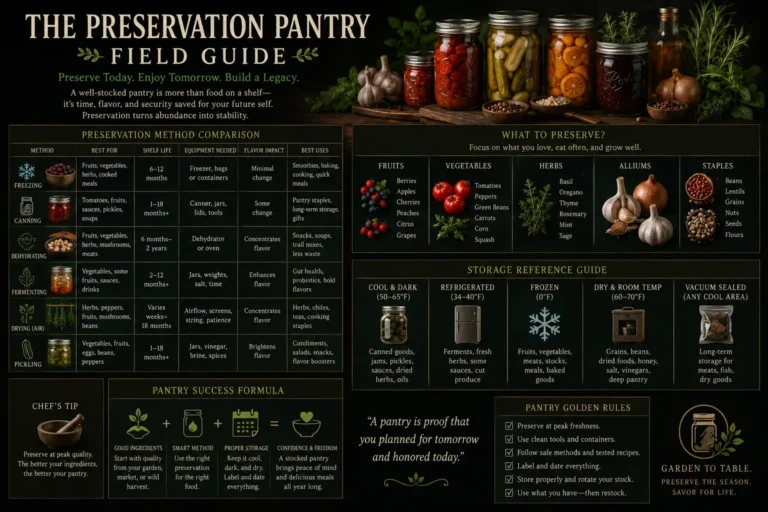
Squash and cucumbers naturally lead to preservation. Pickling, freezing, fermenting, drying, storing, and cooking ahead are the tools that turn overflow into lasting value.
This squash and cucumber guide is one piece of a much larger system.
The more pieces you connect, the clearer the picture becomes.
The Squash & Cucumber Field Guide Lesson
Most people think abundance means having more.
But the garden teaches something deeper.
More is only the beginning.
A zucchini picked young becomes dinner.
A cucumber picked on time becomes freshness.
A pickling cucumber becomes a jar.
A butternut squash becomes winter soup.
An acorn squash becomes a meal in its own bowl.
A pumpkin becomes memory, seed, pie, and tradition.
A surplus basket becomes a chance to share.
Squash and cucumbers do not simply ask you to grow.
They ask you to respond.
They ask you to harvest, cook, preserve, store, share, and notice.
And the better you respond, the more valuable the harvest becomes.
That is the heart of The Gardening Chef.
Final Thought
A garden that produces nothing teaches patience.
A garden that produces a little teaches gratitude.
But a garden that produces too much teaches stewardship.
Squash and cucumbers are the teachers of too much.
They show what happens when life gives more than expected, faster than expected, and asks whether you are ready to turn that overflow into value.
You can let the zucchini grow too large.
You can let the cucumbers turn bitter.
You can let the winter squash sit unused until it becomes decoration instead of food.
Or you can build a system.
Harvest small.
Cook quickly.
Preserve wisely.
Store carefully.
Share generously.
Honor the abundance.
Because abundance is not just what the garden gives.
It is what you do with what you have been given.