Most People Don’t Fail From One Big Decision — They Drift Through Thousands of Small Ones
Most people believe their financial problems come down to one thing:
a lack of knowledge.
And on the surface, that seems true.
Only about half of U.S. adults are considered financially literate, and nearly one in three people report ongoing stress about money. Most were never taught how to manage it, plan it, or grow it.
So the conclusion feels obvious.
Learn more.
Find better strategies.
Make smarter decisions.
So they keep searching.
For the next idea.
The next opportunity.
The next breakthrough.
But if lack of knowledge were the real problem…
it would have been solved by now.
Something quieter is usually happening.
Something easier to miss.
They’ve stopped looking closely at the system they’re already in.
There’s a shift that happens over time.
At first, people are curious. They ask questions. They pay attention.
But slowly, almost without noticing, that curiosity fades into assumption.
“I know how this works.”
And once that happens, something subtle breaks.
They stop questioning.
They stop observing.
They stop adjusting.
In finance, it looks like holding onto decisions longer than they should, ignoring small fees that quietly compound, or assuming everything is “fine” because nothing feels urgent.
In a garden, it shows up faster.
The garden doesn’t care what you know.
Every season is different. Light changes. Water behaves differently. Growth shifts in ways that don’t match memory.
A gardener who assumes… misses the signal.
A gardener who observes… adapts.
There’s a word for this way of seeing.
In Zen Buddhism, it’s called Shoshin—beginner’s mind.
It doesn’t mean starting over.
It doesn’t mean knowing nothing.
It means staying open.
Curious.
Willing to see what’s actually happening, instead of what you expect to happen.
The last time we saw him, he had made a simple decision in the store.
He chose the living basil plant.
Not because he had a plan. Not because he was thinking about wealth or systems.
Just because it made sense.
It was cheaper. It was alive. It might last longer.
That was enough.
Weeks passed.
He clipped leaves when he needed them, added them to meals, watched the plant fill back in. It was a small win. Nothing dramatic. Just something that worked a little better than expected.
Until one night, something caught his attention.
A few stems had been left sitting in a glass of water on the counter. He didn’t remember putting them there. They were just scraps—something he hadn’t thrown away yet.
But now they had roots.
Small, white, quiet roots.
Alive.
He stood there longer than he expected.
That didn’t make sense.
He hadn’t planted anything. Hadn’t tried anything new. Hadn’t followed a plan.
And yet, something had happened.
Later that night, curiosity got the better of him.
Not a deep dive. Not research.
Just a simple question:
“Can basil grow from cuttings?”
He found an article—almost by accident.
At first, it felt too simple.
Cut it. Put it in water. Wait.
That’s it?
But the more he read, the more something shifted.
This wasn’t about keeping herbs fresh.
This was about multiplication.
One plant becoming more.
Not buying again.
Not starting over.
Continuing.
He looked back at the plant on his counter. Then at the glass of rooted cuttings.
And for the first time…
he didn’t just see basil.
He saw a system.
Nothing dramatic had happened yet.
No money made.
No big changes.
Just a moment.
But this is where everything begins to separate.
Part of him shrugged.
“It’s just basil.”
Use it. Throw the rest away. Move on.
Nothing breaks. Nothing changes.
A year later, life looks the same. Still buying herbs. Still solving the same problem the same way.
Another part of him stayed with the question.
What if this worked?
He planted the cuttings. Just to see.
A second plant appeared. Then another.
Weeks later, he noticed something small but undeniable.
He didn’t need to buy basil.
Months later, something else shifted.
He had more than he needed.
And for the first time, a different question appeared:
“What do I do with the extra?”
The difference between those two paths wasn’t knowledge.
It wasn’t time.
It wasn’t money.
It was curiosity.
That same moment appears everywhere.
Most people just don’t recognize it.
At a register, staring at a total that’s slightly higher than expected.
“Debit or credit?”
It feels small. It always does.
But zoom out for a moment.
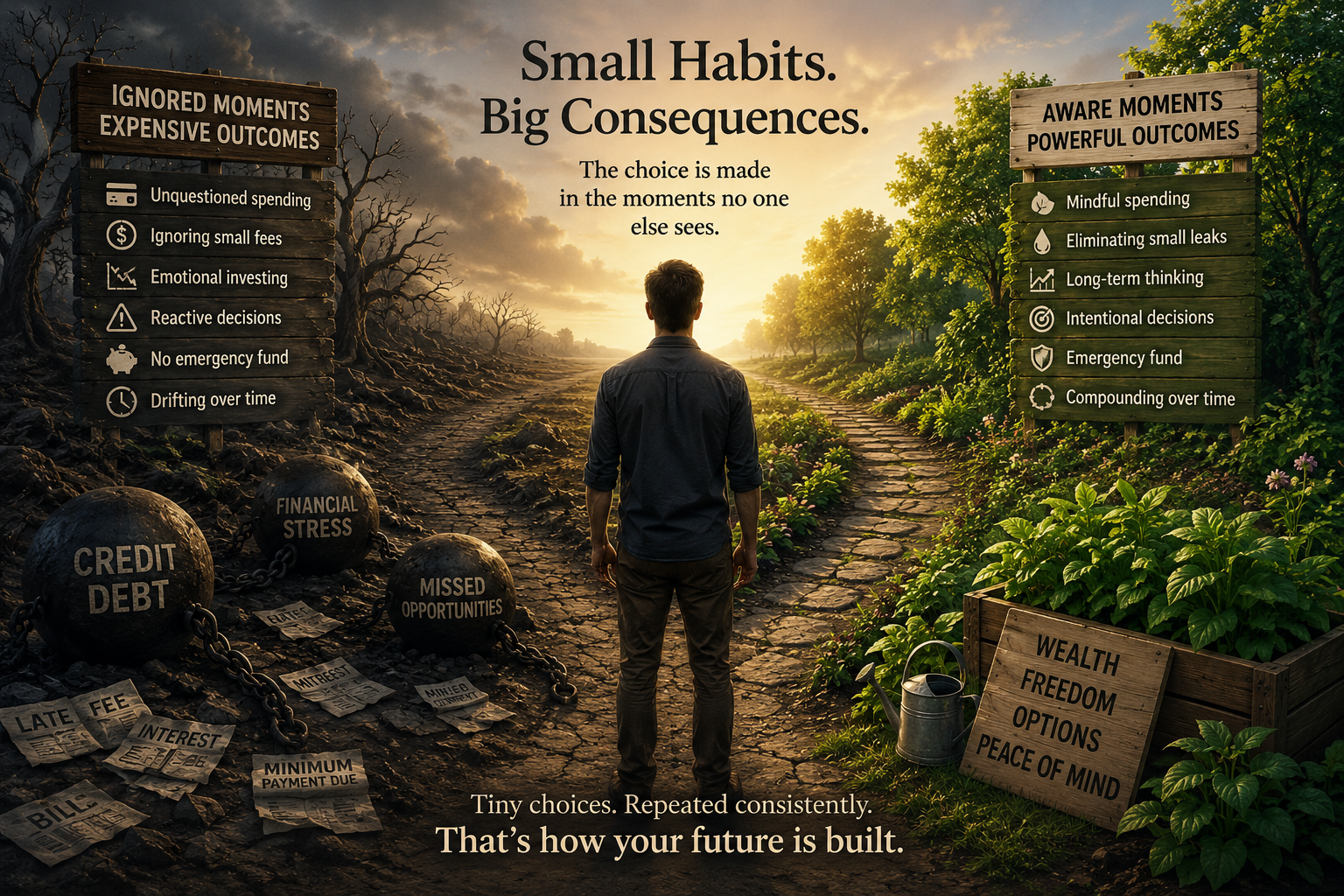
Over $1.2 trillion in credit card debt didn’t come from a few catastrophic decisions.
It came from moments exactly like that one.
Inside that moment, there’s a quiet debate.
One voice says it’s nothing. It’s manageable. It’s normal.
And it is.
That’s the problem.
Because the other voice—quieter, less urgent—asks a different question.
“Is this a pattern?”
Most people don’t hear that second voice.
Or they hear it and move on.
But the moment they pause—even for a few seconds—something changes.
Awareness enters the system.
And awareness is where control begins.
The same thing happens when the market drops.
The screen turns red. Headlines get louder. The urgency feels real.
It always does.
But markets have always moved this way. Through crashes, recoveries, cycles that repeat over decades. Long-term returns have remained strong not because the path is smooth, but because it isn’t.
The drop isn’t the danger.
The reaction is.
Inside that moment, the same debate appears.
One voice wants safety. Action. Control.
The other remembers something quieter.
“This has happened before.”
One path leads to relief.
The other leads to continuity.
And only one of them allows the system to keep working.
At the end of the day, the moment looks even smaller.
Just time.
You’re tired. You’ve done enough. It’s easy to let the day end without thinking about it.
Nothing wrong with that.
Nothing gained either.
Fifteen minutes doesn’t feel like much.
Because it isn’t.
But repeated daily, it becomes something else entirely.
A connection point.
A way of staying inside your system instead of drifting outside of it.
Most people don’t fail because they lack time.
They fail because they disconnect from the system long enough for it to drift.
And then there are the moments no one plans for.
A shift in income.
An unexpected expense.
A small disruption that reveals something bigger.
Nearly sixty percent of people say they couldn’t handle a modest emergency without stress or borrowing.
Not because they’re careless.
Because nothing had been built before the moment arrived.
When the pressure shows up, the system reveals itself.
If nothing is there, everything feels urgent.
If something—even small—is in place, the same situation feels different.
Still uncomfortable. Still real.
But not overwhelming.
Resilience doesn’t appear in the moment you need it.
It appears from what you built before you did.
All of these moments feel the same when you’re inside them.
Small. Optional. Easy to ignore.
But step back, and a pattern becomes impossible to miss.
Trillions in debt didn’t appear overnight.
Market losses didn’t come from one bad choice.
Financial stress didn’t arrive all at once.
They came from small decisions, repeated without awareness.
And the same is true in reverse.
Systems aren’t built in one moment either.
They grow the same way.
Small decisions. Repeated with awareness.
That’s the shift.
Not doing something big.
But finally paying attention to something small.
If there is a place to begin, it isn’t with more information.
It isn’t with a perfect plan.
It’s with consistency.
A small amount of time.
A small amount of attention.
Repeated.
You can find that here:
The 1% Garden Rule
And once you begin looking at your life this way…
you realize something simple.
The opportunity was never hidden.
It just looked too small to matter.
👉 Wealth is not accumulated. It is cultivated. 🌱