A grounded way to think about grocery bills, food waste, cooking confidence, and the small systems that help a household eat well
The refrigerator looked full, but any busy household knows how quickly full can turn into we need to stop at the store.
That is the part worth noticing.
Home food resilience begins with understanding the difference between a kitchen that looks full and a household with more than one way to feed itself.
There may be milk in the door, eggs in their carton, chicken on the bottom shelf, salad greens under plastic, a few apples in the drawer, leftovers that need a plan, and enough condiments to make the shelves look busier than they really are.
A single parent packing lunches sees the next few mornings. A working family sees another grocery bill already beginning to form. An empty nester sees food that needs to be used before it turns. Someone learning to cook may see plenty of ingredients, but not yet enough meals.
The freezer has food too. The pantry has pasta, cereal, peanut butter, canned tomatoes, beans, crackers, and the usual assortment of jars that seem to reproduce in the dark.
Standing in the middle of the kitchen, everything looks normal.
Comfortable, even.
When the System Gets Tested
Then ordinary life puts a little pressure on the system.
A storm closes roads for several days. The refrigerator fails. A produce recall removes something you regularly buy. A paycheck arrives late. Grocery shelves thin out before bad weather. The car suddenly needs a repair.
Or perhaps nothing goes wrong at all.
Perhaps you simply decide:
For the next week, I am not going to the grocery store.
Now open the refrigerator again.
This time, look at it differently.
How long does what you have really last?
And more importantly:
How do we turn what comes into this house into something more useful, more lasting, and less wasteful?
This is not a question about fear. It is a question about understanding.
Our homes are connected to an extraordinary food system—farms, processing plants, warehouses, refrigerated trucks, grocery stores, paychecks, coupons, meal plans, school schedules, work schedules, and that familiar thirty-minute window between getting home and needing dinner on the table.
It is an astonishing system.
For many households, however, it is also the only system.
And when only one stream feeds the table, even a kitchen that looks abundant can become an island surprisingly quickly.
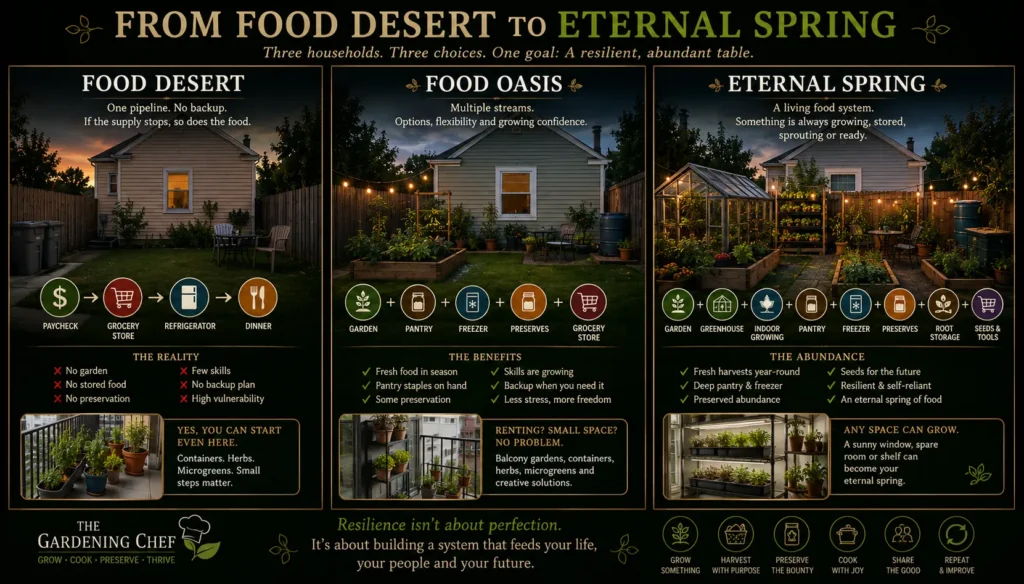
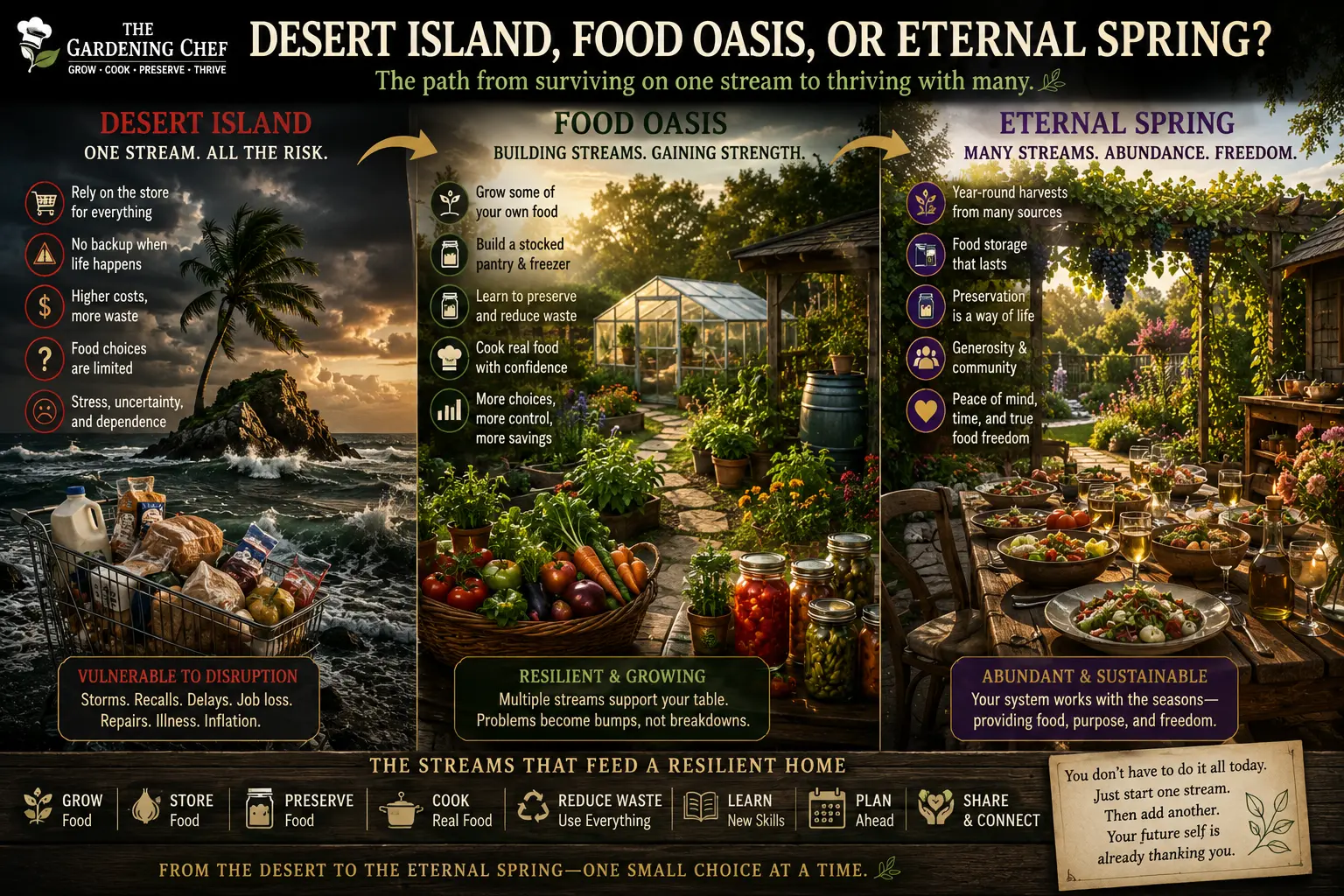
A household does not move from one end of this picture to the other overnight. It begins by adding another stream—something that grows, something that stores, something that preserves, or simply another skill that makes what is already in the house more useful.
The Desert Island
Imagine your house from above—not as a home, but as an island.
Nearly everything required to feed the people inside must cross the water. Tomatoes, lettuce, basil, potatoes, bread, meat, spices and tomorrow’s lunch all arrive from somewhere beyond the shoreline.
As long as the boats keep arriving, the island feels abundant.
That is the deceptive thing about dependence: it rarely feels fragile while everything is working.
The supermarket is open. Trucks are moving. The refrigerator is cold. Dinner can be twenty minutes away.
So it becomes easy to confuse access to food with having a food system.
If tomatoes are always at the store, tomatoes feel handled. If bread is always on the shelf, tomorrow’s lunches feel secure. If the refrigerator is full, the week looks prepared.
Access Is Not a Food System
But a full refrigerator is not the same as a working kitchen.
The refrigerator stores what has already arrived. The pantry does the same. Once the last tomato is eaten, another tomato does not appear. When the basil package is empty, it does not produce another set of leaves.
A desert island consumes what arrives from somewhere else.
Then it waits for the next boat.
The metaphor is not about panic or abandoning the grocery store. It simply asks us to notice how much of dinner depends on the next trip, the next paycheck, the next delivery, or the next burst of energy after a long day.
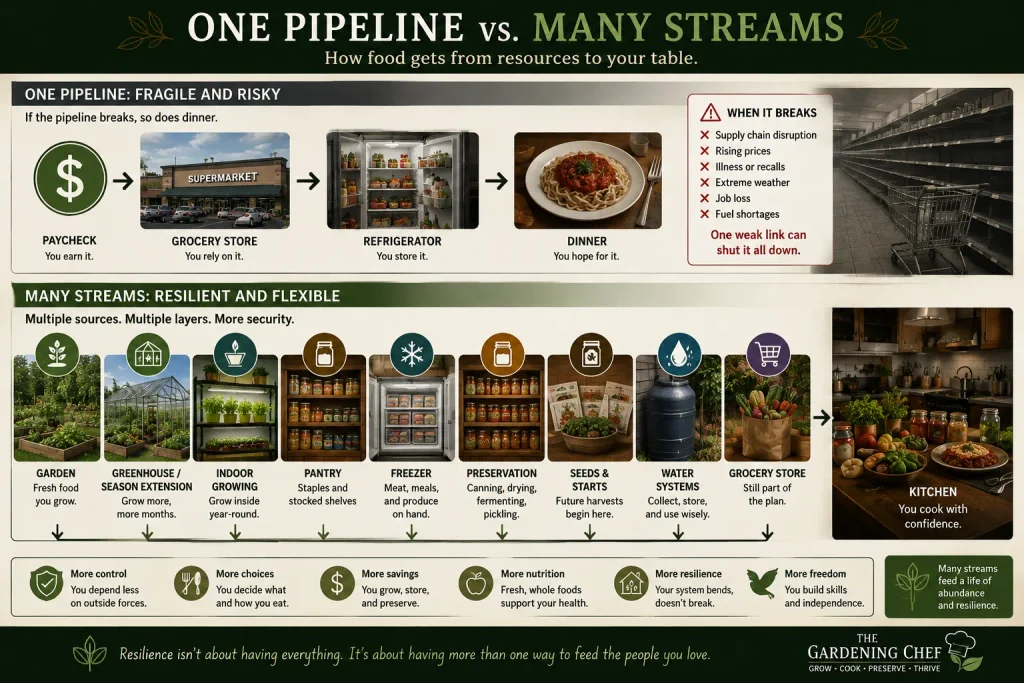
The grocery store does not need to disappear from the picture. The goal is simply to stop asking one stream to do all the work.
The First Green Shoot
Now imagine one small change.
On the kitchen windowsill sits a basil plant, small enough to seem almost unimportant.
Nothing heroic. No farm. No greenhouse. No declaration of self-sufficiency.
Just basil.
Dinner comes around and you need a few leaves, so you pinch them from the plant. A week later you need basil again—and there are new leaves waiting.
You cut some more.
That is when something subtle begins to change.
The package of basil in the refrigerator could only become smaller. The living plant can be harvested and continue producing. Instead of being another ingredient waiting to disappear, it has become a small source of flavor that can renew itself.
For the first time, part of the kitchen is not merely storing food.
It is producing food.
That same shift from consumption to production is the idea behind The $10,000 Garden.
That little distinction can change the way you begin looking at everything around it.
Perhaps basil leads to parsley and chives. A pot of lettuce appears near a bright window. Two tomato plants go into containers outside. A cucumber begins climbing a trellis. Garlic planted months earlier waits quietly beneath the soil.
None of it replaces the supermarket.
It doesn’t need to.
You have simply created something that did not exist before:
another stream feeding the table.
And with that one small stream, your island has developed its first spring.
From Island to Oasis
One basil plant does not make a household self-sufficient.
That is not the point.
An oasis begins when small productive pieces start connecting to one another.
The basil on the windowsill joins tomatoes growing outside. A few cucumbers climb a trellis. Garlic waits underground. The pantry holds olive oil, vinegar, salt, beans and pasta. The freezer carries yesterday’s abundance forward.
And the grocery store?
It is still there.
It simply stops being responsible for every ingredient, every meal, every day.
This is where gardening becomes much more interesting to me, because we can stop thinking only in terms of individual plants and begin thinking in terms of what we actually want to eat.
Start With the Meal
Take a Caprese salad.
You might grow the tomatoes and basil yourself while buying mozzarella, olive oil and salt. Suddenly the supermarket isn’t supplying the meal. It is completing it.
Or consider refrigerator pickles.
Cucumbers, dill, garlic and even a grape leaf for that old-fashioned crispness can come from the garden. Vinegar and salt may come from the pantry. Preservation then takes a harvest that was ready today and carries it into meals that haven’t happened yet.
That is a Food Oasis.
Not independence from the outside world.
More ways to reach dinner.
One Table, Many Streams
| What You Want to Eat | Fresh or Homegrown | Stored / Preserved | Grocery Store Completes |
|---|---|---|---|
| Caprese Salad | Tomatoes, basil | Olive oil, salt | Mozzarella |
| Garden Pickles | Cucumbers, dill, garlic, grape leaves | Vinegar, salt, preserved jars | Whatever the garden doesn’t provide |
| Broccoli Potato Soup | Broccoli, herbs | Stored potatoes and onions, pantry stock | Cheddar, cream or other finishing ingredients |
The goal is not to grow every ingredient. It is to grow, store, preserve, and buy intelligently enough that no single source has to carry the entire meal.
Once you begin looking at food this way, the backyard changes.
A tomato plant is no longer simply a tomato plant. It may be part of Caprese in July, sauce in August, frozen tomatoes for winter soup, and seeds for next year’s garden.
Cucumbers are not merely cucumbers. Some become salads, some become refrigerator pickles, some are shared, and perhaps a few become seed for another season.
The pantry changes too.
So does the freezer.
So does the question you ask at the grocery store.
Instead of:
What do we need to buy?
you begin asking:
What do we already have growing, stored, preserved, or waiting to be used—and what do we need to complete the meal?
That is a very different kitchen.
And once enough of these small streams begin supporting one another, the island starts looking much more like an oasis.
The Pantry Remembers Summer
Eventually a productive garden creates a problem every gardener secretly hopes to have.
Too much.
The first tomato is treasured.
The twentieth is exciting.
The fiftieth tomato begins asking questions.
What are you going to do with me?
That is when the kitchen becomes part of the garden.
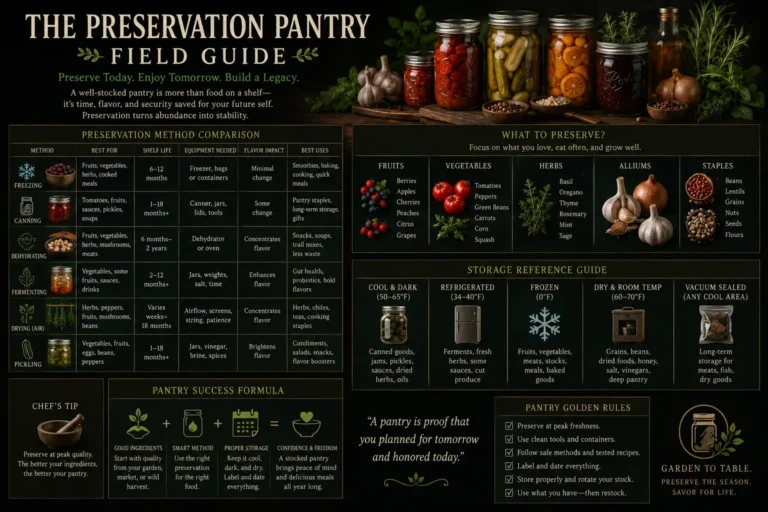
Tomatoes become sauce. Basil becomes pesto. Beans move into the freezer. Garlic and onions cure. Herbs dry. Cucumbers become pickles. Potatoes disappear into a cool, dark place to wait.
The harvest is no longer feeding only today.
It has begun feeding time.
A tomato picked in August can become dinner in January.
An onion lifted in midsummer may wait patiently for a November soup.
Potatoes harvested earlier can meet broccoli from the fall garden months later and become cheddar broccoli potato soup.
Think about that for a moment.
The potato and broccoli may never have occupied the garden at the same time.
Yet preservation and storage allow them to arrive at the same table.
That changes what a garden can do.
It is no longer only a place that produces food during the growing season. The freezer, pantry, jars, curing racks and storage spaces begin carrying the harvest forward after the plants themselves are finished.
In that sense, preservation does something almost magical:
It lets one season feed another.
And once that happens, the question is no longer simply:
What can I harvest today?
It becomes:
How can today’s harvest help feed us tomorrow, next month, or next winter?
That is the beginning of a very different kind of garden.
The Harvest Bridge
Once food can move through time, another possibility appears.
You can begin planning the garden around the meal instead of the harvest.
Most planting advice begins with a question like:
What can I plant this month?
Useful question.
But a Gardening Chef can ask something different:
What do I want to put on the table—and when do I want to eat it?
Then work backward.
Plan Backward From the Meal
Thanksgiving is a good example.
The garlic on the table may have been planted the previous fall. Onions could have been harvested and cured months earlier. Winter squash may have spent weeks in storage. Sage can still be growing outside while preserved beans or frozen vegetables wait inside.
Those ingredients did not mature together.
The household created a bridge between their different seasons.
The Harvest Bridge at a Glance
| Grow | Harvest | Bridge It Forward | Finish Line |
|---|---|---|---|
| Garlic | Early summer | Cure and store | Thanksgiving |
| Onions | Summer | Cure and store | Fall & winter meals |
| Winter squash | Late summer / fall | Cure and store | Thanksgiving & winter |
| Tomatoes | Summer | Freeze, dry, sauce or safely can | Winter meals |
| Herbs | Through the season | Use fresh, dry or freeze | Meals throughout the year |
For canning, freezing, drying, and other home-preservation methods, use tested, research-based guidance from the National Center for Home Food Preservation.
The harvest date and the meal date do not have to be the same date. Storage and preservation are what connect them.
This is one of the most useful changes in thinking a food gardener can make.
You stop asking only:
When will this crop be ready?
and begin asking:
How do I keep it useful until I need it?
That question changes what gets planted, how much gets planted, what gets preserved, and even which kitchen skills become worth learning.
A summer tomato can be planned for a January soup.
A cured onion can wait for a fall stew.
Garlic planted nearly a year before Thanksgiving can become part of the meal without ever needing to be harvested in November.
The garden and kitchen are no longer operating on separate calendars.
They are working toward the same finish line.
And once you learn to connect harvests across days, months, and seasons, you are beginning to build something larger than a productive garden.
You are beginning to build a year-round food system.
From Food Oasis to Eternal Spring
A Food Oasis can be wonderfully productive and still have seasons.
Summer may overflow with tomatoes, cucumbers and herbs. Autumn fills the pantry and freezer. Winter draws down what was stored. Spring begins the cycle again.
Eternal Spring begins when those seasons start overlapping.
Not because you are somehow growing tomatoes outdoors in January.
Not because you have stopped shopping for groceries.
And certainly not because every household needs acres of land, a giant greenhouse or a basement filled with supplies.
Eternal Spring is much simpler than that.
It is the point where something useful is always growing, stored, preserved, curing, sprouting, or ready to cook.
The outdoor garden produces when the weather allows. A greenhouse, cold frame or other season extension can stretch those edges. Herbs or greens can grow indoors. I even use succession planting to grow fresh green beans indoors through winter. Potatoes, onions, garlic and winter squash can wait in storage. The freezer can return summer vegetables to the table months later. Preserved foods can hold a harvest long after the plant is gone.
Seeds and starts prepare the next season before the current one has completely finished.
And the grocery store remains one of the streams.
The difference is that it is no longer the only one.
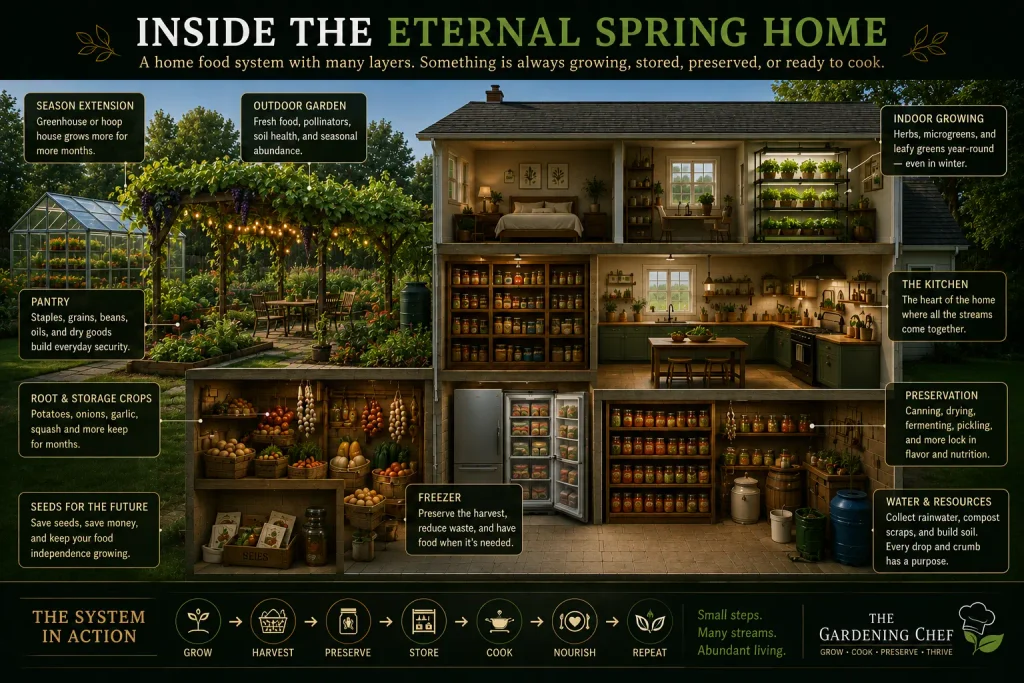
An Eternal Spring home is not a collection of isolated supplies. It is a series of small systems handing food from one season to the next.
Each stream hands something forward: summer into the freezer, the harvest into the pantry, indoor greens into winter gaps, and seeds into another beginning. The kitchen is what connects them.
That overlap is where the strength comes from.
Continuity, Not Self-Sufficiency
You do not need every piece shown in the picture.
A renter might begin with herbs on a windowsill, greens under a light, a deeper pantry and one freezer shelf.
A homeowner may add containers or raised beds.
Someone with more room might eventually add fruit trees, a grape arbor, storage crops, rainwater collection or a greenhouse.
Eternal Spring is not a property size. It is a direction.
Each useful layer reduces the gaps between seasons and gives the household another option when dinner needs to happen.
The goal is not complete independence.
It is continuity.
Build Home Food Resilience in Layers
Looking at a mature food system can make the destination seem much larger than the first step.
But nobody begins with Eternal Spring.
Most households begin with something much simpler: enough food and water to get through a short disruption without immediately needing another trip to the store.
Our ladder uses 72 hours as a simple first rung; Ready.gov guidance for emergency kits similarly begins with keeping enough food, water, and essential supplies on hand for several days.
From there, the buffer can deepen into a better pantry, a more intentional freezer, productive containers, preservation skills, and eventually a household that can carry more of its food from one season into the next.
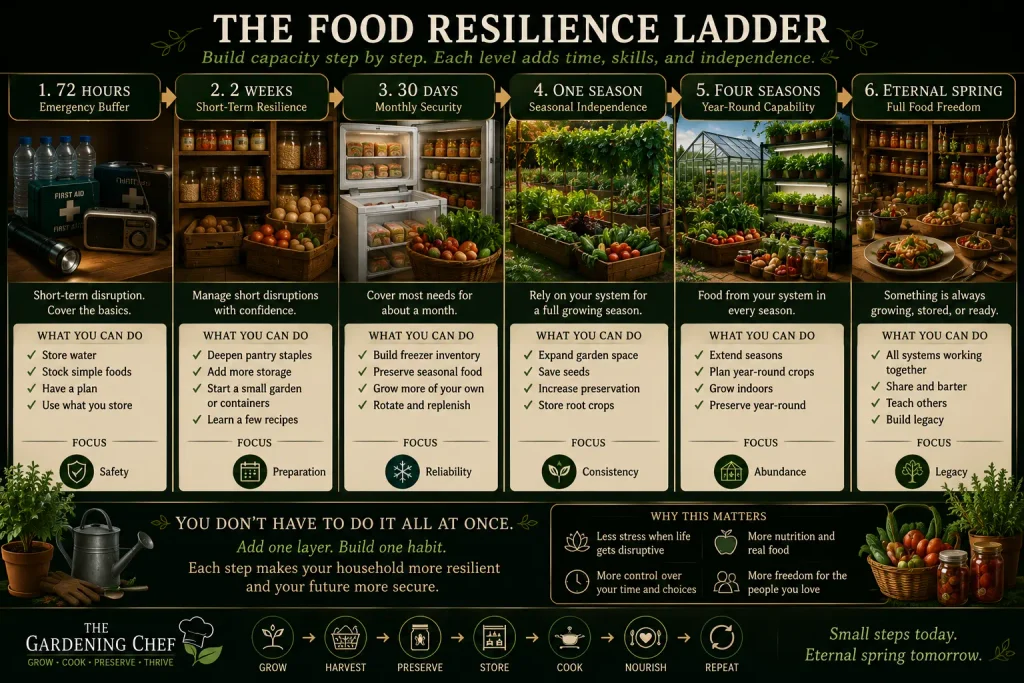
Eventually the household is not just collecting supplies. It is building capacity.
That distinction matters.
A shelf of food can be consumed.
A skill can be used again.
Seeds can become another season.
A garden can produce another harvest.
Preservation can extend what was already grown.
And each layer gives the household a little more time, flexibility and choice.
You do not have to decide today that you want an Eternal Spring.
You only have to ask:
What is the next useful layer for my household?
The ladder is not a test and Eternal Spring is not a requirement. Its purpose is to show that resilience grows gradually. Each rung simply represents more time, more skill, and more ways to respond when ordinary life becomes inconvenient.
Choose the Next Useful Layer
A renter with a two-week pantry, herbs on a windowsill and a few freezer meals may already have created meaningful resilience.
A family with raised beds, stored onions and potatoes, a freezer and some preserving skills may be farther along.
Someone else may eventually add indoor growing, fruit trees, a greenhouse or more serious storage.
There is no correct number of beds, jars, freezers or tomato plants.
What matters is whether the systems you build are useful to the life you actually live.
That is why the next question is more valuable than asking whether you are “prepared.”
It is:
Where are the weak spots in my food system now?
Take Inventory of Your Food Oasis
Once you start thinking in streams instead of supplies, an interesting question appears.
You may already have more resilience than you realize.
Perhaps you grow tomatoes every summer but rarely preserve them.
Maybe your pantry is excellent, but almost nothing in the house is producing fresh food.
You may have a freezer full of vegetables but very little confidence turning those ingredients into meals.
Or perhaps you know how to grow, cook and preserve—but have never thought about keeping seeds, extending the season, or sharing surplus with someone nearby.
That is why I like thinking of a household food system as a scorecard rather than a finish line.
Food Oasis Scorecard
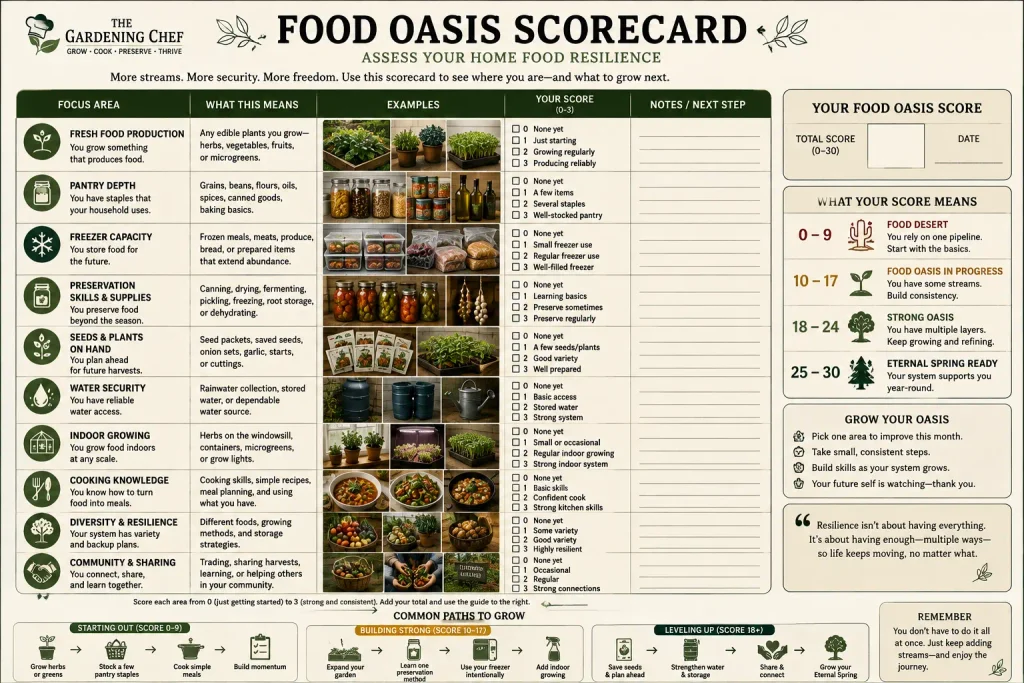
Treat the Score as a Map
Do not treat the score as a grade. Treat it as a map.
You are not trying to collect every possible skill.
You are looking for the places where one small improvement could make the whole system stronger.
A zero does not mean failure.
It simply shows an unused opportunity.
And a three does not mean that category is finished forever. Gardens change. Families change. Storage changes. Skills improve. What worked five years ago may no longer fit the household you have today.
The useful question is:
Which one or two areas would make the biggest difference next?
If you already garden but routinely lose the harvest, preservation may be your next layer.
If the pantry is strong but nothing fresh grows at home, perhaps the next step is nothing more ambitious than herbs or lettuce.
If you grow and preserve well but still struggle to turn what you have into dinner, the greatest improvement may come from learning five dependable meals rather than planting another garden bed.
That is an important distinction.
The weakest part of a food system is not always the garden.
Sometimes it is storage.
Sometimes it is planning.
Sometimes it is cooking.
Sometimes it is simply knowing what is already in the freezer.
The strongest household system is not necessarily the one that produces the most food.
It is the one that can use what it produces well.
The Year Has to Connect
A year-round food system does not mean forcing every crop to grow in every season.
Tomatoes still belong to summer.
Garlic still has its own rhythm.
Winter squash still needs time to cure.
Lettuce may thrive when tomatoes would rather quit.
The goal is not to erase the seasons.
It is to connect them.
In summer, the outdoor garden may do much of the work.
As autumn arrives, storage crops, the freezer and preserved foods begin taking a larger role.
During winter, pantry staples, stored vegetables, frozen harvests, preserved foods and perhaps a few indoor greens help carry the household forward.
Then seedlings begin again.
Cold-tolerant crops return.
The outdoor garden wakes up.
One stream fades while another begins to flow.
That is what makes Eternal Spring possible.
| Food Stream | Winter | Spring | Summer | Fall |
|---|---|---|---|---|
| Outdoor Garden | Light | Growing | Strong | Strong |
| Season Extension | Strong | Strong | Light | Strong |
| Indoor Growing | Strong | Moderate | Moderate | Strong |
| Stored Crops | Strong | Moderate | Begins | Strong |
| Freezer | Strong | Strong | Refill | Refill |
| Preserved Foods | Strong | Strong | Preserve | Preserve |
| Pantry Staples | Strong | Strong | Strong | Strong |
| Grocery / Market | Available | Available | Available | Available |
Overlap Is the Goal
Notice what the calendar does not show.
It does not show twelve months of tomatoes.
It does not show complete independence from the grocery store.
And it does not require every household to own every system.
Instead, it shows something much more achievable:
overlap.
When tomatoes disappear from the garden, preserved tomatoes can remain.
When outdoor herbs go dormant, dried herbs or a small indoor plant can fill the gap.
When fresh potatoes are no longer being harvested, stored potatoes can still be waiting.
When the freezer begins getting emptier in spring, the first new crops are already beginning to return.
That is continuity.
And perhaps the simplest definition of Eternal Spring is this:
Eternal Spring does not mean everything is always growing. It means something useful is always growing, stored, preserved, or ready to cook.
The seasons still change.
The household simply learns how to hand food from one season to the next.
The Resilient Table
Eventually all of these ideas lead back to one very ordinary place.
The table.
Not a bunker.
Not a wall of canned goods.
Not a competition to see who can grow the most food or avoid the grocery store the longest.
Dinner.
Perhaps tonight’s herbs were clipped from a pot near the kitchen.
The onions were harvested months ago and cured.
The tomatoes came from a jar put away during August.
Some vegetables came from the freezer.
The beans came from the pantry.
The bread came from the grocery store.
And maybe the cheese did too.
That does not make the meal less resilient.
It makes the system real.
The garden did some of the work.
Storage did some.
Preservation did some.
The pantry did some.
The grocery store completed what was missing.
And cooking brought all of those streams together.
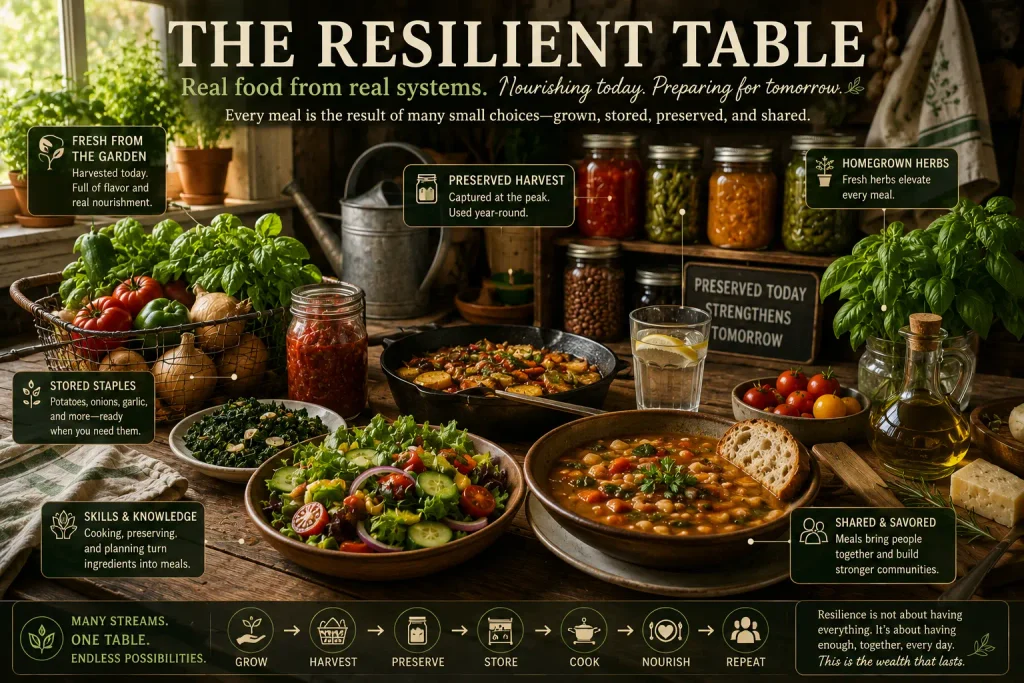
This is what all of those raised beds, jars, freezer containers, seed packets and cooking skills are actually for.
Not simply to possess food.
To use it well.
A resilient household is not the household with the fullest pantry.
It is the household that can look at what is growing, what is stored, what needs to be used, and what can easily be purchased—and turn those pieces into a meal.
That is where gardening and cooking finally become one system.
Open the Refrigerator Again
Now go back to the kitchen where we started.
Open the refrigerator.
The contents may look exactly the same as they did before.
Milk in the door.
Eggs in their carton.
Vegetables in the drawer.
Leftovers waiting for a decision.
But perhaps you see them differently now.
The refrigerator is not the food system.
It is one part of it.
Look beyond the refrigerator.
What is growing?
What is stored?
What is frozen?
What is preserved?
What could be cooked tonight?
What needs to be used before it is lost?
What skill could make the food you already have more useful?
And perhaps most importantly:
What is one additional stream you could create?
It might be basil on the windowsill.
A few containers outside.
A better-stocked pantry.
Learning to freeze summer vegetables.
Planting garlic this fall.
Turning tomatoes into sauce.
Learning five meals you can make almost without thinking.
You do not need to build Eternal Spring this year.
You do not even need to build a Food Oasis this year.
Build one useful thing.
Then connect another.
And another.
Over time, the refrigerator stops being an island supplied entirely from somewhere else.
The kitchen becomes part of the garden.
The pantry begins remembering summer.
The freezer carries harvests through winter.
Different seasons begin meeting at the same table.
And eventually, almost without noticing exactly when it happened, you may look around and realize:
You are no longer waiting for the next boat.
You have begun building your own spring.