Small Seed. Big Impact. Endless Harvests.
It is a working kitchen-and-garden reference for people who want to grow useful food, cook with more confidence, preserve the harvest, improve soil, reduce grocery dependence, and understand how one small seed can become an entire food system.
A cook can use this guide to understand the difference between fresh green beans, snow peas, sugar snap peas, shelling peas, dry beans, lentils, chickpeas, and fava beans.
A gardener can use it to decide which beans and peas need trellises, which grow as compact bushes, which belong in spring, which belong in summer, and which can become pantry crops.
A preserver can use it to turn harvests into freezer bags, dried beans, pickles, ferments, sprouts, seed stock, and future meals.
A beginner can use it to understand why peas like cool weather, why beans need warmth, why harvest timing matters, and why a trellis can change the whole garden.
A creator can use it to see how one crop family becomes a printable guide, a cooking reference, a garden planning worksheet, a preservation checklist, a pantry system, and a reason readers come back for the next field guide.
Beans and peas are small.
But they are not minor.
They are fresh food, pantry food, protein food, seed food, soil food, and future food.
Save This Guide If You Want To
Choose the right bean or pea for the meal.
Understand the difference between bush beans, pole beans, snap beans, shell beans, dry beans, garden peas, snow peas, and sugar snap peas.
Know when peas belong in the cool season and beans belong in the warm season.
Grow vertically with trellises, teepees, fences, cattle panels, arches, and netting.
Harvest fresh beans and peas at the right stage for the best flavor and texture.
Let some pods mature into dry beans, storage food, or seed for next season.
Use beans and peas in soups, stews, salads, stir-fries, curries, rice bowls, casseroles, dips, side dishes, and pantry meals.
Preserve beans and peas by freezing, drying, pickling, fermenting, pressure canning, sprouting, and seed saving.
Understand why legumes can help participate in soil fertility through relationships with beneficial root bacteria.
Cook dry beans safely.
Stop treating beans and peas like simple side dishes and start using them like a system.
Start Here: Choose Your Reading Path
| If you are… | Start with… | You will learn… |
| A home cook | The Bean and Pea Decision Guide | Which bean or pea fits soups, salads, stir-fries, pantry meals, and fresh eating. |
| A beginner gardener | Beans vs Peas: What’s the Difference? | Why peas start the season and beans carry the summer. |
| A small-space gardener | Pole Beans and Peas: Grow Up | How trellises turn vertical space into food. |
| A preserver | The Bean and Pea Preservation Ladder | How to freeze, dry, pickle, ferment, pressure can, sprout, and save seed. |
| A pantry builder | Dry Beans: The Pantry Protein Crop | How beans become stored food and future meals. |
| A soil-minded gardener | How Beans and Peas Feed the Soil | Why legumes matter in rotation, soil partnership, and garden systems. |
| A creator or market gardener | How Beans and Peas Become Products | How the crop becomes guides, recipe cards, seed packets, bundles, classes, and pantry content. |
The Beans and Peas Field Guide
One Seed. Many Meals. Soil, Protein, Pantry, and Future Harvests.
Some garden crops feed you once.
Beans and peas feed the system.
They begin as small seeds, dry and quiet in the palm of your hand. A bean seed looks almost too simple to trust. A pea looks like something you might lose between your fingers.
But plant them in the right soil, at the right time, with the right support, and they begin to reveal one of the most important lessons in the garden:
Small seeds can become a full system.
A bean can become a fresh side dish.
A pea can become a spring snack.
A pole bean can climb toward the sun.
A dry bean can become pantry protein.
A shelling pea can become soup, risotto, freezer meals, and comfort food.
A living legume root can help participate in soil-building relationships underground.
Beans and peas are not just vegetables.
They are soil partners, protein crops, pantry builders, vertical growers, preservation crops, budget stretchers, seed-saving teachers, and beginner-friendly garden confidence crops.
They teach a different lesson than tomatoes, herbs, potatoes, garlic, onions, peppers, or squash.
Tomatoes teach growth.
Garlic teaches compounding.
Herbs teach flavor multiplication.
Potatoes teach stability.
Squash and cucumbers teach abundance.
Beans and peas teach cooperation.
They show that a garden is not only about what you take from the soil.
It is also about what you return to it.
That is why this guide exists.
The Beans and Peas Field Guide is not just about growing pods.
It is about understanding one of the most useful food systems a gardener can plant.
Feed your family. Feed your soil. Feed your future.
Why Beans and Peas Deserve Their Own Field Guide
Beans and peas are often treated like side dishes.
A scoop of peas next to dinner.
A handful of green beans on the plate.
A can of beans stirred into soup.
A bag of frozen peas poured into rice.
A jar of dried beans waiting in the pantry.
They seem ordinary.
But ordinary does not mean simple.
Beans and peas belong in their own field guide because they do something rare: they connect the kitchen, the pantry, and the soil.
In the kitchen, they can be fresh, crisp, tender, creamy, hearty, nutty, earthy, sweet, or deeply comforting. Green beans can be steamed, sautéed, roasted, pickled, frozen, or tossed into salads. Peas can be eaten fresh, shelled, frozen, puréed, folded into risotto, added to soups, or used in spring meals. Dry beans can become chili, refried beans, hummus-style spreads, soups, stews, salads, casseroles, curries, baked beans, and meal-prep staples.
In the pantry, dry beans are one of the great storage foods. They are affordable, filling, versatile, and long-lasting when fully dried and stored properly. A jar of dry beans is not flashy, but it represents future meals.
In the garden, beans and peas teach soil partnership. Many legumes can work with beneficial bacteria on their roots to support nitrogen fixation. This does not mean they magically fertilize the whole garden overnight, and it does not mean they need no care. But it does mean they participate in the soil system differently than many other crops. Legumes can partner with rhizobia bacteria, which convert atmospheric nitrogen into forms the plant can use, and inoculation can be useful when the right rhizobia are not already present in the soil.
That makes them powerful teaching plants.
They are food.
They are storage.
They are structure.
They are partnership.
They are one of the clearest examples of a crop that gives more than it appears to give.
Field Guide Poster Preview
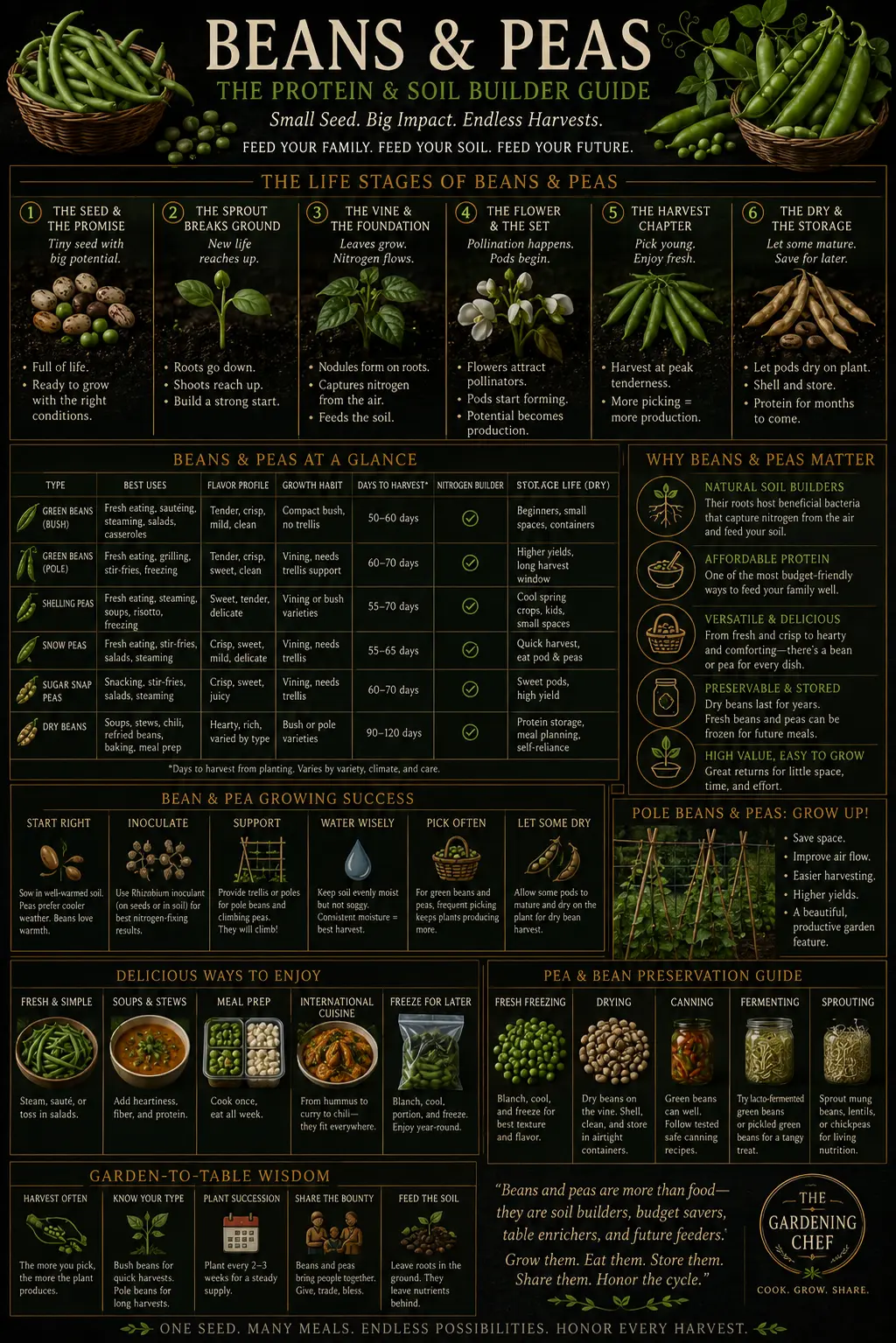
The Beans and Peas Field Guide poster is designed as a visual kitchen and garden reference for cooks, gardeners, pantry builders, meal planners, and anyone who wants to grow useful food in a smart system.
Use it when you need to remember:
Which beans and peas are best fresh.
Which beans and peas are best dried.
Which crops need trellises.
Which crops grow as bushes.
Which can be frozen.
Which can be stored in the pantry.
How beans and peas support soil systems.
How to harvest at the right stage.
How to preserve the surplus.
Why small seeds can become big value.
This kind of guide belongs in a kitchen, pantry, garden binder, seed-planning notebook, meal-prep station, classroom, market booth, or preservation shelf.
Download the Printable Beans and Peas Field Guide
Launch price: $0.99
[Button: Download the Beans and Peas Field Guide]
The Core Lesson: One Seed, Many Meals
The bean or pea seed is one of the best symbols in the garden.
It is small, but it contains direction.
When planted, it becomes root, sprout, stem, leaf, flower, pod, seed, and harvest. Depending on how you grow it and when you pick it, the same basic crop can become several different kinds of food.
A bean pod picked young becomes a fresh vegetable.
A pod left longer can become shell beans.
A pod left to fully mature and dry can become pantry food.
A pea picked flat becomes a snow pea.
A pea picked plump becomes a snap pea.
A pea shelled from the pod becomes a sweet green pea.
A dried pea can become soup.
This is why beans and peas are so useful.
They do not give the gardener one harvest option.
They give the gardener timing decisions.
That makes them a perfect field guide crop.
The question is not only:
“Are they ready?”
The better question is:
Ready for what?
Fresh eating?
Freezing?
Shelling?
Drying?
Saving seed?
Feeding the soil?
Feeding the pantry?
Once you see beans and peas this way, they stop looking like ordinary side dishes.
They become a flexible food system.
Beans vs Peas: What’s the Difference in the Garden?
Beans and peas are both legumes, but they behave differently in the garden and kitchen.
Peas are cool-season crops. They are usually planted early in spring or again in late summer for a fall crop. They like mild weather and often slow down once summer heat arrives.
Beans are warm-season crops. They prefer warmer soil and are usually planted after the danger of frost has passed. Planting beans too early in cold, wet soil can lead to poor germination or rotting seed. Once established in warm conditions, beans often grow quickly and produce heavily.
That difference alone makes them powerful companions in a garden plan.
Peas can begin the season.
Beans can carry the summer.
Together, they help stretch the harvest window.
This is one of the first lessons of a useful garden:
The best crop is not only the one you like.
It is the one that fits the season.
The Bean and Pea System at a Glance
| Type | Best Uses | Flavor Profile | Growth Habit | Harvest Style | Garden Value |
| Bush Green Beans | Fresh eating, sautéing, steaming, salads, casseroles, freezing | Tender, crisp, mild, clean | Compact bush | Pick young and often | Great beginner crop; no trellis needed |
| Pole Green Beans | Fresh eating, grilling, stir-fries, freezing, pickling | Tender, crisp, sweet, clean | Climbing vine | Pick often over a long window | High yield in small space |
| Snap Beans | Stir-fries, side dishes, fresh eating, freezing | Crisp, juicy, bright | Bush or semi-vining | Harvest young before seeds swell | Best when tender and crisp |
| Shell Beans | Soups, chili, baked beans, refried beans, stews | Rich, creamy, hearty | Bush or vining | Harvest when seeds are full | Bridge between fresh crop and dry pantry crop |
| Garden Peas | Fresh eating, soups, risotto, sides, freezing | Sweet, tender, delicate | Often vining | Shell when peas are full | Classic spring crop |
| Snow Peas | Stir-fries, salads, fresh snacks | Crisp, mild, slightly sweet | Vining, usually trellised | Pick flat and tender | Edible flat pods |
| Sugar Snap Peas | Fresh eating, salads, crudités, stir-fries | Sweet, crunchy, juicy | Vining, usually trellised | Pick plump and crisp | One of the best garden snacks |
| Dry Beans | Pantry storage, soups, stews, chili, meal prep | Dense, earthy, filling | Bush or pole types | Let pods dry fully | Long-term food security crop |
| Fava Beans | Fresh shelling, purées, soups, stews, Mediterranean dishes | Nutty, earthy, creamy | Upright plants | Shell when pods are full | Cool-season old-world bean |
| Lentils | Soups, stews, dals, salads, grain bowls | Earthy, mild, quick-cooking | Low bushy plants | Harvest dry | Efficient pantry pulse |
| Chickpeas | Hummus, curries, soups, roasting, salads | Nutty, firm, earthy | Bushy plants | Harvest fresh or dry | Pantry protein and hummus crop |
The best garden is not built around one kind of bean or pea.
It uses them by role.
Fresh snap beans for summer meals.
Sugar snap peas for early eating.
Pole beans for vertical yield.
Shell beans and dry beans for storage.
Lentils and chickpeas for pantry thinking.
Favas for cool-season variety.
That is how a small garden becomes a layered food system.
The Life Stages of Beans and Peas
Beans and peas move through a simple but powerful cycle:
Seed.
Sprout.
Vine or bush.
Flower.
Pod.
Harvest.
Dry seed.
Storage.
Future planting.
Each stage offers a different lesson.
1. The Seed and the Promise
A bean seed looks complete before it ever touches soil.
It has weight. Shape. Color. Pattern. Some beans are white, black, red, tan, speckled, striped, brown, purple, or mottled. Peas are usually round and simple, but they still carry the same hidden design.
At this stage, the seed is potential.
It can be food.
Or it can be future food.
That is the first decision.
A dry bean in a jar can feed you now. A dry bean planted in soil can feed you later. Like garlic cloves, bean seeds teach the tension between consumption and multiplication.
Eat it, and it becomes one meal.
Plant it, and it may become many.
2. The Sprout Breaks Ground
When beans and peas germinate, the first visible sign is small but exciting.
The seed breaks open. A root reaches down. A shoot reaches up. The plant begins the ancient work of finding water, light, and structure.
This stage teaches faith in the unseen.
Before the sprout appears, the gardener has already acted. Soil was prepared. Seeds were planted. Moisture was managed. Timing mattered. But the result was not immediate.
Beans and peas remind us that early growth is fragile.
A seed needs the right conditions before it can become useful.
Too cold, too wet, too dry, too compacted, or too poorly timed, and the promise may fail before the plant begins.
3. The Vine and the Foundation
Some beans grow as bushes.
Some climb.
Some peas reach upward with tendrils.
This is where structure begins to matter.
Bush beans are compact and productive without much support. Pole beans and climbing peas need something to hold onto. A trellis, teepee, netting, fence, cattle panel, arch, or simple string system can turn a small patch of ground into a vertical harvest wall.
This is a major lesson of beans and peas:
Some crops are designed to rise when given support.
A pole bean without a pole sprawls and tangles. A pea without support may flop and become harder to harvest. But give them a structure, and they use it.
That is true in gardens.
It is also true in life.
The right support does not weaken growth.
It unlocks it.
4. The Flower and the Set
Before pods arrive, flowers appear.
Bean flowers and pea flowers may be white, purple, pink, yellowish, or soft and delicate depending on variety. They are easy to overlook if you only care about the harvest, but they are the bridge between plant growth and food production.
Flowers mean the plant is moving from building itself to feeding you.
Pollination matters. Weather matters. Heat matters. Water matters.
A plant can have beautiful leaves and still struggle to set pods if conditions are poor.
This is where the gardener learns that production is not only about size.
It is about timing, stress, pollination, and environment.
5. The Harvest Chapter
The harvest stage depends on the crop type.
Green beans are picked when the pods are tender and before the seeds inside become too large.
Snow peas are picked flat.
Sugar snap peas are picked when the pods are plump but still sweet and crisp.
Shelling peas are picked when peas inside have filled out.
Shell beans are picked when the seeds are full but not fully dry.
Dry beans are left on the plant until pods mature and dry.
This makes beans and peas excellent decision crops.
They force the gardener to look closely.
A few days can change the best use.
Young and tender becomes fresh eating.
Mature becomes shelling.
Dry becomes storage.
Harvest timing is not just a detail.
It is the difference between snap, shell, soup, and seed.
6. The Dry and Storage Chapter
Dry beans and peas are where the crop becomes pantry wealth.
The pod dries. The seed hardens. Moisture leaves. The crop changes from fresh vegetable to storage food.
This is one of the greatest transformations in the garden.
A basket of green beans feeds the week.
A jar of dry beans can feed the winter.
Dry beans do not demand refrigeration. They do not need to be eaten immediately. They sit quietly until needed, waiting to become soup, chili, stew, refried beans, baked beans, salads, dips, curries, and family meals.
To vine-dry beans, the National Center for Home Food Preservation describes leaving pods on the vine until the beans inside rattle, then picking and shelling once vines and pods are dry and shriveled.
This is why beans belong in a wealth garden.
They are not flashy.
They are dependable.
The Fast Bean and Pea Decision Guide
| If you want… | Choose… | Why it works |
| Fast beginner success | Bush green beans | Compact, productive, easy to harvest |
| Vertical yield | Pole beans | More food from less ground space |
| Spring sweetness | Garden peas or sugar snap peas | Cool-season crops with fresh flavor |
| Crisp stir-fry texture | Snow peas or snap peas | Quick-cooking pods that stay bright |
| Fresh summer sides | Green beans or snap beans | Tender pods for steaming, sautéing, roasting, and freezing |
| Pantry protein | Dry beans, lentils, chickpeas | Stored food for soups, stews, curries, chili, and meal prep |
| Old-world cool-season flavor | Fava beans | Nutty, creamy, traditional bean with strong culinary identity |
| Soil partnership | Beans, peas, favas, lentils, chickpeas | Legumes participate in root-bacteria relationships |
| Kid-friendly garden snacks | Sugar snap peas | Sweet, crisp, easy to eat right in the garden |
| Long-term garden learning | Shell beans and dry beans | They teach timing, drying, storage, and seed saving |
Bush Green Beans: The Beginner’s Harvest Crop
Bush green beans are one of the best beginner garden crops.
They are compact, productive, and straightforward. They do not usually require trellising. They can fit into raised beds, small gardens, and even larger containers. They grow quickly and give visible results, which matters for new gardeners.
Bush beans are often harvested young and tender while the pods are still crisp.
That is when they are best for steaming, sautéing, roasting, salads, casseroles, and fresh side dishes.
A fresh green bean should snap.
That sound matters.
It tells you the pod is still lively, crisp, and worth cooking simply.
Bush beans also teach an important harvest lesson: picking encourages production. If you let pods sit too long, the plant may shift energy toward seed maturity. If you harvest regularly, the plant often keeps producing.
Best Uses
Steamed beans, sautéed beans, green bean salads, casseroles, roasting, freezing, quick side dishes.
Garden Value
Bush beans are excellent for beginners, small spaces, succession planting, and quick harvests. They are easy to fit between other crops and can provide a concentrated harvest.
Soil Builder Lesson
Bush beans show that even compact plants can participate in the soil system. Their roots matter, not just their pods.
Pole Green Beans: The Vertical Abundance Crop
Pole beans are climbers.
They want to rise.
Give them a trellis, pole, fence, arch, or teepee, and they turn vertical space into food. This makes them especially valuable in smaller gardens where ground space is limited.
Pole beans often produce over a longer season than bush beans. Instead of one concentrated flush, they can offer repeated harvests if picked regularly.
That makes them one of the best crops for steady kitchen supply.
Pole beans also create a beautiful garden effect. A bean tunnel, teepee, or trellis can become both productive and ornamental. Children love them. Gardeners remember them. Pollinators visit the flowers. The plants create shade, structure, and rhythm.
The kitchen value is strong too.
Pole beans can be steamed, sautéed, grilled, stir-fried, roasted, pickled, frozen, or cooked into soups and stews. Some varieties are grown for fresh pods, some for shelling, and some for dry beans.
Best Uses
Fresh eating, stir-fries, grilling, steaming, freezing, pickling, soups, long harvest windows.
Garden Value
Pole beans are excellent for vertical gardening, high yields, trellis systems, and beautiful garden design. They are ideal when you want more food from less ground space.
Soil Builder Lesson
Pole beans teach that support increases production. The right structure lets the plant become more than it could become alone.
Shelling Peas: The Sweet Spring Treasure
Shelling peas are one of the great spring crops.
They are not grown for the pod.
They are grown for the peas inside.
This changes the harvest. The pod must fill out before picking, but not sit so long that the peas become starchy or tough. The best shelling peas are sweet, tender, and bright.
There is something almost ceremonial about shelling peas.
You sit with a bowl, open each pod, and collect the small green pearls inside. It is slower than grabbing a frozen bag from the store, but it connects you to the food in a way that matters.
Fresh peas are excellent in risotto, soups, pasta, salads, side dishes, purées, rice, grain bowls, and spring meals.
They also freeze beautifully.
That makes shelling peas a bridge between fresh delight and preserved convenience.
Best Uses
Fresh peas, steaming, risotto, soups, pasta, purées, freezing, spring side dishes.
Garden Value
Shelling peas are cool-season crops that give early garden value. They help gardeners start the harvest season before summer crops arrive.
Soil Builder Lesson
Shelling peas teach early-season partnership. They feed the kitchen while helping begin the garden year.
Snow Peas: The Flat Pod Crop
Snow peas are harvested when the pods are still flat and tender.
The peas inside are not the main event.
The whole pod is eaten.
This makes snow peas excellent for stir-fries, salads, quick sautés, noodle dishes, rice bowls, spring meals, and fresh snacking.
Snow peas bring crispness.
They are delicate but useful, especially in fast cooking. A snow pea should not be cooked until limp. It should keep some snap, some color, and some freshness.
Snow peas are especially good in dishes where texture matters. Their flat shape cooks quickly and pairs well with garlic, ginger, sesame, soy sauce, mushrooms, carrots, chicken, shrimp, rice, noodles, and fresh herbs.
Best Uses
Stir-fries, salads, noodle dishes, rice bowls, fresh eating, quick sautés.
Garden Value
Snow peas are excellent cool-season crops for gardeners who like fresh, crisp vegetables early in the year. They usually appreciate support and can be grown vertically.
Soil Builder Lesson
Snow peas teach that not every crop needs to become fully mature to be valuable. Sometimes the young stage is the harvest.
Sugar Snap Peas: The Garden Snack Crop
Sugar snap peas may be one of the most joyful crops in the garden.
They are picked when the pods are plump, sweet, crisp, and juicy. Unlike shelling peas, the pod is eaten too. Unlike snow peas, the pod is fuller and sweeter.
A good sugar snap pea rarely makes it to the kitchen.
It gets eaten in the garden.
That is part of its value.
Sugar snap peas make gardening feel rewarding immediately. Children understand them. Adults snack on them. They can be eaten raw, tossed into salads, steamed lightly, stir-fried, packed in lunches, or served with dips.
They are one of the best crops for teaching that fresh food does not always need a recipe.
Sometimes it only needs to be picked at the right moment.
Best Uses
Fresh snacking, salads, lunch boxes, stir-fries, steaming, spring vegetable platters.
Garden Value
Sugar snap peas are high-reward crops. They are excellent for families, children, small gardens, and gardeners who want early-season excitement.
Soil Builder Lesson
Sugar snap peas teach participation. The harvest invites people into the garden.
Dry Beans: The Pantry Protein Crop
Dry beans are one of the most important crops in the world.
They are not glamorous in the way heirloom tomatoes or glossy peppers can be. They do not always look exciting when they are growing. But their value is enormous.
Dry beans are pantry protein.
They can become chili, soups, stews, refried beans, baked beans, bean salads, casseroles, dips, spreads, curries, rice dishes, and meal-prep foundations. They are affordable, filling, flexible, and long-lasting when dried and stored correctly.
Growing dry beans teaches patience because the harvest is not immediate.
You let the pods mature. You let them dry. You shell the beans. You clean them. You store them. The reward is not a quick snack but future meals.
Dry beans are one of the best examples of delayed value in the garden.
They are also one of the strongest bridges between gardening and financial thinking.
A fresh crop feeds today.
A storage crop feeds later.
Best Uses
Soups, stews, chili, refried beans, baked beans, curries, casseroles, salads, meal prep, pantry storage.
Garden Value
Dry beans are valuable for gardeners who want storage food, self-reliance, seed saving, and pantry security. They turn garden space into future meals.
Soil Builder Lesson
Dry beans teach delayed abundance. Sometimes the best harvest is the one you do not eat immediately.
Fava Beans: The Cool-Season Old-World Bean
Fava beans feel ancient.
They are one of those crops that connect the modern garden to older food traditions. They are common in Mediterranean, Middle Eastern, and other traditional cuisines, and they bring a nutty, earthy, creamy character to the kitchen.
Favas are often grown in cooler weather and can be used fresh or dried.
Fresh fava beans usually require shelling, and sometimes the individual beans are peeled again after blanching to remove the outer skin. This makes them more work than many beans, but the result can be worth it.
Favas can become purées, soups, stews, salads, sautés, spreads, and rustic dishes with olive oil, garlic, lemon, herbs, and bread.
They also deserve a clear safety note. People with G6PD deficiency can have serious reactions after eating fava beans or even inhaling pollen from fava plants, a reaction called favism. Anyone with G6PD deficiency, or a family history of it, should treat fava beans with caution and follow medical guidance.
Best Uses
Fresh shelling, purées, soups, stews, salads, Mediterranean dishes, dried bean dishes.
Garden Value
Fava beans are useful cool-season legumes and can help expand the garden beyond summer crops. They also add culinary variety and old-world depth.
Soil Builder Lesson
Fava beans teach that food plants can carry history, nutrition, risk, and tradition at the same time.
Lentils: The Small but Mighty Pulse
Lentils are small, quick-cooking, and deeply useful.
They are not usually the first legume beginners think to grow, but they belong in this guide because they show the broader world of pulses. Lentils are dry seeds harvested for cooking, and they are one of the most efficient pantry foods.
In the kitchen, lentils become soups, dals, stews, salads, spreads, grain bowls, curries, and meal-prep staples. They cook faster than many dry beans and do not usually require soaking.
Their flavor is earthy, mild, and adaptable.
Lentils pair well with onion, garlic, carrots, celery, tomatoes, cumin, coriander, turmeric, bay, thyme, parsley, lemon, vinegar, yogurt, rice, and greens.
Best Uses
Soups, stews, dals, salads, curries, grain bowls, spreads, meal prep.
Garden Value
Lentils are more niche for home gardeners, but they teach an important pantry principle: small seeds can become major food security.
Soil Builder Lesson
Lentils remind us that not every valuable crop is large, flashy, or heavy. Some value comes from density and efficiency.
Chickpeas: The Hummus Bean
Chickpeas, also called garbanzo beans, are another pantry powerhouse.
They are firm, nutty, and versatile. They can become hummus, curries, soups, roasted snacks, salads, stews, grain bowls, falafel-style mixtures, and flour.
In the garden, chickpeas are a different experience from green beans or peas. They are usually grown for the mature seed rather than tender pods. Each pod often contains only one or two seeds, which means harvest can be more labor-intensive than some crops.
But chickpeas are valuable because of how widely useful they are in the kitchen.
A jar of chickpeas can become lunch, dinner, snacks, spreads, salads, or soup.
Best Uses
Hummus, curries, soups, roasted chickpeas, salads, stews, grain bowls, falafel-style dishes.
Garden Value
Chickpeas are useful for gardeners interested in dry pulses, pantry protein, and expanding beyond common beans.
Soil Builder Lesson
Chickpeas teach that pantry crops often require patience and processing, but they repay that effort with flexibility.
How Beans and Peas Feed the Soil
Beans and peas are legumes, and legumes have a special relationship with soil bacteria.
These bacteria can form nodules on the plant roots and help convert nitrogen from the air into forms the plant can use. This is one of the great legume stories.
But it should be understood correctly.
Beans and peas do not automatically solve every soil fertility problem. They still need healthy soil, proper moisture, correct timing, and sometimes inoculation with the right bacteria if those bacteria are not already present.
The soil benefit is real, but it works as part of a system.
The gardener’s job is not to treat legumes like magic.
The gardener’s job is to design with them intelligently.
When roots and plant matter are returned to the soil, they can help support future fertility. When used in rotation, legumes can reduce the strain caused by repeated heavy-feeding crops in the same place.
This is why beans are more than a harvest crop.
They are a rotation crop.
A support crop.
A system crop.
They do not just take from the soil.
They help return value.
The Three Sisters Lesson: Beans as Cooperative Wealth
One of the most famous examples of beans in a garden system is the Three Sisters planting: corn, beans, and squash grown together.
Corn provides a living trellis.
Beans climb the corn and participate in the soil system.
Squash spreads across the ground, shading the soil and helping reduce weeds and moisture loss.
Each plant produces food.
But the real value comes from the relationship between them.
This is companion planting at its best.
It is not just variety.
It is cooperation.
And that is one of the deeper lessons beans teach.
The strongest systems are rarely built from isolated parts.
They are built from relationships that make the whole system stronger.
That is the Wealth Garden lesson inside the bean row.
Bean and Pea Growing Success
Beans and peas are not difficult, but they reward good timing and basic care.
Start Right
Peas prefer cooler weather.
Beans prefer warmer soil.
This difference matters.
Plant peas too late in hot weather and they may struggle. Plant beans too early in cold, wet soil and they may rot or germinate poorly.
Timing is one of the first success factors.
The seed has potential, but the season has conditions.
A good gardener matches the two.
Inoculate When Needed
Legumes often work with Rhizobium bacteria on their roots.
In some soils, the right bacteria may already be present. In others, using the correct inoculant can help improve nodulation and performance, especially when growing a legume crop in that area for the first time.
Inoculation is not always necessary, but it can be useful.
This is a good example of system thinking.
You are not only planting a seed.
You are supporting a relationship.
Support Climbers
Pole beans and many peas need support.
This is not optional if you want them to thrive.
Trellises make harvest easier, improve airflow, reduce tangling, keep pods cleaner, and allow the plant to use vertical space.
Support can be simple.
String.
Netting.
Bamboo poles.
Cattle panels.
Fencing.
Branches.
A teepee.
The structure does not have to be fancy.
It just has to be present.
Water Wisely
Beans and peas need consistent moisture, especially during flowering and pod formation.
But soggy soil can cause problems.
The goal is steady moisture, not swampy roots. Mulch can help. Deep watering can help. Good soil structure can help.
Stress during flowering and pod set can reduce harvest.
The plant needs support when it is producing.
Pick Often
For green beans, snap peas, snow peas, and many fresh pods, harvesting often encourages continued production.
Letting pods sit too long can signal the plant to slow down.
Picking is not only collecting.
It is communication.
The gardener tells the plant:
Keep going.
Let Some Dry
If you want dry beans, seed saving, or pantry crops, allow some pods to mature fully on the plant.
This requires patience.
The pod must dry. The seed must harden. Weather matters. Moisture matters. Sometimes pods need to be brought indoors to finish drying if wet weather threatens.
Dry beans are not harvested like green beans.
They are matured like storage crops.
Pole Beans and Peas: Grow Up
Vertical growing is one of the best reasons to include beans and peas in a small garden.
A trellis changes the math.
Instead of spreading outward, the plant climbs upward. That saves space, improves airflow, and makes harvesting easier. It also makes the garden more beautiful.
A bean teepee can become a children’s garden room.
A pea trellis can become a spring wall of flowers and pods.
A cattle panel arch can create shade, harvest, and structure.
Vertical crops teach that space is not only horizontal.
The garden has height.
Use it.
Benefits of Growing Up
Vertical growing can save ground space, improve airflow, make harvest easier, keep pods cleaner, create shade, add beauty, and increase the usefulness of a small garden.
This is why pole beans and peas belong in the field guide library.
They are not just crops.
They are architecture.
Chef’s Guide: How to Use Beans and Peas in the Kitchen
| Ingredient | Best Cooking Methods | Best Pairings | Chef’s Note |
| Fresh Green Beans | Steam, sauté, roast, stir-fry | Garlic, lemon, butter, almonds, dill | Harvest young for best texture |
| Pole Beans | Braise, sauté, stew, grill | Tomatoes, onions, smoked meats, herbs | Great for long-cooked dishes |
| Sugar Snap Peas | Raw, stir-fry, quick sauté | Mint, sesame, ginger, citrus | Best when barely cooked |
| Snow Peas | Stir-fry, salads, quick steam | Soy, garlic, ginger, scallions | Keep crisp; do not overcook |
| Garden Peas | Steam, soups, risotto, purée | Mint, cream, potatoes, carrots | Fresh peas are sweetest right after harvest |
| Shell Beans | Simmer, stew, braise | Tomatoes, herbs, onions, broth | Creamy and rich when cooked slowly |
| Dry Beans | Soups, chili, baked beans, refried beans | Garlic, cumin, bay leaf, peppers | Cook fully until tender |
| Lentils | Simmer, stew, curry, salad | Onion, garlic, carrots, cumin, lemon | Quick-cooking pantry protein |
| Chickpeas | Simmer, roast, mash, blend | Tahini, lemon, garlic, cumin, olive oil | A foundation for hummus, salads, and curries |
| Fava Beans | Shell, blanch, sauté, purée | Olive oil, garlic, lemon, herbs | Check G6PD safety concerns before serving |
Beans and peas do not need complicated cooking.
They need respect for timing.
Fresh peas should be handled gently.
Green beans should stay bright and crisp.
Dry beans need time, seasoning, and patience.
Lentils need enough liquid and flavor.
Chickpeas need enough cooking to become creamy.
Favas need awareness and preparation.
The cook’s job is to understand which stage they are working with.
A bean is not one ingredient.
It is several ingredients, depending on when you harvest it.
Flavor Systems for Beans and Peas
Beans become exciting when they meet the rest of the kitchen garden.
The Onion and Bean System
Onions give beans foundation.
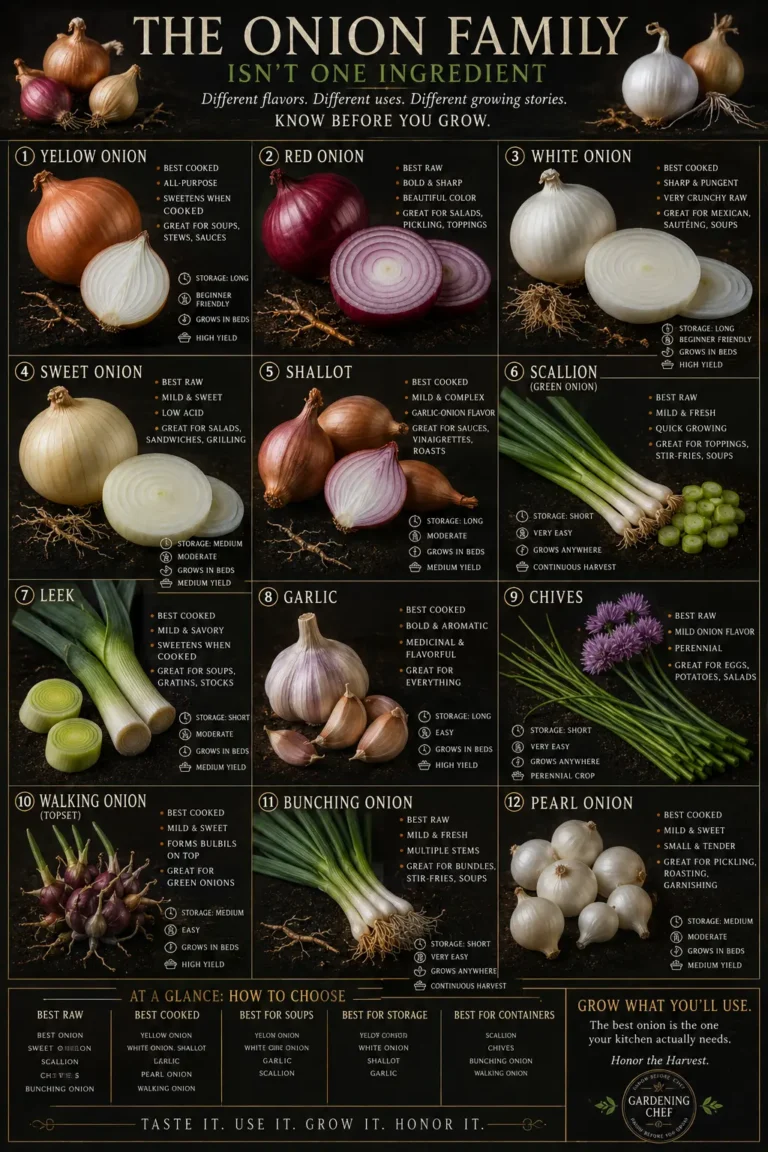
Yellow onions bring depth. White onions bring clean sharpness. Red onions bring color and pickle value. Scallions bring fresh finish. Garlic brings aroma and backbone.
Beans without alliums can taste flat.
Beans with alliums become meals.
The Pepper and Bean System
Peppers bring heat, color, smoke, sweetness, and brightness.
Black beans with peppers become chili, soup, tacos, rice bowls, or salsa-like salads. White beans with roasted peppers become spreads, soups, or Mediterranean-style dishes. Dry beans with dried peppers become deep, warming pantry food.
Peppers help beans travel across cuisines.
The Herb and Bean System
Herbs make beans feel fresh.
Parsley lifts white beans. Cilantro wakes black beans. Oregano supports pinto beans. Thyme deepens navy beans. Rosemary adds comfort to cannellini beans. Dill brightens green beans. Mint belongs with peas.
Beans are the foundation.
Herbs provide the final light.
The Tomato and Bean System
Tomatoes bring acidity, body, and sauce.
Beans bring protein, texture, and comfort.
Together, they become chili, minestrone, baked beans, white bean stew, bean ragout, shakshuka-style bean skillets, and pantry meals that feel complete.
The Grain and Bean System
Rice and beans are not an accident.
They are a food system.
Beans with rice, corn, wheat, barley, farro, couscous, tortillas, pasta, or bread become filling meals that stretch the pantry and satisfy the table.
This is where beans become household strategy.
Delicious Ways to Enjoy Beans and Peas
Fresh and Simple
Green beans, snap peas, snow peas, and fresh peas are wonderful when treated simply.
Steam them. Sauté them. Toss them with butter. Add lemon. Add herbs. Add garlic. Add olive oil. Add salt. Let the freshness speak.
Not every harvest needs a complicated recipe.
Sometimes the best meal is the one that preserves the snap.
Soups and Stews
Beans and peas belong in soups.
Split pea soup, bean soup, lentil soup, chili, minestrone, black bean soup, white bean stew, chickpea stew, fava bean soup, and vegetable soup all show how legumes bring body, protein, and comfort.
Soup turns humble ingredients into meals.
This is where beans shine.
They make broth feel filling.
Meal Prep
Beans and peas are excellent for meal prep.
Cook a pot of beans and use them throughout the week. Add them to salads, tacos, rice bowls, soups, wraps, eggs, roasted vegetables, and dips.
Freeze cooked beans in portions.
A freezer full of cooked beans is a quiet form of kitchen power.
It makes home cooking easier.
International Cuisine
Beans and peas belong everywhere.
Hummus.
Falafel.
Chili.
Dal.
Refried beans.
Minestrone.
Cassoulet.
Rice and peas.
Black bean soup.
Pea risotto.
Chickpea curry.
Green bean stir-fry.
Fava bean purée.
That is one reason beans never need to be boring.
They travel through cuisine.
They accept flavor.
How to Harvest Beans and Peas
Harvest fresh beans when pods are firm, slender, and crisp.
Harvest sugar snap peas when pods are plump but still tender.
Harvest snow peas while pods are flat and before the peas inside enlarge too much.
Harvest shelling peas when the peas inside have filled out but still taste sweet.
Harvest shell beans when seeds inside have filled out but are still fresh.
Harvest dry beans when pods are fully mature and dry on the plant. If wet weather threatens, pull the plants and finish drying them indoors in a protected area with good airflow.
The harvest stage determines the ingredient.
Pick early, and you have fresh vegetables.
Wait longer, and you have shell beans.
Wait fully, and you have pantry food.
That is the beauty of legumes.
They give you choices.
The Bean and Pea Preservation Ladder
| Level | Method | Best For | What It Teaches |
| 1 | Fresh use | Green beans, snap peas, snow peas, fresh peas | Harvest timing and daily kitchen value |
| 2 | Refrigeration | Fresh beans and peas | Short-term storage and meal planning |
| 3 | Freezing | Green beans, peas, sugar snaps | Preserving peak flavor for later meals |
| 4 | Drying | Shell beans, dry beans, lentils, chickpeas | Moisture control and pantry storage |
| 5 | Pickling | Green beans, snow peas, snap beans | Acid, crunch, and preserved snacks |
| 6 | Fermenting | Green beans and snap beans | Salt, time, tang, and live flavor |
| 7 | Pressure Canning | Beans and peas using tested recipes | Shelf-stable storage discipline |
| 8 | Sprouting | Mung beans, lentils, chickpeas, some peas | Living pantry food and careful food safety |
| 9 | Seed Saving | Open-pollinated varieties | Continuity, future crops, and independence |
Bean and Pea Preservation Guide
Fresh Freezing
Peas and green beans freeze well when handled properly.
Blanching, cooling, draining, and freezing in portions can preserve color and quality for many vegetables. Frozen peas and beans are useful for soups, side dishes, stir-fries, casseroles, rice, and quick meals.
Freezing is one of the best beginner preservation methods because it is forgiving and practical.
Freeze the peak.
Eat it later.
Drying
Dry beans are one of the great pantry foods.
Allow pods to dry fully, shell the beans, clean them, and store them in airtight containers in a cool, dry, dark place.
Dry beans should be fully dry before storage. Moisture can cause mold or spoilage.
A jar of homegrown dry beans is deeply satisfying.
It is a visible reminder that the garden can feed future meals.
Canning
Beans are low-acid foods and require pressure canning for shelf-stable storage. Do not water-bath can plain beans. Use tested pressure-canning recipes and reliable food preservation guidance. The National Center for Home Food Preservation specifically notes that beans are low-acid foods requiring pressure canning, and it provides research-based procedures for dry beans and peas.
Canning beans can be extremely useful because it creates ready-to-use jars for quick meals.
But it must be done safely.
Convenience is not worth guessing.
Fermenting and Pickling
Green beans can be pickled or fermented.
Dilly beans are a classic. Fermented green beans can become tangy, salty, and crisp when made properly. Pickled beans can be eaten as snacks, sides, or additions to salads and boards.
Pickling and fermentation both require good technique and safe handling.
The reward is flavor plus preservation.
Sprouting
Some legumes can be sprouted, including mung beans, lentils, and chickpeas.
Sprouts can be fresh, crunchy, and nutritious, but they also require careful food safety practices because warm, moist sprouting conditions can support harmful bacteria if handled poorly. FoodSafety.gov lists sprouts among higher-risk foods and emphasizes careful handling to reduce foodborne illness risk.
Use clean equipment, safe seeds intended for sprouting, proper rinsing, and refrigeration once ready.
Sprouting is another reminder that beans and peas are living foods.
Even in the pantry, they hold potential.
Seed Saving
Seed saving is where beans and peas become future crops.
Open-pollinated beans and peas are good candidates for beginner seed saving when grown with attention to variety purity and proper drying. Save seed from healthy, productive plants. Let pods mature fully. Dry the seeds completely before storing. Label them clearly.
Seed saving turns one harvest into the next season.
That is continuity.
Important Food Safety Notes for Beans and Peas
Beans are powerful foods, but some need proper preparation.
Dry beans should be soaked and cooked according to safe, appropriate methods. Certain beans, especially red kidney beans, contain high levels of natural lectins that can cause illness if the beans are raw or undercooked. Kansas State University Extension summarizes FDA guidance for red kidney beans: soak, drain, and boil in fresh water, with boiling recommended to destroy the toxin; slow cookers are not recommended for raw dry kidney beans because they may not heat the beans adequately or quickly enough.
The safe lesson is simple:
Cook dry beans thoroughly.
Do not eat raw or undercooked dry beans.
Use tested canning methods for shelf-stable beans.
Handle sprouts carefully.
Treat fava beans with special awareness if G6PD deficiency is a concern.
Beans are nourishing when prepared well.
Preparation matters.
Common Bean and Pea Mistakes
Mistake 1: Planting at the Wrong Time
Peas like cool weather.
Beans like warmth.
Respect the season.
A good seed planted at the wrong time can fail.
Mistake 2: Not Providing Support
Pole beans and climbing peas need structure.
Without support, they tangle, sprawl, and become harder to harvest.
The plant wants to climb.
Let it.
Mistake 3: Waiting Too Long to Harvest Fresh Pods
Green beans, snow peas, and snap peas are best when tender.
If left too long, they can become tough, stringy, or starchy.
Pick often.
Mistake 4: Forgetting to Preserve
A heavy bean harvest can overwhelm the kitchen quickly.
Blanch and freeze. Pickle. Ferment. Dry. Share.
Do not let good food age out on the counter.
Mistake 5: Treating Beans as Boring
Beans become boring when they are underseasoned.
They need flavor systems.
Garlic, onions, herbs, peppers, tomatoes, lemon, vinegar, broth, spices, smoke, olive oil, butter, and salt all matter.
Beans are not bland.
They are waiting for direction.
Mistake 6: Confusing Fresh Beans, Shell Beans, and Dry Beans
A bean is not one ingredient at every stage.
Fresh pods, shell beans, and dry beans behave differently.
The harvest stage determines the kitchen path.
Mistake 7: Guessing With Food Safety
Dry beans, canned beans, sprouts, and favas all have different safety concerns.
Good stewardship includes safe preparation.
Honor the harvest by handling it wisely.
Common Bean and Pea Problems and What They Usually Mean
| Problem | Likely Cause | What to Do |
| Poor germination | Soil too cold, old seed, overly wet soil | Replant in warmer soil; use fresh seed |
| Few flowers | Too much nitrogen, not enough sun, young plants | Avoid overfertilizing; increase sunlight; give plants time |
| Flowers drop | Heat stress, water stress, poor pollination conditions | Water consistently; plant peas in cool season; mulch when helpful |
| Tough beans | Harvested too late | Pick younger and more often |
| Yellow leaves | Water stress, nutrient imbalance, disease pressure | Check soil moisture, spacing, and drainage |
| Pest damage | Beetles, aphids, caterpillars | Handpick, use row cover early, attract beneficial insects |
| Powdery mildew | Humidity, poor airflow, crowding | Space plants well; water at soil level |
| Low yield | Poor pollination, heat, lack of harvest | Harvest often; support pollinators; protect plants from stress |
| Moldy dry beans | Stored before fully dry | Dry completely before storing; discard moldy beans |
| Weak flavor | Harvest stage, variety choice, underseasoning | Harvest at the right stage and build a stronger flavor system |
Beans and peas reward attention.
Not constant labor.
Attention.
A few minutes of observation can prevent a small issue from becoming a failed crop.
This is the 1% garden rule in action.
Best Beans and Peas for Beginners
For beginners, start with crops that produce quickly and clearly.
Good beginner choices include bush green beans, sugar snap peas, snow peas, pole beans on a simple trellis, and shell beans if you want to learn storage crops.
Avoid starting with too many varieties at once.
Grow a few.
Learn their habits.
See what your household actually eats.
Then expand.
A garden becomes stronger when it grows from use, not fantasy.
Build a One-Year Bean and Pea Garden Plan
A useful bean and pea garden does not need to grow every legume at once.
Start with one cool-season pea, one fresh green bean, one vertical crop, and one storage crop.
For example:
Sugar snap peas for spring snacking.
Bush green beans for easy summer harvests.
Pole beans for vertical yield.
Dry beans for pantry storage.
That one plan gives you fresh eating, beginner confidence, vertical gardening, preservation, seed saving, and pantry lessons without overwhelming you.
After that, expand based on how you cook.
Add snow peas if you stir-fry often.
Add shelling peas if you love soups and risotto.
Add chickpeas if hummus and curries are part of your kitchen.
Add lentils if you want quick-cooking pantry protein.
Add favas if you want cool-season old-world cooking and understand the safety considerations.
The goal is not to grow everything.
The goal is to grow what your kitchen will actually use.
A Quick Note About Pets
Plain cooked green beans or peas are commonly tolerated by many pets in small amounts, but rich dishes, seasoned beans, onions, garlic, heavy fats, spicy sauces, and salty preparations can be unsafe.
Keep seasoned bean dishes, chili, garlic-heavy foods, onion-heavy foods, spicy foods, compost scraps, moldy pods, and spoiled produce away from pets.
Also avoid letting pets eat unknown garden plant material.
A good kitchen garden feeds the household.
It should also protect it.
Beans and Peas as Wealth Garden Crops
In the Wealth Garden system, beans and peas are protein and soil builder crops.
They are not primarily flavor multiplier crops like herbs.
They are not stability crops like potatoes.
They are not abundance crops like squash and cucumbers.
They are not compounding crops like garlic.
They are partnership crops.
They feed people while participating in soil improvement.
They stretch meals.
They store well.
They preserve well.
They grow vertically.
They invite succession planting.
They teach timing.
They connect the pantry to the garden.
This makes them especially important in a resilience-minded kitchen.
A household that knows how to cook beans can eat well for less.
A gardener who knows how to grow beans can turn small seeds into fresh food, dry storage, and future seed.
A cook who understands herbs, garlic, onions, peppers, tomatoes, and beans can create endless meals from simple ingredients.
That is the system.
Beans are not just cheap food.
They are strategic food.
$10,000 Garden Insight: The Bean Multiplier Effect
A packet of bean seeds does not look like wealth.
It looks like a small envelope.
But inside that envelope are meals, future seeds, soil relationships, vertical harvests, pantry jars, soups, stews, side dishes, salads, and skill.
At first, the value seems small.
A handful of beans.
A few pods.
A side dish.
Then the system expands.
You plant a row. You pick fresh beans. You freeze the extra. You let some pods dry. You save seed. You cook a pot of beans. You make soup. You share a harvest. You leave roots in the soil. You plant again.
The value is no longer just the fresh harvest.
It includes fresh food, stored food, protein, soil participation, seed saving, meal prep, cultural recipes, budget savings, kitchen confidence, and future planting stock.
This is how a small crop becomes a larger system.
One seed becomes many meals.
Beans and peas are not flashy.
They are foundational.
And foundational crops are often where real garden wealth begins.
How Beans and Peas Become Products
Beans and peas are one of the easiest crop families to turn into useful content, kitchen products, teaching tools, and pantry systems.
A bean crop can feed dinner, but it can also create recipe cards, preservation guides, seed packets, dried bean jars, market bundles, class handouts, garden worksheets, and printable posters.
Possible bean and pea products include:
Fresh green bean bundles.
Sugar snap pea snack bags.
Snow pea stir-fry kits.
Dry bean jars.
Soup bean mixes.
Bean-and-herb recipe cards.
Dilly bean pickle recipes.
Frozen pea meal-prep guides.
Seed-saving packets from open-pollinated varieties.
Bean trellis plans.
Beginner legume garden worksheets.
Printable bean and pea field guide posters.
That does not mean every gardener needs to sell beans.
But it does show something important.
Beans and peas are not just crops.
They are a food system people can learn from, cook from, preserve from, and build around.
Where This Connects
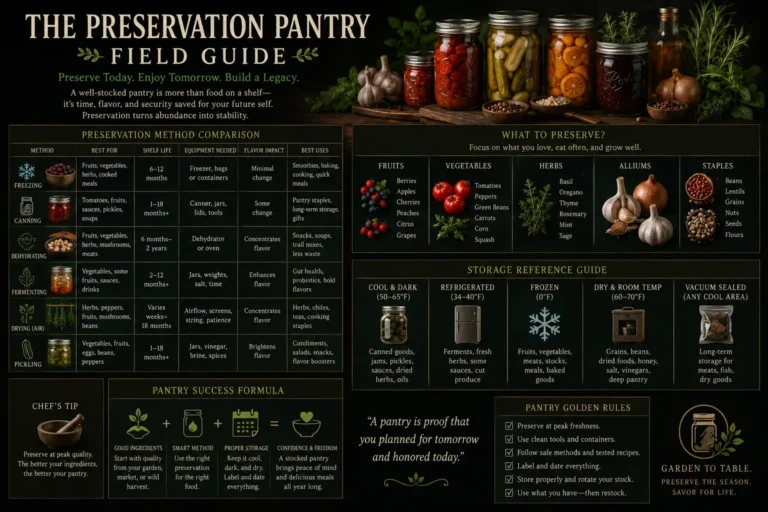
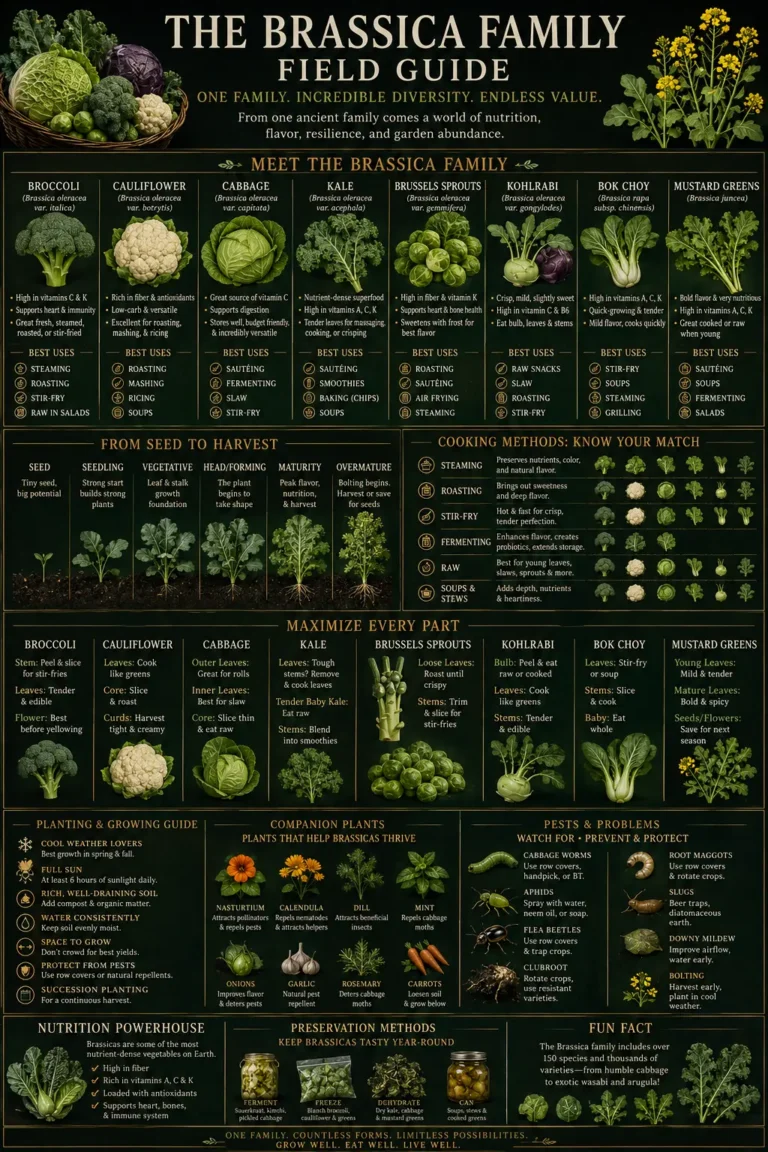
The Beans and Peas Field Guide connects naturally to the rest of The Gardening Chef Field Guide Library.
| Pair Beans and Peas With… | What It Becomes |
| Onions and garlic | Soups, stews, chili, curries, refried beans, bean salads, pantry meals |
| Peppers | Chili, black bean soup, rice bowls, curries, hot sauces, pepper-bean salads |
| Herbs | Parsley white beans, cilantro black beans, dill green beans, mint peas, thyme bean soup |
| Tomatoes | Minestrone, chili, bean ragout, baked beans, stews, pantry sauces |
| Potatoes | Pea and potato soup, green bean potato salad, comfort casseroles |
| Leafy greens | Beans and greens, lentil soups, chickpea kale bowls, pea shoots, stir-fries |
| Squash and cucumbers | Bean salads, summer bowls, pickles, succotash-style meals |
| Cooking fats | Garlic butter beans, olive oil chickpeas, bacon green beans, ghee lentils |
| Preservation pantry | Frozen peas, dried beans, pickled green beans, pressure-canned beans, sprouts |
| Root cellar crops | Bean soups with carrots, onions, potatoes, turnips, and winter squash |
Each guide stands alone, but together they teach the larger system:
Grow with purpose.
Cook with intention.
Preserve the surplus.
Feed the soil.
Honor the harvest.
Download the Printable Beans and Peas Field Guide
If this guide helped you see beans and peas differently, the printable field guide version is designed to live where real decisions happen: the kitchen wall, pantry shelf, garden binder, seed-starting table, market booth, cooking class, preservation station, or meal-planning wall.
The printable Beans and Peas Field Guide includes:
Life stages of beans and peas.
Fresh, shelling, snap, snow, pole, bush, and dry bean categories.
Best kitchen uses.
Growth habits.
Harvest guidance.
Soil builder reminders.
Trellising tips.
Preservation methods.
Cooking ideas.
Garden-to-table wisdom.
Use it to remember when to plant, when to support, when to harvest fresh, when to let pods dry, when to freeze, when to pickle, and how beans and peas help feed both the family and the soil.
Launch price: $0.99
[Button: Download the Printable Beans and Peas Field Guide]
Final Thought: Small Seeds Can Feed a Family
Most people think beans and peas are simple.
But simple does not mean small.
A bean can become a fresh pod, a dry seed, a soup, a stew, a pantry jar, a trellis wall, a saved seed, a soil partner, a family meal, or a future crop.
A pea can become a spring snack, a shelling harvest, a freezer bag, a soup, a risotto, a child’s garden memory, or a sign that the season has begun.
Beans and peas do not simply feed the plate.
They feed the pattern.
They remind us that food systems are strongest when they cooperate:
Roots with soil.
Plants with bacteria.
Gardeners with seasons.
Cooks with harvests.
Families with pantry shelves.
Neighbors with shared abundance.
That is the heart of The Gardening Chef.
Plant the seed. Support the vine. Pick the pod. Save the harvest. Feed the soil.
Honor every seed.