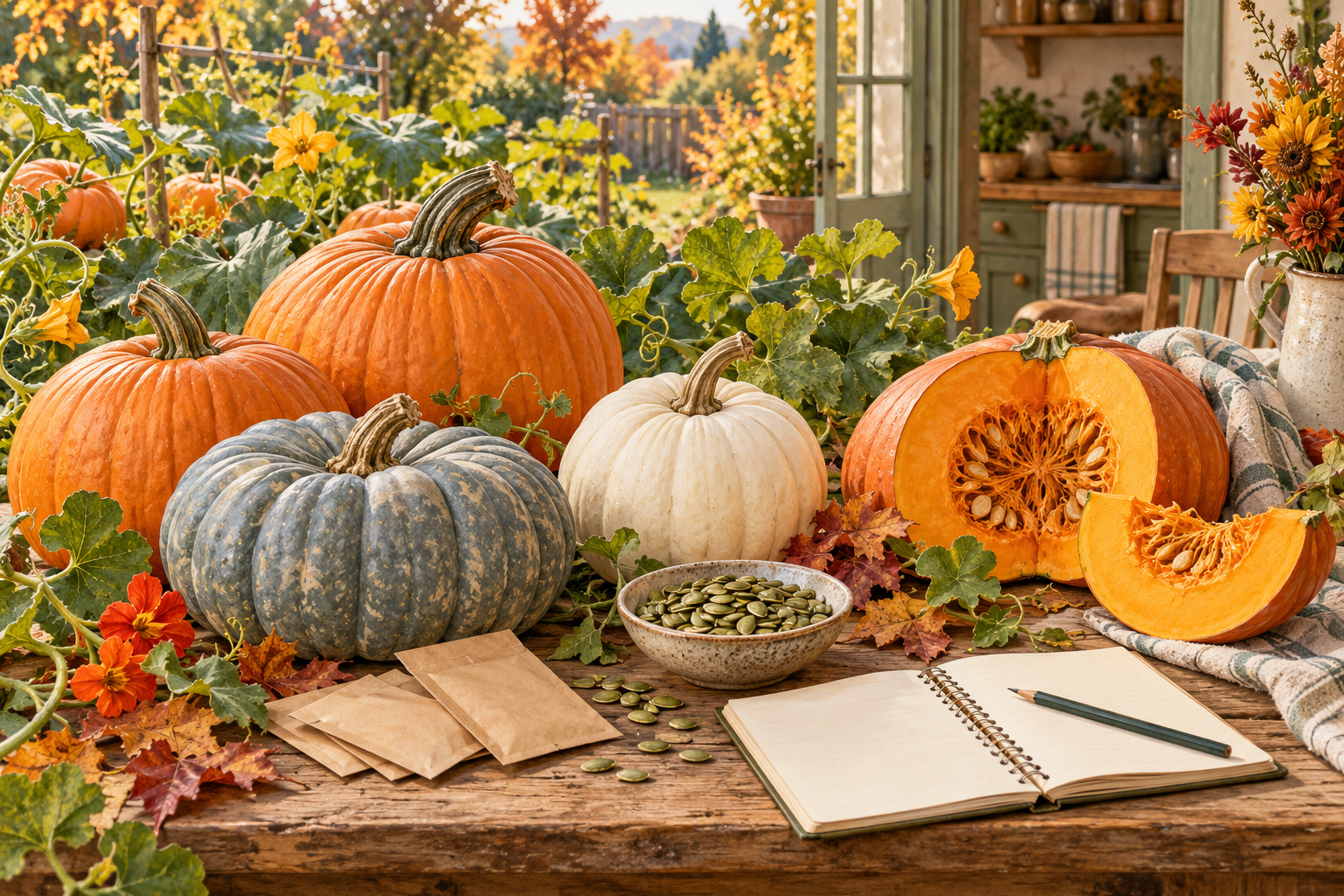
A pumpkin on the porch, a pie on the Thanksgiving table, and a bowl of roasted seeds can all begin with the same small decision: what kind of pumpkin do you want to grow?
The answer matters more than choosing the biggest orange fruit in the photograph. Some pumpkins earn their place through carving. Others through flavor. Some are grown mainly for the seeds inside. A giant may be a wonderful family project while being a poor match for a small kitchen garden.
This fall, use the pumpkins around you to plan next year’s harvest. Notice what you enjoy carving, cooking, eating, and displaying. Then choose a variety, a growing space, and a realistic calendar to match.
This guide compares seven varieties listed by Survival Garden Seeds and helps you narrow the choice. It is a researched planning guide, not a report of side-by-side trials in our garden.
Affiliate disclosure: The Gardening Chef earns a commission if you buy through the Survival Garden Seeds links in this article. Choose what fits your garden; you do not need every variety. Product listings and availability can change. Links invite you to check current options, not promise that seeds are in stock.
Jump to: Five edible harvests ·Choose your purpose · Compare seven varieties · Pumpkin seeds vs. pepitas · White pumpkins · Plan your calendar · Use the harvest safely · Buy or save seeds · Plan a first patch
Which Parts of a Pumpkin Plant Can You Eat?
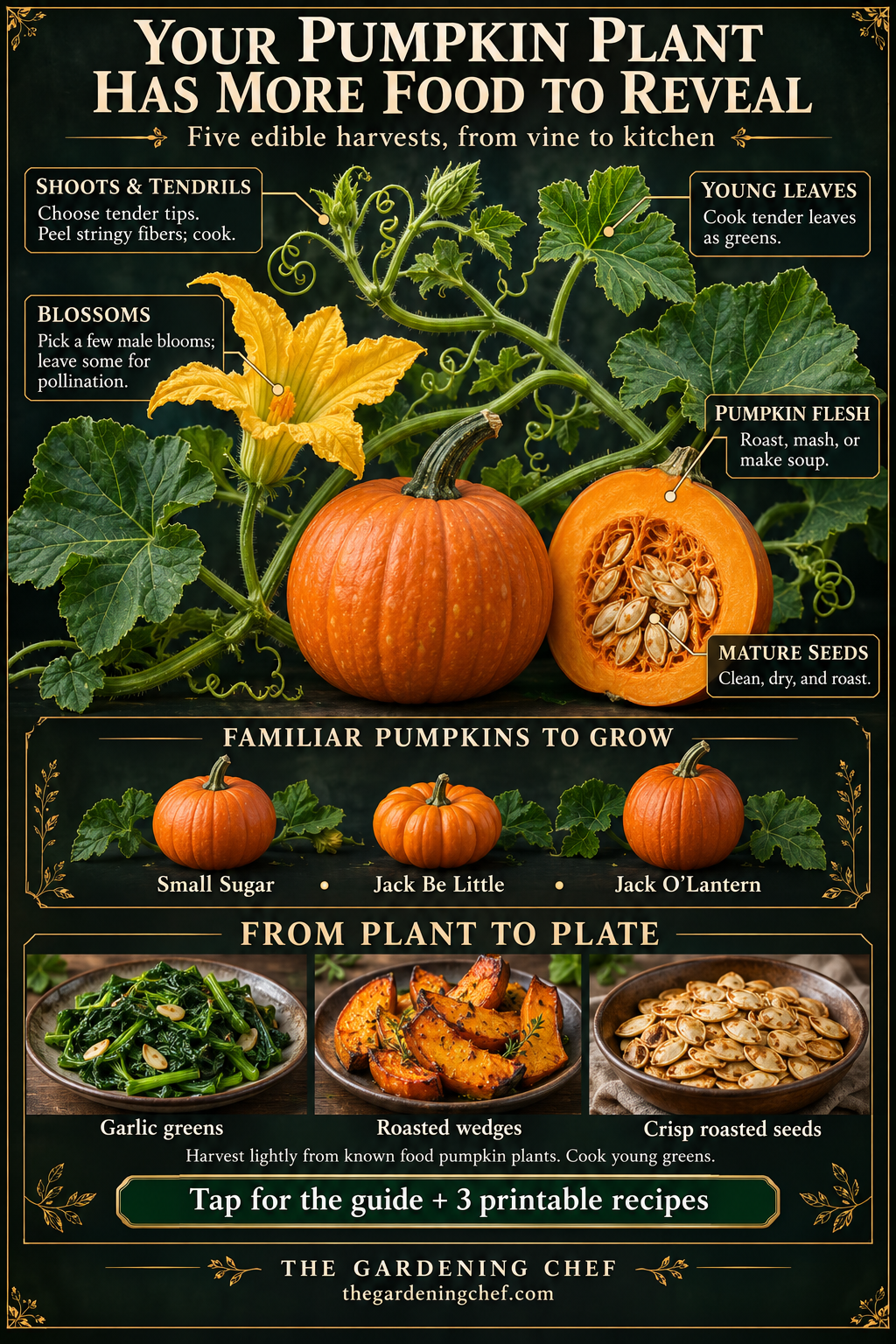
A pumpkin plant can offer food before and after its fruit ripens. Tender shoot tips and young leaves become cooked greens; blossoms offer another small harvest; mature pumpkins bring flesh and seeds to the kitchen.
- Tender shoots and tendrils: choose soft growing tips, wash well, peel away stringy shoot fibers, and cook until tender.
- Young leaves: choose tender new growth and cook it as greens.
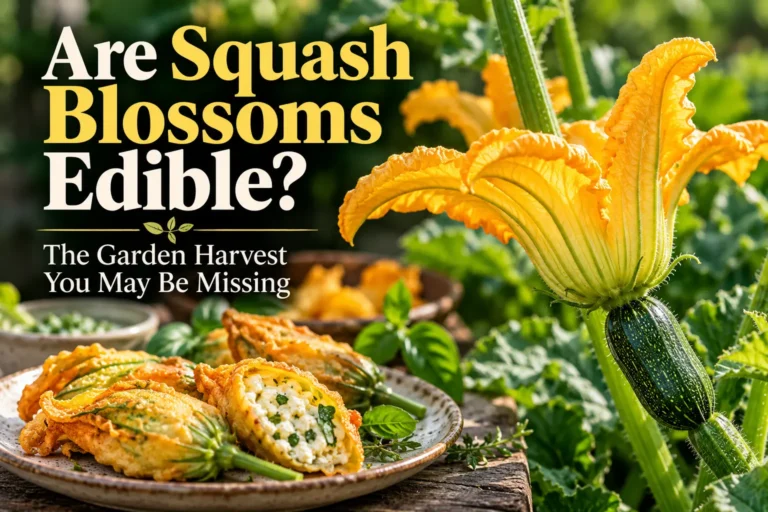
- Blossoms: pick a few male flowers, recognized by their slender stalks. Leave female flowers, with a tiny pumpkin beneath the petals, and enough male flowers for pollination.
- Pumpkin flesh: roast, mash, or turn it into soup. Small Sugar is a straightforward kitchen-first choice.
- Mature seeds: separate from the pulp, rinse, dry, and roast. Shell-on seeds and green kernels need different attention in the pan.
Begin with known food pumpkin plants grown from identified seed. Harvest lightly from established healthy plants, leaving productive growth if fruit is your priority. If plants have been sprayed, the product label must permit harvesting the plant parts you plan to eat. Discard unusually bitter pumpkin or squash; cooking does not make it suitable to eat. Use food-grade harvested seeds, never seed sold for planting.
Familiar names include Small Sugar, Jack Be Little, and Jack O’Lantern. Choose Small Sugar for baking and roasting, Jack Be Little for small stuffed or baked pumpkins, and Jack O’Lantern principally for carving and fresh seeds. These fruit-use examples accompany general pumpkin leaf-and-shoot guidance; the varieties have not been compared in our own trials.
Bring the Harvest to the Table
- Garlic pumpkin greens and tender shoots — printable recipe
- Roasted sugar pumpkin wedges — printable recipe
- Crisp roasted pumpkin seeds — printable recipe
For flower identification and harvesting, visit our edible squash blossom guide.
Keep discovering more food in your garden. Join The Gardening Chef Weekly for garden-to-kitchen guides and recipes. Free to join; unsubscribe anytime.
Further reading: Nebraska Extension on cooked young leaves and peeled shoots; RHS on Jack Be Little.
Start With the Harvest You Actually Want
Picture next autumn before you picture the seed packet. Do you want a pumpkin small enough to carry to the kitchen? Several familiar carving pumpkins? A blue-gray centerpiece that can also become dinner? A harvest of green pepitas? Or one enormous pumpkin you will spend the season tending?
Write down your first priority. Give a second use permission to be a bonus. That keeps a seed order from becoming a collection of ambitions with nowhere to grow.
For the bigger family picture, our squash and cucumber field guide explores other ways these crops enter the kitchen. This guide stays focused on choosing pumpkins and planning their season.
Seven Pumpkin Varieties, Seven Different Reasons to Grow
The uses below draw on the merchant’s named variety descriptions. The fit and tradeoff columns are our planning judgments. They are starting points for choosing, not promises about yield or flavor in your conditions.
| Variety and seed options | Main purpose | Who might choose it | Tradeoff to consider |
|---|---|---|---|
| Small Sugar | Pie, baking, roasting | Start here if the kitchen is your main reason to grow pumpkins. | Small fruit does not mean a compact vine. |
| Jack O’ Lantern | Carving and Halloween displays | Choose for the porch tradition. | Keep separate pumpkins for carving and cooking. |
| Blue Jarrahdale | Cooking and blue-gray displays | Consider when both appearance and meals matter. | Allow room for a sprawling vine and a harvest-handling plan. |
| Fairytale / Musquée de Provence | Cooking and deeply ribbed displays | Consider for soups, roasting, and a distinctive fall centerpiece. | Plan how you will use or preserve a cut pumpkin. |
| Casper | White displays, carving, baking | Consider if you want white skin with culinary possibilities. | Choose by the named variety, not skin color alone. |
| Lady Godiva | Hull-less seeds / pepitas | Choose when the seeds are the main harvest. | A seed-focused choice is different from choosing for pie flesh. |
| Atlantic Giant | A giant-growing project | Choose for the challenge and learning. | Needs substantial space and care; a packet is no promise of a prizewinner. |
The merchant currently lists 90–120 days to harvest for these varieties and describes sprawling vines. Treat that broad catalog range as a screening tool, not a reliable deadline for every garden. Check the actual packet, clarify whether its maturity count begins at sowing or transplanting, and compare with local guidance before ordering.
For Pie and Roasting: Think Beyond the Orange Porch Pumpkin
Small Sugar is the straightforward pie-focused candidate in this selection. Blue Jarrahdale and Fairytale broaden the possibilities for gardeners interested in cooking as well as appearance. Casper adds a white-skinned option that the merchant also describes for baking.
Your decision is not simply which pumpkin is edible. Think about the work between harvest and dinner: carrying the fruit, cutting it safely, cooking a batch, and finding room for the portions you will not use immediately.
If your household makes one holiday pie and little else with pumpkin, begin modestly. If soup, roasted vegetables, breads, and freezer portions are regular parts of your kitchen, a broader culinary planting may make sense. Buying a pumpkin locally this fall and cooking it is also a useful way to explore what you want to grow.
For Carving, Pepitas, or a Giant: Let the Goal Change the Choice
Jack O’ Lantern is the obvious carving candidate. Choose it because carving is the purpose, rather than expecting one pumpkin to be the best possible pie ingredient afterward. University of Minnesota Extension notes that jack-o’-lantern flesh is generally less appealing for cooking than pie types.
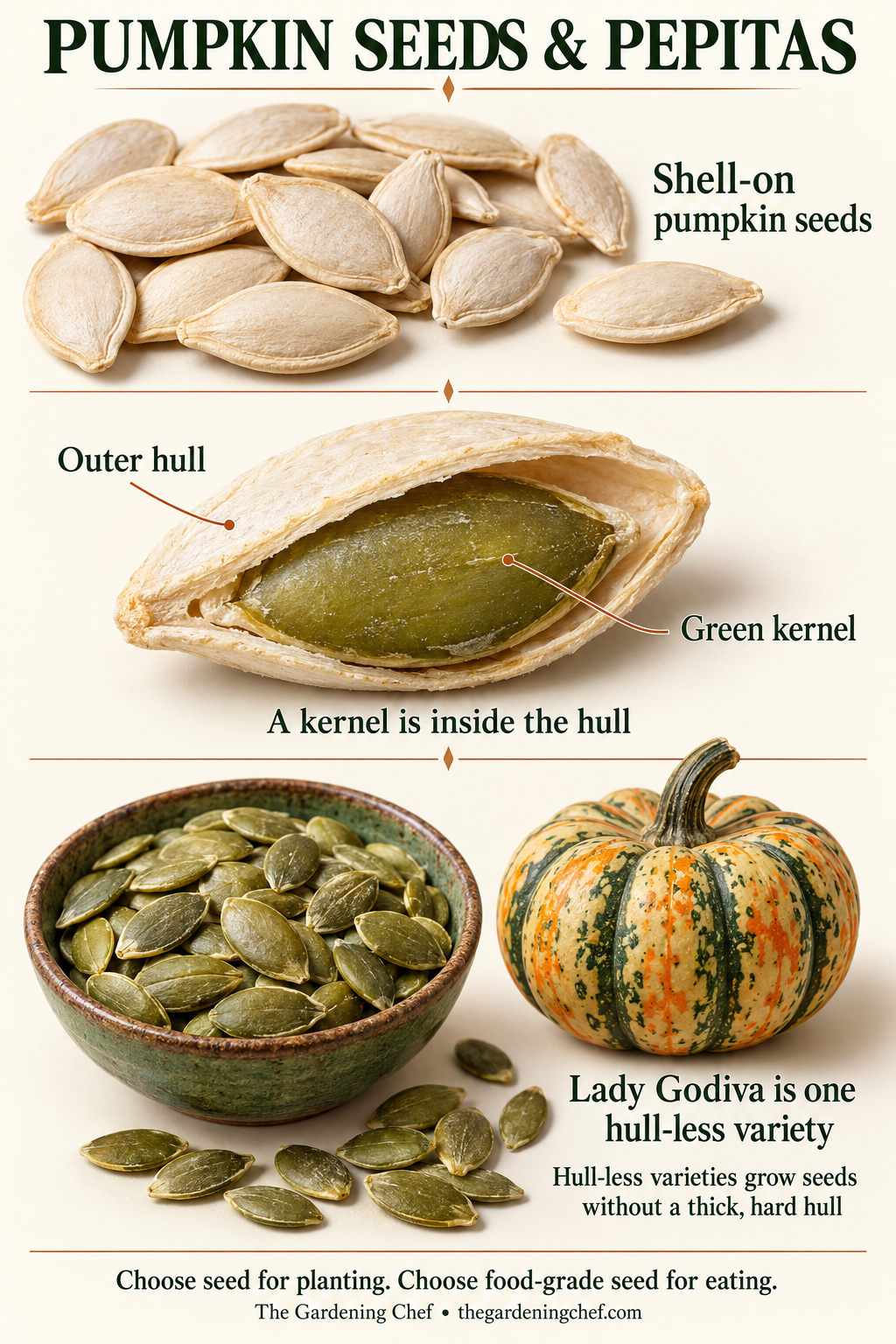
Lady Godiva changes the goal entirely: its attraction is the hull-less seed. Hull-less does not mean the pumpkin has no seeds; it means the edible seed lacks the usual hard outer hull. That is a different proposition from roasting the shell-on seeds scooped from a carving pumpkin.
Atlantic Giant belongs in the project category. Before buying, identify the area you can devote to it and how a very heavy fruit would be handled. A large-pumpkin challenge can be worthwhile without a ribbon, a record, or a guaranteed weight. It does not need to be your food-production plan.
Pumpkin Seeds vs. Pepitas: Why Are Some White and Others Green?
Pepitas are pumpkin seeds. In the grocery aisle, the name usually points to the green kernels eaten without a thick white hull. The pale seeds you scoop from a typical carving pumpkin have a protective outer hull around an edible kernel. Removing that hull reveals the kernel; it does not turn the seed into a different species.
There are two ideas to keep separate: hulled describes a seed whose outer hull has been removed, while hull-less describes varieties that naturally develop seeds without the usual thick, hard hull. Lady Godiva is a hull-less seed pumpkin. Seed and grocery labels may use “pepitas” broadly, so read what is actually being sold.
The University of Alaska Fairbanks seed guide explains the hull, the green kernel, and the option of removing hulls. This is why buying a hull-less variety can be useful when the snack is your main goal: less shelling work after harvest.
For cooking, choose by texture. Shell-on seeds make a more substantial, chewy-crisp snack. Green kernels are easier to scatter over soup, mix into a sauce, or fold into bread. They need different attention in the pan; do not assume a recipe for thick shell-on seeds gives the right cooking time for small kernels.
For your garden: choose a named hull-less variety if that is the harvest you want. For your kitchen, buy food-grade seeds or harvest from a sound food pumpkin. Never eat planting seed, including untreated seed sold for sowing.
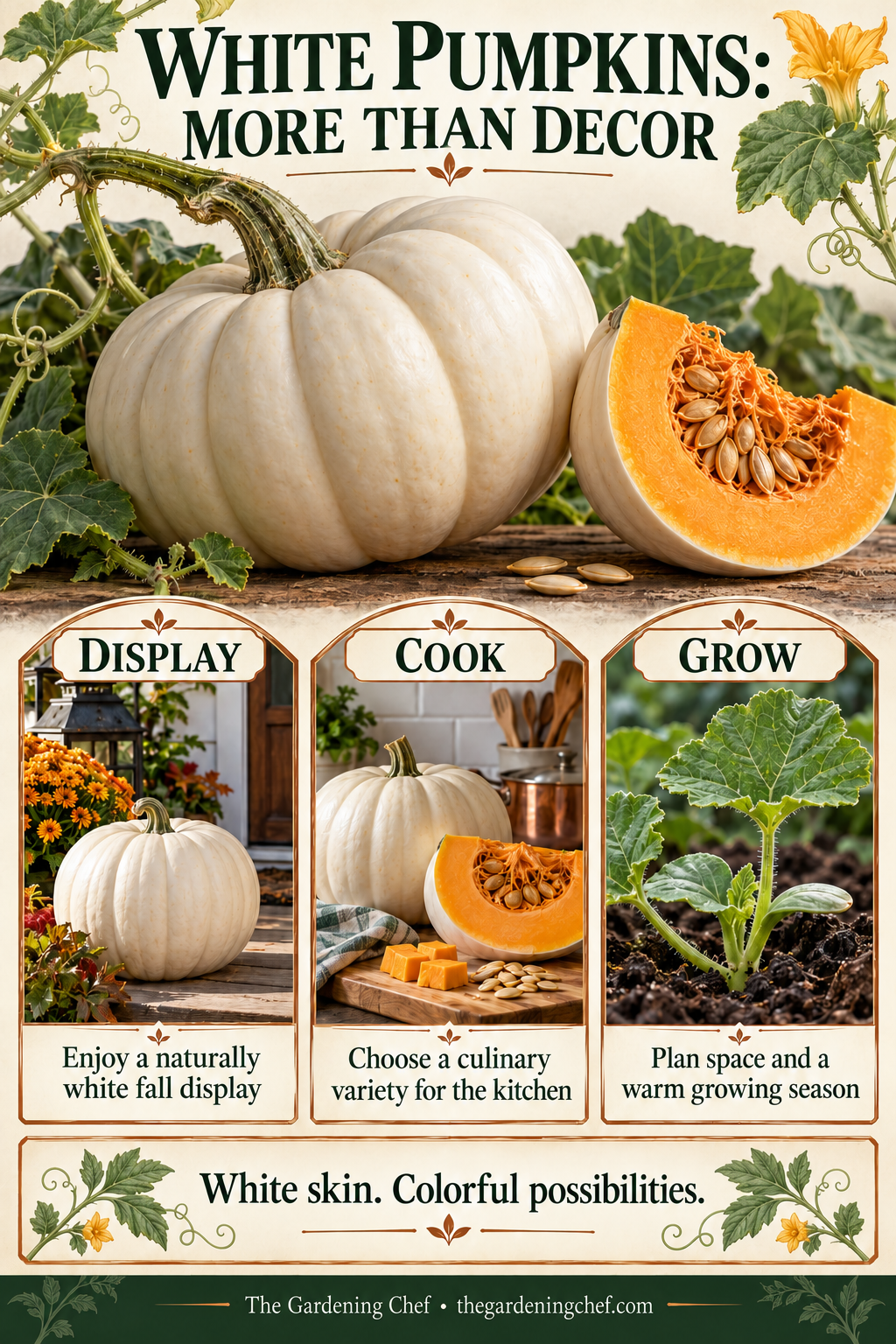
Can You Grow White Pumpkins—and Can You Eat Them?
Yes: naturally white pumpkins are grown from named varieties, not made by painting orange pumpkins. Casper is one white-skinned variety in Survival Garden Seeds’ catalog. Its listing describes culinary as well as decorative use. White skin does not mean white flesh, and a white pumpkin is not automatically a good pie pumpkin.
White pumpkins suit the pale, neutral fall displays seen in decorating ideas, but the garden decision goes beyond the photograph. Compare the particular variety’s size, growth habit, maturity, and kitchen qualities. “White pumpkin” describes appearance, not a single variety or one set of growing instructions.
Choose white pumpkins by their variety and intended use, just as you would orange ones. A culinary variety can bring both a pale autumn display and a colorful meal to the table. For a display-to-dinner plan, use sound fruit and leave it unpainted and uncarved until kitchen prep.
If you want to explore this option, we earn a commission on qualifying purchases through this link: check Casper white pumpkin seed options. Confirm current availability and packet instructions before buying.
Try this fall’s planning exercise: photograph the white pumpkin display you like, write down the actual variety if you can identify it, and decide whether next year’s goal is decorating, cooking, or both. A saved picture becomes more useful when it has a growing purpose beside it.
Check the Space Before You Check Out
Draw the growing area, including paths, neighboring crops, and the place vines could spread. A packet containing many seeds is not a recommendation to plant them all. A small pumpkin can still grow on a long vine; Small Sugar’s merchant listing, for example, describes a 10–20-foot vine.
Ask three practical questions: Where will the vines go? Can I reach the plants and harvest without blocking a path? Where will the mature pumpkins go after picking? If those answers are unclear, reduce the planting before increasing the seed order.
Do not put heavy pumpkins on an ordinary lightweight trellis. Choose a garden plan suited to the fruit, rather than relying on a support designed for peas.
Build a Pumpkin Calendar Around Your Climate
Halloween is a display date. Thanksgiving is a meal date. Neither is automatically the correct harvest date. In a cold climate, the Thanksgiving pumpkin may need to be harvested well before the holiday and held sound or preserved for the kitchen.
| Calendar marker | Your decision | What to record |
|---|---|---|
| This Halloween and Thanksgiving | Notice the pumpkin experiences you want to repeat. | Variety name if known, intended use, what you liked, what you would change. |
| Winter planning | Choose one or two varieties and draw the space. | Packet maturity guidance, vine habit, seed quantity, local planting advice. |
| Before spring sowing | Check frost risk and soil conditions. | A locally suitable outdoor planting window; any indoor-starting plan. |
| Summer growing | Observe the crop rather than counting days alone. | Sowing date, flowering, fruit set, water, pests, and developing fruit. |
| Before damaging autumn cold | Assess maturity and harvest conditions. | Rind and stem condition, forecast, intended storage or immediate use. |
| After harvest | Evaluate the result. | Actual harvest date, usable pumpkins, kitchen results, and next year’s changes. |
Calendar exercise: suppose a packet states 110 days from sowing and you choose September 25 as a hypothetical mature-harvest target. Counting back 110 days lands around June 7. That is arithmetic, not a planting recommendation: germination, weather, maturity-count definitions, and a sensible local margin still need to be considered. If the resulting plan does not fit your warm growing season, change the variety, growing method, or target.
Use your local Cooperative Extension planting guidance rather than copying another region’s month. The University of Minnesota growing guide explains warm-soil planting, space, and harvest considerations; its Minnesota dates should not become a national calendar.
Give the Harvest a Kitchen Plan
Bring the harvest to the table with crisp roasted pumpkin seeds, roasted sugar pumpkin wedges, or garlic pumpkin greens and tender shoots. You can also browse our Recipes section.
Carving for dinner and carving for display are different plans. Cutting a fresh, sound pumpkin during kitchen prep is normal. A jack-o’-lantern left on the porch is a decoration, not a later meal. You can prepare its seeds promptly when first carving, before display; never eat seed sold for planting.
Michigan State University Extension explains why carved pumpkins are for decorating rather than eating. Do not try to rescue a moldy or rotting pumpkin for food. Keep paints, decorative treatments, and other nonfood products away from pumpkins intended for the kitchen.
For sound cooking pumpkins, plan portions around meals: a batch for soup, a measured portion for baking, or pieces for roasting. Homemade purée can differ in moisture from canned purée, so follow the recipe’s instructions rather than assuming every pumpkin behaves identically.
For longer keeping after cooking, use the National Center for Home Food Preservation’s pumpkin-freezing method: cook the prepared pumpkin until soft, remove and mash the flesh, cool it using a cold-water bath with stirring, package with the specified headspace, and freeze. Its full directions are the process reference.
Do not home-can mashed pumpkin, purée, or pumpkin butter. The National Center explains why these are not recommended for home canning. Our root-cellar field guide offers broader stored-crop planning.
Buying Seeds and Saving Seeds Solve Different Problems
Buy named seed when your priority is a predictable variety choice. Save seed when you also want to learn the pollination and selection work involved. Neither route guarantees a harvest, and an heirloom label does not prevent a flower from receiving pollen from a compatible neighboring plant.
As University of Minnesota Extension explains, cross-pollination can affect what grows from saved seed without changing the current fruit. Compatible varieties within the same squash species can cross. Pumpkins do not simply cross with every cucumber or melon because they share a family.
If you save seed from this fall’s pumpkin, label its known variety and pollination history—or write “unknown.” A store-bought fruit or an open-pollinated garden patch may give you a surprise next season. Use controlled pollination and suitable isolation if keeping a variety true is the objective; a small backyard separation is not proof of purity.
A Sensible First Pumpkin Patch
Choose one main job and one optional experiment. A pie-focused household might start with Small Sugar. A carving household might begin with Jack O’ Lantern. A seed enthusiast might choose Lady Godiva. A gardener who values both cooking and a distinctive display could investigate Blue Jarrahdale or Fairytale.
The four-variety pack contains Small Sugar, Jack O’ Lantern, Fairytale, and Casper. Consider it only if you want that mix and have a realistic plan for the plants you will grow. It does not contain every variety discussed here, and owning four packets does not require planting four patches.
Affiliate disclosure: We earn a commission on qualifying purchases through these links. Compare current pumpkin seed options or check the four-variety pack. Confirm availability, packet instructions, and your space before buying.
This week’s useful task is simple: choose the pumpkin experience you want next fall, write down the variety you are considering, and mark a winter planning date on your calendar. Next year’s pumpkin patch can begin with a good question asked this October.
Want more garden-to-kitchen discoveries? Join The Gardening Chef Weekly. Free to join; unsubscribe anytime.
Pinterest loads when you enable these buttons. You can also use the Save links beneath each infographic.
Sources and Variety Notes
Research checked October 24, 2026. Variety links above lead to the merchant descriptions used for the comparison, not independent performance trials. Growing, seed-saving, and preservation references are linked where relevant. Availability and packet details should be rechecked when ordering. This guide does not promise yields, savings, or a particular harvest date.